eBook - ePub
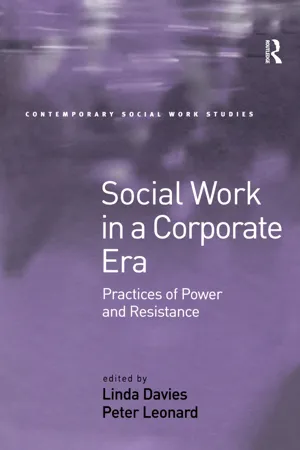
Social Work in a Corporate Era
Practices of Power and Resistance
- 186 pages
- English
- ePUB (mobile friendly)
- Available on iOS & Android
eBook - ePub
About this book
A striking new feature of the welfare systems in many Western countries is the extent to which market relations have permeated social services. Conceptions of 'risk management' now dominate the way parents and children are responded to, while new technologies aim to 'measure' their relationship with state service providers. Bureaucratic control is increasing, while resources are reduced. These factors have led to the demise of the traditional role of the social worker as one who engages with the client in a supportive encounter. Professional competence within social work is increasingly tied to 'mastering' scientific knowledge and new technical skills. The result of collaboration between authors from Canada, Britain and Australia, Social Work in a Corporate Era offers a critical overview of these developments and their implications. It provides a re-evaluation of the assumptions and practices of the critical social work tradition and explores the possibility of rebuilding an 'emancipatory' social work. The authors aim to disentangle the debate between Marxism, feminism and anti-racism, in the context of both postmodern challenges and the corporate restructuring of the welfare state. Calling for the development of a new politics of social work practice, this book addresses many of the urgent issues facing welfare state practitioners in health and social services today.
Information
Part I
Theory, Reflection, Emotion
Chapter 1
The Uses of Theory and the Problems of Pessimism
Peter Leonard
Introduction
Five years after the publication of my book, Postmodern Welfare (1997), readers of that text might wonder whether the confidence expressed in the book's subtitle, reconstructing an emancipatory project, was justified or whether it was simply a confusing oxymoron. Are the deconstructionists, the relativists, the post-Marxists and many of the cultural theorists right in arguing that the story of emancipation is now at an end? In the global politics of exploitation, racism, starvation and terror, the dreams of social justice and equality for all of humanity, which once produced dread amongst the rulers and hope amongst the oppressed, seem now to have vanished. Such dreams of emancipation appear to be, well dreams, appropriately consigned, alongside our own deaths, to that which dare not speak its name. After all, these dreams became, in their most influential form, the nightmare of Soviet oppression of its population, a nightmare from which some projects of emancipation appear not to have recovered. When I visited Britain in 2000, some of my old friends who once shared with me a commitment to a project of socialist social work education were surprised that, though I used post-structural analysis, I also drew on Marxist theory in order to try to understand the relationship between cross-cultural practice and moral agency. For them, my Marxism seemed to be an endearing reminder of a dead past.
Perhaps I should, indeed, at this early point, apologize to the reader for my indulgence in writing about Marxism in a text on social work. And for the lack of good taste, perhaps, in often naming Marxism directly rather than over-using various euphemisms such as critical theory to signify an understanding of the world which is based largely on historical materialism.
Certainty and Uncertainty
In place of talk of emancipation, we who engage in the practice of teaching and learning experience, as many others do, the confusion and paradox of living in a dialectic of certainty/uncertainty. The certainty which resides among the leaders of the dominant culture of the West is a product of the end of the Cold War and the belief that capitalism is not only triumphant but also unstoppable. The end of history has arrived, Francis Fukuyama argues, because the world has produced at this point in history a social formation which is the final destination of humanity: global market capitalism. When, in 1992, Fukuyama published The End of History and the Last Man, his argument was met with a wide range of responses from acclaim to condemnation. He maintained that the end of the Cold War signalled the working out of the logic of History which had come to its concluding stage with the triumph of capitalist liberal democracy evidenced in the free market economy. Superficial as its treatment of both philosophy and history might be, it was a book which resonated with a widespread belief in the continuing leading role of the West, and the United States in particular, as the civilizing, freedom-loving and wealth-producing dynamic center of the world.
On the other hand, substantial critique was mounted against Fukuyama's thesis from the Left and can be summed up, at this point, by Eric Hobsbawm's sharp comment that 'we are constantly confronted by Western ideologists - Mr. Fukuyama, the Doctor Pangloss of the 1990s comes to mind - for which the rich world's superiority simply expresses its discovery of the best of all possible designs for arranging human affairs, as demonstrated by its historic triumph' (Hobsbawm, 2000, p.l66). American triumphalism might be too much to take for many critics, but for those committed to US-led global capitalist expansion, such narratives of overwhelming success provide moral legitimization for the basic experiences of that greed and fear upon which the capitalist social order rests and which so profoundly affects the idea and practice of welfare.
Fukuyama's work is only one example, if a particularly startling and extreme one, of a whole trend of twentieth century theoretical speculation proclaiming the end of phenomena such as history. There are many variants of 'endism' and if they are to function as providing post facto justification of capitalism and supporting self-confident certainty in the virtues of the free market, they have to argue that there can be no alternative to capitalism and that the attempt to pursue the emancipation projects of the nineteenth and twentieth centuries, especially any form of socialism, are doomed to failure. We are urged to embrace the brave new world of unfettered capitalism because this is as good as it gets.
Pessimism
So here we have a ruling ideology in the West which takes the form of a suffocating belief that capitalism is ethically and politically superior to any other conceivable social and economic system.
It is here to stay because it has outlived and triumphed over the particular form of socialism which once flourished in the Soviet Union and other authoritarian state socialist countries. This triumphalism is matched by an overwhelming sense of defeat by many on the Left, and a pessimism which I find shared by many students of social work, especially those at the end of their professional education. Faced with the aftermath of the Cold War, the Left has either retreated to the 'Third Way' and come to terms with the structures and ideologies of capitalism, or it remains both defiant and pessimistic at the same time. Eric Hobsbawm's book, The New Century (2000), illustrates this contradiction. Hobsbawm is a brilliant and immensely influential Marxist historian who, when asked why he stayed in the British Communist Party after the Soviet Union's invasion of Hungary in 1956, explains how conflicted he was, how much he hated the thought of being identified as an 'Anti-Communist', and goes on to explain his own thinking about the relationship between a political cause and the actual practices to which it may give rise:
If you think that communism is something greater than the history of a backward country in which it happened that communists got to power, then that history is not reason enough to abandon the chosen cause
(Hobsbawn, 2000, p.160).
Hobsbawm goes on, however, to mix defiance with pessimism when, in a chilling evaluation of his own history, he says:
I know very well that the cause that I embraced has proved not to work. Perhaps I shouldn't have chosen it. But .. .if people don't have any ideal of a better world, then they have lost something
(Hobsbawn, 2000, p.l60).
Later, Hobsbawm speaks of the need to have moderate expectations of the world and ends his book by saying that 'at the end of the century, I cannot look to the future with great optimism' (Hobsbawm 2000, p. 167). Hobsbawm's pessimistic judgement is, I suggest, widely shared on the Left and perhaps by many of us who have tried to develop a critical social work theory and practice. It has reinforced a pervasive fatalism and a feeling of exhaustion amongst those who might have been expected to continue to support the idea of emancipation. The complex global social system in which we now live is often experienced by us and our students as so overwhelming that we are reduced to feelings of powerlessness. Freire argued, we should remember, that a major obstacle to conscientization in education was 'peasant fatalism' (1970).
Whistling in the Dark
How has the strand of pessimism I have identified on the Left influenced my own work? If I look back at about thirty years of participation in the critical, emancipatory tradition in social work theory and practice, self reflection emerges as one way of moving to counteract pessimism. All of my most significant writing and teaching have been fuelled by a Marxist analysis and, for most of that time, by membership in a Left political party. Have I been optimistic? On the surface, yes. But underneath, in the spaces between the lines of the written text, I can now detect a certain mood in the face of political defeats. My writing was a response, a theoretical practice, in the presence of shifts in the balance of class forces which were profoundly affecting the 'welfare state' and those who worked in it as well as those who used its services. A mood of desperation emerges in some of my writing through an overt focus on feelings of hopelessness about the condition of the poor, subordinated populations with whom social workers practice. My overt focus was on 'crisis', perhaps because thinking and writing about the suffering of actual clients was simply too difficult. The term 'crisis' was the signifier which, for me, represented a depressing reality of major reversals in the struggle for new radical approaches to social work and social policy.
If I take three books written in the last 25 years, it is possible to mark a continuing theme in my justifications for writing predominantly about theory and, in particular, about Marxist theory. In Social Work Practice under Capitalism, which I wrote jointly with Paul Corrigan and which was published in 1978, I wrote an editor's introduction to a proposed series of books called Critical Texts in Social Work and the Welfare State, of which this book was the first of what would later run to ten volumes. The justification for the planned series was the experience of crisis: that the welfare state in Britain was in a serious condition. This condition was not dependent on the existence of a government with a controlling neo Liberal orthodoxy: Margaret Thatcher was not to gain power until a year after this book was published. In the meantime, however, a Labour government, battered by the international oil crisis and the destructive demands of the International Monetary Fund, was required to preside over the dismantling of its own social democratic welfare state. I wrote:
Although the precise nature of this crisis is subject to much debate its effects are recognized everywhere, but especially among those working within the apparatus of the welfare state at central and local level, and those most dependent on certain welfare services - the poor, the deprived and the most exploited, including women, the black population and the unemployed
(Corrigan and Leonard, 1978, p. vii).
A major threat to the very existence of the welfare state had profound effects on Left critics. Previously, we had an antagonistic relationship to the social democratic ideology which ruled the welfare state and towards the remote, bureaucratic and controlling nature of its services. We had attacked the welfare state: now we found that we were forced to defend it. Even the social democratic welfare state was certainly better than no welfare state. This did not mean that we stopped being critical or engaging in theoretical work. Theory, I argued, enabled us to contextualize attacks on the living standards of a population which included the most vulnerable sections of the working class. But, I pointed out, if we looked further back to the 1960s and early 1970s, we would be able to see, through a Marxist analysis, how naive was the assumption that it was possible to develop humane, universalist and non-stigmatizing social services within the structures of capitalism. This was intended as a challenge to the social democratic orthodoxy of social work education of the day - that if we could get rid of conservative influences in the Labour Party we could return to the old Keynesian welfare state. So my argument for critical theory rested, as it always does, on a negation of the existing social order, on strengthening resistance at the level of ideology, a resistance which emerges most strongly, perhaps, when political defeats are experienced and pessimism is likely to be growing. More generally, we could see critical theory as primarily reactive to wider social and economic shifts and dependent on the prior existence of that dominant system which it opposed. Thus Marxism developed as a reaction to capitalism, and feminism as a reaction to patriarchy; without capitalism, there would have been no Marxism, and without patriarchy, no feminism. As the characteristics of these dynamic social systems change over time a discursive space is created for new social theory which can attempt to explain political defeats and so, at least at the ideological level, counteract the pessimism which frequently appears at these historical junctures.
At the level of the educational process and the dissemination of ideas Social Work Practice under Capitalism had its impact in advancing Marxist theory in a form which could be directly used by social workers. At Warwick University we abandoned a revised systems approach which we saw as, despite its potentials, without the critical edge we needed. Teaching and learning about social work was reconstructed to challenge directly dominant ideas about what constituted social work and emphasis was placed on the potentials of Marxist analysis for understanding the material conditions and class relations which constituted the arena in which social work was carried out.
Six years later, in 1984, I published Personality and Ideology. Now neo-liberal orthodoxy was everywhere, the 'Thatcher Years' already seemed endless and we were faced with new questions. These questions were not dissimilar to those which were raised by some Marxists in the 1930s and 1940s. Why, they asked, did large sections of the working class support the Right, the figures of authority? The Critical Theory School, first in Germany and then evacuated to the United States, included in its projects the exploration of the critical potential which lay in psychoanalysis. Erich Fromm and others attempted to understand why so many people supported ideas and practices which, from a Marxist perspective, were against their own 'objective' material interests. The answer lay in the intra psychic mechanisms by which dominant ideology was internalized by the individual subject.
My overall intention in this book was to undertake some preliminary groundwork in establishing a materialist theory of the individual subject based on Marxist and feminist analysis. Once again, its justification was indicated in the early sentences of the book's introduction: acknowledgement of the continuing victories of the Right and the defeats of the Left.
Although the political resurgence of the Right characterizes the present period within many capitalist countries, and often sows despondency and discord amongst those who oppose it, it is a resurgence which also brings a contradiction: it makes clearer issues which were previously confused and it compels those of us who consider ourselves part of the Left to re-evaluate the ways in which we understand our society and ourselves ... [ We are led ] to explore more fully the nature of human consciousness, how it is constructed within specific historical conditions, how it is manipulated in the interests of particular class, gender and ethnic groups, and how such manipulation might be more effectively resisted
(Leonard, 1984, p.l).
Later in the same introductory chapter, I argued that orthodox Leftist thinking had given priority to the overwhelming effects of the structural forces of class, gender and racism, the central role of material production and social reproduction, the controlling operations of the modern state, and the place of the mass media in the manufacture of 'moral panics'. I suggested that this was an over-determinist picture which rendered us, together with our even more oppressed clients, only as victims of a monolithic social order. Such a view is invariably a pessimistic one, one in which exclusive emphasis on the analysis of wider structural forces may lead to paralysis when it comes to our own practice. Such an emphasis, I argued, must be counteracted by understanding more profoundly the dialectic between determining social forces and the ever-present power of collective and individual human agency. I had intended this book to be an alternative text for the teaching, in mainstream social work programmes, of courses variously called Human Growth and Behaviour, Human Development and Social Environment, and Social Influences on Behaviour. These courses, as their titles suggested, drew largely upon what might be called the 'bourgeois' disciplines of sociology, psychology and psychoanalysis. My approach was an attempt to understand individual identity as a product of class and gender relations, an understanding within which socialist feminist social workers would engage in their central counter-ideological role: contributing to the development of a critical consciousness of how the dynamics of class and gender relations are internalized and both hold us captive and, at the same time, encourage rebellious struggles against that which oppresses us. Subsequently, this Marxist - feminist analysis took a new turn with my attempt to critique postmodernism as well as to come to terms with it in my teaching of the social construction of the individual subject.
Postmodern Welfare, published in 1997, continued to reflect the previous themes of crisis and defeat, but by this stage the defeats were seen a...
Table of contents
- Cover
- Half Title
- Title
- Copyright
- Contents
- List of Contributors
- Introduction
- PART I: THEORY, REFLECTION, EMOTION
- PART II: CULTURAL POLITICS, LANGUAGE, COLLECTIVITY
- PART III: NARRATIVE, CRITICAL CONSCIOUSNESS, EMANCIPATION
- A Concluding Reflection
- Index
Trusted by 375,005 students
Access to over 1.5 million titles for a fair monthly price.
Study more efficiently using our study tools.
Frequently asked questions
Yes, you can cancel anytime from the Subscription tab in your account settings on the Perlego website. Your subscription will stay active until the end of your current billing period. Learn how to cancel your subscription
No, books cannot be downloaded as external files, such as PDFs, for use outside of Perlego. However, you can download books within the Perlego app for offline reading on mobile or tablet. Learn how to download books offline
Perlego offers two plans: Essential and Complete
- Essential is ideal for learners and professionals who enjoy exploring a wide range of subjects. Access the Essential Library with 800,000+ trusted titles and best-sellers across business, personal growth, and the humanities. Includes unlimited reading time and Standard Read Aloud voice.
- Complete: Perfect for advanced learners and researchers needing full, unrestricted access. Unlock 1.5M+ books across hundreds of subjects, including academic and specialized titles. The Complete Plan also includes advanced features like Premium Read Aloud and Research Assistant.
We are an online textbook subscription service, where you can get access to an entire online library for less than the price of a single book per month. With over 1.5 million books across 990+ topics, we’ve got you covered! Learn about our mission
Look out for the read-aloud symbol on your next book to see if you can listen to it. The read-aloud tool reads text aloud for you, highlighting the text as it is being read. You can pause it, speed it up and slow it down. Learn more about Read Aloud
Yes! You can use the Perlego app on both iOS and Android devices to read anytime, anywhere — even offline. Perfect for commutes or when you’re on the go.
Please note we cannot support devices running on iOS 13 and Android 7 or earlier. Learn more about using the app
Please note we cannot support devices running on iOS 13 and Android 7 or earlier. Learn more about using the app
Yes, you can access Social Work in a Corporate Era by Linda Davies, Peter Leonard in PDF and/or ePUB format, as well as other popular books in Politics & International Relations & Social Policy. We have over 1.5 million books available in our catalogue for you to explore.