eBook - ePub
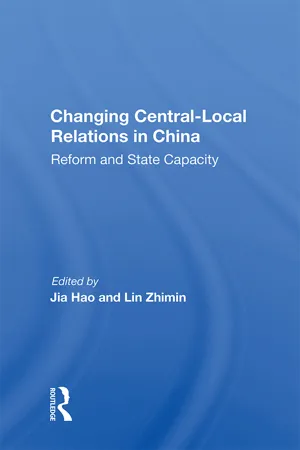
Changing Central-local Relations In China
Reform And State Capacity
- 282 pages
- English
- ePUB (mobile friendly)
- Available on iOS & Android
eBook - ePub
Changing Central-local Relations In China
Reform And State Capacity
About this book
This volume provides a comprehensive analysis of the profound changes in Chinas central-local relations since the late 1970s. Lending insight into a crucial component of Chinas current political economy and the transformation of state socialism, the contributors challenge conventional wisdom that state power rests in the traditional dichotomy of st
Information
Part One
Historical Perspective and Overview
1
China’s Central-Local Relationship: A Historical Perspective
Zhao Suisheng
The People's Republic of China is a unitary state. Formal authority is constitutionally held by the central government. Provincial and local officials are appointed by the center, not elected by local citizens. The nation's constitution and political structure do not guarantee political powers for local governments. Although this unitary state structure has never been seriously challenged, the traditional central-local relationship, which took shape in the 1950s, has become a target of change ever since.
When describing the traditional center-local relationship, both Chinese scholars arid government officials often use the family metaphor. The nation's economy was like an extended traditional family economy. The central authority was jiazhang (family head), who was responsible for the livelihood of the whole family and controlled all family resources. Local governments were like haizi (children) in the family, who were looked after by their jiazhang, They were expected to work hard for the prosperity of the family and contribute their income to the family pool. Haizi obeyed jiazhang out of commitment to the family ideology or a sense of moral responsibility, and were subject to the discipline of the family.
In the family-style unitary state, the administrative system of China was, in some Chinese scholars' words, a "chuizhi xitong" (integrated vertical system) in which "a hierarchical administration was supposed to integrate central authority, local authorities and enterprises."1 All political, social, and economic powers were supposed to be bound up and concentrated within the central authority. Although local governments exercised direct administration over the localities, functions of the central authority and local governments often overlapped. Several Chinese scholars described this functional integration in the following way: "The central authority was responsible for balance and distribution of commodities, materials, investments, financial revenues, credits and loans, and foreign exchange at the top level, whereas local governments were responsible for the same affairs at lower levels."2 In other words, within the functionally integrated system of China, while local governments were responsible for local social and economic development, their formal role was to implement centrally-made policies.
The strength of the integrated vertical system was supposed to be its ability to mobilize resources for rapid economic development. The central government, which controlled material resources and monetary funds, made decisions based on its assessment of the long-term needs of the society as a whole, not on the particularistic interests of individual actors, regions, or enterprises. In reality, nevertheless, the system produced numerous problems which hampered China's overall economic progress. One of the problems was economic inefficiency. The vertical system usually gave the central authority, especially central functional ministries, excessive control over the provinces. All important decisions had to be made in Beijing. Even the acquisition of fixed property worth as little as one hundred yuan required specific approval from the relevant central ministry.3 This frequently resulted in delay and frustration in decisionmaking and implementation. Another problem was "ministry autarky".4 James Wang indicated that tight control over the supply of materials and allocation of resources produced "centralized, ministerial, independent kingdoms, which interfered with provincial and local administration, drew up ill-conceived plans, and made repeated revisions of the plans." He believed that "this resulted in the neglect of priorities and the waste of raw materials."5
Consequently, the integrated vertical system was a major target of change from the late 1950s until the beginning of the reform era in late 1970s. During this period, while the unitary nature of the state was never seriously challenged, the central administration's authority was reduced. Decentralization had weakened the center's capacity to control local governments and encouraged local governments to pursue their own interests. What were the major instruments used by the center to control local governments in the unitary state of China? How had decentralization proceeded since the founding of the People's Republic in 1949 until the late 1970s? How should the decentralization be interpreted? And what features can we see in this process of the decentralization? These are the questions that this chapter seeks to answer.
The Control Instruments in a Unitary State
In the unitary state of China, the central authority exercised its power over local governments mainly through three coercive instruments: ideological requisiteness, party discipline, and the central planning mechanism.
The Ideological Requisiteness
Ideological requisiteness was a traditional control instrument used by the central government of China to make local governments comply with central policies. During the early period of the People's Republic, Chinese communist leaders relied heavily on both traditional Chinese doctrines and communist principles as ideological weapons to govern the nation.
The ideology was typically expressed by the statement that a "natural harmony of social interests" existed within the Chinese people. The central government and the Chinese Communist Party (CCP) represented the nation's highest interest.6 According to this ideological appeal, Chinese people, including the provincial and local governments, were exhorted to defer to the center, subjugating their interests to state needs, their parochial preferences to the national good. It implied that local officials were called upon not only to accept but to internalize the values of the center. This was expressed in a slogan of the 1950s that "quanguo yi panqi" (all the nation was one chess game). There ought to be an identity of goals and a unity of will between the center and the localities. As mere pawns in the nation's chessboard, the rules of the game required that localities have no mind and preferences of their own. A unitary player, the center, made the moves alone. Very often, the localities were required to sacrifice for the good of the nation as a whole.7
Ideological requisiteness was a very powerful force during jive early period of the People's Republic. While a nation for thousands of years, China had also experienced countless wars among regional rulers and warlords throughout its history. The country had often been divided. One of the greatest accomplishments that the Chinese Communist regime claimed was reunification of the nation. With the inauguration of the People's Republic on October 1, 1949, China was unified (except for Taiwan) and at peace for the first time in decades.
This historical background led Mao Zedong, immediately after the Communist Party took power over the nation, to state in his On People's Democratic Dictatorship that one of the most prominent goals of the communist regime was to maintain national political and economic unity. This unity was, according to Mao, based on a common goal represented by the Communist Party. Mao told the Chinese people that there were no fundamental conflicts of interest among the people. The government at different levels pursued the same goal: protecting the interests of the people.8
Mao and the official ideology presented by him did not encourage the pursuit of personal or local interests, or any form of compromise with these interests. In principle, governments at all levels were to discover under party leadership the objectively correct line of the historical moment and guarantee its wholehearted implementation by every government official. The correct line would lead to national unity, strength and prosperity, and the development of socialism. This was frequently a dominant theme in the rhetoric of government and party officials and encoded in propaganda exhortations such as: To pursue the party line, all government officials should maintain a quanju guannian (comprehensive perspective on the whole nation). Another such maxim was that local interests must give way to the national interest or, as it was expressed in Chinese, jubufuchong quanju--the parts are subject to the whole.9
Party Discipline
Party discipline was the second instrument that the center used to control local governments. The Chinese Communist Party emerged from the revolutionary years as a highly disciplined and tightly knit organization with a membership of nearly five million. The imperatives of two decades of armed struggle had imparted a military-like discipline to its organization and to the behavioral habits and cast of mind of its members. The party members were guided by the Leninist principle of "democratic centralism," which meant that discussion of any issue within the party must be followed by unified implementation of whatever decision was reached at the top.10 It in fact required that all party members submit to the decisions of the party center.
As Mao Zedong explained the Communist Party's system of democratic centralism, "The Communist Party not only needs democracy but needs centralization even more."11 He added that, in the system of democratic centralism, "The minority is subordinate to the majority, the lower level to the higher level, the part to the whole, and the entire membership to the Central Committee."12
Deng Xiaoping followed Mao Zedong and talked about party discipline in similar terms: "Individual party members must be subordinate to the party organization, the minority to the majority, the lower party organization to the higher, and all party constituent organizations and members must be subordinate to the Central Committee."13
Party discipline functioned as a coercive instrument to enforce compliance from local governments mainly through two institutional devices. One was the system under which party organs overlapped and often arrogated the functions of government organs. Functioning as a quasi-government long before the formal establishment of the People's Republic, the party provided the main organizational base, leadership, and methods of mass organization as the new government took shape. While there might be some distinctions between the party organization and the formal administrative organs of the government, the leaders of the party usually held the key positions in the formal governmental administration. For example, Mao Zedong was both the party chairman and the chairman of the People's Republic for many years. The pattern was repeated down to the provincial and local levels. Party secretaries either formally held official posts in the governments or were placed in positions that supervised the administrative work of nonparty functionaries.
The second device was the nomenklatura system, through which the party's Central Committee had sovereign control over the appointment, promotion, transfer, and removal of party secretaries and top governmental officials at provincial and local levels. To p...
Table of contents
- Cover
- Half Title
- Title
- Copyright
- Contents
- List of Tables and Figures
- Preface
- INTRODUCTION
- PART ONE Historical Perspective and Overview
- PART TWO Functional Dimensions
- PART THREE Regional Differentiation and Case Studies
- About the Contributors
- Index
Trusted by 375,005 students
Access to over 1.5 million titles for a fair monthly price.
Study more efficiently using our study tools.
Frequently asked questions
Yes, you can cancel anytime from the Subscription tab in your account settings on the Perlego website. Your subscription will stay active until the end of your current billing period. Learn how to cancel your subscription
No, books cannot be downloaded as external files, such as PDFs, for use outside of Perlego. However, you can download books within the Perlego app for offline reading on mobile or tablet. Learn how to download books offline
Perlego offers two plans: Essential and Complete
- Essential is ideal for learners and professionals who enjoy exploring a wide range of subjects. Access the Essential Library with 800,000+ trusted titles and best-sellers across business, personal growth, and the humanities. Includes unlimited reading time and Standard Read Aloud voice.
- Complete: Perfect for advanced learners and researchers needing full, unrestricted access. Unlock 1.5M+ books across hundreds of subjects, including academic and specialized titles. The Complete Plan also includes advanced features like Premium Read Aloud and Research Assistant.
We are an online textbook subscription service, where you can get access to an entire online library for less than the price of a single book per month. With over 1.5 million books across 990+ topics, we’ve got you covered! Learn about our mission
Look out for the read-aloud symbol on your next book to see if you can listen to it. The read-aloud tool reads text aloud for you, highlighting the text as it is being read. You can pause it, speed it up and slow it down. Learn more about Read Aloud
Yes! You can use the Perlego app on both iOS and Android devices to read anytime, anywhere — even offline. Perfect for commutes or when you’re on the go.
Please note we cannot support devices running on iOS 13 and Android 7 or earlier. Learn more about using the app
Please note we cannot support devices running on iOS 13 and Android 7 or earlier. Learn more about using the app
Yes, you can access Changing Central-local Relations In China by eter Tsan-Yin, James Chung,eter Tsan-Yin Chung,Jia Hao,Lin Zhimin,Jio Hao in PDF and/or ePUB format, as well as other popular books in Politics & International Relations & Political Economy. We have over 1.5 million books available in our catalogue for you to explore.