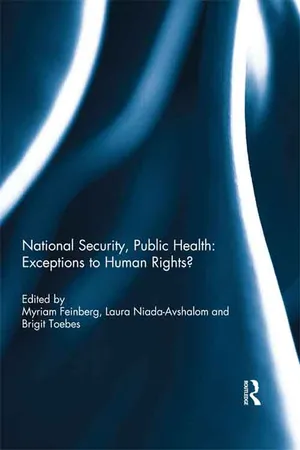
The book deals with the complicated relationships between national security and human rights, and between public health and human rights. Its premise is the fact that national security and public health are both included in human rights instruments as 'exceptions' to the human rights therein sanctioned, yet they can arguably be considered as human rights themselves and be equally valuable. The book therefore asks to what extent the protection of the individual could – or should – be overridden to enable the protection of the national security or public health of the general public. Both practice and case law have shown that human rights risk being set aside when they clash with the protection of national security or public health. Through theoretical analysis and practical examples, the book addresses the conflicts that arise when the concepts of national security and public health are used – and abused – and other rights, including freedom of speech, procedural freedoms, individual health, are violated as a consequence. It provides many interesting findings on the values that states are ready to protect – and forego – to ensure their safety, which can contribute to the ongoing debate on the protection of human rights. This book was originally published as a special issue of The International Journal of Human Rights.
eBook - ePub
National Security, Public Health: Exceptions to Human Rights?
- 180 pages
- English
- ePUB (mobile friendly)
- Available on iOS & Android
eBook - ePub
National Security, Public Health: Exceptions to Human Rights?
International counterterrorism – national security and human rights: conflicts of norms or checks and balances?
Myriam Feinberg
Buchmann Faculty of Law, Tel Aviv University, Israel
Security and human rights norms usually require a balancing act for their contemporaneous application but are often considered to conflict with one another. This is the case, especially when terrorism threats lead the executive branch to temporarily suspend or reduce its human rights obligations. Yet this presumption that these two norms inherently conflict is increasingly criticised. International terrorist sanctions regimes, such as that of the European Union and United Nations, are a prime example of this conflict because these organisations have been concurrently adopting counterterrorism measures, often through their executive branch and without any human rights protections. This article will use the 2008 Kadi case of the European Court of Justice as a framework to provide a contextual analysis of the term ‘conflict’ and provide criticism for the use of the conflict label to describe the relationship between national security policies and human rights, when norms of security and human rights should all form the benchmark of counterterrorism. This article will examine the legal issues created by the Kadi case and suggest that, despite the legal and normative uncertainties it raised, in practice, the case is an example of institutional conflict, or checks and balances that, in effect, actually enhances the fairness of sanctions regimes.
Introduction
Current discourse on international counterterrorism places security and human rights in conflict with each other. While this perspective is hardly new as security and human rights need to be balanced on a regular basis in democratic societies, the norms are increasingly conflicting, due both to the global nature of the terrorist threat, which requires wider-reaching security measures, and to the numerous human rights obligations imposed on states by international and regional instruments. This article questions the assumption that security and human rights should be seen as opposing values and attempts to map out the concept of ‘conflict’ in the specific context of terrorist sanctions.
Using the 2008 Kadi case adjudicated before the European Court of Justice (ECJ) as a framework to analyse the language of ‘conflict’, I critique the focus on the notions of balance generally and ‘conflict’ (between national security and human rights) more specifically, as triggering a choice between norms that should all form the benchmark of counterterrorism. I suggest that, despite the many legal and normative uncertainties raised by the Kadi case, the recent regional case law on terrorist sanctions is, in practice, an example of institutional checks and balances, usually absent from international security and which, in effect, enhances the fairness of sanctions regimes by actively criticising executive measures and requesting the protection of fundamental freedoms from those adopting the measures.
1. Security and human rights: the language of balance
Numerous moral, legal and political justifications exist, either for the complete or partial derogation of human rights. In cases of public emergencies or war, states are entitled to derogate from and completely suspend certain existing human rights protections, thereby making them inoperative. Similarly, public health, national security, or other considerations, are considered to be legal justifications for the partial limitation of human rights in non-emergency situations. Of course, even in situations of emergencies, not all human rights are necessarily suspended and some rights are non-derogable, in which case, no exception or limit is acceptable. A definition of these peremptory norms, which create non-derogable rights, is included in the Vienna Conventions for the Law of Treaties,1 but the exact list of these rights is unclear. As the recent December 2014 release of the 528-page executive summary of the United States (US) Senate Select Committee on Intelligence’s 6300-page report on the CIA torture programme2 shows, freedom from torture, usually considered a non-derogable human right, has been spurned.
These derogations and limitations are included in various human rights instruments or policies: article 4 of the 1966 International Covenant on Civil and Political Rights3 allows states to derogate from their obligations under the convention for reasons of ‘public emergency’. Conversely, the European Convention on Human Rights includes a limitation clause for some of its protected rights, which then leads the court to conduct a balancing exercise between the right and its limitation:
The exercise of these freedoms, since it carries with it duties and responsibilities, may be subject to such formalities, conditions, restrictions or penalties as are prescribed by law and are necessary in a democratic society, in the interests of national security, territorial integrity or public safety, for the prevention of disorder or crime, for the protection of health or morals, for the protection of the reputation or rights of others, for preventing the disclosure of information received in confidence, or for maintaining the authority and impartiality of the judiciary.4
In the context of national security, the political discourse often oscillates between reassurances that human rights are respected and support for a security apparatus. In a 1977 case in the United Kingdom (UK), Lord Denning said:
It is a case in which national security is involved; and our history shows that, when the state itself is endangered, our cherished freedoms may have to take second place.5
When it comes to the specific case of terrorism, many counterterrorism measures are considered a necessary evil aimed at protecting the security of a population, sometimes at the expense of an individual or a group, leading to a language of balance between various norms. This balance between norms of security and of human rights – a necessary feature of democratic societies – becomes problematic if it leads government entities to make an exclusive choice between the norms. In this context, the events of 11 September 2001, and the nature of terrorism subsequently, have definitely shifted this so-called balance discourse to a discourse of choice.6 The language on counterterrorism itself changed drastically after 11 September 2001 when President Bush declared that the US was at war against terrorism.7 In the US, this new view formed the basis of the Patriot Act 2001 and for the 2001 Authorisation for Use of Military Force (AUMF) against terrorism8 and, more broadly, of a whole new legal discussion on the laws of war and their application to terrorism.9 The attacks of 11 September 2001 also resulted in the adoption of Resolution 1373 by the United Nations (UN) Security Council, which required its member states to adopt legislation to address terrorism.10 The resolution was adopted under Chapter VII of the UN Charter, which makes its obligations binding on member states. Following the attacks, many argued that an entirely new approach to counterterrorism should be adopted to reflect the new nature of the terrorist threat.11 This new approach generally prioritises security and can be seen in the US’ political rhetoric about counterterrorism:
First, our highest priority is – and always will be – the safety and security of the American people. As President Obama has said, we have no greater responsibility as a government.12
Such security discourse is not isolated and has been summarised as follows: ‘in this world; security (hence order) is prior to justice’.13 For Thomas Pool...
Table of contents
- Cover
- Half Title
- Title
- Copyright
- Contents
- Citation Information
- Foreword: National security and public health: exceptions to human rights?
- 1. International counterterrorism – national security and human rights: conflicts of norms or checks and balances?
- 2. Protecting ‘national security’ whistleblowers in the Council of Europe: an evaluation of three approaches on how to balance national security with freedom of expression
- 3. Resisting accountability: transitional justice in the post-9/11 United States
- 4. From the barrier to refugee law: national security’s transformation from a balancing right to a background element in the realms of Israeli constitutionalism
- 5. The use of incapacitating chemical agent weapons in law enforcement
- 6. Human rights and public health: towards a balanced relationship
- 7. WHO International Health Regulations and human rights: from allusions to inclusion
- 8. Some scepticism on the right to health: the case of the provision of medicines
- Index
Trusted by 375,005 students
Access to over 1.5 million titles for a fair monthly price.
Study more efficiently using our study tools.
Frequently asked questions
Yes, you can cancel anytime from the Subscription tab in your account settings on the Perlego website. Your subscription will stay active until the end of your current billing period. Learn how to cancel your subscription
No, books cannot be downloaded as external files, such as PDFs, for use outside of Perlego. However, you can download books within the Perlego app for offline reading on mobile or tablet. Learn how to download books offline
Perlego offers two plans: Essential and Complete
- Essential is ideal for learners and professionals who enjoy exploring a wide range of subjects. Access the Essential Library with 800,000+ trusted titles and best-sellers across business, personal growth, and the humanities. Includes unlimited reading time and Standard Read Aloud voice.
- Complete: Perfect for advanced learners and researchers needing full, unrestricted access. Unlock 1.5M+ books across hundreds of subjects, including academic and specialized titles. The Complete Plan also includes advanced features like Premium Read Aloud and Research Assistant.
We are an online textbook subscription service, where you can get access to an entire online library for less than the price of a single book per month. With over 1.5 million books across 990+ topics, we’ve got you covered! Learn about our mission
Look out for the read-aloud symbol on your next book to see if you can listen to it. The read-aloud tool reads text aloud for you, highlighting the text as it is being read. You can pause it, speed it up and slow it down. Learn more about Read Aloud
Yes! You can use the Perlego app on both iOS and Android devices to read anytime, anywhere — even offline. Perfect for commutes or when you’re on the go.
Please note we cannot support devices running on iOS 13 and Android 7 or earlier. Learn more about using the app
Please note we cannot support devices running on iOS 13 and Android 7 or earlier. Learn more about using the app
Yes, you can access National Security, Public Health: Exceptions to Human Rights? by Myriam Feinberg,Laura Niada-Avshalom,Brigit Toebes in PDF and/or ePUB format, as well as other popular books in Law & International Law. We have over 1.5 million books available in our catalogue for you to explore.