eBook - ePub
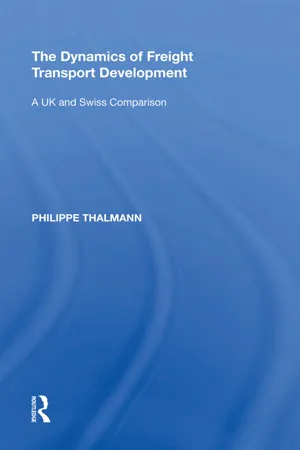
The Dynamics of Freight Transport Development
A UK and Swiss Comparison
- 247 pages
- English
- ePUB (mobile friendly)
- Available on iOS & Android
eBook - ePub
About this book
Through the eye of an economist Thalmann explores 200 years of the dynamics of freight transport development in Switzerland and the United Kingdom. With a strong underlying theme concerned with the impact of government intervention on the efficiency of the freight transport system, Thalmann is able to provide an insight into the differences and similarities of the two countries who are currently the pioneers of this industry and thus make interesting case studies for the rest of Europe. This book provides quality data in graphical form which is accessible to all. Contrary to other work, Thalmann does not focus on road or rail transportation alone but on the whole range of transport modes. At the same time the research remains manageable with its focus on freight transportation while most comparable books deal solely with people transportation. The Dynamics of Freight Transport Development should be an invaluable tool for researchers in the field of transportation and also for the more general reader interested in the past and future of transportation.
Chapter 1
Introduction
Context and Issues
Through economic and political integration, Europe is evolving towards a network economy in which flows of people and particularly of goods become essential. Switzerland cannot but participate in this evolution, given the weight of international trade for its economy and its central location in Europe. The consequence is heavy pressure on the Swiss transport system to increase its capacity and performance. At the same time, the growth of transport attracts critical attention for its social, financial and environmental consequences.
Several problems must be resolved relatively quickly in order to create favourable conditions for the economic and social development of the country:
- Efficient structures: railways reform and management of road transport.
- Fair and correct prices: internalisation of transport external costs.
- Financial soundness: financing of public transport infrastructure.
- Popular support: protecting the most sensitive regions like the Alps.
- European integration: negotiations with the European Union.
- Environmental protection: limits on toxic emissions and nuisances.
- Sustainability: increase of safety, rational use of energy, slowing down global warming.
- Performance: provision of mobility and response to transport demand.
- Spatial integration: regional and urban planning.
Most of the problems concerning the transport sector relate to its social costs in its widest sense. In Europe the social costs appear to be unacceptably high — a low estimate is some 4 to 5 per cent of GDP (ECMT, 1998). The European transport sector is confronted with severe capacity constraints of all kinds. Furthermore, average growth figures of mobility in Europe of 50 per cent and greater for the next 20 years are foreseen. The greatest part of this growth takes place on roads.
Road transport already accounts for about one quarter of the man made gases that are contributing to global warming. Of more immediate concern is the enormous local damage in terms of air pollution, noise, landscape degradation and time wasted in traffic congestion. The conventional solution to this problem —building more roads — is extremely costly. Sustainable development requires great efforts foremost in the transport sector, in particular more efficient energy use. Sustainability also encompasses economic and social dimensions, legitimising concern for continued mobility and economic development.
The most striking impact of transport is accidents. In 2001, more than 30 000 people were injured and nearly 544 lost their lives on Swiss roads, one-fifth of them pedestrians (Swiss Federal Statistical Office). The figure relative to Western Europe is equally catastrophic, with over 30 000 deaths per year. In comparison, railways caused one hundred times fewer casualties.
An important part of freight transport in Switzerland is transit by road. Although numerous studies have proven that mass road transport is damaging, Switzerland must accept connections between EU countries through its territory. The only sustainable solution is to transfer more transit freight to the railways. New infrastructure is called for and is being built. This is not sufficient. The reform of the railways' organisation should bring greater efficiency and competitiveness. Intermodality is facilitated. Long-term financial resources are reserved for the transport system. When these resources originate in taxes on road freight, they help restore a level playing field. All these changes are part of international efforts to restore the attractiveness of the railways, an effort to which this book testifies by reporting on the evolution in Great Britain, a country in which the railways have a lot of catching up to do and are doing just that.
The Contribution of this Book
Clearly, the dynamics of freight transport in Switzerland are very complex, being part of larger economic and social, as well as national and international systems. Understanding these dynamics is an essential step before proceeding with building costly new pieces of infrastructure and implementing organisational reforms. The goal of this book is to contribute to this understanding, with a view to helping decision-making on infrastructures and transport policies. The dynamics are not shown with the help of a complex simulation model — other teams of researchers have done so — but by looking back at two centuries of (freight) transport history. Showing what was possible in the past — e.g. competing private rail companies and a dominance of rail freight — may suggest to decision-makers what is possible in the future, provided it is shown why earlier solutions failed and changes occurred.
The goal of this book is ambitious. Although plenty of data on quantities shipped is available, there exists very little information on the position of freight transport within society and the economy. There exists no systematic data on prices or tariffs. The scientific literature is quite sparse regarding global views of transport in Switzerland. Hopefully, more can be learned about the dynamics of Swiss freight transport by examining Great Britain.
Switzerland and Great Britain are interesting case studies for the rest of Europe, as they are pioneers today in different areas:
- Switzerland is moving further than other countries towards true costing of road transport, including external costs. It also has the highest proportions of rail freight in Europe.
- Great Britain started very early with privatisation and the separation of infrastructure and operation, i.e. with the application of EU directive 91/440/EEC.
The reason for investigating British transport history back to the 1800s is that the country was a pioneer of the railways, and the first to manage this new transport system. By assumption, studying periods makes more sense than merely comparing dates and facts, especially for understanding the dynamics of evolution. GB is still setting the pace for Europe, in some regards. Observing its experiences intently might help to avoid detrimental developments and to create and foster desirable innovations. This is one goal of the present book.
This book structures and interprets the history of freight transport in Switzerland and GB from different angles: the unfolding of events and political decisions and their driving forces; the statistical data and its regularities; the environmental impacts. Such background information is necessary to forecast the future evolution of transport, although no such exercise is attempted here.
Inland waterways, pipelines, airfreight and other special transport modes contribute to freight movement. They may be significant for some regions and particular industries or goods. However, they are far less important and mobilise far fewer resources and attention than road and rail, particularly in Switzerland. The analysis in this book therefore concentrates on road and rail transport.
Book Outline
This book has three parts and 9 chapters. The first part examines the situation in Great Britain, the second in Switzerland, and the third compares and concludes.
Chapter 2 in part I and chapter 5 in part II, trace the history of transport, particularly freight transport, in Great Britain and Switzerland respectively, with elements of general economics, technology, politics and transport policies. The chronology of these stories is structured along main periods identified from the historical events and the statistical analyses of chapters 3 and 6 respectively. The historical chapters show how the two countries answered the challenges of the 19th century — building a transport network for industry — the first half of the 20th century — rationalising this network and augmenting it with a second, road network — and the second half of the 20th century — competition between rail and road. Analysis of Britain's recent history is particularly interesting as it allows assessing one of the most radical experiments in privatisation and competition on the railways. Switzerland stands out in international comparison by managing to maintain a high share of rail freight.
Chapter 3 gathers the existing British data on freight transport and displays it graphically with a view to revealing general trends and structural breaks in the chronology. It helps to identify the main time periods in the history of freight transport since the 19th century. Chapter 6 performs the same exercise for Switzerland. The two chapters adopt the same structure for easy comparison: rail freight, road freight, and total freight. Gathering the statistical data and analysis in these chapters meant that they could be kept out of the historical chapters. However, the historical and statistical chapters should really be read in parallel. Or better, readers more inclined to historical...
Table of contents
- Cover
- Half Title
- Dedication
- Title
- Copyright
- Contents
- List of Figures
- List of Tables
- List of Abbreviations
- Foreword
- Acknowledgements
- 1 Introduction
- Bibliography
- Index
Trusted by 375,005 students
Access to over 1.5 million titles for a fair monthly price.
Study more efficiently using our study tools.
Frequently asked questions
Yes, you can cancel anytime from the Subscription tab in your account settings on the Perlego website. Your subscription will stay active until the end of your current billing period. Learn how to cancel your subscription
No, books cannot be downloaded as external files, such as PDFs, for use outside of Perlego. However, you can download books within the Perlego app for offline reading on mobile or tablet. Learn how to download books offline
Perlego offers two plans: Essential and Complete
- Essential is ideal for learners and professionals who enjoy exploring a wide range of subjects. Access the Essential Library with 800,000+ trusted titles and best-sellers across business, personal growth, and the humanities. Includes unlimited reading time and Standard Read Aloud voice.
- Complete: Perfect for advanced learners and researchers needing full, unrestricted access. Unlock 1.5M+ books across hundreds of subjects, including academic and specialized titles. The Complete Plan also includes advanced features like Premium Read Aloud and Research Assistant.
We are an online textbook subscription service, where you can get access to an entire online library for less than the price of a single book per month. With over 1.5 million books across 990+ topics, we’ve got you covered! Learn about our mission
Look out for the read-aloud symbol on your next book to see if you can listen to it. The read-aloud tool reads text aloud for you, highlighting the text as it is being read. You can pause it, speed it up and slow it down. Learn more about Read Aloud
Yes! You can use the Perlego app on both iOS and Android devices to read anytime, anywhere — even offline. Perfect for commutes or when you’re on the go.
Please note we cannot support devices running on iOS 13 and Android 7 or earlier. Learn more about using the app
Please note we cannot support devices running on iOS 13 and Android 7 or earlier. Learn more about using the app
Yes, you can access The Dynamics of Freight Transport Development by Philippe Thalmann in PDF and/or ePUB format, as well as other popular books in Business & Business General. We have over 1.5 million books available in our catalogue for you to explore.