eBook - ePub
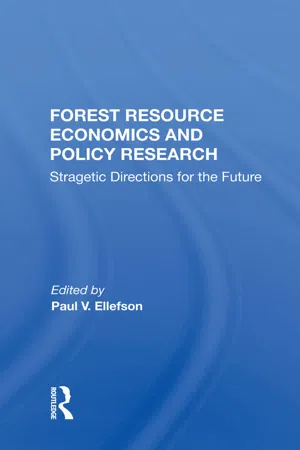
Forest Resource Economics And Policy Research
Stragetic Directions For The Future
- 402 pages
- English
- ePUB (mobile friendly)
- Available on iOS & Android
eBook - ePub
About this book
This book reviews the status of discipline-wide activity in forest economics and policy research, especially investment levels, past and current program emphasis, program planning, and organizational involvement. It defines strategic directions for forest economics and policy research.
Trusted by 375,005 students
Access to over 1.5 million titles for a fair monthly price.
Study more efficiently using our study tools.
Information
Subtopic
Business GeneralIndex
BusinessPart One
Historical, Institutional, and Investment Context
1
Development and Accomplishment of Research Programs
Henry J. Vaux and H. R. Josephson
Forest resource economics and policy research has evolved strikingly over the past forty years in a number of fundamental respects. For example, the size of the effort devoted to such research has grown substantially. The research methods available for use have become much more sophisticated. And the array of problems needing and receiving attention has multiplied in number and become much more complex. But what can be said of major program developments and accomplishments in the field of forest economics and policy research? And how has forest economics and policy research related to major contemporary trends in national affairs, of which forestry research is a part? Of necessity, answers to such questions must be broad in scope. A fully detailed account of program developments and accomplishments would far transcend the limits of space and time that apply here. Moreover, excessive detail could overwhelm the highlighting of fundamental societal forces that have strongly influenced research activity in the field of forest economics. In what follows, major emphasis will be given to the period 1947-1987. As appropriate, research begun before 1947 will be recognized in order to provide essential historical perspective.
Basic Trends Affecting the Forestry Sector
The four decades following World War II were, for the most part, periods of great dynamism in the whole of American society. The population of the country increased by more than seventy percent, real national product almost tripled, per capita real income doubled, and use of natural resources and energy rose substantially. Improved technology and better developed infrastructure expanded both the leisure time and the mobility of the steadily growing population. This almost unprecedented growth in numbers of people and their ability to exert effective demand for goods and services would, under any circumstances, have had strong repercussions within the forestry sector. But such effects were intensified by another fact. Prior to World War II, the inventory of timber in the contiguous forty-eight states was so vast that both virgin timber and good site commercial forest and could be readily purchased at nominal prices in many Pacific Coast localities. As such, the primary determinants of both market and long run supplies of timber were inventory volume and its accessibility to the market. Under such circumstances, stumpage prices bore little relation to the cost of growing timber—market incentives to grow timber were generally lacking. Because transport costs for wood products were low in relation to product prices, the economic effect of large virgin timber inventories in the West also depressed timber prices in the South and East. About the time of World War II, these fundamental conditions of timber supply changed greatly. Old-growth timber inventories were finally reduced to levels where they were perceived as no longer adequate to sustain timber supply in the long run. Real prices for stumpage and forest land began to rise. For the first time, timber growing became a feasible economic activity and the costs of growing timber became a major determinant in long-run timber supply.
A number of events signalled this fundamental and permanent change in the economics of timber. For example, the first of many industrial tree farms was dedicated in 1941. At the same time, the pulp and paper industry, especially in the South, acquired extensive areas of cutover land to assure long-term wood supply for its rapidly expanding markets. After World War II, western industries brought pressure to greatly increase extension of roads and the annual harvest from the National Forests. And new enterprises were established in the virgin forests of Canada to supply growing U.S. markets that could no longer be fully served by opening up previously undeveloped domestic forests.
In contrast to earlier times, control over additional long-term supplies of timber was no longer to be had by moving to a little settled geographic area. New reserves for forest parks, wilderness, and other forms of dispersed forest recreation could no longer be found without reducing the apparent timber supply of existing industries and significantly modifying opportunities for other forest uses. These forces and events had, by the 1950s, wrought fundamental changes in the nature of American forestry—changes that greatly stimulated development of forest economics as a field and whose consequences continue to preoccupy forest economics and policy research. The more important and immediate impacts on forestry included the following.
- Steady and widespread increase in the economic value of forests and forest products. In real terms, stumpage prices increased two to five-fold (depending on region and species) during the period 1947-1987. The real value of commercial forest land used for timber-growing showed comparable increases in market price. Lumber prices increased roughly 50 percent in real terms.
Rising values of timber and timberland provided rapidly expanding incentives for analysis of timber supply, wood products demand, forest industry and market organization, wood product prices, and related economic topics. Increasing competition for timber and the rising value of wood commodities increased pressures for greater efficiency in the growing, manufacturing, and marketing of such materials. Achieving increased efficiency required more and better economic data and more refined analysis across all wood-producing sectors. Expanded needs for housing, packaging materials, and numerous other products required to support national growth inspired continued attention to the nature and adequacy of raw material supplies and called for an emphasis on economic and geographic, rather than merely physical, dimensions of timber supplies.
Similarly, rising land and timber values intensified the need for more information and improved methods of stumpage valuation, land and timber assessment and taxation, efficiency of alternative contractual arrangements, and knowledge about the nature of markets in the forestry sector.
- Expanding population and income increased the demand for conversion of forest land to nonforestry uses for agriculture, home subdivisions, and attendant industrial and commercial purposes. Effects of these forces on the area of land available for forestry and on forest land values were more localized than those of rising wood prices. But, whether actually or potentially at work, they resulted in substantial land value increases and thus created incentives for additional research.
Ongoing land use adjustments affecting the forest base required research to determine their effects, project their future impacts, and provide factual and analytical bases. Such information was important for development of zoning controls and taxation, for forest planning within the remaining forest area, and for analysis of other problems associated with the geographic interface between the forest and adjoining areas.
- Growth in population, income, and leisure time led to dramatic increases in peoples demands for outdoor recreation of all kinds, including forest-based recreation. The result was strong and sustained political pressure for the dedication of additional public forest land for wilderness, parks, and wildlife and recreation areas and increased incentives for protection and development of recreational values on private forest land.
These pressures led forest economics and policy research into areas of study and methodology that previously had been virtually unexplored. Because most forest recreation services are unmarketed, the solving of acute economic and policy problems required the development of data and methods appropriate for establishing reasonable equivalents to market values for wilderness use, hunting and fishing, camping sites, and a variety of other activities within the spectrum of outdoor recreation activities. Transferring land from what had been considered by many as part of the timber growing economy was often vigorously opposed by industry groups and others because of perceived adverse economic impacts. Hence, the new methods were quickly applied in an effort to make reasonably valid comparisons of the economic and social values at stake under various combinations of forest uses. Research approaches to such comparisons were further complicated by the geographically specific requirements of many recreational uses and by the need to consider cumulative impacts of changes in resource allocation.
- Public concern and specialists' attention broadened from almost exclusive preoccupation with timber-related problems to considering the entire spectrum of multiple-use values. This occurred partly as a result of the growing body of research information available about forests and partly because of growing public interest in forests for recreational use and related concerns.
This shift in emphasis, combined with the fact that the major short-run supply response to increased demand for forest recreation was accommodated on public land, was reflected in research. More attention was directed to the nature and content of decision making in the public sector, to economic implications of budgeting for forestry agencies, and to interactions between economic and political forces in determining policy. On the one hand, forest economists had to devote more attention to factors outside the traditional market framework. On the other, specialists in social science disciplines other than economics were drawn into the analysis of forestry problems.
- Increasing public concern with environmental considerations such as air and water quality, control of pesticides and toxins, habitat requirements for rare and endangered species, and the adverse effects of congestion in certain critical areas also pushed research and analysis into new terrain.
The biological foun...
Table of contents
- Cover
- Half Title
- Title
- Copyright
- Contents
- Foreword
- Preface
- PART 1 HISTORICAL, INSTITUTIONAL, AND INVESTMENT CONTEXT
- PART 2 STRATEGIC RESEARCH DIRECTIONS
- PART 3 FUTURE RESEARCH PROGRAM DIRECTIONS
- About the Editor and Contributors
- Index
Frequently asked questions
Yes, you can cancel anytime from the Subscription tab in your account settings on the Perlego website. Your subscription will stay active until the end of your current billing period. Learn how to cancel your subscription
No, books cannot be downloaded as external files, such as PDFs, for use outside of Perlego. However, you can download books within the Perlego app for offline reading on mobile or tablet. Learn how to download books offline
Perlego offers two plans: Essential and Complete
- Essential is ideal for learners and professionals who enjoy exploring a wide range of subjects. Access the Essential Library with 800,000+ trusted titles and best-sellers across business, personal growth, and the humanities. Includes unlimited reading time and Standard Read Aloud voice.
- Complete: Perfect for advanced learners and researchers needing full, unrestricted access. Unlock 1.5M+ books across hundreds of subjects, including academic and specialized titles. The Complete Plan also includes advanced features like Premium Read Aloud and Research Assistant.
We are an online textbook subscription service, where you can get access to an entire online library for less than the price of a single book per month. With over 1.5 million books across 990+ topics, we’ve got you covered! Learn about our mission
Look out for the read-aloud symbol on your next book to see if you can listen to it. The read-aloud tool reads text aloud for you, highlighting the text as it is being read. You can pause it, speed it up and slow it down. Learn more about Read Aloud
Yes! You can use the Perlego app on both iOS and Android devices to read anytime, anywhere — even offline. Perfect for commutes or when you’re on the go.
Please note we cannot support devices running on iOS 13 and Android 7 or earlier. Learn more about using the app
Please note we cannot support devices running on iOS 13 and Android 7 or earlier. Learn more about using the app
Yes, you can access Forest Resource Economics And Policy Research by Paul V. Ellefson in PDF and/or ePUB format, as well as other popular books in Business & Business General. We have over 1.5 million books available in our catalogue for you to explore.