- 400 pages
- English
- ePUB (mobile friendly)
- Available on iOS & Android
eBook - ePub
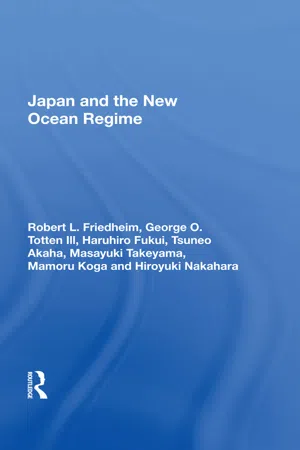
Japan And The New Ocean Regime
About this book
The regime under which humankind has governed its uses of the ocean is in the process of change—shifting away from the traditional freedom of the seas toward a "mixed†system in which most of the valuable near-shore resources come under coastal jurisdiction. The transition to a new regime has been difficult for many states, most notably Japan, whose rights to use the entire ocean were well protected by the traditional regime. Japan's response to the need to develop a modern ocean policy— to adapt to the emerging ocean management regime—is the subject of this multiauthor volume. U.S. and Japanese scholars look at what Japan is doing, how, and with what results. They first assess general trends in ocean management, then examine the role of Japan in the international political economy of the oceans, and finally look at Japan's ocean policy in various sectors: shipbuilding, fisheries, mineral resources, offshore petroleum, and nuclear power generation. Given Japan's importance in ocean affairs, the authors point out that the lessons that can be learned from its experience are of prime international importance.
Information
Chapter 1
Japan and the Ocean
The current effort to find agreement on an international convention of the seas is perhaps of greater concern to Japan than any other country, because of its dependence on the waters of the world for a significant portion of its food and on global sea lanes for its economic survival.1
Edwin O. Reischauer
One of the most important global trends we have observed in the last half of the century is the “enclosure” of larger areas of the ocean and its resources.2 Nation-states have become increasingly aware of the real and potential value of the ocean space and resources and also cognizant of the growing scarcity of natural resources on land. Consequently, they have been exerting strenuous efforts to secure what they perceive as their rightful claims to ocean riches. They have been laying unilateral claims to their coastal waters and resources therein; they have been meeting bilaterally to settle competing claims over waters and resources that lie between them; and they have been negotiating in international and multinational political forums, such as the United Nations conference on the Law of the Sea (UNCLOS) in an attempt to reach a comprehensive agreement on a large number of issues regarding the management of ocean activities.
The heart of the question has been: Who gets what, how, and at what cost, as well as why?3 Views on the international ocean regime vary widely. Some argue for the natural right of coastal states to lay claim to their coastal waters and resources therein and also to regulate and, when necessary, exclude other nations from activities within their jurisdictional boundaries. Others argue for the “freedom of the seas,” that is, that ocean space should be free from jurisdictional division and that traditional users of the seas should be allowed to continue their ocean activities unhampered by new coastal state claims and restrictions. Still others assert that the ocean and its riches belong to every nation and that not only traditional users but also newcomers to ocean activities as well as future users should be accorded equal rights to the ocean space and resources on an equitable basis.
Developing countries and other countries that have not enjoyed the benefits of the traditional regime of the sea tend to advocate expanded coastal state jurisdiction. The developed coastal states have generally supported freedom of the sea and against expansionist coastal state claims. Japan is included in the latter group. Japan’s extensive participation in worldwide ocean activities such as fishing and shipping has made it a major beneficiary of the traditional ocean regime. Japan, through continued interest in the traditional uses of the ocean and modern technological capabilities and financial resources that allow expansion into areas such as deep sea mining and ocean energy development, continues to be one of the most extensive users of ocean space and resources.
As is obvious in Reischauer’s quotation, Japan’s dependence on the ocean space and its resources is at the highest level of any developed state. For example, in the mid-1970s, Japan got about 50 percent of its animal protein intake from her fisheries products, the bulk of which came from foreign coastal waters.4 As of 1978, this maritime power accounted for as much as 15 percent of the world’s total fish catch. Japan produces 44.9 percent of the world’s edible seaweed, 45.5 percent of the squid and octopus, and 44.2 percent of the world’s eel. It produced, through vigorous competition, 15 percent of the total cod catch, 32 percent of the tuna, and 21 percent of the salmon.5 Japan’s dependence on coastal as well as bluewater fishing will certainly continue.
Japan’s dependence on foreign sources of mineral resources is also well known. In 1973, for example, the percent of total needs of the minerals imported from foreign countries were: nickel, 100 percent; zinc, 63 percent; manganese, 98 percent; and cobalt, 100 percent.6 Thus, the possibility of mining the enormous amounts of manganese nodules on the deep seabeds in the Pacific is very attractive to Japan. These deposits are estimated to amount to as much as 500 billion tons, and if they can be successfully exploited, a vast amount of several minerals could be obtained that would greatly exceed the world’s present land-based resources. For example, 132 times as much nickel, 250 times as much manganese, and 1,250 times as much cobalt as are presently available from land-based reserves would go on the world market.7 Despite the enormous capital and technological investment necessary to make such minerals available for industrial consumption, Japanese observers claim that it will be feasible in the near future to actually start exploiting them.8
It is also estimated that transportation costs account for as much as 20–30 percent of the import prices of iron ore, coal, and crude oil.9 The Japanese are also concerned that increased shipping regulations and environmental restrictions on ocean transportation are likely to raise the already substantial shipping costs.
Japan’s misgivings over the UNCLOS negotiations were apparent from related articles published in the mid-1970’s: Can Japan — a Maritime Nation — Survive?10 Japan, Squeezed Out of the Sea,11 North Pacific Fishing Faces a Crisis of Complete Devastation,12 etc.
The declaration of 200-mile fishery or economic zones by an increasing number of coastal states in the 1970s has had both a symbolic and a real impact on Japanese ocean interests. The government has had to abandon its long-standing position in favor of the 3-mile territorial sea limit and against coastal state jurisdiction beyond that narrow limit. Not only has the Japanese government abandoned its opposition to expansionist claims by other coastal states, it has itself established a 12-mile territorial sea and a 200-mile fishery zone.
The international upsurge in ocean interest has been accompanied by substantial debate within developed and developing nations to what patterns of national policy and organization are appropriate to consolidate the new powers being granted or taken by national claimants in the international arena. In short, the need for national ocean policy is a subject of some importance in contemporary domestic political systems. In some governments, new agencies have been created to consolidate powers of ocean management. In others, existing agencies have been given new powers. In many governments, new coordinating and supervisory bodies have been created, new interest groups have entered the political arena, and new coalitions have been forged with political parties and other interest groups. In other words, a number of new constituencies are demanding to be served, and, with increasing frequency, many of these demands are perceived as being available to some of the interested participants only at the expense of other participants. This obviously complicates the task of ocean management. This difficulty is compounded by the fact that the ocean is a physical common in which different sets of rights cannot be geographically separated. The result is the problem of “multiple use” —fishing, mining, oil drilling, transportation, recreation, and pollution, all takes place in the same body of water at the same time.
Japan is caught up in the turmoil of modern ocean policy. How should its government agencies be organized to maximize the chance of implementing policies that will make wise use of scarce renewable and nonrenewable ocean resources? What type of policy direction should the Cabinet and the Diet provide? How can the policies chosen enhance Japan’s position in the world political arena and also be viable in the domestic political system?
Japan has responded to stimuli that have come largely from outside her own political system. She has established policies, developed new governmental organs to coordinate overall Japanese ocean policy, and has added new responsibilities to existing agencies and ministries. Some critics say that Japan has acted hesitantly and too slowly in some areas. In other areas, it has acted boldly and with obvious success.
An analysis and evaluation of Japan’s performance in ocean policy is of interest to many states and groups throughout the world. The following questions should be asked: What is Japan doing and how is it doing it? In such analysis and evaluation, what are the successes and failures? Why? These concerns are important for two reasons. First, given the degree of Japan’s importance in ocean affairs, the success of the world’s future management of ocean resources rests to a considerable extent on Japan’s success in coping with its ocean management problems. Second, Japan is wrestling with problems typical of those major ocean-using developed states. Thus, many important lessons can be learned both by developed and developing states from Japan’s experience.
This examination of the process of Japan’s adaptation to the modern regime of ocean management will deal extensively with a problem that is at the meeting point of domestic and foreign policies, since oceans are inherently transnational. The background will be established, followed by a look at trends in ocean managment. Japan’s position in the international political economy of the oceans will be examined, followed by discussion of the nature and characteristics of ocean policy in developed ocean-using states.
Trends in Ocean Management
The ocean covers about 70 percent of the surface of the earth. Because the ocean is a physical common, it is difficult to divide it among “owners” since “wandering ocean assets” such a currents, weather, and living creatures are virtually impossible to contain, as are such “wandering ocean liabilities” as pollutants. As a result the ocean must be used in common with all users having a right of access.13 If the number of claimants to an area or function is low in proportion to the size of the asset, shared access presents few problems. However, the incentives built into the system favor the probability of economic waste. If the asset is not sufficient to accommodate all claimants, and if each claimant takes the “rational” short-run course of action that is best for himself, then the probabilities are that the outcome will be the worst collective outcome, or the “tragedy of the commons.”14 Thus, we must examine not only the separate ocean activities but look at all activities in relation to each other.
Navigation for commercial as well as non-commercial purposes is one of the most traditional uses of the ocean space. Fishing is another traditional ocean activity. Fish provide about 3 percent of the total amount of all protein available for human consumption and about 10 percent of the animal protein.15
Extraction of raw materials from seawater is another use of the ocean, accounting for about 30 percent of the world’s salt, 70 percent of its bromine, 60 percent of its magnesium metal, 5 percent of its magnesium compounds, and 60 percent of its desalinated water supply.16 The ocean is also a supplier of hydrocarbons such as petroleum and natural gas, energy, and hard minerals. It has also been used for recreational purposes. Furthermore, the ocean is constantly being used for disposal of waste.
These uses of the ocean space and resources are of benefit to man, but at the same time, they impose various costs on him. For example, navigation requires that measures be taken to ensure safety and to protect the environment. Fishing must be accompanied by fishery resource conservation if depletion is to be avoided. Safety and environmental concerns apply also to extraction of non-living resources from the sea as well as to the use of the ocean as a waste receptacle. Many of these costs result from “congestion” — where there are more claimants than can be accommodated. Such congestion gives rise to the necessity of management of the uses of the sea. The need for ocean management is particularly acute in areas of competing uses or claims where the ocean users lay competing to the right to the use of ocean space and the exploitationlof ocean resources. This is the “multiple use” problem.
On the international level, three possible model regimes are available for the management of ocean use: (1) open access and free use; (2) national management; and (3) international management.17 Of course, in reality there are “mixes,” and, indeed, the current world regime can be characterized as a mixed regime with features of all three. As will become apparent, this is a source of policy confusion.
Under the regime of open access and free use, most of the ocean space and resources are accessible to all nations, and no nation is charged a fee for the use of the ocean. The laissez-faire regime was espoused by Hugo Grotius toward the end of the seventeenth century to justify the rights of the Dutch East India Company. In opposition to the Spanish and Portuguese division of the world oceans into their spheres of dominance, Grotius asserted in his Mare Liberum that the ocean belonged to everyone (res communis) or to no one (res nullius). The implication was that whoever wanted and was able to use it could do so freely.
The Grotian principle of freedom of the seas was not without opposition. John Seldon challenged it in his Mare Clausem, arguing that nations had the right to enclose portions of the ocean and to exclude others to prevent fishing, navigation and landing, and the taking of gems within territorial waters over which it had claims. However, Grotian doctrine eventually prevailed and dominated during the ensuing centuries. In 1930, League of Nations called the Ha...
Table of contents
- Cover
- Half Title
- Series Page
- Title
- Copyright
- CONTENTS
- List of Tables and Figures
- Preface
- 1 Japan and the Ocean
- 2 How Japan Handled UNCLOS Issues: Does Japan Have an Ocean Policy?
- 3 Consensus Building in the Council for Ocean Development
- 4 Japanese Ocean Science and Technology Policy and the National Budget
- 5 The Reconstruction of the Japanese Shipbuilding Industry
- 6 A Cybernetic Analysis of Japan’s Fishery Policy Process
- 7 Developing a Manganese Nodule Policy for Japan
- 8 Japan’s Foreign Negotiations over Offshore Petroleum Development: An Analysis of Decision-Making in the Japan-Korea Continental Shelf Joint Development Program
- 9 Coastal Management and Nuclear Power: Siting a Nuclear Power Plant at Onagawa
- 10 Japan’s Ocean Policy: An Assessment
- The Authors
- Index
Trusted by 375,005 students
Access to over 1.5 million titles for a fair monthly price.
Study more efficiently using our study tools.
Frequently asked questions
Yes, you can cancel anytime from the Subscription tab in your account settings on the Perlego website. Your subscription will stay active until the end of your current billing period. Learn how to cancel your subscription
No, books cannot be downloaded as external files, such as PDFs, for use outside of Perlego. However, you can download books within the Perlego app for offline reading on mobile or tablet. Learn how to download books offline
Perlego offers two plans: Essential and Complete
- Essential is ideal for learners and professionals who enjoy exploring a wide range of subjects. Access the Essential Library with 800,000+ trusted titles and best-sellers across business, personal growth, and the humanities. Includes unlimited reading time and Standard Read Aloud voice.
- Complete: Perfect for advanced learners and researchers needing full, unrestricted access. Unlock 1.5M+ books across hundreds of subjects, including academic and specialized titles. The Complete Plan also includes advanced features like Premium Read Aloud and Research Assistant.
We are an online textbook subscription service, where you can get access to an entire online library for less than the price of a single book per month. With over 1.5 million books across 990+ topics, we’ve got you covered! Learn about our mission
Look out for the read-aloud symbol on your next book to see if you can listen to it. The read-aloud tool reads text aloud for you, highlighting the text as it is being read. You can pause it, speed it up and slow it down. Learn more about Read Aloud
Yes! You can use the Perlego app on both iOS and Android devices to read anytime, anywhere — even offline. Perfect for commutes or when you’re on the go.
Please note we cannot support devices running on iOS 13 and Android 7 or earlier. Learn more about using the app
Please note we cannot support devices running on iOS 13 and Android 7 or earlier. Learn more about using the app
Yes, you can access Japan And The New Ocean Regime by Robert L. Friedheim in PDF and/or ePUB format, as well as other popular books in Politics & International Relations & Asian Politics. We have over 1.5 million books available in our catalogue for you to explore.