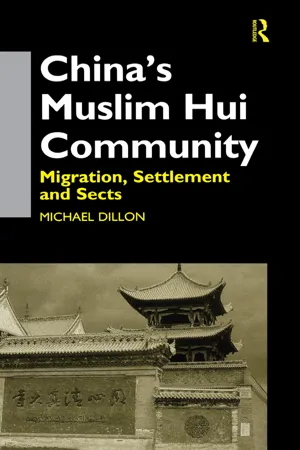
This is a reconstruction of the history of the Muslim community in China known today as the Hui or often as the Chinese Muslims as distinct from the Turkic Muslims such as the Uyghurs. It traces their history from the earliest period of Islam in China up to the present day, but with particular emphasis on the effects of the Mongol conquest on the transfer of central Asians to China, the establishment of stable immigrant communities in the Ming dynasty and the devastating insurrections against the Qing state during the nineteenth century. Sufi and other Islamic orders such as the Ikhwani have played a key role in establishing the identity of the Hui, especially in north-western China, and these are examined in detail as is the growth of religious education and organisation and the use of the Arabic and Persian languages. The relationship between the Chinese Communist Party and the Hui as an officially designated nationality and the social and religious life of Hui people in contemporary China are also discussed.
This study traces the history of the Muslim ethnic group known in China today as the Hui (Huizu
) as it has developed, changed and been recreated over the last eight hundred years of Chinese history. Economic and social organisation are considered as well as the religious activities that are the clearest indicators of Hui identity although these frequently overlap. A number of themes run through the study: the distinctiveness of Hui history or society in comparison with both the majority Han population and other Muslim ethnic groups; the role of Islam and other aspects of their tradition which define them as Hui; the continuity of Hui identity and its persistence for so many centuries in the face of pressure to conform to a pan-Chinese norm.
Official population statistics put the total Hui population of China at 7.22 million in 1982, making them one of the most significant of China’s national minorities in terms of size. By the 1990 census there had been a substantial increase to 8,602,978, a rise of 19.04% over the eight years, which was nearly double the growth of the Han population in the same period. It is not clear whether this is a reflection of natural population increase or whether Hui people have been accepted as Hui more readily since the implementation of the post-Mao reform policies started by Deng Xiaoping in 1978. There are Hui communities in most counties and cities in China with significant concentrations in the Ningxia Hui Autonomous Region, Gansu, Qinghai, Henan, Hebei, Shandong, Yunnan and the Xinjiang Uygur Autonomous Region.1 There is a Hui population of almost 185,000 in Beijing itself and they are served by over sixty mosques, some of them visited regularly by foreign Muslim diplomats and businessmen in China. The best known of these mosques is the Niujie or Ox Street Mosque which is the centre of the capital’s Islamic life.2 Shanghai has a well-established Hui community. Last but not least are the ancient Hui communities of southern China, notably Changzhou and Quanzhou in Fujian Province and Guangzhou (Canton).3
Because of their wide dispersion throughout China and the variety of Hui experience historically and in contemporary China, it is difficult to generalise about the Hui. The lives of Hui people in major cities such as Beijing, Xi’an, Guangzhou, Tianjin and Shanghai are very different from those of rural Hui living in the mountainous south of Ningxia or in Yunnan, and the Hui of the southern and southeastern port cities of Quanzhou and Guangzhou with traditions going back to the earliest history of Islam have a distinct tradition. Because of this diversity, the question of whether the Hui can realistically be considered as a single separate ethnic group or nationality has been raised, notably by Dru C. Gladney.4 Gladney has also drawn attention to a related problem, the identity of the Uyghurs, and is equally sceptical about treating them as a single ethnic group, arguing that the term Uyghur as it is presently used probably dates back only to Soviet advisers in Xinjiang in the 1930s.5 There is no evidence to suggest that the term Hui is similarly a recent revival, but studies under Communist Party auspices, beginning with The Question of the Huihui Nationality6 first published in Yan’an in 1941 have reinforced the idea of the Hui as a single and separate ethnic group. Hui people are happy to identify themselves either as members of the Hui nationality, Huizu
to use the classification favoured by the Communist Party, or as Hui people Huimin
.
The main emphasis of this study is on the Hui communities of northwestern China, that is the Ningxia Hui Autonomous Region, Gansu and Qinghai provinces and the Xinjiang Uyghur Autonomous Region. As its name suggests, the Ningxia Hui Autonomous Region is the region with the greatest concentration of Hui people and it is their nominal homeland in the People’s Republic of China. Gansu, which also administered Ningxia before the Chinese Communist Party came to power in 1949, and Qinghai are multi-ethnic regions with a mixture of Han Chinese, Hui and Tibetans as well as smaller ethnic groups. Both include territory that was once part of greater Tibet. Xinjiang or Eastern Turkistan has a small majority of Muslim Uyghurs over Han settlers and Muslims of other Turkic and Persian speaking communities. It also has a significant Hui population which has played an important role in local history, often mediating between the Han and the other Muslim communities, and a nominal Hui Autonomous Prefecture, Changji, which is just to the north of the regional capital Urumqi.
The reason for concentrating on this area to the detriment of Hui communities in other parts of China is that, by virtue of their concentration in these areas, northwestern Hui have played a disproportionate role in the creation of Hui ethnic identity. The strength of Hui communities in that area has enabled them to retain their perception of their distinctive origins with a remarkable degree of success. To compensate for any possible imbalance caused by this emphasis, reference will also be made to Hui communities in Beijing, Hunan and Tianjin and to the southwestern frontier Hui of Yunnan province. This approach adopts a different perspective from some of the histories of Islam in China which have traced the emergence of the faith in China to its roots in the Arab and Persian traders who arrived on the south-eastern seaboard in the Tang dynasty. It is also consonant with Hui demography as the northwest has the most concentrated Hui population in China, and it coincides with trends in contemporary historiography of the Hui in China. The Hui of south China and the southeastern coast have not been neglected, but are not given the same emphasis here as in other studies.
Ethnicity
Ethnicity is undoubtedly important, both to individuals and to communities. It serves to confirm a sense of identity, differentiating the self from the other. It is difficult to pin down exactly which factors contribute to ethnic identity, but language, religion, dress, custom and, above all else, the perception of a common blood line (however misplaced that perception might be) are involved. The concept of ethnicity is relatively new and is a replacement for older categories of race, nationality and minority group which have been discredited or have been found inadequate to explain complex historical and social developments.7 Ethnicity or the awareness of ethnic identity is not always overt. It may lie dormant for long periods, to be reawakened in times of crisis. The collapse, or threat of collapse, of an existing social order tends to provoke a search for security, for identity, for community. Where no other bonds are available, bonds of ethnicity are extremely powerful.
The ethnic dimensions in Chinese history and Chinese society have always been there, but they have never attracted as much attention as in the twilight years of the twentieth century.
‘Ethnicity’, whatever one may mean by it, has emerged as a seminal issue in historical, sociological and cultural exchange. It has become a catch-phrase whose elasticity is in some ways welcome, in some ways to be regretted.… there is an irreconcilable incompatibility between sinological concepts (including ‘sinicization’) and contemporary ethnic studies …’8
‘The present predilection for identifying ethnicity as a phenomenon in China and using it as an analytical tool has evidently grown out of an awareness that the ‘sinicization’ (or ‘sinification’) commonplace received from previous ‘generations of China scholars was conceptually flawed, intellectually inert and impossible to apply to real history. Sinicization was not merely a convenient word describing acculturation to Chinese culture or assimilation by it, but was a bundle of assumptions regarding the reasons for and the manifestations of cultural change throughout a very broad expanse of Asia. In itself, the idea of sinicization (hanhua) may someday be a suitable object for study and analysis. Its conceptual flaw lay in its circularity. To be ‘sinicized’ was to become ‘like the Chinese’, who were only those who had been previously sinicized.’9
These arguments are not merely abstract, theoretical or historical. During a seminar I gave at Ningxia University in Yinchuan in 1991, there was a ferocious and highly emotional argument about the extent to which the Hui had been subjected to a process of Hanisation (hanhua
) or Chinesisation (Zhongguohua
). Since such discussions in China are normally bland and carefully orchestrated, this was an interesting and revealing exchange of views.
The two central arguments of Pamela Kyle Crossley’s essay from which these passages are drawn are that ‘there is an irreconcilable incompatibility between sinological concepts (including ‘sinicisation’) and contemporary ethnic studies, and that diachronic studies of ‘race’, ethnicity’ and ‘nationality’ are particularly important.
‘One speculates that the boundaries of ethnicity in China will be found to be more porous than has been previously suggested, but not less historically significant for that. The more such studies advance, it appears, the more rapid will be the deterioration of sinological conceits lingering in our professional language. Not a diminution, but a magnification of the significance of China study will likely result.’10
One of the most common terms applied to the Hui and their relationship with the rest of Chinese societly is acculturation. In an article on the role played by religion in Muslim ethnicity in China, Mark Hudson has examined how religion has been used to express Muslim identity and how it determined Chinese attitudes to the Hui.
‘For the Muslims, especially the Hui who became very outwardly acculturated to Chinese distinctiveness. The doctrinal core of this religious expression was, however, society, religion was the way in which they could most vigorously express their generally not understood by the Chinese. Han Chinese prejudices were conditioned more by cultural and racial factors than by religious ones.’
Hudson goes on to explore the idea of an ‘ethnic boundary’ and its maintenance by the manipulation and display of behavioural (including religious) or material symbols). Using the classic anthropological concepts of Great and Little Tradition as an analogy, Hudson argues that at the level of the Great Tradition acculturation to Han norms required outward conformity of language, dress and material culture, although there have been significant Hui deviations from this, notably the white or blue head caps for men and the veils for women. At Little Tradition level, however in ‘the villages, Chinese religious beliefs were less abstract and were intimately connected with social institutions. Thus Muslim denial of filial piety (xiao
) and of the world of gods, ghosts and ancestors meant by definition that they were dangerous to the stability of the social order.’
Hudson argues that this made it difficult for Muslims in China to play a full part in the social life of the community but the historical evidence suggests that in fact they participated fully in their own communities and in the wider community when they were permitted to do so. There is no conflict between Islamic values and Chinese filial piety. As will be demonstrated, family and lineage connections and allegiance to the memory and teachings of preceding generations were crucial to the Sufi orders that proliferated in northwestern China.
He also points to evidence of conflict between the outward acculturation and inner faith. ‘Each mosque, for example, had to contain Chinese Imperial Tablets, but when Muslims prostrated themselves before them they avoided touching the floor with their head and so invalidated the rite in their own minds.11 Surveying the history of the Hui people, it is difficult to see them as one, distinct, ethnic group, becoming acculturated to the Han Chinese majority. Individual Hui men and women followed a variety of paths through life. Some became religious professionals and lived their lives in mosques or Sufi orders, others entered for the imperial examinations and became officials of the Chinese imperial civil service and many able Hui men took the examinations for military officials and pursued careers in the arm...
Table of contents
Cover
Half Title
Title Page
Copyright Page
Contents
Acknowledgements
Chinese and Arabic Terms
Preface
1 Ethnicity and Hui history
2 China and Islam before the Ming Dynasty
3 Settling in China: The Hui during the Ming Dynasty
4 Hui Communities under Manchu Rule
5 Hui Insurrections in the Nineteenth Century
6 Hui Communities in Early Twentieth Century China
7 Sects and Sufism (1): The Islamic Background
8 Sects and Sufism (2): Sufi Orders in China
9 Sects and Sufism (3): The Xidaotang
10 Language and the Hui
11 Hui Communities in Contemporary China
Appendix: Jews and the Blue-capped Hui
Bibliography
Index
Trusted by 375,005 students
Access to over 1.5 million titles for a fair monthly price.
Study more efficiently using our study tools.
Frequently asked questions
Yes, you can cancel anytime from the Subscription tab in your account settings on the Perlego website. Your subscription will stay active until the end of your current billing period. Learn how to cancel your subscription
No, books cannot be downloaded as external files, such as PDFs, for use outside of Perlego. However, you can download books within the Perlego app for offline reading on mobile or tablet. Learn how to download books offline
Perlego offers two plans: Essential and Complete
Essential is ideal for learners and professionals who enjoy exploring a wide range of subjects. Access the Essential Library with 800,000+ trusted titles and best-sellers across business, personal growth, and the humanities. Includes unlimited reading time and Standard Read Aloud voice.
Complete: Perfect for advanced learners and researchers needing full, unrestricted access. Unlock 1.5M+ books across hundreds of subjects, including academic and specialized titles. The Complete Plan also includes advanced features like Premium Read Aloud and Research Assistant.
Both plans are available with monthly, semester, or annual billing cycles.
We are an online textbook subscription service, where you can get access to an entire online library for less than the price of a single book per month. With over 1.5 million books across 990+ topics, we’ve got you covered! Learn about our mission
Look out for the read-aloud symbol on your next book to see if you can listen to it. The read-aloud tool reads text aloud for you, highlighting the text as it is being read. You can pause it, speed it up and slow it down. Learn more about Read Aloud
Yes! You can use the Perlego app on both iOS and Android devices to read anytime, anywhere — even offline. Perfect for commutes or when you’re on the go. Please note we cannot support devices running on iOS 13 and Android 7 or earlier. Learn more about using the app
Yes, you can access China's Muslim Hui Community by Michael Dillon in PDF and/or ePUB format, as well as other popular books in Social Sciences & Ethnic Studies. We have over 1.5 million books available in our catalogue for you to explore.