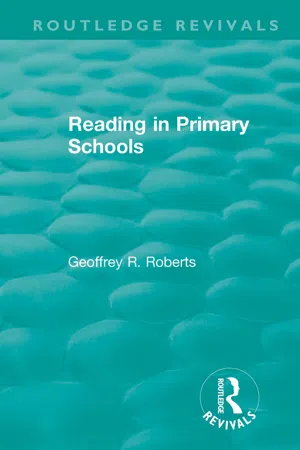
Learning to read and the teaching of reading have long been surrounded with controversy. Originally published in 1969, this book takes the view that the subject is best approached via linguistic theory. The relationship between reading and spoken language is clearly brought out in the author's attempt to define more closely the area in which the teacher has to operate when teaching children to read. His analysis of reading problems in children up to the age of 11 will encourage experienced teachers to question constructively their own beliefs and practices, while the book as a whole provides a valuable introduction to the psychology of reading for the student of education.
- 118 pages
- English
- ePUB (mobile friendly)
- Available on iOS & Android
eBook - ePub
Reading in Primary Schools
About this book
Information
1
Introduction
Most of the books that have been written about reading and learning to read have not attempted to describe the complex skill of reading as a unified operation. A few books, Stott’s and Diack’s in particular, have attempted to explain what happens when reading takes place, and to draw from this some conclusions about suitable methods of teaching. The main purpose of this book is to re-examine reading and learning to read and their relationship with spoken language, and, out of this study, to attempt to define more clearly the field in which the teacher has to operate when teaching children to read. But there is another purpose of this book: it is to consider the whole range of learning to read for all children in the primary years, up to the age of eleven.
Many people have assumed that once children could read simple prose the task of teaching them to read was finished. Every teacher knows that this is not so, but only a few do anything significant about it. Children are left to their own devices, to stumble as best they can into more efficient reading during the junior school years, and very little is done to help them. We have been reminded of this unsatisfactory state of affairs by Dr Joyce Morris. Yet children’s reading in the junior schools has not been totally neglected. There are many ways in which these children have been helped to improve their reading. The main trouble has been that these ways were frequently too haphazard in their application and did not achieve the desired standards of efficient reading. It is hoped that this book will stimulate further discussion and result in steps being taken to give all junior school children a skilfully prepared programme, which will improve their ability to use their reading skill as an efficient tool for further learning and enjoyment.
The whole content of the book is an attempt to introduce a greater degree of rigour into the teaching of reading. Whenever this is attempted there is a tendency for the more progressive teachers to fear a return to the formality which bedevilled learning in the infant and junior schools until the advent of the more enlightened approaches of recent years. This fear is misplaced as far as this book is concerned. It is not the intention to advocate a return to an older and discredited approach. It is an attempt to see what can be done to help the child, so that he will progress with the greater ease. Indeed, it is hoped that by differentiating in the mind of the teacher the various skills and sub-skills involved in learning to read, it will be possible in practice to integrate the teaching of reading more precisely and more naturally within the wider objectives of the enlightened primary school. If this can be done, then the child will find learning to read a much easier and engrossing task, and he will be better equipped to participate fully in all the exciting activities that are available.
Whilst accepting the fact that greater informality in the classroom has brought great improvements to the education of primary school children, it has, nevertheless, had undesirable effects in some instances. Undoubtedly, the better teachers can use an informal situation to great advantage, but the less able teacher has sometimes been able to masquerade as a progressive teacher, when in fact the children in the class are learning little or nothing. This is something that is very difficult to eradicate. It is no use laying down an exact programme of what should be done, because teachers and classes differ in so many ways. Therefore the only course left is to attempt to examine in great detail what the child needs to do in order to read a text, and then to consider some of the ways in which the child can be helped. If a teacher is prepared to do this, then she is bound to improve her teaching techniques. Her increased awareness of the implications of her actions and her greater understanding of the processes involved in learning to read will enable her to modify her teaching. This will bring both greater depth and greater flexibility to her teaching, and the child will benefit as a result.
2
Skilled reading
It is very important, in any discussion of ways in which children learn to read and of the teaching that is necessary for rapid progress, to have a clear knowledge of what is involved in the actual process of reading. Bartlett’s (1947) approach to the study of skill was to observe first the behaviour in its final form. There seems to be every reason for following his example and to apply this approach to the study of reading and learning to read. If we know what happens when a person reads with skill, then we shall have a clearer notion of how to achieve this desired skill.
TWO MISCONCEPTIONS
However, before examining skilled reading it is necessary to clarify two points which have caused confusion and have led to inaccurate conclusions about the best way to teach reading.
Recognition of words
The first point concerns the statement frequently made that skilled readers recognize words as wholes, implying that they do not have to examine the word letter by letter. This is so in the case of familiar words, but although skilled readers recognize familiar words at a glance, they recognize unusual or unfamiliar words in a different way. For example, most adults would recognize gentleman, ladies, and stop at a glance, but most adults would not recognize geomorphology, ichthyoid, idiosyncratic, and hugeous at a glance. They would have to take a little time to examine the parts of these words and read off the signals, or information, given by the letters of the word: in some cases individual letters and in some cases strings of letters. Outline shape and length, ascenders and descenders, have little to do with recognition of these unfamiliar words. It is the sounds which can be attached to letters or to strings of letters that indicate what the word sounds like. In the case of familiar words, instant recognition is made possible by means of reduced cues: that is, certain features within the word are noted and the skilled reader’s knowledge of written language is such that he can make certain assumptions about the remaining features. For example, we can recognize a person who is well-known to us by the cut of his hair and the shape of his fore-head, even though the rest of the face is partly obscured (Neisser, 1964); we can distinguish between the rear ends of two different cars even though we can see only a quarter of each car.
The same applies, of course, to the recognition of strings of words, such as once upon a time, good morning, needless to say. When the reader is sufficiently familiar with these strings of words he no longer needs to read off all the signals given by each part of each word.
Later it will be shown that this argument is relevant in the case of young children and, as a consequence, look-and-say should be regarded as a part of the preparatory approach which should be clearly differentiated from word identification and learning to read in the true sense of these phrases. Indeed, where look-and-say persists beyond the necessary preparatory period the children will learn to read by other means, in that they will learn to make correspondences between letters and sounds for themselves. Later, when they have learned the fundamental skills of reading, then look-and-say techniques can be used to achieve a quicker easier rate of reading.
Processing the perceptual input
The second point of possible confusion concerns what is loosely termed perception. It is frequently assumed that seeing the letters of a word, or the words of a sentence, is all that is involved in word recognition. This is an oversimplification. The facts are that in reading the reader sees shapes and he proceeds to interpret these shapes by giving them some auditory significance, so that what has actually happened is something more than merely seeing or perceiving. The reader has associated something from his previous experience—in this case letter sounds—with the abstract letter shapes before him. Hence, to think of letter, word, phrase or sentence recognition as a single act of perception is misleading. A process more accurately described as apperception has taken place, in which the various parts or cues were interpreted; and, like all acts of interpretation, the responses to cues are in some measure subjective.
For example, the word tip would be recognized by a reader. It is the dot above the vertical line and its relationship with t and p rather than its exact height which helps recognition of the i. What is seen is interpreted and the result is the word tip. This is how children manage to read their own irregular writing. Backward children frequently have to use this processing procedure when reading what they have written!
This is merely another way of stating that interpretation of perceptual input is distinct from the perception itself. What is seen is interpreted in such a way that it complies with the constraints or rules of language. There is no such word as tip, but there is a word tip.
To carry this point a bit further: if the sentence I should love to see Paris in the the Spring was placed in a meaningful paragraph and the reader asked to read the passage as quickly as possible, it is doubtful whether he would notice the repetition of the word the even though we can reasonably assume that he has seen the the. The reader is using his knowledge of language to interpret what he sees.
In a similar way, this process, involving apperception, also occurs when a person reads a passage and interprets the meaning of several sentences. This can be discovered by quickly reading aloud once the following passage and attempting to reproduce what has been read:
As we have already reported, after the rioting of the past weeks, the atmosphere in Hong Kong is now more relaxed in spite of the continued discovery of home-made bombs. Four such bombs were found today and were detonated by police experts.
It is a fair assumption that, although the reader could not reproduce the exact wording and syntax of the passage, he could reproduce the sense.
This has a very important implication. It means that strings of words are retained in the immediate memory store until their sense is revealed. Then the sense is stored so that the immediate memory store is cleared and the reader can take in the next string of words. Some strings, e.g. As we have already reported, may be rejected because they contribute little to the meaning of the passage. It follows from this that the texts of children’s reading books must consist of connected prose, the meaning of which develops in a sequential manner so that children can extract and retain the sense of the text without having to remember all the individual words. If the texts are not constructed in this manner, and the child has to read a series of statements only loosely connected with each other, the burden on his memory would be too great: too many separate entities would have to be remembered without developing into any form of connected sense.
One of the finest examples of a story which develops and yet employs severe semantic constraints is ‘Bullawong’ by Jenny Taylor and Terry Ingleby (My Yellow Book) and reproduced in the Young Puffin, Time for a Story edited by E. Colwell. It is a useful and revealing exercise to compare this story with the stories in such popular reading sets as the Key Words, Happy Venture, and Janet and John Series.
SKILLED READING
Having clarified two points of confusion, it is now possible to consider the process of reading as a whole, beginning with skilled reading.
There are three major factors that should have a profound effect upon the approach to the teaching of reading that is adopted.
Reading is skilled behaviour
The first of these is that reading is skilled behaviour performed in order to obtain information of one kind or another. It can occur at five levels at least—the paragraph, the sentence, the word, the letter string and the letter—and the type of information obtained depends upon the level. Letters convey information about sounds, and this leads on to words, which convey information contributing to meaning, and so on. Therefore, although a reader begins a passage uncertain of any of the information it contains, he reduces this uncertainty, level by level, as he proceeds. The position and order of letters, the juxtaposition of words, the formation of the phrases and the sentences, and the part they play within the paragraph or story—these cover the phonic, syntactic and semantic aspects of language; it is the task of the reader to interpret them in a way which brings meaning to the text. All this is part of the processing of the perceptual input and it emphasizes the importance of a text that flows and develops.
Reading is a linguistic process
The second major factor is that reading is a linguistic process and as such reflects the constraints of language. That is, there is an imposed order at all levels. For example, there are constraints on the consonants which could follow an initial t : h, r, w, (and s if we include the word tsetse). There are constraints on the word that could follow constraints at the beginning of this sentence. It could be only one of a very limited number of words. There are constraints on the meaning of the phrase which could follow the opening phrase, I went to the shops . . . the more so if this sentence is to be part of a wider passage.
This means that, by familiarity with the constraints of language, the reader can anticipate within certain clearly defined limits what is likely to follow at any of the five levels that I have mentioned. Without this order or constraint reading would be impossible.
It is the reader’s task to learn to interpret these constraints in terms of the printed text, and to do so he must have experience in manipulating letters within words, words within strings of words or sentences, sentences within paragraphs or stories. A good example of the way in which letters and sounds can be manipulated within words is illustrated by Dr Gattegno in his demonstration of the use of word charts in the film, ‘Words in Colour’. Here it is possible to see a very able teacher teaching children how to manipulate letters and their sounds and in the process interpret them.
Reading and the critical units of language
The final factor concerning skilled reading that should be mentioned is connected with word identification, and it is really a continuation of the last point. In the past there have been several assumptions made about the critical unit of language for the reading process. First the letter was regarded as the proper unit, so the alphabetic method developed; this was followed by the sound of individual letters being considered as the proper unit, so there emerged the early phonic methods; later, the word was regarded by many as the proper unit and the word method or look-and-say became popular; and finally, out of all this, there has begun to evolve a far more sophisticated approach which recognizes the unity of the word but realizes the functions of the letter-sound relationships which constitute each word. Daniels and Diack began this trend and many are beginning to follow.
But we have not yet achieved, by any means, a full working knowledge of how the complete skill of reading is acquired. Recent investigations by Eleanor Gibson and her colleagues indicate that the principal factor in the identification of words is provided by the constraints on letter sequences. They suggest that the critical unit of language in the reading process is not the letter or individua...
Table of contents
- Cover
- Half Title
- Title Page
- Copyright Page
- Original Title Page
- Original Copyright Page
- Dedication
- Table of Contents
- 1 Introduction
- 2 Skilled reading
- 3 Learning to read
- 4 The organization of reading in the classroom
- 5 Reading in the junior school
- 6 Quicker reading in the junior school
- 7 A method to meet the needs of backward readers
- 8 The task of the teacher
- 9 Training students
- 10 Sources of books for children
- Bibliography
Trusted by 375,005 students
Access to over 1.5 million titles for a fair monthly price.
Study more efficiently using our study tools.
Frequently asked questions
Yes, you can cancel anytime from the Subscription tab in your account settings on the Perlego website. Your subscription will stay active until the end of your current billing period. Learn how to cancel your subscription
No, books cannot be downloaded as external files, such as PDFs, for use outside of Perlego. However, you can download books within the Perlego app for offline reading on mobile or tablet. Learn how to download books offline
Perlego offers two plans: Essential and Complete
- Essential is ideal for learners and professionals who enjoy exploring a wide range of subjects. Access the Essential Library with 800,000+ trusted titles and best-sellers across business, personal growth, and the humanities. Includes unlimited reading time and Standard Read Aloud voice.
- Complete: Perfect for advanced learners and researchers needing full, unrestricted access. Unlock 1.5M+ books across hundreds of subjects, including academic and specialized titles. The Complete Plan also includes advanced features like Premium Read Aloud and Research Assistant.
We are an online textbook subscription service, where you can get access to an entire online library for less than the price of a single book per month. With over 1.5 million books across 990+ topics, we’ve got you covered! Learn about our mission
Look out for the read-aloud symbol on your next book to see if you can listen to it. The read-aloud tool reads text aloud for you, highlighting the text as it is being read. You can pause it, speed it up and slow it down. Learn more about Read Aloud
Yes! You can use the Perlego app on both iOS and Android devices to read anytime, anywhere — even offline. Perfect for commutes or when you’re on the go.
Please note we cannot support devices running on iOS 13 and Android 7 or earlier. Learn more about using the app
Please note we cannot support devices running on iOS 13 and Android 7 or earlier. Learn more about using the app
Yes, you can access Reading in Primary Schools by Geoffrey R. Roberts in PDF and/or ePUB format, as well as other popular books in Education & Education General. We have over 1.5 million books available in our catalogue for you to explore.