Plant Pathogens
eBook - ePub

Plant Pathogens

Detection and Management for Sustainable Agriculture

  1. 344 pages
  2. English
  3. ePUB (mobile friendly)
  4. Available on iOS & Android
eBook - ePub

About this book

Addressing the most critical issues in the management of emerging diseases throughout the world, experts in plant pathology from internationally renowned institutes share their research and examine key literature. They look at both traditional pathology and advanced biotechnological and molecular diagnosis, and integrated management practices.

This book is divided into four parts, covering viral and fungal disease detection and management, nematode diseases and management, bio-control, and biotechnological approaches and impact of climate change. The authors look at the challenges of crop protection against diseases caused by plant pathogens for the most economically important crops. The establishment and management of plant diseases using conventional and eco-friendly methods are discussed with an emphasis on the use of beneficial microbes and modern biotechnological approaches.

Frequently asked questions

Yes, you can cancel anytime from the Subscription tab in your account settings on the Perlego website. Your subscription will stay active until the end of your current billing period. Learn how to cancel your subscription.
No, books cannot be downloaded as external files, such as PDFs, for use outside of Perlego. However, you can download books within the Perlego app for offline reading on mobile or tablet. Learn more here.
Perlego offers two plans: Essential and Complete
  • Essential is ideal for learners and professionals who enjoy exploring a wide range of subjects. Access the Essential Library with 800,000+ trusted titles and best-sellers across business, personal growth, and the humanities. Includes unlimited reading time and Standard Read Aloud voice.
  • Complete: Perfect for advanced learners and researchers needing full, unrestricted access. Unlock 1.4M+ books across hundreds of subjects, including academic and specialized titles. The Complete Plan also includes advanced features like Premium Read Aloud and Research Assistant.
Both plans are available with monthly, semester, or annual billing cycles.
We are an online textbook subscription service, where you can get access to an entire online library for less than the price of a single book per month. With over 1 million books across 1000+ topics, we’ve got you covered! Learn more here.
Look out for the read-aloud symbol on your next book to see if you can listen to it. The read-aloud tool reads text aloud for you, highlighting the text as it is being read. You can pause it, speed it up and slow it down. Learn more here.
Yes! You can use the Perlego app on both iOS or Android devices to read anytime, anywhere — even offline. Perfect for commutes or when you’re on the go.
Please note we cannot support devices running on iOS 13 and Android 7 or earlier. Learn more about using the app.
Yes, you can access Plant Pathogens by Pradeep Kumar, Ajay K. Tiwari, Madhu Kamle, Zafar Abbas, Priyanka Singh, Pradeep Kumar,Ajay K. Tiwari,Madhu Kamle,Zafar Abbas,Priyanka Singh in PDF and/or ePUB format, as well as other popular books in Biological Sciences & Agriculture. We have over one million books available in our catalogue for you to explore.

Information

PART I
Viral and Fungal Disease and Management

CHAPTER 1

Viral Diseases of Okra in Ghana and Their Management

ELVIS ASARE-BEDIAKO*
Department of Crop Science, University of Cape Coast, Cape Coast, Ghana
*Corresponding author. E-mail: [email protected]

Abstract

Viral diseases are major biotic factors that affect productivity of okra (Abelmoschus esculentus L. Moench) worldwide. Okra mosaic disease (OMD) caused by Okra mosaic virus (OkMV; genus Tymovirus; family Tymoviridae) and Okra leaf curl disease (OLCD) caused by a complex of begomoviruses: Cotton leaf curl Gezira virus (CLCuGV]), Okra yellow crinkle virus (OYCrV), Hollyhock leaf crumple virus (HoLCrV), and Okra leaf curl virus (OLCV) are the major viral diseases of okra in West Africa including Ghana. OLCD and OMD are commonly observed among okra crops in Ghana, with disease incidence of up to 100% depending on the okra cultivar and stage of growth. Management of OLCD and OMD involves the use of both synthetic and phytopesticides against the Bemisia tabaci and Podagrica spp. vectors, respectively, as well as the use of compost and fertilizers to ensure healthy growth of plant and to improve the tolerance of plants against viral infection. Resistance and tolerant okra genotypes have so been identified and their integration with phytopesticides and judicious use of chemical pesticides is recommended for effective management of these viral diseases.

1.1 Background

Okra (Abelmoschus esculentus L. Moench) is a member of the family Malvaceae and a native to West and Central Africa but is now widely grown throughout the tropics (Kochhar, 1986; Schippers, 2000). The world production of common okra as fresh vegetable is estimated at 1.7 million tons year−1 (Schippers, 2000; Asare-Bediako et al., 2014). Ghana is the eighth largest producer of okra in the world (FAOSTAT, 2014).
Okra crop is the third most important vegetable in Ghana after pepper and tomato, with production of 80,000 tons estimated at $51, 189,000 USD (FAOSTAT, 2011; 2013).
It can be grown anywhere in Ghana but the major producing centers are Brong Ahafo, Ashanti, Northern, Volta, Greater Accra, and Central regions (NARP, 1993). Okra production provides livelihood, employment, and income to rural smallholder farmers and retailers in urban centers. Okra is an important fruit vegetable crop in Ghana, and a source of energy for human consumption (Babatunde, 2007). The crop is a rich source of protein, fat, carbohydrate, fiber, thiamine, riboflavin, nicotinamide, and ascorbic acid (Hamon, 1988; Schippers, 2000; Babatunde, 2007). It also contains significant amount of potassium, magnesium, calcium, and iron (Hamon and Charrier, 1997). Okra is a multipurpose fruit vegetable due to its diverse uses of the fruits (pods), fresh leaves, buds, flowers, stems, and seeds (Mihretu et al., 2014). Immature okra fruits and fresh leaves are usually consumed as vegetables while the dried fruits are ground into powder and used in stews and soups (Siemonsma, 1982a). Okra seeds can be used as substitutes or additives in feed preparation (Purseglove, 1974), in the preparation of okra seed meal (Martin and Roberts, 1990), in the confectionery industry (Adetuyi et al., 2011), and in blood plasma replacement or blood volume expander.
In spite of the significant contribution (75%) of the West and Central African region including Ghana to okra production in Africa, average productivity in the region (2.5 t ha−1) is far below that of East (6.2 t ha−1) and North Africa (8.2 t ha−1) (FAOSTAT, 2008). In Ghana, yield potential of up to 3.0 t ha−1 has been reported for Okra (MoFA,...
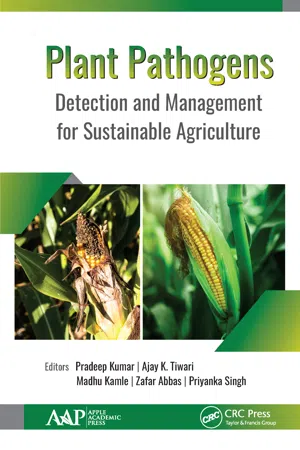
Table of contents

  1. Cover
  2. Half Title
  3. Title Page
  4. Copyright Page
  5. About the Editors
  6. Table of Contents
  7. Contributors
  8. Abbreviations
  9. Preface
  10. PART I: Viral and Fungal Disease and Management
  11. PART II: Nematode Diseases and Management
  12. PART III: Biocontrol
  13. PART IV: Biotechnological Approaches and the Impact of Climate Change
  14. Color insert of illustrations
  15. Index