- 248 pages
- English
- ePUB (mobile friendly)
- Available on iOS & Android
eBook - ePub
Science Foundations: Physics
About this book
This title was first published in 2001. The new edition of Science Foundations provides comprehensive coverage of single- and double-award GCSE science. It is fully revised and updated to match the new GCSE specifications, for teaching from September 2001. It contains all the material required for the foundation and higher tiers, with clear progression and explicit differentiation. 'Higher tier only' material is clearly marked in separate spreads. The language level is carefully controlled, with illustrations and layout specifically designed to make the concepts accessible. There are frequent opportunities for students to confirm their understanding of each key idea as it is introduced, via short questions and summary passages on each spread. The books include guidance for students on how to prepare for and answer their GCSE examinations, and a glossary of key words for ease of reference.
Information
Waves and radiation
KS3A Ideas you need from Key Stage 3
Reflection and refraction
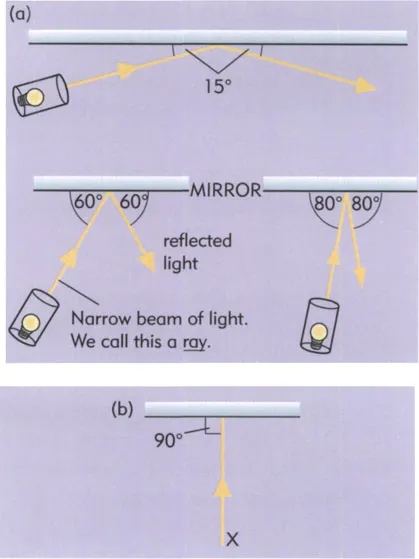
■ How light is reflected
A mirror that is flat is called a plane mirror.
The diagrams show how a plane mirror reflects light.
Look at the angle with the mirror:
■ of the beam of light that comes from the lamp
■ of the beam of light after it is reflected.
1 Copy the following headings.
Then complete the table.
Angle of beam going towards mirror | Angle of beam reflected from mirror |
15° | |
60° | |
80° |
Light is reflected from a plane mirror at the same angle as it strikes the mirror.
2 Ray X is going straight towards a mirror.
At what angle will it be reflected from the mirror?
Give a reason for your answer.
■ How light is refracted
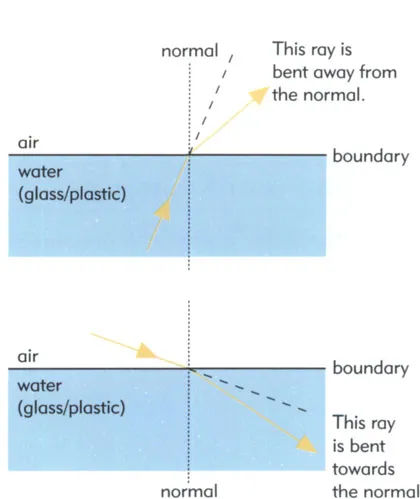
Light can be refracted when it passes from one substance into another.
The diagrams show you more about the way light is refracted.
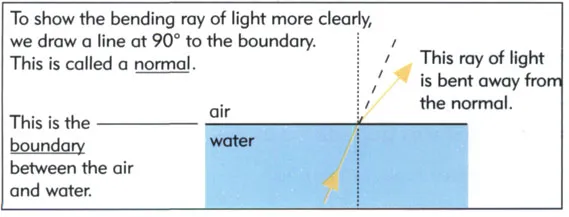
3 Copy the table. Then complete it.
Where the ray of light travels | What happens to the ray of light |
from water into air | refracted ____________ the normal |
from air into water | refracted ____________ the normal |
■ Rays that aren’t refracted
The diagrams show what happens to rays of light when they strike a boundary head-on at 90° (along a normal).
4 Copy and complete the following sentences.
A ray of light travelling along a normal strikes a boundary at ____________ degrees.
When it crosses the boundary, the ray of light carries on travelling in the same ____________.
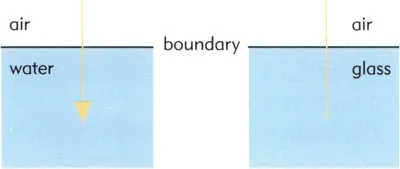
These rays of light strike the boundary at 90°. They do not change direction.
■ How sound is reflected
It isn’t only light that can be reflected.
You can also reflect sounds.
5 Look at the diagram.
Copy and complete the following sentences.
Light reflects well from a ____________, ____________ surface.
Sound reflects well from a ____________, ____________ surface.
When a sound strikes a hard, flat surface at a certain angle, it reflects at the ____________ angle.
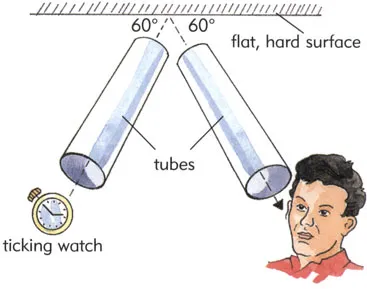
The ticks sound loudest when the tubes are at the same angle to the surface.
■ How sound is refracted
Sound can also be bent or refracted. just like light. This happens when sound travels across the boundary between two different substances.
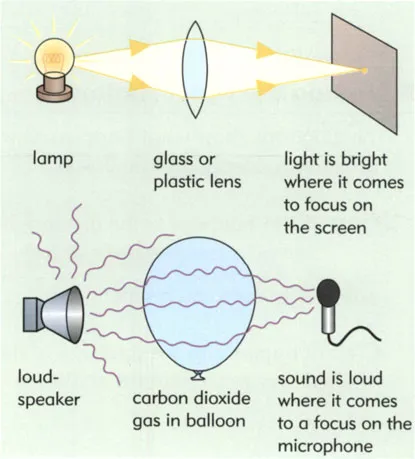
6 Look at the diagrams.
Then copy and complete the following sentences.
Light is ____________ as it passes into and out of the glass or plastic ____________.
This brings the light to a ____________ on the screen.
Sound is ____________ as it passes into and out of the ____________ ____________ gas in the balloon.
This brings the sound to a ____________ on the microphone.
Waves and radiation
1
Why do people say that light and sound are waves?
You can see waves on lakes and on the sea.
The wind makes these waves.
But we can look at water waves more easily if we make them in a tank.
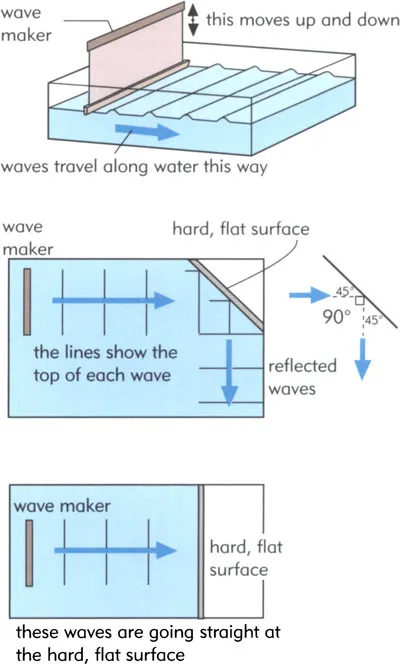
The diagram shows how you can do this.
REMEMBER
A normal is a line at 90° to a boundary.
■ Reflecting water waves
The diagram shows what happens if you send water waves towards a hard, flat surface.
1 Copy and complete the following sentences.
A hard, flat surface ____________ water waves just like a plane mirror reflects ____________.
The water waves are reflected from the surface at the same ____________ as they strike it.
Your friend sends some water waves at 90° to a hard, flat surface.
2 What will happen to these waves after they have hit the surface?
■ Making the water shallower
The diagrams show what happens to water waves when the water suddenly gets shallower.
3 (a) What happens to the distance between the water ...
Table of contents
- Cover
- Title Page
- Copyright Page
- Table of Contents
- ■ How to use this book
- ■ Energy
- ■ Electricity
- ■ Waves and radiation
- ■ Forces
- ■ Handling data
- ■ Revising for tests and examinations
- ■ Physics formulas
- ■ How to write good answers in GCSE Science examinations
- ■ What you need to remember: completed passages
- ■ Glossary/index
Trusted by 375,005 students
Access to over 1.5 million titles for a fair monthly price.
Study more efficiently using our study tools.
Frequently asked questions
Yes, you can cancel anytime from the Subscription tab in your account settings on the Perlego website. Your subscription will stay active until the end of your current billing period. Learn how to cancel your subscription
No, books cannot be downloaded as external files, such as PDFs, for use outside of Perlego. However, you can download books within the Perlego app for offline reading on mobile or tablet. Learn how to download books offline
Perlego offers two plans: Essential and Complete
- Essential is ideal for learners and professionals who enjoy exploring a wide range of subjects. Access the Essential Library with 800,000+ trusted titles and best-sellers across business, personal growth, and the humanities. Includes unlimited reading time and Standard Read Aloud voice.
- Complete: Perfect for advanced learners and researchers needing full, unrestricted access. Unlock 1.5M+ books across hundreds of subjects, including academic and specialized titles. The Complete Plan also includes advanced features like Premium Read Aloud and Research Assistant.
We are an online textbook subscription service, where you can get access to an entire online library for less than the price of a single book per month. With over 1.5 million books across 990+ topics, we’ve got you covered! Learn about our mission
Look out for the read-aloud symbol on your next book to see if you can listen to it. The read-aloud tool reads text aloud for you, highlighting the text as it is being read. You can pause it, speed it up and slow it down. Learn more about Read Aloud
Yes! You can use the Perlego app on both iOS and Android devices to read anytime, anywhere — even offline. Perfect for commutes or when you’re on the go.
Please note we cannot support devices running on iOS 13 and Android 7 or earlier. Learn more about using the app
Please note we cannot support devices running on iOS 13 and Android 7 or earlier. Learn more about using the app
Yes, you can access Science Foundations: Physics by Bryan Milner in PDF and/or ePUB format, as well as other popular books in Social Sciences & Sociology. We have over 1.5 million books available in our catalogue for you to explore.