eBook - ePub
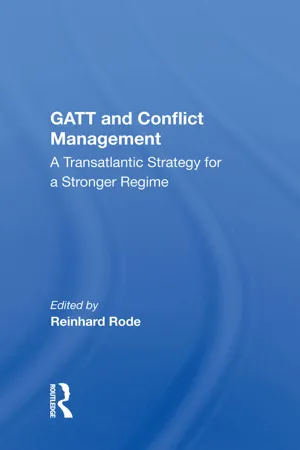
GATT and Conflict Management
A Transatlantic Strategy for a Stronger Regime
- 134 pages
- English
- ePUB (mobile friendly)
- Available on iOS & Android
eBook - ePub
About this book
This book presents the views of an international group of trade experts, who analyses the policies of the United States, Japan, and the European Community vis-a-vis the GATT. It is based on an October 1988 conference on GATT issues held at the Peace Research Institute Frankfurt, Germany.
Information
1
Introduction
Reinhard Rode
The 1960s, and to a lesser degree the 1970s, were generally perceived as a successful period for the General Agreement on Tariffs and Trade (GATT). There is no question that it greatly contributed to the expansion of world trade and hence to peace and prosperity. Not only did it help intra-Western trade recover and stabilize but, by refraining from injecting too high a dose of politics into trade conflicts, it had a favorable impact on the Atlantic alliance, too. As for the 1980s, they have turned out to be a frustrating decade for GATT. Trade questions have become heavily politicized and have generated new and severe conflicts. After tremendous initial progress in tariff reductions, the GATT momentum has slowed down dramatically as the new non-tariff barriers, or NTBs, are proving very difficult to eliminate. But since they are of an extremely complex nature, it can be argued that GATT is a victim of its own earlier success. NTBs are deeply rooted in the domestic structures of the respective contracting parties, thus bringing into stark relief the tensions that arise when international cooperation supplants national interests, i.e., once independent nations have to relinquish some of their sovereignty in economic matters. But since this is a widespread phenomenon, GATT does not stand alone. Compared with the IMF, however, it may suffer more because of its limited character as an international agreement.
The limits of GATT, a remnant of what had been envisioned as something called the International Trade Organization (whose charter was never ratified by the U.S. Congress), were less obvious as long as U.S. leadership remained strong. Looking back, one can say that by and large the period of U.S. hegemony benefited the GATT. American pressure for free trade became weaker the more the United States turned out to be a relative loser in the wake of trade liberalization. The huge trade deficits of the United States in the 1980s bear witness to this. American national trade interests and liberal trade principles no longer automatically coincide. U.S. trade policy has changed. GATT and its logical corollary of multilateral liberalizing trade activities have lost momentum and have become but one strategy—if still the major one—along with two others, unilateral trade nationalism and bilateralism (reciprocity), which are on the rise. No one can be certain at this stage that multilateralism will maintain its position as the number one U.S. trade strategy. Jeffrey Schott addresses this in Chapter 3.
Declining American leadership in GATT, the U.S.-initiated current Uruguay Round notwithstanding, focused attention on the hegemonic stability theory. American scholars like Steven Krasner and Robert Gilpin argue that a system like GATT needs a hegemon, or leader, to guarantee stable cooperation. The Europeans, and probably the Japanese as well, dislike this perspective, perceiving it as a claim for U.S. neohegemony. Institutionalists such as Robert Keohane offer a more sanguine alternative: stable cooperation after hegemony. After Hegemony also happens to be the title of a book by Mr. Keohane.
The basic assumption is that a regime like GATT—with its principle, norms, rules and decision-making procedures—is viable and can prevail without a leader. The advantages flowing from a GATT reorganized along these lines would benefit all participants; they would also help stabilize the system, if only because the sole alternative would be complete trade anarchy, an orgy of bilateralism. And GATT, so the idea, has an embedded strength: it lies in its being able to last only as a multilateral trade agreement. The open question, however, is whether GATT will be capable of developing further and of initiating new liberalization efforts by itself. To be sure, the GATT bureaucracy could do it—the paperwork it generates in terms of proposals is impressive enough. But would such bureaucratic politics prove sufficient? I, for one, doubt it. What I think we need are new initiators of regime development to pursue trade liberalization efforts, to assist the weakened former leader and pick up the flag of the free trade ideal, i.e., GATT's free trade principle.
Who else but the European Community and Japan could perform this task? Unfortunately, neither has volunteered so far. The European Community has turned sharply inward, seemingly preoccupied with the overriding idea of bringing about its single market. Outsiders fear the emergence of a "Fortress Europe." As for Japan, it just keeps on smiling and relentlessly goes on exporting (while importing only reluctantly) and thus does not seem ready to assume the role of promoter of liberal trade practices. Since neither the United States nor the European Community nor Japan seem ready, willing or capable to take up that role individually, why don't they assume it jointly? For quite some time, the Trilateral Commission fostered the idea of such a triumvirate to steer GATT around the treacherous shoals of bilateralism toward the more rewarding shores of multilateralism. But the enthusiasm generated during the meetings of this trilateral elite was never contagious enough to sway the governments of the three trading blocs, which seemed intent on pursuing their bilateral quarrels within GATT and, in my view, even more so outside of it. Such behavior was not made to inject any new strength into the flagging GATT regime; it only precipitated its neglect.
There exist no other potential initiators. Newly industrializing countries, or NICs, behave in a development-oriented way, stressing the infant-industry argument for trade. They are not strong enough and their narrow national trade interests put them at odds with the principle of free trade. As to poor countries, they ask for more preferential treatment and are divorced from the liberal trade principle. Some countries with centrally planned economies would like to subscribe to the GATT. The Soviet Union, for example, is about to join it. But such countries are small traders par excellence and do not share the liberal trade ideal at all. Most likely, their rationale for seeking participation in GATT's affairs is to obtain some sort of preferential treatment, too. Of course, their socialist pride does not allow them to say so openly. More influence for any of these groups might push GATT in the direction of UNCTAD, making it like the latter a forum for Third World demands, not for a liberal trade order. Thus one major problem GATT may face is that of an "overload," inevitable result of its global aspirations. I would put it this way: the global integration function suffers when the attractiveness of the liberal trade principle fades, and the attractiveness of this principle fades if the large traders cease to act as role models.
Pressure on the liberal trade principle has come not only from developing countries and from those with centrally planned economies, which do not adhere to this principle, but increasingly, too, from the large traders with their tradition of liberal trading practices. The United States has already been mentioned; as for the European Community, its upcoming single market is clearly aimed at achieving regional goals at the expense of global liberal trade principles. The third player and world export champion, Japan, has not actually converted to trade liberalism and has proven very slow in altering its highly successful export-oriented growth strategy. This may undermine the principle of liberal trade in a dual way. First, Japan's economic decision makers will not use the liberal trade philosophy as their guide, for they merely pay occasional lip service to trade liberalism, more, I think, as a consequence of external pressure and expectations than of changing convictions—Hiroshi Kitamura expounds on this in Chapter 4. Second, the Japanese example of success by means of an explicitly restrictive trade strategy based on economic nationalism was instrumental in causing the economic elites of other countries to question their longstanding belief in the liberal trade principle. Thus my fear that this principle has entered a period of heavy turbulence, fraught with grave danger, as the most successful trader remains seemingly reluctant to subscribe to it.
A structural change in protectionism also places additional stress on the liberal trade principle. The former pattern was more or less to place agriculture and declining industries under a national protectionist wing and to permit relatively free trade for the modern industrial sector, based on the motto "The more advanced products and technologies, the freer their trade." Competing industrial policies and a general trend to ward high-tech protectionism may change this. World trade is likely to become less free, as the dual pressures of traditional and high-tech protectionism grow heavier. This trend toward changing the rules of the game, i.e., making organized trade the rule and free trade the exception, bodes ill for the future of the latter.
These dark clouds gathering over the horizon of free trade demonstrate how vital it is to inject new strength into the liberal trade principle, as the sine qua non for a revival of the GATT regime. With the United States, GATT's former undisputed leader, turning out to be a loser at the game of free trade, the European Community turning increasingly inward, and Japan proving slow to adapt to the liberal trade principle, it can definitely be said that the regime is in deep trouble. While it will no doubt survive for lack of any credible alternatives, it can be expected to sink gradually into relative irrelevance. The views of a Colbert, List or Kitamura rather than those of a Smith or Ricardo would then be its lowest common denominator.
Thus GATT might just evolve into a mere bargaining platform tor the organization of world trade, assuming the role of a broker for "orderly marketing agreements." The only real alternative I can foresee is that of a continuing institutional belief in the prevailing regime, coupled with the hope that a liberal trilateral or bilateral transatlantic leadership will eventually come to pass. This optimistic scenario posits that the three (or at least two) giant trade partners constitute more than the mere sum of egocentric actors, that they play a positive leadership role collectively. The ability to play a responsible global role and to overcome narrow national interests finds strong backing in fairly recent history. The beggar-thy-neighbor policies of the 1930s and their economically and politically catastrophic consequences are a case in point and should act as a powerful deterrent. But how long this consensual transatlantic interpretation of the past will last (and how strong its global impact will be) remains to be seen.
The concept of the GATT regime and of a trilateral (or bilateral) leadership of liberal traders reinforcing each other is a highly optimistic vision. A trilateral or bilateral transatlantic management, which would use the GATT framework as a means of promoting the common Western liberal trade principle, would certainly appear to constitute a desirable and reasonable alternative. But it is not at all self-evident or automatic. Whether a responsible joint leadership takes over very soon, or only after some future economic disaster brought about by competing mercantilisms has given the necessary impetus, therefore, is a question that should provide trade analysts with a fascinating field of study for the rest of the millennium. A comparative perspective for the GATT regime, by means of policy analyses for various countries by scholars and experts from different disciplines (economics, political science and international law) and with a practical background, may help develop prospects and strategies for strengthening a regime which most of us consider worth encouraging to prevail and function as efficiently as possible.
2
The GATT Regime: Issues and Prospects
Gerard Curzon and Victoria Curzon Price
The Uruguay Round of trade negotiations, launched at Punta del Este, Uruguay, in September 1986, underwent a midterm review in Montreal, Canada, in December 1988. The tough period still lies ahead. People who take an interest in these matters are either academic observers or practicing diplomats. For the former, the issues appear to be simple, for the latter, they are of an unbelievable complexity, requiring for their solution all the subtle skills of their trade: pragmatism, reasonable behavior, compromise.
It is clear to which camp we belong. And within that camp, we are not among those who believe that the exceptions to the GATT system should be condoned on grounds of expediency. The international trade system may be in crisis, GATT may be honored more in the breach than in the observance, but it is essential to bear in mind what constitutes a viable international trade order. The principles upon which a "good" international trade system should be run are not even very difficult to live up to: more trade is usually better than less trade, multilateralism is to be preferred to bilateralism, the balance of trade should be a matter of macroeconomic management, not of trade policy. There is not much more to it than that. In fact, if countries could live up to just one principle, the one enshrined in GATT's Article I—the most-favored-nation clause—then we would have no preferential arrangements, no Multifibre Arrangement, no Voluntary Export Restraints (VERs), no Orderly Marketing Arrangements (OMAs), no bilateral semi-conductor agreement between the United States and Japan—in fact, none of the exciting things that the international trade system offers us for analysis.
Clearly, the academic view of the world trade system as it should be differs quite dramatically from the world trade system as it actually is. This raises the interesting question of why governments pay lip service to GATT and freer trade, but often end up acting differently—a worthy subject of analysis in itself, which has found an intellectually satisfactory answer in the theory of public choice.
And it is because we now understand why democracies, via the lobbying process, generate a certain "supply" of protection to respond to constant demands for it, that we have to approach the future of the GATT system with our eyes open. It is no longer enough to exhort countries to conduct themselves better and explain the merits of nondiscriminatory trade, open markets and competition. We have to imagine ways of building a political constituency for freer trade and we have to examine the use of power to achieve this objective.
This chapter will present what I consider to be a series of potential dangers and obstacles on the road to a successful conclusion of the Uruguay Round. It makes no attempt to be comprehensive, for the important and potentially lethal (for the Uruguay Round) issue of agriculture will not be discussed. The material is organized under three headings: the changing attitude of the United States toward the GATT; the implications of the post-1992 single European market for GATT and the Uruguay Round; and the future of multilateralism.
Changing Attitude of the United States to the Multilateral Trade System
Section 301 Investigations
Until the early 1980s GATT was the principal vehicle through which the United States conducted its trade policy. It initiated all the "GATT Rounds," made sure that the European Economic Community gave it, and others, proper compensation for the use of Article XXIV, and generally supported the universal, multilateral philosophy behind the Treaty, which it had largely inspired and brought into being in 1947. In particular, the United States was content with making sure that the EC and Japan played an active part in the various rounds, and let large numbers of developing countries, and some small developed countries, enjoy relatively free access to the U.S. market without asking for or obtaining any dismantling of protection on their part.
This rather lofty attitude has changed. The United States now wants to have access to other countries' markets on the same terms as it offers to imports coming into the United States. This is known as "fair" trade and has involved the United States in a large number of arm-twisting bilateral negotiations with a long list of countries, based on Section 301 of the 1974 Trade Act. This, as is well known, provides for the introduction of unilateral measures by the United States against other countries' unfair trade practices. Since 1985 the threat of such sanctions has been used 26 times by the Reagan administration to try to extract trade concessions from ten different trade partners on a bilateral and unrequited basis. Only three times did the United States actually introduce sanctions: unilateral concessions were obtained in most cases.
These negotiations may have had a positive effect on the multilateral trade system, insofar as the United States uses its powers of persuasion to open up previously closed markets multilaterally. However, there are many dangers to the multilateral trade system in these strong-arm tactics. It goes too much against the grain, politically, for countries which are singled out for threatened Section 301 retaliation to offer the whole world the concessions extracted by the United States. They will do all they can to find concessions not covered by GATT, or inherently ambiguous, for instance in the field of non-tariff barriers, in order to target their change of policy at the United States alone. And in any case, the legality of the U.S. sanctions themselves, in the event of the negotiations being unsuccessful, is extremely doubtful.
For instance, as a result of a U.S.-initiated 301 negotiation, Japan agreed to liberalize its cigarette imports in 1986. The purpose was to improve access to the large and very lucrative Japanese market for U.S.-type cigarettes. The Japanese tariff concession was certainly on an erga omnes basis, but further promises to ease the certification and distribution procedure would be possible to target in a discriminatory manner in favour of the U.S. After all, one can see why Japan would make every effort to reduce the scope of the concession to prevent EC cigarette producers from getting a "free ride" out of it. Especially as the United States, under 301 negotiations, offers no concessions, just the promise not to introduce retaliatory trade measures against the "unfair" trade practice; and of course, the EC offers no concessions either.
The "tin-opener" effect of 301 actions (and now "Super 301" actions under the new trade legislation) is bound to have an effe...
Table of contents
- Cover
- Half Title
- Title
- Copyright
- Contents
- Preface
- 1 Introduction
- 2 The GATT Regime: Issues and Prospects
- 3 U.S. Policies Toward the GATT: Past, Present, Prospective
- 4 Japan in the GATT
- 5 EC and GATT: A European Proposal for Strengthening the GATT Dispute Settlement Procedures
- 6 Prospects for the Uruguay Round: The Declaration of Punta del Este
- 7 GATT: Revival or Decay? A Plea for a New Transatlantic Leadership Effort
- About the Editor and Contributors
Trusted by 375,005 students
Access to over 1.5 million titles for a fair monthly price.
Study more efficiently using our study tools.
Frequently asked questions
Yes, you can cancel anytime from the Subscription tab in your account settings on the Perlego website. Your subscription will stay active until the end of your current billing period. Learn how to cancel your subscription
No, books cannot be downloaded as external files, such as PDFs, for use outside of Perlego. However, you can download books within the Perlego app for offline reading on mobile or tablet. Learn how to download books offline
We are an online textbook subscription service, where you can get access to an entire online library for less than the price of a single book per month. With over 1.5 million books across 990+ topics, we’ve got you covered! Learn about our mission
Look out for the read-aloud symbol on your next book to see if you can listen to it. The read-aloud tool reads text aloud for you, highlighting the text as it is being read. You can pause it, speed it up and slow it down. Learn more about Read Aloud
Yes! You can use the Perlego app on both iOS and Android devices to read anytime, anywhere — even offline. Perfect for commutes or when you’re on the go.
Please note we cannot support devices running on iOS 13 and Android 7 or earlier. Learn more about using the app
Please note we cannot support devices running on iOS 13 and Android 7 or earlier. Learn more about using the app
Yes, you can access GATT and Conflict Management by Reinhard Rode in PDF and/or ePUB format, as well as other popular books in Politics & International Relations & Politics. We have over 1.5 million books available in our catalogue for you to explore.