eBook - ePub
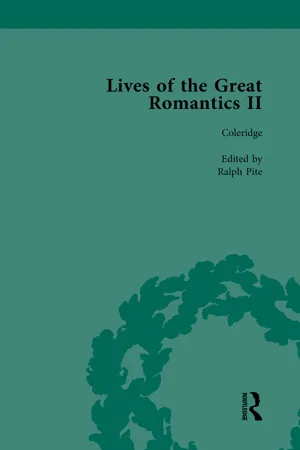
Lives of the Great Romantics, Part II, Volume 2
- 444 pages
- English
- ePUB (mobile friendly)
- Available on iOS & Android
eBook - ePub
Lives of the Great Romantics, Part II, Volume 2
About this book
In this second collection of biographical accounts of Romantic writers, the characters of Keats, Coleridge and Scott are recalled by their contemporaries, offering insights into their lives and writings, as well as into the art of 19th-century biography.
Information
[Thomas Love Peacock], Melincourt, 3 vols (London, 1817) Vol. III: pp. 32–43
In April 1816, Coleridge became a permanent resident in Highgate, the guest and patient of Dr James Gillman. The move was another attempt to escape the ‘detested Poison’ of opium (Griggs, IV, p. 628) and though not completely successful, it did bring his intake under better control. From Highgate, Coleridge continued the energetic programme of writing and publishing on which he had been working for the previous few months. His pamphlet of poems – Christabel: Kubla Khan, A Vision; The Pains of Sleep (London: John Murray, 1816) – was published in May and reprinted twice by June; the first of the ‘Lay Sermons’, The Statesman’s Manual, appeared in December, the second, A Lay Sermon, in March 1817. They were followed by Biographia Liter aria and Sibylline Leaves (both 1817). In the same year, his play Remorse was revived and his ‘dramatic poem’ Zapolya published. This astonishing, concerted effort on Coleridge’s part was completed by his republishing The Friend in a three-volume edition in November 1818.
Before 1816, Coleridge’s most recently published books were a reprint of his Poems in 1803, a reprint of The Friend in 1812 and copies of Remorse in 1813. Though still a bankable (if unreliable) lecturer, Coleridge had made very little impression as a writer for about ten years. His reception when he began to publish again was loud and rather violent. William Hazlitt made a point of reviewing everything Coleridge produced and did so with a volatile mixture of outrage, abusiveness and respect. Francis Jeffrey, the powerful editor of the Edinburgh Review, pursued him through its pages by commissioning articles which he then tampered with or added to himself (see Ashton, pp. 296–303, 316–18 and Jackson, I, pp. 295–322).
Thomas Love Peacock (1785–1866) wrote three of his seven novels in the same period, 1816 to 1818. Each of them – Headlong Hall (1816), Melincourt, or Sir Oran Haut-ton (1817) and Nightmare Abbey (1818) – is a satire on contemporary intellectual and political life and each includes a portrait of Coleridge: ‘Mr Panscope’ in Headlong Hall, ‘Mr Flosky’ in Nightmare Abbey and the character presented in this extract from Melincourt: ‘Mr Mystic’ of ‘Cimmerian Lodge’. Each of them speaks a species of incomprehensible and mystified jargon based to a greater or lesser extent on the style of Coleridge’s Lay Sermons. ‘Mr Mystic’ follows Coleridge’s arguments most nearly, as is appropriate in Melincourt, where contemporary, political commentary predominates. Peacock’s other novels are less specific and, in some ways, more genial and dispassionate; there, ‘Mr Flosky’ and ‘Mr Panscope’, though evidently based on Coleridge, draw away from him towards a satire on the academic, theoretical mind in general.
Nonetheless, political hostility to Coleridge underlies all of the novels. Peacock, a friend of Shelley, was a learned, largely self-taught man, who lived off a private income until 1819 (when he joined the East India Office). His own loyalties were liberal, enlightened and anti-religious, so that the Coleridge of 1816 (Tory, Anglican and notoriously difficult to understand) aroused some of his most amused and amusing hostility (see Buder, pp. 13–15). More measured than Hazlitt, more perceptive than the reviewers, Peacock’s versions of Coleridge pinpoint the weaknesses of his arguments. They do so, however, without descending into the personal attacks of Hazlitt or the Edinburgh. T never trespassed on private life, ‘Peacock wrote in a Preface to Melincourt written in 1856, but ‘shadowed’ the ‘opinions and public characters’ of his disputants (quoted Buder, p. 17). His critiques, though not based on personal knowledge, are exact as well as witty. They show in its best light, perhaps, the world of sceptical, advanced opinion which Coleridge was pitting himself against in the second half of his career. And, though not reminiscences themselves, they reveal an image of the man which personal reminiscence aimed either to confirm or refute.
They went steadily on through the dense and heavy air, over waters that slumbered like the Stygian pool; a chorus of frogs, that seemed as much delighted with their own melody, as if they had been an oligarchy of poetical critics, regaling them all the way with the Aristophanic symphony of Brek-ek-ek-ex! ko-ax! ko-ax*! till the boat fixed its keel in the Island of Pure Intelligence; and Mr. Mystic landed his party, as Charon did Æneas and the Sibyl, in a bed of weeds and mud†: after floundering in which for some time, from losing their guide in the fog, they were cheered by the sound of his voice from above, and scrambling up the bank, found themselves on a hard and barren rock; and, still following the sound of Mr. Mystic’s voice, arrived at Cimmerian Lodge.
The fog had penetrated into all the apartments: there was fog in the hall, fog in the parlour, fog on the staircases, fog in the bedrooms;
“The fog was here, the fog was there,The fog was all around.”
It was a little rarefied in the kitchen, by virtue of the enormous fire; so far, at least, that the red face of the cook shone through it, as they passed the kitchen-door, like the disk of the rising moon through the vapours of an autumnal river: but to make amends for this, it was condensed almost into solidity in the library, where the voice of their invisible guide bade them welcome to the adytum of the luminous obscure.
Mr. Mystic now produced what he called his synthetical torch, and requested them to follow him, and look over his grounds. Mr. Fax said it was perfectly useless to attempt it in such a state of the atmosphere; but Mr. Mystic protested it was the only state of the atmosphere in which they could be seen to advantage: as daylight and sunshine utterly destroyed their beauty.
They followed the “darkness visible” of the synthetical torch, which, according to Mr. Mystic, shed around it the rays of transcendental illumination; and he continued to march before them, walking, and talking, and pointing out innumerable images of singularly nubilous beauty, though Mr. Forester and Mr. Fax both declared they could see nothing but the fog and “la pale lueur du magique flambeau:” till Mr. Mystic observing that they were now in a Spontaneity free from Time and Space, and at the point of Absolute Limitation, Mr. Fax said he was very glad to hear it; for in that case they could go no further. Mr. Mystic observed that they must go further; for they were entangled in a maze, from which they would never be able to extricate themselves without his assistance; and he must take the liberty to tell them, that the categories of modality were connected into the idea of absolute necessity, As this was spoken in a high tone, they took it to be meant for a reprimand; which carried the more weight as it was the less understood. At length, after floundering on another half hour, the fog still thicker and thicker, and the torch still dimmer and dimmer, they found themselves once more in Cimmerian Lodge.
Mr. Mystic asked them how they liked his grounds, and they both repeated they had seen nothing of them: on which he flew into a rage, and called them empirical psychologists, and slaves of definition, induction, and analysis, which he intended for terms of abuse, hut which were not taken for such by the persons to whom he addressed them.
Recovering his temper, he observed that it was nearly the hour of dinner; and as they did not think it worth while to be angry with him, they contented themselves with requesting that they might dine in the kitchen, which seemed, to be the only spot on the Island of Pure Intelligence in which there was a glimmer of light.
Mr. Mystic remarked that he thought this very bad taste, but that he should have no objection if the cook would consent; who, he observed, had paramount dominion over that important division of the Island of Pure Intelligence. The cook, with a little murmuring, consented for once to evacuate her citadel as soon as the dinner was on table; entering, however, a protest, that this infringement on her privileges should not be pleaded as a precedent.
Mr. Fax was afraid that Mr. Mystic would treat them as Lord Peter treated his brothers: that he would put nothing on the table, and regale them with a dissertation on the pure idea of absolute substance; but in this he was agreeably disappointed; for the anticipated cognition of a good dinner very soon smoked before them, in the relation of determinate co-existence; and the objective phœnomenon of some superexcellent Madeira quickly put the whole party in perfect good-humour. It appeared, indeed, to have a diffusive quality of occult and mysterious virtue; for, with every glass they drank, the fog grew thin, till by the time they had taken off four bottles among them, it had totally disappeared.
Mr. Mystic now prevailed on them to follow him to the library, where they found a blazing fire and a four-branched gas lamp, shedding a much brighter radiance than that of the synthetical torch. He said he had been obliged to light this lamp, as it seemed they could not see by the usual illumination of Cimmerian Lodge. The brilliancy of the gas lights he much disapproved; but he thought it would be very unbecoming in a transcendental philosopher to employ any other material for a purpose to which smoke was applicable. Mr. Fax said, he should have thought, on the contrary, that ex fumo dare lucem would have been, of all things, the most repugnant to his principles; and Mr. Mystic replied, that it had not struck him so before, but that Mr. Fax’s view of the subject “was exquisitely dusky and fuliginous:” this being his usual mode of expressing approbation, instead of the common phraseology of bright thoughts and luminous ideas, which were equally abhorrent to him both in theory and practice. However, he said, there the light was, for their benefit, and not for his: and as other men’s light was his darkness, he should put on a pair of spectacles of smoked glass, which no one could see through but himself. Having put on his spectacles, he undrew a black curtain, discovered a cylindrical mirror, and placed a sphere before it with great solemnity. “This sphere,” said he, “is an oblong spheroid in the perception of the cylindrical mirror: as long as the mirror thought that the object of his perception was a real external oblong spheroid, he was a mere empirical philosopher; but he has grown wiser since he has been in my library; and by reflecting very deeply on the degree in which the manner of his construction might influence the forms of his perception, has taken a very opaque and tenebricose view of how much of the spheroidical perception belongs to the object, which is the sphere, and how much to the subject, which is himself, in his quality of cylindrical mirror. He has thus discovered the difference between objective and subjective reality: and this point of view is transcendentalism.”
“A very dusky and fuliginous speculation, indeed,” said Mr. Fax, complimenting Mr. Mystic in his own phrase.
Tea and coffee were brought in. “I divide my day,” said Mr. Mystic, “on a new principle: I am always poetical at breakfast, moral at luncheon, metaphysical at dinner, and political at tea. Now you shall know my opinion of the hopes of the world....
Table of contents
- Cover
- Half Title
- Editor
- Title Page
- Copyright Page
- Dedication
- Contents
- Acknowledgements
- Introduction
- Bibliography
- Chronology
- Copy Texts
- 1. Peacock, Thomas Love, Melincourt
- 2. Brown, Thomas, the Elder, Bath
- 3. Lamb, Charles, ‘Christ’s Hospital Five and Thirty Years Ago’
- 4. Hazlitt, William, ‘My First Acquaintance with Poets’.
- 5. Hazlitt, William, ‘Mr Coleridge’
- 6. Hunt, Leigh, Lord Byron and Some of His Contemporaries
- 7. Unsigned, ‘Memoir of Samuel Taylor Coleridge’
- 8. Heraud, John A., An Oration on the Death of Samuel Taylor Coleridge.
- 9. Le Grice, C, ‘College Reminiscences of Mr. Coleridge’
- 10. De Quincey, Thomas, ‘Samuel Taylor Coleridge by The English Opium-Eater’
- 11. Specimens of the Table Talk of the Late Samuel Taylor Coleridge
- 12. Allsop, Thomas, Letters Conversations and Recollections of S. T. Coleridge
- 13. Carlyon, Clement, Early Years and Late Reflections
- 14. Cottle, Joseph, Early Recollections
- 15. Gillman, James, The Life of Samuel Taylor Coleridge
- 16. Coleridge, Samuel Taylor, Biographia Literaria, second edition
- 17. Cottle, Joseph, Reminiscences of Samuel Taylor Coleridge
- 18. Talfourd, Thomas Noon, Final Memorials of Charles Lamb
- 19. Southey, Charles Cuthbert, The Life and Correspondence of Robert Southey
- 20. Wordsworth, William, The Prelude
- 21. Wordsworth, Christopher, Memoirs of Wordsworth
- 22. Carlyle,Thomas, Life of John Sterling
- 23. Warter, John Wood, Selections from the Letters of Robert Southey
- 24. Emerson, R. W., English Traits
- 25. Davy, John, Fragmentary Remains
- 26. Grattan, Thomas Colley, Beaten Paths
- 27. Cornwall, Barry, Charles Lamb
- 28. Jerdan, William, Men I Have Known
- 29. Crabb Robinson, Henry, Diary
- 30. Meteyard, Eliza, A Group of Englishmen
- 31. Young, Julian Charles, A Memoir of Charles Mayne Young
- 32. Wordsworth, Dorothy, Recollections of a Tour made in Scotland
- Notes
Trusted by 375,005 students
Access to over 1.5 million titles for a fair monthly price.
Study more efficiently using our study tools.
Frequently asked questions
Yes, you can cancel anytime from the Subscription tab in your account settings on the Perlego website. Your subscription will stay active until the end of your current billing period. Learn how to cancel your subscription
No, books cannot be downloaded as external files, such as PDFs, for use outside of Perlego. However, you can download books within the Perlego app for offline reading on mobile or tablet. Learn how to download books offline
Perlego offers two plans: Essential and Complete
- Essential is ideal for learners and professionals who enjoy exploring a wide range of subjects. Access the Essential Library with 800,000+ trusted titles and best-sellers across business, personal growth, and the humanities. Includes unlimited reading time and Standard Read Aloud voice.
- Complete: Perfect for advanced learners and researchers needing full, unrestricted access. Unlock 1.5M+ books across hundreds of subjects, including academic and specialized titles. The Complete Plan also includes advanced features like Premium Read Aloud and Research Assistant.
We are an online textbook subscription service, where you can get access to an entire online library for less than the price of a single book per month. With over 1.5 million books across 990+ topics, we’ve got you covered! Learn about our mission
Look out for the read-aloud symbol on your next book to see if you can listen to it. The read-aloud tool reads text aloud for you, highlighting the text as it is being read. You can pause it, speed it up and slow it down. Learn more about Read Aloud
Yes! You can use the Perlego app on both iOS and Android devices to read anytime, anywhere — even offline. Perfect for commutes or when you’re on the go.
Please note we cannot support devices running on iOS 13 and Android 7 or earlier. Learn more about using the app
Please note we cannot support devices running on iOS 13 and Android 7 or earlier. Learn more about using the app
Yes, you can access Lives of the Great Romantics, Part II, Volume 2 by John Mullan,Ralph Pite,Fiona Robertson,Jenny Wallace in PDF and/or ePUB format, as well as other popular books in Letteratura & Critica letteraria inglese. We have over 1.5 million books available in our catalogue for you to explore.