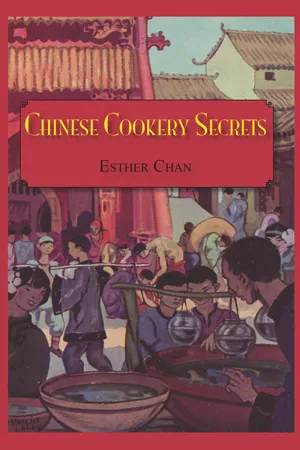
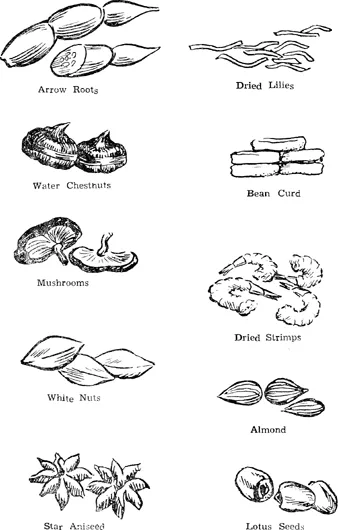
To eat a Chinese meal is to enjoy one of the truly delicious pleasures of life. The Chinese are artists when it comes to presentation, seasoning and combining, and their greatest skill is in choosing the freshest and most wholesome foods, and making the most of them. Chinese Cookery Secrets reveals exactly how the magic is accomplished. Written over fifty years ago, this is an authentic book on Chinese home cooking that is both a practical cookery book and a work of culinary history and culture that explains Chinese food preferences and describes the entire culinary process, beginning with the selection of ingredients and the best way to shop for them, preparation, Chinese utensils, the merits of different cooking methods, seasoning and menu composition before proceeding to the recipes themselves which are classified in fifteen different categories, displaying the variety of Chinese edible delights. These include recipes for meat, poultry, game, sea food, fish, noodles, vegetables and sweet-sour dishes as well as special sections on chafing dish and sandy pot cookery. The directions are thorough, and Chan includes social and historical information relating to Chinese food and cooking throughout the text, which is lavishly illustrated with line drawings of ingredients to aid identification when shopping. The variety of dishes, background knowledge and detailed instructions from start to finish introduce the reader to a golden age of Chinese home cookery.
- 184 pages
- English
- ePUB (mobile friendly)
- Available on iOS & Android
eBook - ePub
Chinese Cookery Secrets
About this book
Information
Part I. General Directions
Chapter 1. Cooking Utensils
A typical old Chinese kitchen will not be able to boast of an array of bright, glistening enamel ware, latest model electric stove or gas stove with automatic signals, shut-offs, turn-ons and instrument board, refrigerator, egg beater, dish washer, electric kettle, coffee percolator and all the paraphernalia of this modern age.
Back in the olden days the Chinese had mud stoves with two or three cauldrons and wooden lids to cook meals for ten or twenty people in a family. Tin cans, hibachi ( a kind of mud charcoal stove) were also used to cook an entire meal without tears, Copper ladles, iron frying shovels, gourds and calabashes were used to hold water or food stuffs. Rice was cooked in a brass pot, fish fried in an iron pan with a broken handle, mutton stewed properly in a vessel made from an empty petrol can, and tea prepared in a pot with a broken spout. Bottles were substitutes for rolling-pins and chopsticks were egg beaters. The cleaver was used in chopping meat and as a mincer. Dishes were washed with a whiskbroom.
Despite all the primitive utensils used and limited facilities employed, China has a long history in culinary art.
Nowadays, in modern Chinese homes, some of the utensils employed for cooking are almost the same as in any Western home, but many are still bereft of modern cooking equipment. A good supply of pots and pans of various sizes is always necessary. For instance, pots used for slow-cooking such as braising, stewing and making soups must be heavy and thick; thin pans are to be used for various forms of frying. Deep-frying, of course, needs something deep enough in which to float the pieces to be deep-fried.
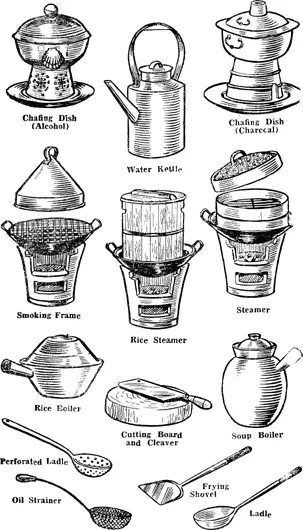
A Chinese family kitchen can get along fine without an oven, but it can never go without a good steamer of Chinese fashion. For ordinary steaming, there is no special equipment needed. All that is required is a saucepan big enough to hold a bowl. In the saucepan place 3 inches of water. Do not allow it to boil dry; a little water should be added from time to time during the process of steaming. If too much water is used the bowl will float, causing the ingredients in the bowl to pour out; if there is too little the temperature will be too low and a longer time for steaming is required. When pastry is steamed, a double boiler will not be able to serve the purpose because the steam does not get at the food; in that a case perforated upper layer has to be used.
In ordinary practice, rush leaves, pine needles, or a piece of clean white cloth are placed on a perforated layer to prevent sticking. In case a good steamer of Chinese fashion cannot be obtained in the market, a tin can be used. Pierce holes in the bottom and then place it in a bigger boiler. Chopsticks are very useful for both eating and cooking purposes. They are not only used to pick up things from the vessel or putting things into it; but they can be used as an egg beater.
Ladles, perforated ladles and frying slice shovels are used to handle food that is being cooked. The cleaver is used for cutting, chopping and even scaling nowadays. A cutting board, round in shape, which is made from the trunk of a tree always works hand-in-hand with the cleaver.
An oil strainer is used to drain off the oil for deep-frying. It is made from wire strings with a bamboo handle. A special kind of wooden rice steamer with a movable bamboo bottom is used to steamed rice in the South-west Provinces of China. For smoking, a certain kind of frame is used. The charing dish and sandy-pot are served on the table.
Other kitchen accessories such as frying pan, kneeding board, rolling pin and aluminium pots of various sizes in a modern Chinese family kitchen are much the same as in a Western family.
Chapter 2. Choice and Variety of Food
As regards foodstuffs, it would be well perhaps if once first alters some of the preconceived notions regarding the Chinese diet. Stories are told of Chinese people being mouse-eaters. Such ideas are fallacious though it is true that snakes are eaten in South China and dogs are eaten by some people. They do not in any case occupy a place in the menu.
The fundamental difference between Chinese and Western food lies in the method of cooking, not in the materials. There are two Chinese proverbs saying ‘Feed moderately on wholesome food; garden herbs surpass rich viands,’ and ‘Only eat fresh fish and ripened rice.’ From these two proverbs we understand that a delicious dish is not estimated by its cost but by the selection of the best types of foodstuffs and the choice of the right material for each particular dish.
In China, from the same chicken two or there dishes can be cooked—the breast for frying, legs for stewing or braising, back and head for boiling soup and liver and gizzard for frying. The exception is when a whole chicken in to be served on the table. Often Chinese chefs have a whole chicken braised or boiled for soup. But remember a young chicken is good for braising and frying; the hen is good for boiling soup.
Ducks are regarded as the second best fowl and geese the third. Games such as wild ducks and pheasants are not very often found in the market, though they are good for braising and frying.
In china, as in any other country, hen’s eggs are used as food. Duck’s eggs are not commonly used, but are good for making soup. Goose eggs are very seldom eaten. Pigeon’s eggs are served quite often at feasts but seldom in home cooking.
In the Chinese sense, meat means pork, unless some other kind of meat is specified. This is because the Chinese regard pork as the popular meat. Different dishes will need different kinds of cuts. The advice of butchers and one’s own common sense will solve half the problem of what to select for a certain dish. For instance, the lean part can be fried while the fat part can be stewed or braised. Legs are good when stewed or braised and pork bones and ribs are used for making soups. A good piece of rib with plenty of meat is sometimes used for braising or in making the popular sweet and sour dishes.
The byes are usually more expensive than simple lean meat. Liver was considered a good thing in China long before scientists discovered its nutritive value. Kidneys, lungs, intestine and tripe are good when they are cleaned and cooked properly. This arrangement of materials, besides producing the most satisfactory result, provides for more variety.
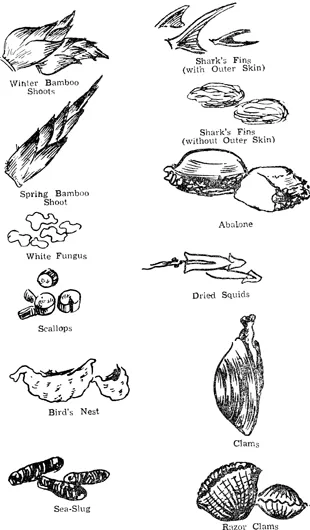
Most of the fish eaten in China are fresh-water first, except in cities along the coast where sea-fish abounds. Actually fresh-water fish is better than that taken from the sea, although it must at once be admitted that shark’s fins are the exception. Ordinarily, these are not used much in home cooking. Fishes in China, are so plentiful and varied that they cannot all be mentioned by name. Carp, ell, bass, scup, mullet are good for braising; bream and perch are good for both steaming and braising. Shell fish are just as good.
Lobsters, prawns, and shrimps all belong to one family. Small river shrimps are best and they are widespread in China. In the crab class, the fresh-water crabs are best of all. When shelled they make a very good accompaniment to dishes, especially that of sharks’s fins. The best way to eat crabs is to steam them and dip them in a sauce of ginger mixed with vinegar.
Fresh vegetables are numerous. There is no need to mention those which are unobtainable. However, there are Chinese vegetables common to those in foreign countries, these being the cucumber, spinach, radish, cauliflower, turnip, french beans, and carrots. Bean sprouts, pea sprouts and winter melon are found almost daily in the Chinese diet. Potatoes and sweet potatoes are not eaten as vegetables. There are two kinds of bamboo shoots in the market, the winter and spring bamboo. The former is more tasty and the price is more expensive.
The Chinese are great vegetables eaters, especially the poorer class. Cabbage and bean curd are regarded as a poor family’s food. Soy beans are rich not only in starch but are also a most important source of protein and since most people cannot afford to eat much meat, bean and bean products are the most typical kind of economical food.
Many people think that Chinese live entirely on rice. The idea is a mistaken one and should be corrected. Rice does form a staple food m the diet of approximately two-fifths of the Chinese people but the majority of the population live upon wheat, barley and millet. Rice and millet are usually boiled or ground into flour to make into bread, noodles, etc.
There are in China stores specializing in preserved food such as shark’s fins, “hundred-year-old” eggs and Chinese ham. The commonest preserved eatables are black fungus, dried mushrooms, bamboo shoots, dried transparent pea-starch noodles ( vermicelli, ) dried lilies, dried shrimps, salted vegetables and salted fish of various kinds.
In conclusion, the average Chinese thrives mainly on vegetables, eggs, bean products and meat. Fowls are less eaten, comparatively, yet the Chinese are able to maintain good health because they know how to make vegetables as palatable as meat and to utilize the value of vegetables to the fullest extent.
Chapter 3. Seasoning
The chief aim of seasoning is to develop the original taste of food and to get rid of undesirable taste or odour. In Chinese cooking, wine is used very often because it takes away the strong, undesirable flavour that is found in fowl, duck, fish, shrimp, kidney and liver. Rice wine and yellow wine are good substitutes for dry sherry. Both rice and yellow wines are made from glutinous rice but yellow wine is to be preferred for cooking purposes. Never use distilled liquor for cooking, as it will spoil the taste.
Vinegar is also made from rice. It is indispensable in cooking fish, crabs, shrimps, etc. It is also served on the table. The best vinegar is the Chingkiang vinegar which is black in colour.
Fresh ginger and spring onion are absolutely necessary in the cooking of fish, chicken, liver, etc., to neutralize their strong flavours. Ginger used in cooking must be peeled and slices very thinly or chopped very fine as desired. In cooking fish, shrimps and crabs, ginger and spring onions are always used together. Spring onions sometimes are eaten raw when chopped and put on the top of a dish. The northerners in China are very fond of eating them raw.
In China, salt used for cooking is not so fine as the salt used in Western countries and it is more salty. Chinese dishes are know as “red-cooked” or ‘white-cooked” according to whether they are cooked with or without soy sauce. Soy sauce adds considerable salt to a dish, and allowance must be made for this when it is used for cooking. Generally speaking” the sauce is only essential in braising or when it is needed for colour, though it is usual to dip “white-cooked” dishes in soy sauce when they are eaten. Soy sauce is made by soaking fermented soy beans in flour and salted water for a month or longer. The colour and consistency of sauce depend on the length of soaking. If Bovril or Oxo is used as a substitute, it fails to give the distinctive soy flavour, although it provides the colour.
There are several kinds of soy sauce in the market. The dark thick sauce with a strong colour but comparatively mild in flavour is called “chu-jan” in Cantonese. It is widely used in restaurants. Another linght-coloured variety, without enough colour for use in cookery. but with fine flavour, ...
Table of contents
- Cover
- Half Title
- Title Page
- Copyright Page
- Table of Contents
- Foreword
- Preface
- Author’s Note
- Part I – General Directions
- Part II – Recipes
- Index
Trusted by 375,005 students
Access to over 1.5 million titles for a fair monthly price.
Study more efficiently using our study tools.
Frequently asked questions
Yes, you can cancel anytime from the Subscription tab in your account settings on the Perlego website. Your subscription will stay active until the end of your current billing period. Learn how to cancel your subscription
No, books cannot be downloaded as external files, such as PDFs, for use outside of Perlego. However, you can download books within the Perlego app for offline reading on mobile or tablet. Learn how to download books offline
Perlego offers two plans: Essential and Complete
- Essential is ideal for learners and professionals who enjoy exploring a wide range of subjects. Access the Essential Library with 800,000+ trusted titles and best-sellers across business, personal growth, and the humanities. Includes unlimited reading time and Standard Read Aloud voice.
- Complete: Perfect for advanced learners and researchers needing full, unrestricted access. Unlock 1.5M+ books across hundreds of subjects, including academic and specialized titles. The Complete Plan also includes advanced features like Premium Read Aloud and Research Assistant.
We are an online textbook subscription service, where you can get access to an entire online library for less than the price of a single book per month. With over 1.5 million books across 990+ topics, we’ve got you covered! Learn about our mission
Look out for the read-aloud symbol on your next book to see if you can listen to it. The read-aloud tool reads text aloud for you, highlighting the text as it is being read. You can pause it, speed it up and slow it down. Learn more about Read Aloud
Yes! You can use the Perlego app on both iOS and Android devices to read anytime, anywhere — even offline. Perfect for commutes or when you’re on the go.
Please note we cannot support devices running on iOS 13 and Android 7 or earlier. Learn more about using the app
Please note we cannot support devices running on iOS 13 and Android 7 or earlier. Learn more about using the app
Yes, you can access Chinese Cookery Secrets by Chan,Esther Chan in PDF and/or ePUB format, as well as other popular books in Social Sciences & Anthropology. We have over 1.5 million books available in our catalogue for you to explore.