Theorising Identity and Subjectivity in Educational Leadership Researchbrings together a range of international scholars to examine identity and subjectivities in educational leadership in new and original ways. The chapters draw on a variety of approaches in theory and method to demonstrate the important new developments in understanding identity and subjectivity beyond the traditional ways of understanding and thinking about identity in the field of educational leadership.
The book highlights empirical, theoretical and conceptual research that offers new ways of thinking about the work of educational leaders. The authors take critical approaches to exploring the influences of gender, race, sexuality, class, power and discourse on the identity and subjectivity formation of educational leaders. It provides global perspectives on educational leadership research and researchers and offer exciting new approaches to theorising and researching these issues.
This book will appeal to researchers, students, and professionals working in the fields of educational leadership and sociology, and the chapters within offer readers new perspectives in understanding educational leaders, their work and their identities.
1 Conceptualising constructions of educational-leader identity
Steven J. Courtney and Ruth McGinity
Introduction
In this chapter, we present and discuss a new typology of identity constructions in and for the field of educational leadership. Our aims are threefold: first, we seek to conceptualise being an “educational leader”; second, we aim through this to illuminate the ontological processes involved in identifying leaders and in how leaders might identify themselves. Third, heuristically, we want to prompt questions about what it means to “be” an educational leader, where the label itself is contested and does identity work (Gunter, 2012).
We make conceptual contributions through our presentation of six idealised identity types in educational leadership and through our explanation of identity construction. We contribute methodologically through suggesting new avenues of investigation, following Bolam’s (1999) argument that mapping what is known is necessary to identify patterns, well-ploughed furrows and silences in the literature, such that new research agendas can be identified robustly.
Our focus is on how the field both presently constructs and might usefully construct educational leaders’ identities: this interpretative scope includes and subsumes the somewhat narrower category of how leaders’ identify themselves (insofar as such identifications are represented in the literature). Our justification for this approach is that identity concerns not only what actors claim or understand about themselves but also how those claims are received and variously contested or accepted through ongoing social negotiation. We go further than Crow, Day and Møller (2017), for instance, who are explicit about how their five proposed dimensions of leader identity formation are contingent and enacted through social interactions, claims and rebuttals. Nonetheless, ultimately these are still located in and primarily enacted by the individual, who in their analysis is the school principal.
We conceptualise identity, however, as communally constructed and just as attributed to as located within an individual. For example, we note that characteristics or labels may be applied a priori to social actors, regardless of their own wishes, that constitute or contribute to their identity. Whilst race, disability and gender are significant structural features that are susceptible to being imposed in this way, this principle extends too to other labels, including scholars’ or policy-makers’ normative interpretations of leaders’ identities. Followers, too, may impose, legitimate or perceive leaderful characteristics.
Such statements raise important questions concerning where and in whom an ‘identity’ is located and what interplay of structure and agency produces it. The literature is replete with examples where extrinsically derived labels such as ‘distributed leader’ (e.g. Courtney & Gunter, 2015) have become incorporated into the accounts of research participants and how they understand and narrate their identity.
Equally, there are instances of stigmatising identity markers concerning for example race (Johnson, 2016) and sexuality (Courtney, 2014) being attributed to those professionals constructed as school leaders, and these meanings being variously rejected or reimagined. Notwithstanding such rejections, those stigmatising identity features remain discursively available for imposed re-application at any moment. Despite embodying an identity, the educational leader doesn’t get the final say over it. We are not claiming simply that the liminal space between ‘leader’ and ‘follower’ is busily vital in constructing the former’s identity: we suggest that identity is a shared resource and a ‘site of struggle’ (Maclure, 1993, p. 312), where the struggle is as much with others as it is with oneself, as in Maclure’s (1993) analysis. This should not surprise: despite these individualised times (Courtney, McGinity & Gunter, 2018), identity has always been relational. One identifies or is identified with another, not with oneself (Crimp, 1992). Identity is not private property and is not reducible to subjectivity.
Our inspiration by elements of the Hegelian understanding of identity – that is, that denotes it as a common rather than individual enterprise – prompts two observations that speak to our methodology. First, embodiment brings no particular privileges in processes of identification; and second, agency is necessary but insufficient in such processes. A third observation differentiates our approach from Hegelian objective idealism: we argue that embodiment is product and producer of a material reality that is interpreted nonetheless in incalculably multiple and socially contingent ways. So, for example, we hold that sex produces material differences that do not determine practice but that are susceptible to categorisable social responses, which may be conceptualised and experienced as gender. This is meaningful for the female educational leader and for our sociological analysis of her identity.
The methodological statements we set out above are consequential for the scope of our analysis, in that the field attributes leadership and hence leaderful identity more widely than only amongst those post-holders who form the object of analysis in most previous studies. Whilst it is our intention to capture and exemplify this through our typology below, we are clear that our aim is not to map the extant field: our typology draws on new conceptualisations to provide a trajectorial heuristic for the field to be used in the generation and analysis of future empirical projects. Our typology will also prove useful to educational professionals in senior roles, through indicating new directions and possibilities for their own identity work; through legitimating practice that contra-indicates the characteristics and features of what we identify here as the dominant leader “character” constructed in policy; and through making explicit how critical reflexivity is a desirable disposition in leadership in prioritising educational purposes and values.
Our intellectual resources and methodology
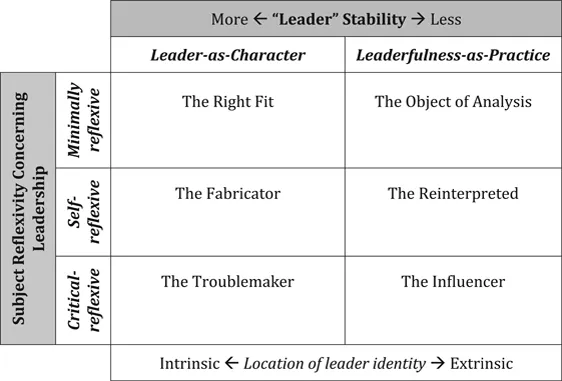
We intend here to deploy two dimensions to illuminate identity and identifying in educational leadership (see Figure 1.1, shaded cells). The first is leader stability: this dimension speaks to the spectral ontological status of “leader” and the ways in which it is imbricated in its more “fixed” iterations with notions of “role”, and in its less “fixed” iterations with “practice”. The second dimension is subject reflexivity concerning leadership: this attempts to capture how the agency of those constructed as educational leaders is deployed more or less reflexively and the effects this has on identity. We explain these two dimensions in more detail below, along with the intellectual resources we have drawn upon to operationalise them as typological dimensions.
Figure 1.1 A typology of conceptualisations of educational-leader identity
Through reported research projects, the field constructs the notion of “leader” as variously more or less stable, and so an ontological spectrum exists that stretches from leader as role, that is, fixed, to leader as one doing leadership, that is, where the concept of “leadership” is understood in different ways. In this second category, such understandings extend as far as leadership as relational practice (e.g. Eacott, 2015), where meaning-making practice is decoupled partly or entirely from the label of “leader” and where what is actually signalled through that label is a senior role holder (e.g. principal, headteacher or executive headteacher).
Much of the predominantly functionalist scholarship in the school-effectiveness and school-improvement leadership fields accepts and reproduces an assumption of leader stability, where “leader” reduces to role in signifying the person in the top job. There is considerable evidence, too, that this stability is reflected in the accounts of some educational leaders themselves. For example, Fuller’s (2017) theorisation of “leadership monoglossia” (p. 18) aims to capture such instances of alignment between leaderful agency and the role constructed for leaders through policy. Such ontological buy-in results in the collapse of the meaningful distinction between leader role and leader identity, producing increased identity stability.
We now set out in more detail the two conceptual resources that inform our typology: leader stability, which we depict as either character or practice, and subject reflexivity concerning leadership, which we arrange spectrally from minimally to critically reflexive.
Leader stability: the leader as a MacIntyrean “character”
To theorise and typologise this aspect of identity, we have drawn on MacIntyre’s (2013 [1981]) “dramatic metaphor” (p. 32) of the character. MacIntyre invokes a theatrical tradition exemplified in Japanese Noh and English mediaeval morality plays in which the use of stock characters fulfilled vital functions. These functions consisted in delimiting plot and action; enabling immediate audience recognition; facilitating the audience’s interpretation of the behaviour and, importantly, morality of the protagonists playing these characters; and structuring the actions of these characters’ co-players, along with their interpretation.
MacIntyre applies this metaphor also to certain social roles in particular cultures, such that understanding the character enables the interpretation of the actions of whoever inhabits that character. This means that in characters, “role and personality fuse… [and] the possibilities of action are defined in a more limited way than in general” (p. 32). Not all social roles qualify as characters: these latter “are a very special type of social role which places a certain kind of moral constraint on the personality of those who inhabit them in a way in which many other social roles do not” (MacIntyre, 2013, p. 32). Characters are therefore “the moral representatives of their culture” (p. 32). However, these embodied moralities do not achieve universal assent: indeed, characters may prompt the dissensus necessary to reinforce their status as the essence or standpoint against which oppositional moral definitions or stances are made or taken.
For MacIntyre, Weber’s (2012 [1947]) idealised type of the bureaucratic manager constituted a character owing to its domestication – and thus recognition – across industrialised economies internationally and to the way in which the manager’s objectives – to apportion resources rationally, effectively and efficiently – denote not neutral, valueless objectivity but rather an implicit morality. This is because rationality and particularly effectiveness concern ends, and ‘questions of ends are questions of values’ (MacIntyre, 2013, p. 30).
Inspired by important scholarship from, for example, Rogers (2017), we suggest that this morality was transferred from management to educational leadership from the 1990s in what we call the Great Leadership Turn (GLT), where the moral objective to improve children’s outcomes entered educational leadership’s definitional gates in a Trojan horse of unthreatening blandness. As Rogers (2017) points out, however, “moral purpose as a trope served to reinforce that one [i.e. school leaders] had no choice but to be on board with the programme” (p. 140). Through this, the educational leader was simultaneously endowed as a MacIntyrean character in its own right and the morality it represented was defined in alignment with what has been characterised as the neoliberal global education reform movement (GERM) (Sahlberg, 2011). Our example, using Rogers (2017), is from England, and whilst we argue that the leader character, like the Weberian Bureaucratic Manager, is international, it will not be identical internationally. Its characteristics will be suffused with features of the state-level policy environment and with local historical traditions and expectations of what it means to be an educational leader.
We argue through incorporating it into our typology that educational leaders may enact their agency to embody the leader not as a role but as a character, where it becomes indistinguishable from other elements of their professional identity. We therefore use it here to exemplify and illuminate the more stable end of our dimension of leader stability in our typology.
Leader stability: leaderfulness as practice
To conceptualise the other, less stable end of this identity dimension, we have applied two guiding typological principles. First, since it must provide an ontological counterpoint to the notion of leader-as-character, and following Hegelian principles of communally held identity, it must entail the possibility of the “leader” in question being unaware of the label being applied to him or her either at all or in that particular way. This element of the stability dimension therefore privileges imposed over claimed identity and so is derived extrinsically in contrast to the MacIntyrean ch...
Table of contents
Cover
Half Title
Series Page
Title Page
Copyright Page
Contents
List of contributors
Acknowledgements
Introduction
1 Conceptualising constructions of educational-leader identity
2 Identity, subjectivity and agency: feminists re-conceptualising educational leadership within/against/beyond the neo-liberal self
3 The principalship as a social relation
4 This bridge called my leadership: theorising Black women as bridge leaders in education
5 Towards an ethics of leadership
6 Manufacturing the woman leader: how can wardrobes help us to understand leadership identities?
7 Tropes and tall tales: leadership in the neoliberalised world of English academies
8 Being, becoming and questioning the school leader: an autoethnographic exploration of a woman in the middle
9 The will not to know: data leadership, necropolitics and ethnic-racialised student subjectivities
10 Subjectivity and the school principal: governing at the intersection of power and truth
11 A day in the life performance of a re/dis/un/covering administrator
12 Exploring and que(e)rying the subjectivity of educational leadership researchers who pursue queer issues
13 That’s enough about me: exploring leaders’ identities in schools in challenging circumstances
What does this book contribute to understandings of educational leadership, leaders’ identities and subjectivities?
Index
Trusted by 375,005 students
Access to over 1.5 million titles for a fair monthly price.
Study more efficiently using our study tools.
Frequently asked questions
Yes, you can cancel anytime from the Subscription tab in your account settings on the Perlego website. Your subscription will stay active until the end of your current billing period. Learn how to cancel your subscription
No, books cannot be downloaded as external files, such as PDFs, for use outside of Perlego. However, you can download books within the Perlego app for offline reading on mobile or tablet. Learn how to download books offline
Perlego offers two plans: Essential and Complete
Essential is ideal for learners and professionals who enjoy exploring a wide range of subjects. Access the Essential Library with 800,000+ trusted titles and best-sellers across business, personal growth, and the humanities. Includes unlimited reading time and Standard Read Aloud voice.
Complete: Perfect for advanced learners and researchers needing full, unrestricted access. Unlock 1.5M+ books across hundreds of subjects, including academic and specialized titles. The Complete Plan also includes advanced features like Premium Read Aloud and Research Assistant.
Both plans are available with monthly, semester, or annual billing cycles.
We are an online textbook subscription service, where you can get access to an entire online library for less than the price of a single book per month. With over 1.5 million books across 990+ topics, we’ve got you covered! Learn about our mission
Look out for the read-aloud symbol on your next book to see if you can listen to it. The read-aloud tool reads text aloud for you, highlighting the text as it is being read. You can pause it, speed it up and slow it down. Learn more about Read Aloud
Yes! You can use the Perlego app on both iOS and Android devices to read anytime, anywhere — even offline. Perfect for commutes or when you’re on the go. Please note we cannot support devices running on iOS 13 and Android 7 or earlier. Learn more about using the app
Yes, you can access Theorising Identity and Subjectivity in Educational Leadership Research by Richard Niesche, Amanda Heffernan, Richard Niesche,Amanda Heffernan in PDF and/or ePUB format, as well as other popular books in Education & Education General. We have over 1.5 million books available in our catalogue for you to explore.