- 422 pages
- English
- ePUB (mobile friendly)
- Available on iOS & Android
eBook - ePub
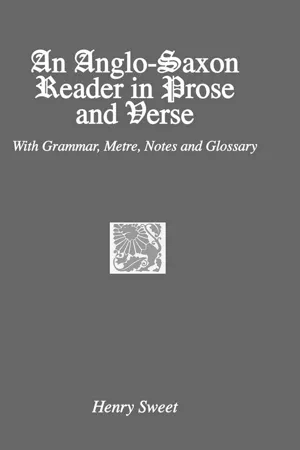
An Anglo-Saxon Reader in Prose and Verse
About this book
First published in 2005. An excellent introduction to Old English, this book begins with an elementary grammar, ably preparing students for the thirty-four texts that follow. Among the carefully selected stories, verses and histories can be found a wide sampling of dialects: West Saxon, Northumbrian, late and early Kentish and early Mercian. A comprehensive glossary is included.
GLOSSARY.
The following abbreviations require special notice:—
m., n., f., masculine, &c. noun.
Cases: nom., a., d., inst., g. w.d.g., with dat. of person and gen. of thing, &c.
cp., sp., comparative, superlative.
tr., int., transitive, intransitive. rfl., reflexive.
The parts of speech are not marked in the case of adjectives, pronouns. and weak verbs, although pronouns are marked no. (noun) and aj. (adjective) when necessary, and irregular verbs are marked vb., especially the preterite-present verbs, such as cann. Strong verbs are distinguished by the number of their class (beran 4).
The words are arranged in the alphabetic order of their Early West-Saxon forms. But the prefix ge- is ignored (gebed under b), being omitted before verbs, except when it distinctly affects their meaning. ē = œ̄ is written œ̄ but ranged under ē. ǫ must be sought under a, and y often under ie, i. W.S. œ̄, ie = Mercian ē, 0119;, e are written œ̂, i0119;, ie respectively.
Words in -ing -ung and in -nes -nis are generally given under -ung, -nis.
Such headings as byrgen(n) imply inflected byrgenne, &c.
~ denotes repetition of the head-word.
† marks words or meanings peculiar to poetry.
Words enclosed in [ ] are cognate Old English words, or else Latin originals of foreign words.
A
ā av. 13/338, āwa 23/120, ō (for) ever: ‘ne . . ō’ not (at all) 24/25.
abbod m. abbot 17/22.
abbudisse f. abbess 10/12, 68.
ā·belgan 3 w. d.: ptc. ābolgen
angry 22/185.
ā·bēodan 7 w. d. announce 21/27, 49.
ā·beran 4 bear, support.
ā·berstan 3: ‘ūt ~’ break out 3/218.
ā·bīdan 6 await 31 g/2: remain (alive), be spared 15/208.
ā·bl0119;ndan blind.
ā·blinnan 3 cease 13/181.
ā·borgian borrow 12/4.
ā·brecan 4 take (city, fortress) 5/94; 8/11.
ā·bregdan 3 draw (sword) 23/79.
ā·brēotan 7 destroy, kill 20/48, 349.
ā·brēoþan 7 fail 21/242: plc. ābroþen (instead of -den) degenerate, reprobate 16/158.
ābūtan = onbūtan or ymbūtan.
ā·bysgian. (i) occupy, trouble 3/124; 8/83.
ac cj. but: and 23/209.
āc f. oak.
ā·cęnnan bear (child) 13/131.
ā·cęnnednis f. birth 14/3, 61.
ā·ceorfan 3 cut—‘on weg ∼’ cut away 3/238; ‘of ∼’ cut off 5 b/87: cut down (tree) 11/70: cut off (head) 31/10.
ā·cięrran turn 31 g/36.
ā·cræftan devise 5/64.
ācsian see āscian.
ā·cwęccan shake tr. and int. 21/255; 14/190.
ā·cwelan 4 die 8/100; 9/10; 13/31.
ā·cwęllan kill 13/35; 14/4.
ā·cwęncan quench (fire) 16/22.
ā·cweþan 5 speak tr. 26/91—‘∼fram’ reject 22/59.
ā·cwięlman kill 17/47.
ā·cwincan 3 be extinguished.
ā·cӯþan make known 26/113.
ād m. funeral pile 4/142.
ā·dīl(e)gian (y) destroy; erase 13/185.
ādl f. disease 14/147.
ādlian be diseased 14/165.
ādlig sick 15/31, 167.
ā·dōn put 19 b/29.
ā·drǣfan drive, expel 1/4, 9; 7/3.
ā·dręncan dr...
Table of contents
- Cover
- Half Title
- Regan Paul Library of Chivalry
- Title Page
- Copyright Page
- Preface
- Table of Contents
- Grammar
- Metre
- I. Cynewulf and Cyneheard
- II. On The State of Learning in England
- III. Alfred's Translation of the Cura Pastoralis
- IV. The Voyages of Ohthere and Wulfstan
- V. Alfred's Translation of Orosius
- VI. The Battle of Ashdown
- VII. Alfred And Godrum
- VIII. Alfred's Wars with the Danes
- IX. From Alfred's Translation of Boethius
- X. Account of the Poet Cæmon
- XI. From the Laws
- XII. Charters
- XIII. Ælfric's Homilies1The Homilies of Ælfric, by B. Thorpe, Esq. (Ælfric Society), 1843.
- XV. Œlfric's Life of King Oswald
- XVI. Wulfstan'S Address to the English
- XVII. The Martyrdom of Ælfeah
- XVIII. Eustace at Dover, and the Outlawry of Godwine
- XIX. Charms
- XX. Beowulf and Grendel‧s Mother
- XXI. The Battle of Maldon
- XXII. The Fall of the Angels
- XXIII. Judith
- XXIV. The Happy Land. From the Phœnix
- XXV. The Dream of the Rood
- XXVI. The Wanderer
- XXVII. Selections from the Riddles of Cynewulf
- XXVIII. Gnomic Verses
- XXIX. The Seafarer
- XXX. Northumbrian Fragments
- XXXI. Mercian Hymns
- XXXII. Early Kentish Charters
- XXXIII. Codex Aureus Inscription
- XXXIV. Late-Kentish Psalm
- Notes
- Glossary
Trusted by 375,005 students
Access to over 1.5 million titles for a fair monthly price.
Study more efficiently using our study tools.
Frequently asked questions
Yes, you can cancel anytime from the Subscription tab in your account settings on the Perlego website. Your subscription will stay active until the end of your current billing period. Learn how to cancel your subscription
No, books cannot be downloaded as external files, such as PDFs, for use outside of Perlego. However, you can download books within the Perlego app for offline reading on mobile or tablet. Learn how to download books offline
Perlego offers two plans: Essential and Complete
- Essential is ideal for learners and professionals who enjoy exploring a wide range of subjects. Access the Essential Library with 800,000+ trusted titles and best-sellers across business, personal growth, and the humanities. Includes unlimited reading time and Standard Read Aloud voice.
- Complete: Perfect for advanced learners and researchers needing full, unrestricted access. Unlock 1.5M+ books across hundreds of subjects, including academic and specialized titles. The Complete Plan also includes advanced features like Premium Read Aloud and Research Assistant.
We are an online textbook subscription service, where you can get access to an entire online library for less than the price of a single book per month. With over 1.5 million books across 990+ topics, we’ve got you covered! Learn about our mission
Look out for the read-aloud symbol on your next book to see if you can listen to it. The read-aloud tool reads text aloud for you, highlighting the text as it is being read. You can pause it, speed it up and slow it down. Learn more about Read Aloud
Yes! You can use the Perlego app on both iOS and Android devices to read anytime, anywhere — even offline. Perfect for commutes or when you’re on the go.
Please note we cannot support devices running on iOS 13 and Android 7 or earlier. Learn more about using the app
Please note we cannot support devices running on iOS 13 and Android 7 or earlier. Learn more about using the app
Yes, you can access An Anglo-Saxon Reader in Prose and Verse by Henry Sweet,Sweet in PDF and/or ePUB format, as well as other popular books in History & Ancient History. We have over 1.5 million books available in our catalogue for you to explore.