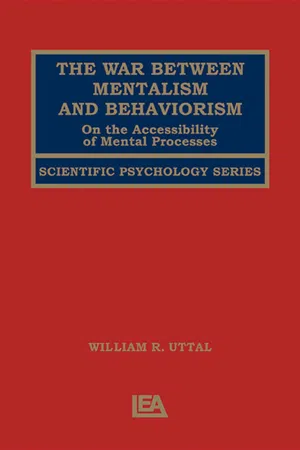
This book considers one of the most fundamental, but only infrequently considered, issues in psychology--Are mental processes accessible by means of verbal reports and/or experimental assays? It is argues that this is the main characteristic distinguishing between behaviorism and mentalistic cognitivism. The answer posed by the author is that, with few exceptions and for the most fundamental reasons, mental processes are not accessible and that any psychology, such as contemporary cognitivism, based on a putative analysis of mind into its mental components must be fallacious. Classic and modern arguments against both mentalism and behaviorism are reviewed. In general, it is concluded that most antibehaviorist arguments are based on second order humanistic considerations rather than those underlying the usual scientific standards. Behaviorism represents the best that can be done in a situation of fundamental immeasurability and uncertainty. A modern version is offered in the final chapter of this book.
eBook - ePub
The War Between Mentalism and Behaviorism
On the Accessibility of Mental Processes
- 218 pages
- English
- ePUB (mobile friendly)
- Available on iOS & Android
eBook - ePub
About this book
Information
Chapter 1
The Issue—Mentalism Versus Behaviorism
Can the mind be observed, measured, and then analyzed into its parts? In other words, is it accessible to scientific examination? These are the questions that motivate this book. Anyone who has had the audacity to ask these questions must acknowledge at the outset that there are not likely to be simple answers to what is obviously a collection of related and profoundly complex queries. Nevertheless, these are among the most important of the fundamental issues that drive psychology, whether it be classical and speculative or modern and empirical. These questions also underlie the foundation of the historical and continuing conflict between mentalism and behaviorism—the two great contending approaches that have divided and destabilized as well as energized scientific psychology, in particular, for the last 120 years. Although one cannot make a judgment about the value of this destabilization in the history of this science (it is yet to be determined whether it has been detrimental or seminal), it is clear that this dialog, this debate, this controversy, has been ubiquitous during the intellectual development of our diverse attempts to understand psychological processes.
Make no mistake, although there have been many other matters of import that have risen to the attention of psychologists from time to time, the development, extinction, and reemergence of the various schools of psychology has been based on their respective answers to these fundamental controversies. Methodologies have come and gone and will come and go as new technologies are developed. Theories of one or another phenomenon of this science have been offered, debated, and ultimately have disappeared within the context of a newly emerging perspective or point of view. For that matter, some of the most popular theories of psychology’s history have been shown to be misinterpretations and have been discarded. Alternative models of relatively limited extent arise, compete, and then more often than not are merged into a more global explanation than had been used to describe either theory. However, the fundamental questions I have just raised remain at the deepest conceptual core of our science.
The swing from one point of view to the other (concerning the issue of whether the intrapersonally privileged awareness of our own mental life is amenable to the same techniques that characterize interpersonally observable empirical science) continues, and the controversy remains unresolved. Unresolved, perhaps, but not without influence. In fact, as I just suggested, the scientific accessibility of “mind,” or “cognition,” or “consciousness,” or whatever else one wishes to call this “stuff of self-awareness” has been the main historical force behind the evolution of the various psychological schools and general approaches that have emerged over the years.
There are several important points that must be made clear at the outset of this book. I am approaching this problem from the point of view of a natural scientist. My arguments will mainly be those based on the same kind of scientific standards that characterize any other science. Psychology is a subdivision of biology and as such is subject to all of the standard criteria that would be required to resolve any controversy there. For example, standards of compatibility between theory and observation, standards of mathematical and computational logic, standards of simplicity, and, to an important degree, standards of elegance all must play their part. The problem for psychology is that its content matter impacts on so many other important aspects of human existence that these scientific standards are often subjugated to the constructs and values of other aspects of our life. This book is about the science of psychology, not about the arguable implications that it may have for society or the influence that society may have on it.
It is also important as we begin this discussion to appreciate that it is not the “reality” of mind or consciousness that is being debated here. Even the most radical behaviorist can not easily reject the ontological existence of personally experienced awareness. To do so would be tantamount to not only rejecting the reality of the world around us but of ourselves as well. The focus of the present discussion is on a far more specific point—how far can psychological science go in the kind of systematic analysis and reduction that was characteristic of other, if I may say, simpler scientific subject matters?
As the history of this problem is reviewed, it becomes evident how the epistemological issues of the accessibility and analyzability of mind, not the ontological issue of its existence, were truly at the focus of the evolution from one school of psychology to the next. Early in the history of what we now consider to be modern science, the notion that mind was inherently physical in origin led quite easily to the analogous idea that it was just another process that could be observed and analyzed as well as any other. This point of view evolved into mentalistic associationism, structuralism, and cognitivism as well as some behaviorisms that assumed, at least in principle, that mind could be reduced to its components. A reaction to these philosophies led to the global and molar and antiatomistic approaches that characterized some other behaviorisms and such related psychologies as Gestaltism.
Currently, a new form of mentalism called cognitive science or cognitive psychology has captured the attention of most experimental psychologists. As with previous forms of mentalism, it is characterized by premises of mental observability, accessibility, and functional analyzability. These are the basic ideas espoused by cognitive psychology, as well as all of its predecessor mentalisms. Whatever modern methods may have or will evolve, the classic assertion remains—the subject matter of psychology is mental activity itself and it can be studied.
Opposed to such a mentalism has traditionally been a collection of behaviorisms asserting that it is not mind, but rather, only the interpersonally observable behavior resulting from a complex of different driving forces, some internal and some external, that must be the target of a valid psychological science. The key difference of opinion between the two points of view concerns whether or not the observed behavior can be used to infer the nature of the underlying mental states and mechanisms. In the baldest of terms, the question posed is—is mind accessible?
The metaphor of a pendulum going back and forth between two extreme conditions is probably inadequate to describe what has really happened in the history of psychology. Each successive pendular swing did not return to the same behaviorism or the same mentalism that was its predecessor, but rather to a new and modified version of it. In another perhaps more illuminating metaphor, Amsel (1989) suggested that advanced versions of the alternating approaches to psychology could vary considerably from earlier ones. The model he suggested is represented by a cone standing on its narrow tip—the tip representing a time at which there was little scientific information. As time goes on and our knowledge increases, however, the alternation goes upward from one version of either mentalism or behaviorism to a more advanced version of the other on a wider portion of the cone. The width of the cone, of course, represents the knowledge available at each historical epoch of the psychology. As psychological history runs its course, the knowledge base grows and the cone widens. The point of this metaphor is that both behaviorisms and mentalisms come in many different varieties.
Whatever the conceptual model, some of us now feel that the mental-ist-behaviorist pendulum is ready to swing back to some kind of behaviorism. Perhaps it won’t be as radical as some of its predecessors, but there is an increasing appreciation that the cognitive mentalism of the recent past is deeply flawed for logical, empirical, philosophical, and technical reasons.
The questions of the accessibility and analyzability of mental functions are complex. Accessibility, of course, is assumed a priori by many different systems of psychology. Analyzability or reductionism has also been a tenet of many different schools of psychological thought. To understand the impact of the question of the analyzability of “mind” on our science, it is necessary to understand the positions taken by and interpretations made by both mentalists and behaviorists in their classic and contemporary versions.
In this chapter, I have chosen to undertake a brief historical analysis of the intended meaning of some of the more notable mentalisms and behavior in the past. It seems very clear that the fundamental nature of the respective positions of the two schools has been clouded by secondary issues other than the ones that are at the scientific core of their intellectual structures.
It is mainly with regard to their respective positions on the twin issues of accessibility and analyzability that differentiates the theories of mentalists and behaviorists. The key to understanding the mentalist program has always been their foundation assumption of cognitive accessibility and the corollary idea that, in actual fact, there exist fundamentally real elements of mental activity that can be inferred from behavioral observations. This is the essence of both the concepts of analyzability and elementalism, two sides of the same coin, and two ideas that are inextricably intertwined through the history of mentalist psychology.
Analyzability (i.e., the property of being separable into parts) is closely related to reductionism, the latter generally referring to the explanation of one level of discourse in the language, terms, and measurements, especially as they define the components, of a lower level. The classic reductionism for our times is neuroreductionism—the explanation of psychological functions in neurophysiological terms. I also use the term reductionism to refer to the attempts by psychologists, for example, to reduce reaction time to subcomponents such as detection time, decision-making time, and response-selection time. As another example, attempts are now being made to reduce perceptual processes such as apparent motion to “matching and parsing” subprocesses. These examples of attempts to go from the global or molar phenomenological level to a level of more elemental mental processing components is also a kind of reductionism.
This elemental reductionism is nowhere more evident than in the study of memory. Watkins (1990) called our attention to this phenomenon when he reminded us of Underwood’s (1972) comment that:
Memories now have attributes, organization, and structure; there are addresses, read out rules, and holding mechanisms…our memories are filled with T-stacks, implicit associational responses, natural-language mediators, images, multiple traces, tags, kernel sentences, markers, relational rules, verbal loops, and one-buns. (p. 1)
Watkins (1990) pointed out that along with these mechanisms, there is also a superabundance of learning and memory theories that seem to perpetuate themselves, proliferate, yet not enlighten us. He argued that all of this theorizing about memory and all of these hypothetical constructs (and those that have come forward since) are due to our tendency to seek a”mediational” explanation—that is, to seek out the component traces or mechanisms that underlay the behavior. Watkins’ assertion is essentially a criticism of reductionism to elements and an argument against searching for mediating internal mechanisms. He concluded by pointing out that the attempt to reduce memory to its neural substrates or to computer models exacerbates the microscopic, elemental approach. His conclusion is a behavioral one, although he does not use the word.
The antithesis of an accessible and analyzable mind is to assume that mental processes are private (i.e., interpersonal, inaccessible). Of course, mind is not inaccessible in one sense—some facets of its content can be communicated through speech and writing, by means of facial, postural, or other motor responses and even, to at least a modest degree, by means of physiological indicators.
However, behaviorists generally argue that all responses (or behaviors) are measures of the totality of the experience or awareness of the behaving organism and are the resultant of a combination of many different stimulus, organism, and response variables as well as the past experiences and (to an unknown, but usually lesser, degree) the genetic heritage of the individual. The combination is irretrievably tangled, according to behaviorists, and little if anything can be done to disentangle the combination. According to this viewpoint, behavior cannot tell us anything about the component processes or mechanisms that underlie the mental events. Indeed, because many possible mechanisms could lead to the same psychological event and there are many obscuring and transforming factors between behavior and mental processes, the barrier between the two domains is impenetrable as a matter of both deep principles and practical considerations.
Furthermore, consciously or unconsciously, people can and do obscure their true mental processes. Actors are trained speci...
Table of contents
- BOOKS BY WILLIAM R.UTTAL
- Contents
- Preface
- SCIENTIFIC PSYCHOLOGY SERIES
- Chapter 1 The Issue—Mentalism Versus Behaviorism
- Chapter 2 The Critics Speak Against Mentalism
- Chapter 3 Some Arguments Against Behaviorism
- Chapter 4 Toward a Renewed and Revitalized Psychophysical Behaviorism
- Chapter 5 Epilogue: Conclusions and Emerging Principles
- References
- Author Index
- Subject Index
Trusted by 375,005 students
Access to over 1.5 million titles for a fair monthly price.
Study more efficiently using our study tools.
Frequently asked questions
Yes, you can cancel anytime from the Subscription tab in your account settings on the Perlego website. Your subscription will stay active until the end of your current billing period. Learn how to cancel your subscription
No, books cannot be downloaded as external files, such as PDFs, for use outside of Perlego. However, you can download books within the Perlego app for offline reading on mobile or tablet. Learn how to download books offline
Perlego offers two plans: Essential and Complete
- Essential is ideal for learners and professionals who enjoy exploring a wide range of subjects. Access the Essential Library with 800,000+ trusted titles and best-sellers across business, personal growth, and the humanities. Includes unlimited reading time and Standard Read Aloud voice.
- Complete: Perfect for advanced learners and researchers needing full, unrestricted access. Unlock 1.5M+ books across hundreds of subjects, including academic and specialized titles. The Complete Plan also includes advanced features like Premium Read Aloud and Research Assistant.
We are an online textbook subscription service, where you can get access to an entire online library for less than the price of a single book per month. With over 1.5 million books across 990+ topics, we’ve got you covered! Learn about our mission
Look out for the read-aloud symbol on your next book to see if you can listen to it. The read-aloud tool reads text aloud for you, highlighting the text as it is being read. You can pause it, speed it up and slow it down. Learn more about Read Aloud
Yes! You can use the Perlego app on both iOS and Android devices to read anytime, anywhere — even offline. Perfect for commutes or when you’re on the go.
Please note we cannot support devices running on iOS 13 and Android 7 or earlier. Learn more about using the app
Please note we cannot support devices running on iOS 13 and Android 7 or earlier. Learn more about using the app
Yes, you can access The War Between Mentalism and Behaviorism by William R. Uttal in PDF and/or ePUB format, as well as other popular books in Psychology & Cognitive Psychology & Cognition. We have over 1.5 million books available in our catalogue for you to explore.