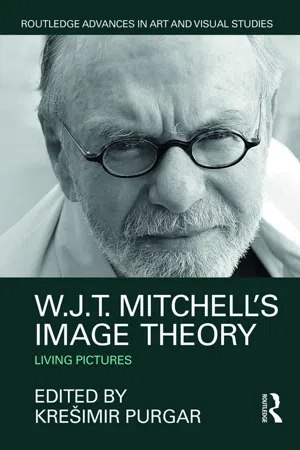
W.J.T. Mitchell – one of the founders of visual studies – has been at the forefront of many disciplines such as iconology, art history and media studies. His concept of the pictorial turn is known worldwide for having set new philosophical paradigms in dealing with our vernacular visual world. This book will help both students and seasoned scholars to understand key terms in visual studies – pictorial turn, metapictures, literary iconology, image/text, biopictures or living pictures, among many others – while systematically presenting the work of Mitchell as one of the discipline's founders and most prominent figures. As a special feature, the book includes three comprehensive, authoritative and theoretically relevant interviews with Mitchell that focus on different stages of development of visual studies and critical iconology.
- 296 pages
- English
- ePUB (mobile friendly)
- Available on iOS & Android
eBook - ePub
About this book
Information
Part I
Toward a Critical Iconology
1The Changing Patterns of Iconology1
Seven Questions to Mitchell from the Twentieth Century2
Timothy Erwin
The appearance of W.J.T. Mitchell’s Iconology (1986) brings new interest to the study of the pictura-poesis relation for literary critics and art historians who advocate a more critically informed approach to their shared subject. Author of the well-received Blake’s Composite Art (1978), Mitchell comes naturally to the study of the sister arts, yet little in the Blake study prepares readers for the ideological reach of Iconology. Apart from the occasional glance at Milton or Wordsworth the book includes no readings of ekphrastic verse or narrative images. Instead of offering the expected reflexive views of poetry and painting, it comments on the possibility of ideological critique in contemporary and traditional readings in the interdisciplinary analogy. In taking up with analytic precision a topic that typically invites the prose of soft focus, Iconology is determinedly theoretical (more than most studies that claim the epithet, it can be called metatheoretical). In brief, the method is to compare different approaches to the sister-arts relation in comparative commentary ranging from contemporary figures like E. H. Gombrich and Nelson Goodman back to the classic texts of Edmund Burke and G. E. Lessing in order to argue against the nineteenth-century notion, still widely held among comparatists, that there exists a single essential difference between poetry and painting.
As argumentative first moves go, the premise is little short of breathtaking. To say that the experiential difference between space and time is not at all great when compared to the cultural difference invested in those opposed categories is to argue against a commonplace of intellectual history reified by disciplinary division. Little in contemporary culture or the academy will have prepared readers to accept the argument. One useful way of taking up Mitchell’s revisionism is by way of a lexical overview of the title term, a term now asked to perform interdisciplinary double duty. In art history the formidable notion of an iconological practice approaches the half-century mark even as the discipline which gave it voice enjoys its centenary. In literary studies the term is just now broached to define an evaluative approach to a new area of interest. What can we expect iconology in both senses to mean to the future of interartistic study? We might begin with a narrative scene of introduction. Like the ancient histories of Dibutade and Polemon, of Zeuxis and the painted grapes, Panofsky’s story of the greeting is perhaps the ur-narrative of modern visual theory, celebrating not the beginnings of representation or ancient standards of excellence but the origin of a totalizing mode of interpretation, the myth of modern iconology.
I
Somewhere in Europe, between the world wars, a man is strolling pensively down a city street. From the other direction another man steps out of the crowd and begins to perform a vague gesture. Approaching nearer, the second man raises his hand toward his hat. Before passing by he gently lifts the brim and in nearly the same motion returns the hat to its former position. What strikes the first man most forcibly is that the meaning of the gesture depends upon a host of contingencies, most of which, like the state of mind of his acquaintance, he can never know firsthand. He recognizes that the gesture would likely become invisible for him once it left the path of social significance, and he also senses that the gesture registers the expression of an attitude or emotion almost as soon as it registers a physical fact. While the man knows that the gesture is significant he is unsure of its meaning. Does the greeting express simple recognition? like or dislike? indifference? A student of conventional signs, our observer associates the greeting with the medieval doffing of helmets as a sign of courtesy. And as he looks into the matter he makes several preliminary distinctions.
For purposes of setting out an interpretive practice he decides to separate the motif of the gesture (the actual lifting of the hat) from its traditional conventional meaning or theme (politeness). He calls his first impressions of the gesture primary, factual, and expressional, and distinguishes them from his second thoughts on the matter, which he terms secondary and conventional. Borrowing a familiar dichotomy he calls the object of his first impressions the form and the object of his second thoughts the subject matter of the event. Neither of these, he decides, should be considered the content of the gesture. Instead he’ll understand the intrinsic meaning or content to be the historically constituted composite of all three things taken together – of formal event, of the primary and secondary aspects of the subject matter, and of the symbolic value of the gesture.
For Panofsky, who tells the story in his famous essay on iconography and iconology and whom art historians will recognize as its young protagonist strolling the avenues of Freibourg, is the last of these which almost alone brings point to the anecdote. In taking the gesture as a metonymy for the Kunstwollen, Panofsky wants to view the artwork as the historical expression of the symbolic human dimensions which lend art its greatest value. Where the descriptive practice of iconography had analyzed the allegories of the settecento in terms of emblem literature, noting with a Émile Mâle, for example, how the mysteries of Bernini’s Truth could be decoded in Ripa, Panofsky’s new science of iconology would take formal interpretation into the more intuitive and idealizing sphere of the symbolic form.3 To understand the basic principles of iconographic production and interpretation, Panofsky goes on to explain, “we need a mental faculty comparable to that of a diagnostician – a faculty which I cannot describe better than by the rather discredited term ‘synthetic intuition’”.4
In theory the intuited synthesis of the art historian will open onto both history and politics. Ideally the all-encompassing gaze of iconology will be corrected by
an insight into the manner in which, under varying historical conditions, the general and essential tendencies of the human mind were expressed by specific themes and concepts. This means what may be called a history of cultural symptoms – or “symbols” in Ernst Cassirer’s sense – in general. The art historian will have to check what he thinks is the intrinsic meaning of a work … against … the intrinsic meaning of as many other documents … historically related to that work … as he can master: of documents bearing witness to the political, poetical, religious, philosophical, and social tendencies of the personality, period, or country under investigation. Needless to say that, conversely, the historian of political life … should make analogous use of works of art.5
In practice the iconology of Panofsky proves political and historical in only the broad-brush sense though, and for a couple of reasons. Generally speaking, the artwork is seen to mediate between the informing cultural epistemology bracketed by history and some more essential tendency of the human mind, the symbolic form. As is often remarked, iconology thus presupposes the neo-Kantian epistemology of Panofsky’s Hamburg colleague Cassirer. Panofsky wants to lead us to a truth writ large by both the objective hand of the event and by the subjective impulse to grasp it whole, and so raises early the methodological problem of distinguishing between the subjective and objective elements of the inquiry. In Michael Podro’s astute account of the essay, the problem of the mind-world relation locates itself at once within and without the artwork so that the expressive features of the work are made available with other features for the emotional response of the viewer. Yet Podro also points that for two related reasons the mind-world problem rests unresolved: for one thing, every aspect of the artwork is implausibly expected to reveal the same a priori regulative idea, and for another the regulative idea rejects in advance the social facts of history.6
As a result, modern iconology will tend to confuse the inevitable bias of the inquirer with the subjective dimension of the object of inquiry, using the former as its rationale for rarely exploring the latter. Rather than assume that the two stand in reciprocal relation and that together they might be used to plot an Archimedean point of engaged objectivity for the inquirer, iconology keeps its distance from the ideology of cultural history, a distancing evidence even at the level of the anecdote. In part because the affect latent in the story Panofsky tells is so unpromising, the narrative only separates further the local meaning of the gesture from the reaches of figurative art. As a result, the movement of the hand toward the head in greeting finally seems alien to the movement of the mind toward representational and cultural truth. Surely the mind wants to know more about the gesture than its summary implication presented in the intellectual shorthand of epistemological cipher. Other questions inevitably suggest themselves. In order to recognize the event as a gesture, the mind would first need to know when the event loses consciousness, as it were, and becomes conventional. Another moment worth knowing would be when the behavioral convention begins to be represented, since that would tell us something about the local relation of behavioral to representational convention. And as the inquiry of Panofsky turns back upon itself, it leaves us to wonder whether the lasting effect of the story of the greeting as modernist narrative is not in fact to discount gesture as a sign of the particular urgency of any historical moment. The iconology of Panofsky, it seems fair to say, is easily inserted into the modernist narrative of a sleek and immediate representation and shares a modernist potential noted by Linda Hutcheon, isolationism that would separate the artwork from the world.7
In Panofsky’s own writings the subjective dimension of the artwork remains locked within the realm of the formal event, relatively inaccessible to historical synthesis. In Perspective as Symbolic Form, Panofsky contrasts the haptic, aggregate space of ancient axial perspective to the systematic Renaissance world of the central vanishing point.8 The central perspective of Alberti is for Panofsky largely an artificial construct, one that suppresses the curvilinear vision of the ancients at the expense of the new rectilinear vision. Since painting shares its new vision with other aspects of epistemology – or since in the words of Michael Ann Holly, on whose excellent analysis of the essay I rely, “everything becomes symptomatic of everything else”9 – through linear perspective the Renaissance is restructured as a radically different psycho-physiological space. The essay is a uniquely complex contribution to perspective theory and offers a kaleidoscope of shifting cultural relations between representation and the epoch that shapes it. At the same time, Panofsky excludes the hapless human procedures of trial and error that other writers treating the discovery of linear perspective have described, the struggles of Brunelleschi with mirror and compass in the parallel account of Samuel Edgerton, to take one example, as well as the differentiated aims of the artists themselves, the quattrocento formulation through perspective of the several quite different metaphysical views of time distinguished by Yves Bonnefoy, to take another.10 In a universe where perspective is a metaphor for reshaping the world according to symbolic form, little place will be found for ordinar...
Table of contents
- Cover
- Half Title
- Series Information
- Title Page
- Copyright Page
- Dedication
- Contents
- List of Illustrations
- Acknowledgments
- Introduction
- Part I Toward a Critical Iconology
- Part II (Post)Disciplinary Context
- Part III Interpretive Readings
- List of Contributors
- Resources
- Index
Trusted by 375,005 students
Access to over 1.5 million titles for a fair monthly price.
Study more efficiently using our study tools.
Frequently asked questions
Yes, you can cancel anytime from the Subscription tab in your account settings on the Perlego website. Your subscription will stay active until the end of your current billing period. Learn how to cancel your subscription
No, books cannot be downloaded as external files, such as PDFs, for use outside of Perlego. However, you can download books within the Perlego app for offline reading on mobile or tablet. Learn how to download books offline
Perlego offers two plans: Essential and Complete
- Essential is ideal for learners and professionals who enjoy exploring a wide range of subjects. Access the Essential Library with 800,000+ trusted titles and best-sellers across business, personal growth, and the humanities. Includes unlimited reading time and Standard Read Aloud voice.
- Complete: Perfect for advanced learners and researchers needing full, unrestricted access. Unlock 1.5M+ books across hundreds of subjects, including academic and specialized titles. The Complete Plan also includes advanced features like Premium Read Aloud and Research Assistant.
We are an online textbook subscription service, where you can get access to an entire online library for less than the price of a single book per month. With over 1.5 million books across 990+ topics, we’ve got you covered! Learn about our mission
Look out for the read-aloud symbol on your next book to see if you can listen to it. The read-aloud tool reads text aloud for you, highlighting the text as it is being read. You can pause it, speed it up and slow it down. Learn more about Read Aloud
Yes! You can use the Perlego app on both iOS and Android devices to read anytime, anywhere — even offline. Perfect for commutes or when you’re on the go.
Please note we cannot support devices running on iOS 13 and Android 7 or earlier. Learn more about using the app
Please note we cannot support devices running on iOS 13 and Android 7 or earlier. Learn more about using the app
Yes, you can access W.J.T. Mitchell's Image Theory by Krešimir Purgar in PDF and/or ePUB format, as well as other popular books in Art & Art General. We have over 1.5 million books available in our catalogue for you to explore.