This book discusses the advanced databases for the cloud-based application known as NoSQL. It will explore the recent advancements in NoSQL database technology. Chapters on structured, unstructured and hybrid databases will be included to explore bigdata analytics, bigdata storage and processing. The book is likely to cover a wide range of topics such as cloud computing, social computing, bigdata and advanced databases processing techniques.
- 408 pages
- English
- ePUB (mobile friendly)
- Available on iOS & Android
eBook - ePub
About this book
Information
1
Distributed Transaction Processing
Rebika Rai
Contents
1.1Introduction to Distributed Database
1.1.1Distributed Processing and Distributed Database
1.1.2Parallel DBMS and DDBMS
1.1.3Distributed Database Techniques
1.1.4Concurrency Control in Distributed Database
1.1.5Promises of DDBMS
1.2Introduction to Distributed Transaction Processing
1.2.1Background of Distributed Transaction Processing
1.2.2Introduction to Distributed Transaction Processing Models
1.2.2.1Atomic Actions and Flat Transactions
1.2.2.2Nested Transactions
1.2.3Distributed Transaction Processing in Relational and Non-Relational Database
1.2.3.1Distributed Transaction Processing in Relational Database
1.2.3.2Distributed Transaction Processing in Non-Relational Database
1.3Return of ACID Property in Distributed Transaction Processing
1.3.1Introduction to ACID Property
1.3.2ACID Property and Non-Relational Database
1.4NoSQL in Distributed Transaction Processing
1.5Security Issues in Distributed Transaction Processing Systems
References
1.1Introduction to Distributed Database
With the expansion of huge quantity of real-time data, the dimensions of data are escalating exponentially with each passing day, thereby seeking for a centralized repository that can efficiently store the data, which needs to be retrieved, manipulated, and updated using some form of management system. The transaction management module is a very popular component for the management of large collections that guarantee the consistency of data records when multiple users perform concurrent operations on them. The development of database management system (DBMS) helped to fully achieve data independence (transparency) providing centralized controlled data maintenance and access. However, the necessity to balance the computer’s workload to avoid peak-load problems when people across an organization want to use it limits users’ flexibility in doing their own work in a centralized computing system, which has led to the swing toward decentralized/distributed computing.
A distributed database consists of a set of interrelated databases stored on several computers distributed over a network wherein the data can be concurrently accessed and altered. The components of a distributed database include a database server and a client as depicted in Figure 1.1.
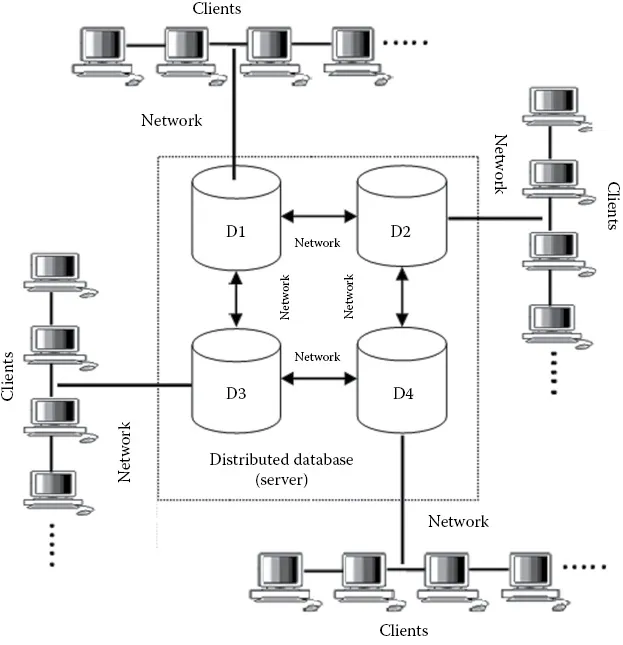
Figure 1.1
Components of distributed database.
A database server is the software that administers a database, and a client is an application that requests information and seeks services from a server. Each computer in a system is represented as a node, and node in a distributed database system can be a client, a server, or both depending on the scenario taken into consideration. Each database server in the distributed database is managed by its local DBMS, and each cooperates to preserve the consistency of the global database. A software system known as distributed database management system (DDBMS) manages a distributed database and makes the distribution apparent to users. It consists of a logical database that is partitioned into a number of sections, and each is stored on one or more computer systems.
1.1.1Distributed Processing and Distributed Database
Distributed processing refers to the use of more than one computer (or processor) to run an application and perform the processing for an individual task. More often, distributed processing refers to local area networks (LANs) designed so that a single program can run simultaneously at various sites. Most distributed processing systems contain a sophisticated software that identifies idle CPUs on the network and parcels out programs to make use of them. Distributed processing is composed of distributed databases, wherein the data are stored across computer systems, generally two or more in number. The database system generally keeps track of the location of data so that the distributed character of the database is not evident to users (Manpreet Kaur 2014).
The main goal of a distributed processing system is to connect users and resources in a transparent, open, and scalable way. Ideally, the arrangement in distributed processing system is drastically more fault tolerant and more powerful than many combinations of stand-alone computer systems. Resource sharing, scalability, fault tolerance/robustness, and performance/speed are other benefits of distributed processing.
1.1.2Parallel DBMS and DDBMS
Despite the explosion in terms of speed, computers are not able to keep up with the scale of data becoming available. Manufacturers have come up with the solution known as multiple processors to outwit physical and mechanical limitations on speed of individual processor. The availability of more than two processors definitely boosts up the speed of program getting executed drastically, wherein when one processor is performing a particular aspect of some computation, other computation can be performed by other available processors and the work will advance in parallel. In order to be able to work together, several processors need to be able to share information with each other. Parallel processing can be considered a subset of distributed computing, wherein a single computer uses more than one CPU to execute programs (Manpreet Kaur 2014). A distributed system is a network of independent computers that interact with each other in order to achieve a goal and do not physically share memory or processors. They communicate with each other via messages, which are basically a piece/pieces of information transmitted from one computer to anothe...
Table of contents
- Cover
- Half Title
- Title Page
- Copyright Page
- Contents
- Preface
- Editor
- Contributors
- 1. Distributed Transaction Processing
- 2. X/Open Distributed Transaction Processing Model Using EJB and MTS
- 3. Data Migration Techniques from SQL to NoSQL
- 4. Comparative Study on Mostly Used NoSQL Databases
- 5. NoSQL and Cloud Paradigm: Characteristics and Classification, Data Storage Technology, and Algorithms
- 6. A Scalable Record Linkage Technique for NoSQL Databases Using GPGPU
- 7. NoSQL for Handling Big and Complex Biological Data
- 8. Applications of Hadoop Ecosystems Tools
- 9. Hadoop Ecosystem Tools and Algorithms
- 10. Big Data Management Tools for Hadoop
- 11. Realization of Optimized Clustering Algorithm on RHadoop
- 12. Security and Privacy: Challenges and Defending Solutions for NoSQL Data Stores
- 13. Challenges and Security Issues of Distributed Databases
- 14. Security Issues and Privacy Challenges of NoSQL Databases
- 15. Attack Graph Generation and Analysis Using Graph Database
- 16. Hands-On Aerospike
- 17. Hands-On Cassandra for Windows
- 18. Hands-On Cloudant
- 19. Hands-On InfluxDB
- 20. Hands-On Redis
- 21. Hands-On RethinkDB
- 22. Hands on Neo4j: Graphs for Real-World Applications
- 23. Tutorial on MongoDB
- 24. Introduction to Oracle NoSQL Database
- 25. Hosting and Delivering Cassandra NoSQL Database via Cloud Environments
- Index
Trusted by 375,005 students
Access to over 1.5 million titles for a fair monthly price.
Study more efficiently using our study tools.
Frequently asked questions
Yes, you can cancel anytime from the Subscription tab in your account settings on the Perlego website. Your subscription will stay active until the end of your current billing period. Learn how to cancel your subscription
No, books cannot be downloaded as external files, such as PDFs, for use outside of Perlego. However, you can download books within the Perlego app for offline reading on mobile or tablet. Learn how to download books offline
Perlego offers two plans: Essential and Complete
- Essential is ideal for learners and professionals who enjoy exploring a wide range of subjects. Access the Essential Library with 800,000+ trusted titles and best-sellers across business, personal growth, and the humanities. Includes unlimited reading time and Standard Read Aloud voice.
- Complete: Perfect for advanced learners and researchers needing full, unrestricted access. Unlock 1.5M+ books across hundreds of subjects, including academic and specialized titles. The Complete Plan also includes advanced features like Premium Read Aloud and Research Assistant.
We are an online textbook subscription service, where you can get access to an entire online library for less than the price of a single book per month. With over 1.5 million books across 990+ topics, we’ve got you covered! Learn about our mission
Look out for the read-aloud symbol on your next book to see if you can listen to it. The read-aloud tool reads text aloud for you, highlighting the text as it is being read. You can pause it, speed it up and slow it down. Learn more about Read Aloud
Yes! You can use the Perlego app on both iOS and Android devices to read anytime, anywhere — even offline. Perfect for commutes or when you’re on the go.
Please note we cannot support devices running on iOS 13 and Android 7 or earlier. Learn more about using the app
Please note we cannot support devices running on iOS 13 and Android 7 or earlier. Learn more about using the app
Yes, you can access NoSQL by Ganesh Chandra Deka in PDF and/or ePUB format, as well as other popular books in Informatique & Cloud Computing. We have over 1.5 million books available in our catalogue for you to explore.