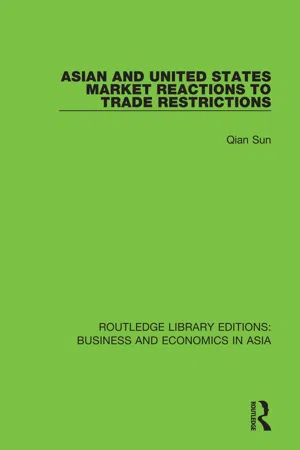
The effect of US protectionist policy on stock prices of firms in the US and abroad is still an open question. This book, first published in 1996, investigates the effects of trade restrictions at the level of the individual firm, focusing on US, Taiwan and South Korea.
- 162 pages
- English
- ePUB (mobile friendly)
- Available on iOS & Android
eBook - ePub
Asian and United States Market Reactions to Trade Restrictions
III
Trade News and Stock Prices
3.1 A Dynamic Setup
In the simple efficient markets model, the stock price Pt of a share at the beginning of the time period t is given by
where Dt is the dividend paid at the end of time t, Et denotes the mathematical expectation conditional on information available at time t, and r is the expected cost of equity or required rate of return on equity for k+1 periods, i.e.,
rt+k for k≥0 is determined by the security market line,
where Rf and Rm are the risk free rate and the market rate respectively, and ß is the systematic risk of the firm. Therefore, r depends on the current and the expected future path of Rf, Rm and ß.
Following Shiller (1981), we adopt the innovation notation which will facilitate our analysis. We define the innovation operator as σt ≡ Et - Et-1. Then for any variable Xt, we can write
namely, σtXt+k represents the change in the conditional expectation of Xt+k that is made in response to newly arrived information between time t-1 and t. Since conditional operators satisfy EjEk = Emin(j,k),
where m≥l.
The implication from (3.5) is that σtXt+k must be uncorrelated with σt, Xt+j t’<t for all js and ks. This means that innovations in expectations are serially uncorrelated, which is consistent with efficient markets.
We know for one period holding, the stock price is:
or
Therefore,
where ΔPt = Pt - Pt-1; Dt-1 - rt-1Pt-1 is the adjustment for the dividend paid out at the end of time t-1 and the time value of Pt-1. Both Dt-1 and rt-1Pt-1 are in the information set at time t and they constitute a forecastable part of the price innovation. However, Dt-1 - rtPt-1 is negligible in the data set that we are going to use. Therefore, σtPt is approximately equal to the price change, ΔPt. According to Samuelson (1965), σtPt is unforecastable by efficient markets.
On the basis of the above analysis, we have
This means that the price change depends on the innovation of the discounted future dividend stream. Any new information which can cause a revision of the expected future dividend stream and/or the discount rate will affect the stock price.
Suppose that the discounted future dividend stream is determined by a vector of fundamentals related to the earning power1 and the discount rate, then the innovation of price will be affected by the innovations of all these fundamentals. For trade related firms, we can identify two fundamentals, trade restrictions TR and the exchange rates. For U.S. import-competing firms, an increase in the protection level, no matter if it is in the form of a tariff or non-tariff, will increase the barrier for foreign competitors. It will, in turn, increase the market power and profitability for the protected firms. The increased protection may also reduce the systematic risk ß for the protected firms because increased market power reduces the uncertainty these firms face relative to the market. For foreign export-oriented firms in general, if the protection is directed against them, they will lose their market share and their ß may also increase. Ceteris paribus, they should be made worse off. Therefore, an increase in U.S. trade protection will have a positive impact on the share prices of the protected firms and a negative impact on the share prices of the foreign rival firms.
Unexpected exchange rate changes may also have a significant impact on the share prices of trade related firms. A dollar depreciation will enhance the U.S. import-competing firms’ competitiveness in the market becau...
Table of contents
- Cover
- Half Title
- Title Page
- Copyright Page
- Original Title Page
- Original Copyright Page
- Dedication
- Table of Contents
- List of Tables
- List of Figures
- Foreword
- Preface
- I Introduction
- II Literature Review
- III Trade News and Stock Prices
- IV Empirical Investigation for U.S. Import-Competing Firms
- V Empirical Investigation for Taiwanese Export-Oriented Firms
- VI Empirical Investigation for South Korean Export-Oriented Firms
- VII Comparison and Conclusion
- Appendices
- Bibliography
- Index
Trusted by 375,005 students
Access to over 1.5 million titles for a fair monthly price.
Study more efficiently using our study tools.
Frequently asked questions
Yes, you can cancel anytime from the Subscription tab in your account settings on the Perlego website. Your subscription will stay active until the end of your current billing period. Learn how to cancel your subscription
No, books cannot be downloaded as external files, such as PDFs, for use outside of Perlego. However, you can download books within the Perlego app for offline reading on mobile or tablet. Learn how to download books offline
Perlego offers two plans: Essential and Complete
- Essential is ideal for learners and professionals who enjoy exploring a wide range of subjects. Access the Essential Library with 800,000+ trusted titles and best-sellers across business, personal growth, and the humanities. Includes unlimited reading time and Standard Read Aloud voice.
- Complete: Perfect for advanced learners and researchers needing full, unrestricted access. Unlock 1.5M+ books across hundreds of subjects, including academic and specialized titles. The Complete Plan also includes advanced features like Premium Read Aloud and Research Assistant.
We are an online textbook subscription service, where you can get access to an entire online library for less than the price of a single book per month. With over 1.5 million books across 990+ topics, we’ve got you covered! Learn about our mission
Look out for the read-aloud symbol on your next book to see if you can listen to it. The read-aloud tool reads text aloud for you, highlighting the text as it is being read. You can pause it, speed it up and slow it down. Learn more about Read Aloud
Yes! You can use the Perlego app on both iOS and Android devices to read anytime, anywhere — even offline. Perfect for commutes or when you’re on the go.
Please note we cannot support devices running on iOS 13 and Android 7 or earlier. Learn more about using the app
Please note we cannot support devices running on iOS 13 and Android 7 or earlier. Learn more about using the app
Yes, you can access Asian and United States Market Reactions to Trade Restrictions by Qian Sun in PDF and/or ePUB format, as well as other popular books in Business & Business General. We have over 1.5 million books available in our catalogue for you to explore.