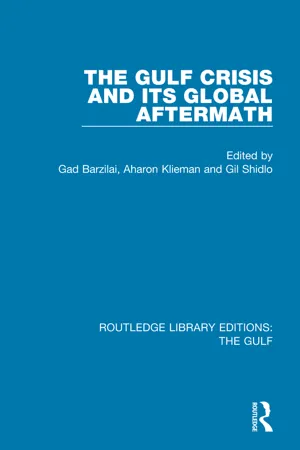
The crisis in the Gulf of 1990-1 affected more than just the regional powers in the area. Rippling outward, its military, economic and political effects were felt throughout the international political system, testing US steadfastness in the face of Saddam Hussein's political survival, European ability to form a united front on foreign policy issues and the effectiveness of the UN in confronting international aggression. The rationale behind this book, first published in 1993, is to investigate and analyse the various aspects of the crisis, especially in regard to the interactions between internal and international prospects for a new order in the Middle East. It also examines the wider effects of the war, and includes analysis of Europe, America and the Soviet Union. Each one of the essays chosen for this volume has been written by an expert in their field. This collaboration between historians, regional specialists and political scientists, integrating a variety of research methods in the framework of one book, will be useful to a wide range of readers.
- 304 pages
- English
- ePUB (mobile friendly)
- Available on iOS & Android
eBook - ePub
The Gulf Crisis and its Global Aftermath
About this book
Information
1 Lost in the shuffle
The threatened marginality of the Gulf Crisis for international relations enquiry
Aharon Klieman
The great Gulf confrontation of 1990-91 is withdrawing into the recesses of our collective historical consciousness. Not so long ago the most minute details stood out in sharp relief; now only the broader contours remain. And as the overall event recedes still further, what was perceived of at the time as an acute world crisis - indeed, in the eyes of many a defining moment in global affairs - could very well be downgraded, and relegated to marginal status.
An initial discordant note is sounded at the practitioner level, with criticism raised in retrospect at how individual leaders, state actors and systemic agents sought to cope with the stressful Middle East challenge. If taken, for example, as a paradigm for international crisis management, Iraq's aggression against Kuwait and eventual containment yield mixed reviews owing to errors of omission and commission. This disappointment is echoed, in the second instance, because of the secondary impact the Persian Gulf crisis has had thus far in framing the current agenda of international relations. Nor do we find improved prospects for its doing so in the future.
Any subsequent renewed crisis confrontation in southern Iraq only accelerates the act or process of forgetfulness. Because the entire thrust of analysis and commentary is given to the later round of political-military re-engagement at the expense of the earlier phase. If not actually pushed into oblivion, those formative events would merely serve as the background for reminiscence and perspective, but not as a subject in their own right for closer, in-depth study.
Crisis Conventions
A good deal of the problem lies in the analysis of data and interpretation of events. When looking at the initial two phases - threat detection and conflict avoidance - it is fair to say that once the crisis erupted the American administration, and President Bush in particular, earn high marks for resolve in painstakingly building up domestic support while simultaneously orchestrating an exceptionally heterogeneous coalition and assembling a credible military option. Yet the fact remains Kuwait was ignored as a potential flash-point prior to 2 August 1990. Arguably, had US intelligence analysis correctly assessed Iraqi intentions early on, and an unambiguous cautionary signal of casus belli been transmitted to Baghdad,1 two cardinal rules of crisis management might have been honoured at the very outset: avoid strategic surprise, and strive to prevent crisis.2 Moreover, of course, on 17 January 1991 actual fighting did ensue, thereby climaxing a belated, and ineffectual, exercise in crisis diplomacy.
In restructuring the chronology of crisis, the record is similarly inconclusive in the next phase. Here the application of overwhelming military preponderance by the US-led alliance seemed virtually flawless at the time, except that subsequent declassified reports have exposed a number of tactical shortcomings. Major Iraqi military installations that either went undetected or undamaged are merely one illustration; the relatively high casualty rate among allied ground forces from friendly fire another; the mixed performance of sophisticated weapons systems yet another. Still it can be argued that defusing the crisis and bringing it to a satisfactory conclusion - the ultimate bottom line in grading successful crisis performance - were achieved, and achieved brilliantly. What better confirmation than the primary objective in liberating Kuwait and rolling back the aggressor through a limited, controlled war.
Indeed, at first glance this favourable outcome to the crisis suggests outstanding success in the fourth and decisive phase of crisis termination. However, here, too, any inclination to put forward the Gulf as a model for crisis management is dampened by the mounting realization that the denouement on 3 March 1991 in many ways was inconclusive, if not unsatisfactory. Whatever else, surely references to victory (in the strict scientific meaning of the term as unilateral, unconditional and undisputed) were exaggerated and hence inappropriate. The follow-up to the crisis found its precipitator, Saddam Hussein, unrepentant and defiant, his staying power and regional pretensions encouraged by retention of a still formidable conventional arms capability.
Our ambivalence towards how accepted conventions of crisis may or may not have been applied in the case of the Gulf doubtless will further increase the more removed we become from the drama itself. This uncertainty is only exacerbated by the deeper underlying political issues which the conflict failed to resolve, such as the plight of the Kurds, the lingering insecurities of Iraq's neighbours to the south, oil dependencies, a refuelled regional arms race and, permanently at the background of Middle East politics, the appeal of Islamic fundamentalism and political radicalism.
Contrasting Professional Responses
Dissonance over the consequences of the Gulf War, nevertheless, would appear to be having a positive, salutary effect in one sense at least. Picking up where the earlier stream of media commentary left off at the end of the protracted seven-month conflict, a healthy debate has continued among historians. Which is precisely the contrast I wish to make, because it is a source of professional concern that international relations specialists have been slow to rise to the challenge offered by the 1990 crisis, and not solely in terms of possibly refining crisis theory.3 This does not imply that the agenda for the study of international relations is not undergoing meaningful change in a period of turbulence; only that these changes and new emphases owe less to the Gulf crisis than one might expect.
In fairness, it is perhaps too soon to expect a tremendous output of scholarly work inspired by the Gulf experience. Nevertheless, in this second year of the post-crisis period there is a perception, admittedly more impressionistic than empirically substantiated, of an intellectual opportunity about to be lost.
A Missed Opportunity
If our interim assessment is correct, disappointment is that much greater since the Gulf drama had all the makings of a perfect catalyst for professional progress in two directions: 'the breaking of conceptual jails' encouraged by Rosenau,4 even as we seek 'to isolate those factors that are likely to be the driving forces of history' urged by Mearsheimer.5
What recommends Gulf-oriented scientific inquiry are, Halliday's 'three concentric circles' for developing the discipline of international relations: change and debate within the subject itself, the spillover of fresh ideas within other areas of social science and the impact of actual events.6 This especially holds true when the latter is the genuine article - those rare system-transforming crises with the capacity to alter both (a) the existing structures of a particular international order (the hierarchy of states, the balance of power) and (b) its 'rules of the game' (legal conventions, diplomatic codes).7
The Middle East crisis is further distinctive for having posed the first real challenge to the post-Cold War international system. Closely related, it also inspired 'New World Order' enthusiasts to proclaim a new ethic of conduct in world affairs marked 'by acceptance and not by rejection ... by dialogue and not by violence ... by cooperation and not by conflict ... by hope itself, and not despair';8 in short, the end to what Bull, in his classic study, describes as 'the anarchical society'.9 The 'new era' - 'new thinking' perspective, by sharing with the school of 'endism' an extreme interpretation of contemporary world history and politics as crossing a great divide, surely calls for the testing and validation of first postulates in light of the Gulf experlence.10
Lastly, what unfolded in the Middle East also qualifies as an exceptionally integrative event. Few recent global developments quite equal the Gulf power contest for sheer complexity: the multiplicity and diversity of participants, the entanglement of interests at stake, the web of interactions and sequence of moves, the far-reaching ramifications. This interplay of variables in turn highlights, among other things, the strong influence of domestic-external linkages. It recommends the synthesis of all three foci of international relations studies: man (perceptions), the state (interests) and the international system (environmental factors). And it so nicely mirrors the many cross-currents governing prospects for stability at least through this decade. In a word, part of the Gulfs fascination should lie in the presence of nearly every theme we teach, research and argue over within the profession.
To date, however, Gulf-related questions are being addressed by the military sciences more than the political or social sciences, giving an additional boost to security studies broadly defined at the expense of what traditionally fell under the purview of foreign and international affairs,11 and making it harder to distinguish what Gabriel Garcia Marquez terms the 'ingenuity of politics' from the 'intuition of warfare'12
In so far as international relations studies are concerned the Gulf has failed to register an intellectual shock-wave. What bearing has it had, for instance, on the contention made by Keohane and Nye that sovereign states have all but forfeited their Westphalian saliency to non-state supranational and transnational actors?13 After 'the mother of all battles', how convincing is Mueller's proposition about warfare sinking into obsolescence, going the way of duelling, slavery and colonialism before it?14 Have economics, interdependence and functional cooperation really come to supersede geopolitical preoccupations like national identity, territory and security which traditionally have ranked at the top of international concerns?
The point is not the lack of definitive answers, which is understandable. Only that at the time of writing, what might have been a stimulating exchange occasioned by the Gulf over the prevailing wisdom is rather desultory. Before proceeding to volunteer some useful avenues for study and discourse inspired by what we witnessed in the Middle East, I will hazard several possible explanations why international relations specialists might be deterred from wrestling with the theoretical implications of the Gulf conflict.
Five Mitigating Factors
One possible deterrent has already been mentioned in passing; namely, the inconclusive outcome. By way of contrast, the positive finish to the 1962 Cuban missile crisis - with everyone a winner - nevertheless must have emboldened Allison to use it as the illustration for his three conceptual models or 'cuts' of state behaviour.15
No less treacherous than its mixed signals and subjective, often contradictory 'lessons' is the dazzling complexity of the Gulf affair also alluded to earlier. The weight of detail alone, plus the seemingly limitless number of intervening variables, is intimidating, and could easily scare off many students of international relations. There is, to be sure, the very real fear of not getting the analysis right: by mistaking the key driving forces behind the crisis, by confusing dependent and independent variables, by overlooking the real determinants, or by simply failing to master the flow of crisis events.16
No matter how intensely eventful it may have been in its own right, the Gulf chronology of crisis merges like a tributary into the still larger flow of global affairs. Mindful of this, we are led to a set of two additional mitigating factors, the first being that the international environment of the 1990s may discourage our pausing to zero in on the Gulf per se. Relentless, accelerated change constantly redirects our attention and professional skills to the latest fast-breaking global development as the world system lurches from one drama and one tension spot to another. Under the ceaseless barrage of headlines, save perhaps for the occasional doctoral candidate who can afford the luxury of dealing in isolation with the ageing tale of Iraqi crime and punishment? The Gulf, in short, threatens to be left behind scholastically, outpaced and overshadowed by ever more current events
This same tendency to marginalize one of the more formative events of our time, treating it as merely episodic, is also reflected, on the other hand, from a macropolitical perspective. As memory fades, the Gulf crisis even now is being viewed less as a self-contained event than as but another link in the chain of historic events all contributing to, and illustrative of, a larger pattern of worldwide, systemic transformation. Bracketed between the collapse of the Warsaw Pact in 1989 and the collapse of the USSR in 1991, in all probability the 1990 crisis will lose its own distinctive identity together with whatever identifiable boundaries it may have had. The prospect of the Gulf simply being enveloped in the vast reshuffling of international politics is very real.
Going one step further, this line of thinking might argue that the authentic 'sea-changes' in world affairs (a) had little or nothing to do with the Gulf (b) preceded the Gulf and have been in motion since 1985;17 (c) have come to the fore really only since the Gulf.18 Whichever, the net effect is...
Table of contents
- Cover Page
- Half Title page
- Title Page
- Copyright Page
- Contents
- Figures
- Tables
- Acknowledgements
- Introduction
- 1 Lost in the shuffle The threatened marginality of the Gulf Crisis for international relations enquiry
- Part I Middle East tremors
- Part II Israel in the post-Gulf era
- Part III Great Power realignment
- Part IV Ripples worldwide
- Part V Future prospects for calm after the storm
- Name Index
- Subject Index
Trusted by 375,005 students
Access to over 1.5 million titles for a fair monthly price.
Study more efficiently using our study tools.
Frequently asked questions
Yes, you can cancel anytime from the Subscription tab in your account settings on the Perlego website. Your subscription will stay active until the end of your current billing period. Learn how to cancel your subscription
No, books cannot be downloaded as external files, such as PDFs, for use outside of Perlego. However, you can download books within the Perlego app for offline reading on mobile or tablet. Learn how to download books offline
Perlego offers two plans: Essential and Complete
- Essential is ideal for learners and professionals who enjoy exploring a wide range of subjects. Access the Essential Library with 800,000+ trusted titles and best-sellers across business, personal growth, and the humanities. Includes unlimited reading time and Standard Read Aloud voice.
- Complete: Perfect for advanced learners and researchers needing full, unrestricted access. Unlock 1.5M+ books across hundreds of subjects, including academic and specialized titles. The Complete Plan also includes advanced features like Premium Read Aloud and Research Assistant.
We are an online textbook subscription service, where you can get access to an entire online library for less than the price of a single book per month. With over 1.5 million books across 990+ topics, we’ve got you covered! Learn about our mission
Look out for the read-aloud symbol on your next book to see if you can listen to it. The read-aloud tool reads text aloud for you, highlighting the text as it is being read. You can pause it, speed it up and slow it down. Learn more about Read Aloud
Yes! You can use the Perlego app on both iOS and Android devices to read anytime, anywhere — even offline. Perfect for commutes or when you’re on the go.
Please note we cannot support devices running on iOS 13 and Android 7 or earlier. Learn more about using the app
Please note we cannot support devices running on iOS 13 and Android 7 or earlier. Learn more about using the app
Yes, you can access The Gulf Crisis and its Global Aftermath by Gad Barzilai,Aharon Klieman,Gil Shidlo in PDF and/or ePUB format, as well as other popular books in Social Sciences & Regional Studies. We have over 1.5 million books available in our catalogue for you to explore.