eBook - ePub
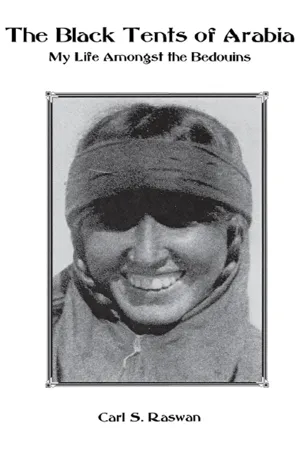
The Black Tents of Arabia
My Life Amongst the Bedouins
- 256 pages
- English
- ePUB (mobile friendly)
- Available on iOS & Android
eBook - ePub
About this book
Published originally in 1935, this is an account of twenty two years spent, off and on, among the Bedouins of Arabia, migrating, hunting, raiding, starving, feasting and making wonderful desert friendships. The author writes the book for 'the Lord of his fathers,' the king of Arabia 'Abdel-' Aziz ibn Sa'ud el Wahhab and his governors and chiefs in Neijd, Hasa, Jauf, and Kaf and Amir Nuri Sha'lan, his family and tribe of the Ruala. An intimate account of the tradition and ancestors of the Bedouin.
Trusted by 375,005 students
Access to over 1.5 million titles for a fair monthly price.
Study more efficiently using our study tools.
Information
Subtopic
AnthropologyIndex
Social SciencesPART ONE
THE HEIRS OF ISHMAËL
CHAPTER I
THE YOUNG PRINCE OF THE RUALA, AMIR FUAZ
THE setting sun painted in delicate tints the naked hills of the Jabal Ruak.
In the south-west, black tents and fawn-coloured camel-herds covered the close-cropped plain of Tueyf. Armed men on nimble mares galloped towards us, as I, accompanied by a few horsemen, for the first time in my life approached the woven goat-hair “houses,” a camp of the Ruala Bedouins.
The mounted sentries, who had come to meet us, conducted us to the smoke-blacked tent of an old slave. It was here I was received by Amir Nuri Sha’lan, the grey-bearded prince of the tribe.
The aged Nuri had lately (it was two years before the outbreak of the Great War) exchanged, not without reason, his own comfortable tent for the mean shelter of one of his slaves. He was in hiding. He had been warned of the activity of blood-avengers, men of his own kith and kin. For in the struggle for the head-ship of the tribe he had shot one of his brothers with his own hand, and his slaves had killed another. Their sons, now grown to manhood, were not only seeking to avenge the murder of their fathers, but also to wrest the position of chieftain from Nuri Sha’lan.
While Nuri thus stood at bay against enemies in his own tribe, his eldest son, Nauaf, was charged with leading the Ruala against their external enemies. Nuri was the father of a large family and was in fact credited with eighty-two children, of whom thirty-seven were sons, nearly all of whom died violent deaths.
A few days after this first meeting with Nuri Sha’lan, I paid a visit to Nauaf, whose tents were pitched a day’s ride away by the rainwater pools of Rukuban, one hundred and twenty odd miles east of Damascus.
Nauaf differed greatly from his father. He lacked the old Sheykh’s strong personality. Nor had he the talent to organize for warfare a tribe so vast as the Ruala, with its seven thousand tents, thirty-five thousand souls, and over three hundred thousand camels.
He had just mustered another small camel-troop to strengthen his forces operating against Jauf, the oasis at the south-eastern end of the wide, fertile depression of the Wadi Sirhan. They had already taken a few lesser fortified outposts. But these successes had brought Nauaf little credit: neither from his own tribesmen nor from the subjugated settlers could he win the respect which would have consolidated his position. Moreover, this attack on Jauf was a reversal of tribal policy. From of old the Ruala had peacefully traded with that oasis, bartering their camels, wool, cheese, and butter for dates, barley, salt, coffee, tent fittings, camel saddles, and textiles. Suddenly, and quite against the old Sheykh’s intentions, Nauaf conceived the scheme of monopolizing that trade for himself and occupying the oasis as a strategic stronghold from which to dominate Northern Arabia and the caravan routes to Nejd.
Within sight of Jauf opens out the great, red-sand desert of the Nufud, which extends more than three hundred miles from east to west and nearly two hundred miles from north to south. Its northern half, called El-Labbe, forms the proper grazing-ground of the Ruala. Their real home is there. The southern part is held by the Shammar Bedouins, who have made Hayil, on the southern edge of the Nufud, their trading centre.

FARIS, WHO MORE THAN ANYONE MADE MY LIFE IN ARABIA BEAUTIFUL BY HIS FRIENDSHIP

TUËMA
The beautiful bride of Faris. The life and death of my friend Faris and his love for Tuëma inspired me to write this book.
The beautiful bride of Faris. The life and death of my friend Faris and his love for Tuëma inspired me to write this book.
Until after the Great War, the Shammar were ruled by Ibn Rashid, a renegade governor of the Ibn Sa’ûd family, who with his negro bodyguard had rebelled against his masters and had taken Hayil. Ibn Sa’ûd, however, succeeded in recovering that dominant position, which secured him undisputed power in Central Arabia (Nejd, Kasim, and Hejaz).
The efforts Ibn Sa’ûd made to weld all the tribes into one national unit, his subjugation, in campaign after campaign, of all Shyuks (Sheykhs) who resisted him, are well known. Now, at the time of my first sojourn in the land of the Bedouins, this Ibn Rashid, the traitor governor, had still the greater part of Inner Arabia under his power. He became so completely sovereign that his former masters, the Ibn Sa’ûd family, had to live for decades in exile, while the “Black Princes” held sway over the towns and oases as well as the many Bedouin tribes of Central Arabia. In the history of Arabia there are few bolder achievements than Ibn Sa’ûd’s recovery, with a mere handful of men, of his capital, Riyadh, his subjugation of Hayil and the Shammar, until he, adding success to success, became at length the virtual dictator of Arabia, to whom the world to-day accords its sincere admiration.
At the time of which I speak, however,—in 1912—Nauaf, the son of Nuri Sha’lan, was at war against the hereditary enemy of the Ruala, the Shammar Bedouins and their ruler, Ibn Rashid, who held Jauf. The capture of that oasis was the objective of long and bitter fighting. Much blood was shed; every year took its long toll of human lives. Now, however, Nauaf had come close to his goal and soon Jauf actually fell into his hands.
Nauaf had three sons, amongst whom was the young Prince, Amir Fuaz; it is with him I would begin my tale. For to this child I owe the fact that I was privileged to live with the Ruala as one of them, that I was permitted to visit them eleven times in twenty-two years; that I wandered, hunted, and fought with them; that on horseback or camel-back, I crossed and recrossed their grazing-grounds year in and year out; that I was adopted into the tribe as a Rueyli chieftain; and that they knew and loved me as I knew and loved them.
Amir Fuaz was just eight years of age. Even so, he already had the reputation of being an adroit rider and a good shot, though his legs were as yet rather short to grip the flanks of a mare and his arms too weak to balance a carbine for any length of time. “Wordly learning,” as the Arabs call reading and writing, held no interest for him. He preferred to go camel-riding with me or to join in the hunt. His mother, Misha’il, who had gone blind, proudly related to me that it was an omen of good for the future that Nuri Sha’lan had laid the halter of his war-mare and a silver khanjar in the boy’s cradle. The small khanjar is a curved dagger, and it was with this very one Nuri had killed in single combat a minor chieftain of the Muntefiq.
One afternoon young Fuaz and a company of his boy friends were practising with slings, the ancient weapon with which David slew Goliath. They shot flat pebbles with astounding accuracy at the curved wooden pegs, a foot high, of a tent some thirty paces distant. Unseen by them I suddenly stepped out from behind this tent. A stone, which had hit its target close to me, rebounded from the smooth wood and struck me on the forehead, between the eyes. For a moment I was nearly stunned, more perhaps from shock than from the actual blow. My first thought was that I had been struck by a bullet.
Gasping and with a frightened face, Fuaz ran up to me. He had noticed the wound in my forehead and a few drops of blood on my fingers, which I had, in my confusion, pressed to my head. When I took the lad in my arms and laughingly lifted him up to let him know that it was no great matter, a look of anger crossed his face, as if he had been offended. He wriggled free and stood still before me. Then he tore his aghal and kaffiyah (the veil and head-clothing) from his head, letting the six fine braids of his hair fall over his shoulders. They reached to his hips. With tears welling from defiant eyes, he cried: “Ana dachilak! Before the face of God I deliver myself unto you: tell me the price of your blood.” It sounded not in the least regretful, nor did it suggest any wish to be forgiven. It was sheer defiance, because he thought I had made fun of his offer.
How my heart went out to the wild, little creature! He had such an air of aloofness and arrogance. Yet it would have been impossible to be angry with him. Was not his whole way of thinking different from a European’s? Quite unintentionally he had the blood of his father’s guest on his conscience, and he only thought of the satisfaction due to me, before the news of this accident could travel any further. How much blood was shed—in this case only a few drops—did not matter; the only thing that mattered was the unwritten Bedouin law, that secures to the stranger absolute safety and inviolability, even in the tent of the humblest nomad. The blood-price of a guest is reckoned twice as high as that of a man killed in fight—fifty camels and four mares.
I had to smile when I thought of the value set on a few drops of my blood. But outwardly I composed my face to due solemnity and, calling the other boys and some men, who had gathered round out of curiosity, as witnesses, I said to Amir Fuaz: “This has happened according to the will of Allah. I know no other price than thy friendship.”
For a moment blank amazement! He stared at me wide-eyed. Probably Amir Fuaz could not yet believe it possible that I, a stranger, should invoke the ancient custom of his forefathers. Suddenly he flung away the fateful sling and advanced to me with outstretched arms, and with childish affection he clasped them round my neck as I bent down to him. In a wave of joyous love I pressed the youngster to my breast and kissed him on both cheeks. With his little finger he lightly dabbed the scratch on my forehead and rubbed four drops of blood on his own forehead between his black eye-brows—the old Bedouin “Nur ed-Dam,” the “Light of Blood.”
In this unusual, dramatic fashion I became, by the will of Allah, the blood-brother of Amir Fuaz.
Our friendship was soon to receive baptism by fire. A band of Ruala, two hundred and sixty-eight warriors, led by Rasheyd-ibn-Whafa, set out on a ghazu (raid) into the Hamad and the Wudian region, against the Shammar Bedouins, and I accompanied them. We rode twelve hours the first day. In camp that night we were overhauling our riding gear, water-skins, and so forth, when to our amazement we discovered, curled up in one of the goat-hair camel saddle-bags—huge receptacles made of goat skins—little Amir Fuaz, sound asleep.
Not by the slightest sound nor sign had he betrayed to us during the long and hard day’s ride that we were carrying a stowaway. Our leader, Rasheyd (of the Muraf Ruala) wanted the boy taken home on the morrow by a camel-rider, but Fuaz pleaded so earnestly that the heart of the old free-booter was softened. He merely sent a mounted messenger to Misha’il’s camp to let her know that her son was with us.
We were gone on this great ghazu almost two months. When we returned, worn out, having suffered serious losses, yet victorious, Amir Fuaz took four of the booty-camels, splendid fawn-coloured beasts, into the camp, and made them kneel before the tent of his blind mother. Misha’il, still a young woman, enquired pleasantly who was the stranger seeking her hospitality. Custom forbade asking direct questions of a stranger. A Rueyli called out: “Khalati—it is a great prince, who comes, O blessed daughter, to honour thee.”

THE MEJLISTHE
The Assembly of the Shiyukhs. The young Prince of the Ruala and the Author in company with relations and slaves of the chief.
The Assembly of the Shiyukhs. The young Prince of the Ruala and the Author in company with relations and slaves of the chief.

ARABIA DESERTATHE
The great nomad-city of the Ruala; 7000 tents assembled together. An unusual amount of rain-water had collected in a depression, causing the tribe to rally to this spot and form one of the largest camps in their history.
The great nomad-city of the Ruala; 7000 tents assembled together. An unusual amount of rain-water had collected in a depression, causing the tribe to rally to this spot and form one of the largest camps in their history.
“And where is his dira (pastures) that I may send Hamar, our old slave, to proclaim him to our neighbour?”
“His name is ‘The Young Falcon,’ and his dira extends as far as his eyes rove. It is thy son, O mother of Amir Fuaz.”
In this foray, Rasheyd, the leader, had his right hand severed by a sword cut. He fainted from loss of blood. Our slaves then plunged the mutilated arm in boiling fat—a desperate remedy but successful, for Rasheyd recovered. He carried his amputated hand from that day forward in the saddle of his racing camel, It dried up completely, like the hand of a mummy.
When we reached Bahr Saigal, not far from Dumeyr, the first Turkish fortress in Syria, its Commandant sent a cavalry detachment to our camp. He had been informed by telegraph of our illicit operation...
Table of contents
- Cover
- Half Title
- Title Page
- Copyright Page
- Dedication
- Table of Contents
- PART ONE THE HEIRS OF ISHMAËL
- PART TWO HUNTING AND WARFARE
- APPENDICES
Frequently asked questions
Yes, you can cancel anytime from the Subscription tab in your account settings on the Perlego website. Your subscription will stay active until the end of your current billing period. Learn how to cancel your subscription
No, books cannot be downloaded as external files, such as PDFs, for use outside of Perlego. However, you can download books within the Perlego app for offline reading on mobile or tablet. Learn how to download books offline
Perlego offers two plans: Essential and Complete
- Essential is ideal for learners and professionals who enjoy exploring a wide range of subjects. Access the Essential Library with 800,000+ trusted titles and best-sellers across business, personal growth, and the humanities. Includes unlimited reading time and Standard Read Aloud voice.
- Complete: Perfect for advanced learners and researchers needing full, unrestricted access. Unlock 1.5M+ books across hundreds of subjects, including academic and specialized titles. The Complete Plan also includes advanced features like Premium Read Aloud and Research Assistant.
We are an online textbook subscription service, where you can get access to an entire online library for less than the price of a single book per month. With over 1.5 million books across 990+ topics, we’ve got you covered! Learn about our mission
Look out for the read-aloud symbol on your next book to see if you can listen to it. The read-aloud tool reads text aloud for you, highlighting the text as it is being read. You can pause it, speed it up and slow it down. Learn more about Read Aloud
Yes! You can use the Perlego app on both iOS and Android devices to read anytime, anywhere — even offline. Perfect for commutes or when you’re on the go.
Please note we cannot support devices running on iOS 13 and Android 7 or earlier. Learn more about using the app
Please note we cannot support devices running on iOS 13 and Android 7 or earlier. Learn more about using the app
Yes, you can access The Black Tents of Arabia by Cari S. Raswan,Raswan,Carl S Raswan in PDF and/or ePUB format, as well as other popular books in Social Sciences & Anthropology. We have over 1.5 million books available in our catalogue for you to explore.