- 382 pages
- English
- ePUB (mobile friendly)
- Available on iOS & Android
eBook - ePub
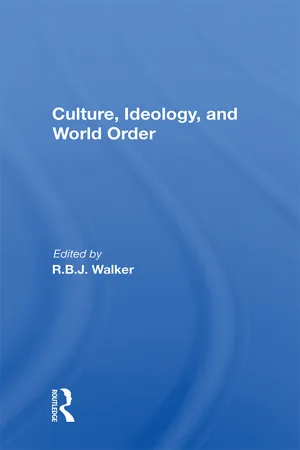
Culture, Ideology, And World Order
About this book
Contemporary discourse about human affairs is largely grounded in the specific historical experience and interests of a few dominant societies. This poses an important challenge to all those who urge that we need to adopt a global perspective on modern political life, whether in terms of international relations, comparative and developmental politi
Information
Part 1
Introduction
Chapter 1
East Wind, West Wind: Civilizations, Hegemonies, and World Orders
R.B.J. Walker
I
Cultural and ideological themes have been invoked with increasing regularity in the analysis of international affairs. Whether addressing Islamic radicalism, strategies of autonomous development, resurgences of nationalism, debates over human rights or international law, critiques of the monopolization of communications media by the industrialized states, attempts to demystify Western notions of economic growth and political development, or calls for a dialogue of cultures in the creation of an emerging global society, it now seems less useful than ever to view global tensions only in terms of explicitly economic and military structures.
The essays in this volume are brought together to underline the importance of cultural and ideological issues in contemporary world politics and to point toward some of the complex theoretical difficulties that arise once they are taken seriously. The essays derive from a variety of theoretical and doctrinal viewpoints, yet they all engage in one way or another with an issue that has to be confronted in any attempt at understanding world politics with even a minimum of critical sensitivity. Although many analysts now agree that it is necessary to examine world politics as a totality and to adopt a global perspective on human affairs, contemporary discourse about world politics is still grounded in the specific experience and interests of particular historically and geographically delimited societies, not to mention classes in those societies. Viewed in terms of "culture," this gives rise to the problem of ethnocentrism, the tendency to assume the superiority and universal nature of one's own cultural values. Viewed in terms of "ideology," it appears as a form of political power: assumptions of cultural superiority play a part in the domination of the strong over the weak. Some observers have begun to suggest that we are entering an epoch that will be characterized increasingly by a clash of civilizations and a decline of the current hegemony of Western cultural forms. This in turn gives rise to enquiries into ways in which ethnocentrism might be transcended, in which cultures might meet in a creative dialogue about future possibilities. Other observers, emphasizing the more critical concept of ideology rather than that of culture, seek to unravel the ways in which specific concepts and discourses have played an essential role in maintaining the dominant position of the West in the world.
To suggest that culture and ideology are crucial for analysis of world politics is not necessarily to take an idealist position on the matter. On the contrary, it is important to recognize that ideas, consciousness, culture, and ideology are bound up with more immediately visible kinds of political, military, and economic power.1 But it is all too tempting to lapse into the kind of crude reductionism in which culture, ideology, and so on are treated as mere epiphenomena determined by something supposedly more fundamental. Indeed, the very assumption of a clear-cut division between a realm of "ideas" and one of "matter" can itself be seen as an ideological form associated with historically specific traditions of Western philosophy and science. Almost the entire development of the concept of ideology has in fact centered on ways of overcoming the debilitating effects of simplistic dualistic formulations of the political role of ideas and of associated notions of determinism.
Lapses into crude reductionism are common enough both in the conservative schools of realpolitik and in the more deterministic brands of international political economy. Some might argue that blunt analytical tools are all we need to illuminate the crude "realities" of world politics. But then, students of this subject are sharply divided about precisely what these realities are--a states system, a world economy, a world society, or some combination of each. In the face of such divergent conceptions, it is wise to be skeptical about any simplified representation of the nature of things--especially one that would eliminate the effects of human consciousness.
Nevertheless, to suggest that culture and ideology are important is to enter into a complex theoretical universe. Part of the intention of bringing these papers together is precisely to suggest that, despite the generally pragmatic and policy-oriented nature of most analyses of world politics, this is a realm that poses a range of difficult issues at least as significant as those raised by life within sovereign states, the usual focus of attention for social and political theory. As concepts, "culture" and "ideology" are themselves historically and sociologically specific, bringing with them meanings and implications that may require careful handling. Ideology, after all, has often become something "they" have—a doctrine, inevitably false, that has to be overcome by the guarantors of truth. And culture, like civilization, becomes something "we" have, distinguishing us from the barbarians outside. In the context of international politics, such concepts merely add to what is already a wide range of difficulties confronting any analyses of an emerging world order. And in the context of the development of social and political theory in general, they invite a renewed emphasis on such perennial themes as the opposition between the "one" and the "many," the "universal" and the "plural." For the conventional view of world politics has largely been pluralist and, indeed, relativist in inspiration, a matter of the continuous collision of the particular interests of supposedly autonomous states. More recently, the relativity of Western claims to universality has become the target of Third World criticism of the global hegemony of the modernized industrial states. In both cases, we are confronted by powerful challenges to the commonly voiced hopes for a form of political organization that expresses and embodies the universality of humankind.
It is this underlying tension between universalist aspiration and the claims of pluralistic relativism--a tension that has always been central to an understanding of world politics--that has emerged once again with renewed insistency in the literature on world order. It is a tension that has found a great number of historical articulations. In the Western tradition, perhaps the most important formulation was the contrast between the universalizing Enlightenment and pluralizing Romanticism. The Third World, we may recall, once began at the Rhine. Historically we find resonances of contemporary discussions in the contrast between the philosophies of, for example, Kant and Herder and in the relations between modernizing Europe and the Ottoman Empire. Much of the discussion of contemporary world order is still preoccupied with the dynamics of the spread of and resistance to a universalizing West. It therefore seems appropriate to approach the issues raised in recent analyses of culture and ideology in modern world politics in terms of this underlying historical and philosophical problematic, which can be invoked in a number of different ways.
II
For many observers, the necessity of taking some kind of global perspective on human affairs is no longer in doubt. From the broadest speculation about the future of humankind to more technical analyses of biospheric equilibrium, international political economy, or various world systems, the emphasis on a global context has come to be a major theme underlying all kinds of commentaries on the modern human condition.2 It is possible--indeed necessary--to be intensely skeptical about the specific contribution of any particular school of thought, but the general point has probably been made decisively enough.
However, because a global perspective challenges some of the more fundamental categories of thought within which human activity has come to be understood in the West, the implications of its adoption certainly are in doubt. The concept of politics, for example, becomes problematic. Viewed retrospectively, modern conceptions of the nature of politics have emerged in the context of the European state. Even though considerable variety and development can be found within this context, as a whole our present understanding of politics differs substantially from that which characterized, say, the Hellenic polis or the world of St. Thomas Aquinas. The development of the European nation-state was a phenomenon without precedent. Conceptions of politics appropriate to it, while drawing on the experience of the preceding social formations, emerged in the specific historical context of a transition from a feudal to a capitalist mode of production and the associated closing of territorial space. It is precisely the novelty of this transition, this movement to modernity, that becomes the focus of any serious attempt to understand modern political life. For some, following Marx, the transition can be portrayed in terms of a novel principle of social organization--the wage-labor-capital relation. Others, drawing more on Weberian themes, have been more concerned with the restructuring of consciousness. But whatever the substantive explanation or the variations in detail between different historical perspectives, our modern understanding of political life is tied inextricably to the experience of the post-Renaissance European state. As Perry Anderson has put it in a penetrating study, "the Renaissance remains--despite every criticism and revision--the crux of European history as a whole: the double moment of an equally unexampled expansion of space and recovery of time. It is at this point, with the rediscovery of the Ancient World, and the discovery of the New World, that the European state system acquired its full singularity."3
To suggest that it is necessary to take a global perspective on human affairs is thus to throw into question the continuing vitality of political forms specific to the European state. It is to raise the possibility that whereas the most difficult and important issues in social and political thought since Machiavelli have been concerned with life within sovereign states, they now increasingly concern the possiblity and character of life on a single planet.
III
It is also now clear enough that Western social and political thought is in the midst of considerable uncertainty and possibly significant transformation. Gone are the days when the social sciences could confidently pretend to imitate the physical sciences or appeal to some timeless methodological formula in order to condemn the recalcitrant ideologues or metaphysicians. Instead we witness a widespread sense of ambivalence about the kinds of assumptions that have guided the study of human activity for most of this century. The tale is usually told in terms of deeper difficulties within the traditions of Western philosophy, particularly those traditions preoccupied with epistemology. It is said, for example, that we have fallen too deeply into the grips of eighteenth-century empiricism, Cartesian or Kantian dualism, or mechanistic materialism and atomism; that we have not learned carefully enough from Hegel, Marx, Nietzsche, pragmatism, phenomenology, structuralism, or other attempts to escape the twin demons of objectivism and subjectivism.
Certainly this story captures much of what is most creative and fertile in modern sociopolitical thought. But it has one obvious and major deficiency. It tends to concern itself only with the intricacies of European or Western philosophy; to assume that a more authentic account of human experience would be possible if only we could discover some way out of the maze constructed by Descartes, Kant, Hegel, and the rest. For all the sophistication of much of the discussion of this issue, and for all the insistence that we take account of the specific historical and social grounding of philosophy in general and claims to universality in particular, the limited context of the contemporary debate tends to get obscured. The West is not the world. European philosophy is not the only discourse attempting to give meaning to human experience. The problems confronting modern industrial societies are not entirely the same as those facing most of humanity, although they are undoubtedly structurally related. In an age in which many of the major forces that shape the modern world are international or global in scope, the most obvious characteristic of recent discussions of the restructuring of social and political theory may well be its parochialism.
There is a well-known and all-pervasive response to this sort of complaint, one that comes in much the same form from widely divergent doctrinal positions. It is the response implicit in the unilinear view of history in which the West merrily leads the rest of the world down the road to modernity. Western philosophy is thus assigned a universal stature, and parochial traditionalisms are recommended to transcend their own limitations with this philosophy. Some simply think this is a good thing. Others evoke a tragic sense of loss reminiscent of Weber's portrayal of the "disenchantment of the world." We may progress or we may "progress." But from the universal histories of the Enlightenment down to those more recent scenarios of global salvation that have liberalism or socialism in the starring role, this attitude has been questioned too infrequently.
There has also been resistance to this response. Some, reacting to a presumed loss of innocence, have idealized the primitive, the exotic, the foreign. Others have claimed to see the imminent collapse of Western civilization, one of many such collapses among the cycles of history. More recently, resistance has taken the form of a critique of the ideological and cultural forms assumed by the global hegemony of the industrialized powers. Theories of "development," for example, are said to be a mere mask for the realities of "underdevelopment." The universalization of parochial social and political concepts thereby appears as part of a system of stratification, one in which poorer states are integrated into a global division of labor organized by, and to the advantage of, the dominant powers. More recently still, with the economies of the industrialized world in shock and with the forceful assertion of other civilizational traditions in the Middle East and elsewhere, it no longer seems inevitable that Western societies will continue to hold the initiative in human affairs. "East Wind prevails over West Wind" is an aphorism attributed to Mao, but it echoes in many languages in an increasingly complex world.
Out of sensitivities about the parochialism and ethnocentrism of the Western traditions of social and political theory in a global context, there has developed a substantial interest in other civilizations. Joseph Needham's attempt to come to terms with China and Marshall Hodgeson's work on Islam" are now well known and very important recent enterprises of this sort, but they are part of a much broader tendency. It is now remarkable only that this interest has not percolated very far into the debates about theoretical and methodological assumptions in the social sciences. For what seems to be the most important feature of Western social and political theory is that it is faced by internal and external critique simultaneously. The long-entrenched claims to universality made by Western sociopolitical theory and philosophy appear to be increasingly vulnerable both on their own terms and on those of other civilizational traditions that are able to assert themselves in the modern world.
However, it is one thing to say simply that we must escape the parochial, cease being ethnocentric, and be open to other civilizations. This can be a misleadingly seductive rhetoric. After all, the pitfalls of relativism or eclecticism are always waiting for the critics of a presumed universal reason. It is quite another thing to come to terms with the full implications of what a sensitivity to other civilizations might mean for social and political theory as we know it.
IV
In contrast with those who urge the necessity of adopting a global perspective on human affairs, most theorists of world politics are always quick to point out that we in fact live in a deeply fragmented world, with very little room for common agreement on the most basic necessities of coexistence. Schopenhauer's dictum that states exist like hedgehogs in a bag captures the prevailing tone quite nicely. And there are enough contemporary examples of conflict and brutality to drive the point home. The conventional image of international politics evokes a devious Machiavellianism or a Hobbesian state of nature, a version of original sin or a biologically induced lust for power. There may be rules of the game that allow for some degree of coexistence, or even, at times, for some kind of community of nations. Yet, in the end, the key rule of the game is the presumed legitimacy of war. Once upon a time, war may have been merely the sport of kings. Now there are fewer and fewer observers who give us a good chance of surviving the logic of the war system for much longer. A similar hardboiled cynicism characterizes the professional view of relationships between rich and poor states, or of the degradation of planetary ecology. The strong exact what they can, the weak grant what they must; the individual national interest always takes precedence over any common human interest.
This stark, conventional view often comes as a shock to those socialized within the cocoon of modern Western societies. In order to understand international affairs it becomes necessary to undergo a sort of ritualized deflation, a critique of the prevailing liberal values that, if directed at intrastate affairs, might even be thought subversive. Despite almost daily reminders, it is not always easy to comprehend the extent to which, say, the American way of life depends on the brutal exercise of power beyond its borders, on the underwriting of corruption and naked aggression on a global scale.
This form of selective vision is particularly endemic to the citizens of dominant powers. But it is a selectivity that is itself part of the basic structure of the modern state system. Within states, it is possible to envisage a perfect social order. Being perfect, the vision is easily assumed to be exportable to all other states--with a little persuasion from economic or military forces if necessary. The possession of "civilization" justifies the conquest of "barbarism." Such is one way to empire. But in a states system, perfection can remain relative; it develops in a variety of national forms. The tendency toward empire is thwarted by the fragmentation of powe...
Table of contents
- Cover
- Half Title
- About the Book and Editor
- Title
- Copyright
- Dedication
- Contents
- Preface
- PART 1. INTRODUCTION
- PART 2. CULTURES, ECONOMIES, AND STATES
- PART 3. HEGEMONY, RESISTANCE, AND REASSERTION
- PART 4. IDEOLOGY AND WORLD ORDER DISCOURSE
- PART 5. CULTURE, IDEOLOGY, AND PEACE
- Selected Bibliography
- About the Contributors
Trusted by 375,005 students
Access to over 1.5 million titles for a fair monthly price.
Study more efficiently using our study tools.
Frequently asked questions
Yes, you can cancel anytime from the Subscription tab in your account settings on the Perlego website. Your subscription will stay active until the end of your current billing period. Learn how to cancel your subscription
No, books cannot be downloaded as external files, such as PDFs, for use outside of Perlego. However, you can download books within the Perlego app for offline reading on mobile or tablet. Learn how to download books offline
Perlego offers two plans: Essential and Complete
- Essential is ideal for learners and professionals who enjoy exploring a wide range of subjects. Access the Essential Library with 800,000+ trusted titles and best-sellers across business, personal growth, and the humanities. Includes unlimited reading time and Standard Read Aloud voice.
- Complete: Perfect for advanced learners and researchers needing full, unrestricted access. Unlock 1.5M+ books across hundreds of subjects, including academic and specialized titles. The Complete Plan also includes advanced features like Premium Read Aloud and Research Assistant.
We are an online textbook subscription service, where you can get access to an entire online library for less than the price of a single book per month. With over 1.5 million books across 990+ topics, we’ve got you covered! Learn about our mission
Look out for the read-aloud symbol on your next book to see if you can listen to it. The read-aloud tool reads text aloud for you, highlighting the text as it is being read. You can pause it, speed it up and slow it down. Learn more about Read Aloud
Yes! You can use the Perlego app on both iOS and Android devices to read anytime, anywhere — even offline. Perfect for commutes or when you’re on the go.
Please note we cannot support devices running on iOS 13 and Android 7 or earlier. Learn more about using the app
Please note we cannot support devices running on iOS 13 and Android 7 or earlier. Learn more about using the app
Yes, you can access Culture, Ideology, And World Order by R.b.j. Walker in PDF and/or ePUB format, as well as other popular books in Politics & International Relations & Political Ideologies. We have over 1.5 million books available in our catalogue for you to explore.