eBook - ePub
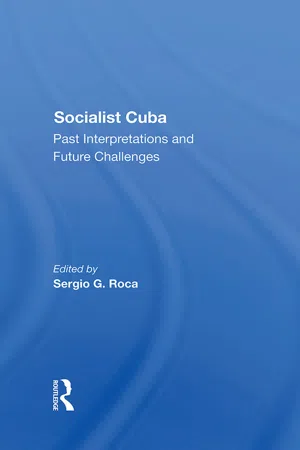
Socialist Cuba
Past Interpretations And Future Challenges
- 253 pages
- English
- ePUB (mobile friendly)
- Available on iOS & Android
eBook - ePub
Socialist Cuba
Past Interpretations And Future Challenges
About this book
This book examines change within continuity and analyzes stability within revolution. It focuses on uneven rate of development among the political, economic, and social realms of revolutionary life in socialist Cuba; on the implications of the changes unleashed by the Third Party Congress in 1986.
Information
Part One
Political Aspects
1
Blaming Itself, Not Himself: Cuba's Political Regime After the Third Party Congress
Jorge I. Domínguez
At the end of the Cuban revolutionary regime's first decade, Fidel Castro surveyed many of the problems that had emerged and, on July 26, 1970, he blamed himself. At the First Party Congress in 1975, he surveyed the political, economic, social, and military developments of the previous half-decade which had consolidated the regime at home and spread its influence abroad; the Congress celebrated success at last. At the Second Party Congress in 1980, he surveyed the more mixed record of the preceding years, and blamed the troubles on a part of the people for sloth, indiscipline, and lack of commitment—some thousands of whom had been induced to emigrate earlier that year. At the Third Party Congress in February 1986, he surveyed the equally mixed, though different, record of the early 1980s and blamed the leadership, though not himself, for poor performance.
The Third Party Congress, therefore, marked Fidel Castro's reassertion of his political power in a manner not yet attempted since the formalization of governmental and political institutions over a decade ago. It confirmed more than revealed problems in many areas. And yet, it was also the first party congress to create a more sensible pattern of continuity and rotation at the top. In short, while this Congress opened a window on the regime's weaknesses, it also pointed to a path that might strengthen the regime in the years ahead. There are, of course, no guarantees of success and the record of the past decade is not reassuring on this point.
The Third Party Congress was the culmination of a process begun in late 1984. This process was noteworthy for several "firsts" since the establishment of top party institutions in 1965. A black man not a part of the political coalition of the 1950s and early 1960s entered the Politburo (Esteban Lazo). No navy officer is a full member of the Central Committee. And also for the first time in full visibility, an officer was promoted politically to the top ranks ahead of his former military superiors (Abelardo Colomé).1
Also for the first time, two Commanders of the Revolution left the Politburo as part of a sizeable change in the Bureau's membership. For the first time, the Interior Minister is not a Politburo member. And for the first time, a member of the Central Committee was listed as without employment. This was Humberto Pérez, Cuba's economic czar up to a year before the Congress, who months before had been dismissed as Central Planning Board president and who was dropped as an alternate Politburo member at the Congress. Along with the dismissal early in 1985 of Antonio Pérez Herrero as party secretary for ideology, the combined effect of these changes was to weaken all but one of the stronger claimants to succeed Fidel Castro. The exception was Armed Forces Minister General Raúl Castro, Fidel's brother, who was publicly and clearly recognized at the Congress as the designated successor.
For the first time, too, the pattern of membership in top party organs indicated the necessity for choice. Unlike at the two previous party congresses, the size of top party organs remained basically constant at the Third Party Congress, forcing choices in order to rejuvenate the top leadership. About 47 percent of the alternate members of the 1980 Central Committee still alive were dropped in 1986; 37 percent of the Central Committee's full members still alive were also dropped (the respective numbers for 1980 were 17 percent and 21 percent).
These facts, however, suggest more turmoil at the top than in fact occurred. Consider also the following. No one who was dropped as a member of the Politburo, or as a Politburo alternate, was also asked to leave the Central Committee. No one was dropped from a full to an alternate member of the Central Committee. The pattern of recruitment to the top organs showed also a good mix of rewards through promotion from the immediately lower rank and of a challenge to even better performance by jumping through the hierarchical ranks for appointments, with priority— appropriate from the perspective of institutionalization— for promotions from the immediately lower rank. For example, no one was promoted to alternate or full membership in the Politburo who had not been already at least an alternate member of the Central Committee. Three of the four new members of the Politburo had been its alternate members. Six of the new eight alternate members of the Politburo had been full Central Committee members. Of the 56 full members of the Central Committee who had a new role, 57 percent acquired it through promotions from the alternate Central Committee member ranks. In short, the pattern of renewal shows a healthy mix of order and change.
Somewhat similar patterns obtain in individual promotions apart from membership in top party organs. For example, Ramiro Valdés was succeeded as Interior Minister by his own first deputy, Division General José Abrantes. Sergio del Valle was succeeded as Public Health Minister also by his first deputy, Julio Teja. Comparably sensible changes occurred in other ways. For example, the first party secretary of Villa Clara province was replaced by the president of that province's legislative-administrative assembly. Upon Central Bank President Raúl León Torras' death, he was replaced by the former Minister-President of the State Committee for Economic Collaboration, who knew about some of the international economic issues that had come to absorb so much of the bank president's time.
Other changes are subtler but they may indicate the winds of the future: the predominance of civilian party and government officials over the military in the conduct of the regime's affairs. The share of military officers on active duty in the Central Committee has been falling steadily since 1965. However, though the military share fell between 1975 and 1980, the number remained the same thanks to the expansion of the Central Committee's size. In 1986 both the share and the number fell (18 percent and 26, respectively). More interestingly, only one of the 21 full members continuing to the 1986 Central Committee had been shifted to a civilian post. Therefore, the military drop out rate of 42 percent (compared to the civilian drop out rate of 32 percent) came almost entirely through political demotion rather than lateral transfer.
These demotions affected the Revolutionary Navy and the Interior Ministry much more than the other branches. All four navy full or alternate Central Committee members were dismissed and the navy's representation was reduced to one new alternate Central Committee member. This and other evidence suggests some serious organizational problems within the Cuban Navy.
The Interior Ministry lost four of its full Central Committee members and all but one of its six alternate Central Committee members; its net representation on the Central Committee fell from seven to five full members and from six to three alternates. In contrast, Army and Air Force officers, combined, showed a drop out rate of only 37 percent. The political weakness of the Interior Ministry can also be seen in the manner in which Ramiro Valdés was replaced. The announcements of the replacements as ministers of Valdés and Sergio del Valle occurred within two weeks of each other. The Politburo statement in the Interior Minister's case was terse. In contrast, del Valle received fulsome praise.2 At the Central Committee meeting when Fidel Castro noted Valdés's departure from the Political Bureau, Castro's only references to Valdés's good service predated 1959. Moreover, the departure from the Central Committee and other top responsibilities of José Joaquín Méndez Cominches, who had headed foreign intelligence activities for the Interior Ministry, seems to have been connected to the malperformance of those services in gathering information about the decomposition of the New Jewel Movement and its government in Grenada. Some Interior Ministry personnel were also thought to have become corrupt; others may have agreed with former party ideology secretary, Antonio Pérez Herrero, who opposed the new political opening toward the Roman Catholic church.
The standing of members of the Council of Ministers did not change much. As in the past, many of the more technical ministers do not belong to the Central Committee, although most of the key ministers do. Of course, the most significant change was the removal of Humberto Pérez as Central Planning Board president and his replacement by a new ad hoc structure under the leadership of Osmany Cienfuegos. The policies associated with the new procedures emphasize centralization and discipline rather than the earlier trend toward enterprise autonomy under market socialism. Beginning in April 1986, Castro's severe critique of the use of monetary incentives to promote economic growth and efficiency weakened further the policies Humberto Pérez once advocated.3
On the other hand, the standing of the party's first secretaries in the provinces—the key position at the regional level—improved markedly. In 1980, there were only three first secretaries as Politburo members or alternates; in 1986, there were five. In 1980, only 9 of the 14 first secretaries were full Central Committee members; in 1986, all of them were. The team of first secretaries in office at the Third Party Congress, therefore, commanded a greater confidence from top leaders than had been the case at the previous congress. The rise of the party's own elite, and the decline of military representation and especially of technocratic civilian power, signals a shift in the direction of party authority.
Symbolic politics have mattered in Cuba for quite some time, and the Third Party Congress was no exception. For the first time, President Castro told the Party Congress that "in order for the party's leadership to duly reflect the ethnic composition of our people, it must include those compatriots of proven revolutionary merit and talents who in the past had been discriminated against because of their skin color."4 Although the non-white share of the Politburo and Secretariat remained basically unchanged, the share of the Central Committee at last passed the one-fifth mark (the 1981 census reports one-third of Cubans are non-white), a large improvement from past serious underrepresentation. In contrast, women accounted for 13 percent of the full members of the Central Committee in both 1980 and in 1986, although their share of Central Committee alternates doubled in 1986 and their representation in the Politburo and its alternates also improved. While the pattern of improvement in women's representation in leadership ranks slowed down by historical standards, the pattern of representation for blacks increased substantially for the first time.
In politics below the top, there appears to have been a reversal of past patterns. In the late 1970s, mass engagement in politics, as signified through members in key mass organizations, had stabilized at about 80 percent of the relevant pool of adults. The hard-core opponents had been identified and were constant in their views. By 1986, however, Fidel Castro told the party congress that the Committees for the Defense of the Revolution (CDR) encompassed nearly 84 percent of the population above age 14. It is not likely that this reflects a broadening of political support among the previously non-supportive; instead, this is probably the political effects of the country's changing demographics. The baby-boomers of the early 1960s are now eligible to join the CDRs and their rate of participation may be higher than that for older Cubans. If so, it is good news for the regime.
On the other hand, the party's democratization stopped. Castro told the party congress that net party membership grew by only 21.5 percent from 1980 to 1986 in contrast to the party's doubling in membership between 1975 and 1980. The proportion of party members in production and services fell from 47.3 percent in 1980 to 43.2 percent in 1986. Including those in education and in the professions, the proportion still fell from 62.3 percent to 60 percent. In 1986, nearly three-quarters of party members had a ninth grade education or higher but 48 percent of the members of the Third Party Congress and 78 percent of the Central Committee's full and alternate members had a university education.5 In short, the party changed course. It has become more of an elite party, more capable of governing, but also less representative. And the party's Central Committee is even more the elite of the elite. The reversal in the party's democratization resulted from a deliberate decision. As President Castro told the Third Party Congress, "references and recommendations for Party membership have become more exacting." This pattern toward overrepresentation of those with higher education at the pinnacle of power contrasts with their underrepresentation fifteen years earlier.
Personnel changes since February 1986 conform to the patterns described above. The most important subsequent collective change was the reconstitution in December 1986 of a new Council of State; its size (31 members) is fixed by the Constitution. Of the 29 members of the old Council who were still alive, 28 percent were dropped, a rate somewhat below the rotation of the party's Central Committee. Ramiro Valdés, Guillermo García, and Blas Roca were dropped as vice-presidents though they remained as Council members—the same pattern as their earlier drop from the Politburo to mere party Central Committee members. Their successions were consistent with the goal of institutionalization in the circulation of elites: the three new vice-presidents (Osmany Cienfuegos, José R. Machado, and Pedro Miret) had been Council of State members before. The proportion of women Council members rose from 7 percent to 13 percent. In the National Assembly, a majority of the 510 members had higher education, confirming the significance of this factor for the new composition of the top elite.6
However, the changes in the Politburo and in the Council of State did not affect a long-standing feature of the Cuban elite: interlocking memberships in the top organs of party and state. Eleven of the sixteen full members and three of the alternate members of the party's Politburo are also members of the Council of State, where they account for 45 percent of the membership. The president and all vice-presidents of the Council of State are Politburo members. Moreover, 81 percent of the Council of State's members are also members of the party's Central Committee.
In conclusion, the Third Party Congress, and subsequent events, have been part of a process which has focused on some of the regime's serious weaknesses. There is too much ...
Table of contents
- Cover
- Half Title
- Title
- Copyright
- Contents
- Preface
- Acknowledgments
- Remembering Carlos
- PART ONE POLITICAL ASPECTS
- PART TWO ECONOMIC ISSUES
- PART THREE SOCIAL RELATIONS
- About the Editor and Contributors
- Index
Trusted by 375,005 students
Access to over 1.5 million titles for a fair monthly price.
Study more efficiently using our study tools.
Frequently asked questions
Yes, you can cancel anytime from the Subscription tab in your account settings on the Perlego website. Your subscription will stay active until the end of your current billing period. Learn how to cancel your subscription
No, books cannot be downloaded as external files, such as PDFs, for use outside of Perlego. However, you can download books within the Perlego app for offline reading on mobile or tablet. Learn how to download books offline
Perlego offers two plans: Essential and Complete
- Essential is ideal for learners and professionals who enjoy exploring a wide range of subjects. Access the Essential Library with 800,000+ trusted titles and best-sellers across business, personal growth, and the humanities. Includes unlimited reading time and Standard Read Aloud voice.
- Complete: Perfect for advanced learners and researchers needing full, unrestricted access. Unlock 1.5M+ books across hundreds of subjects, including academic and specialized titles. The Complete Plan also includes advanced features like Premium Read Aloud and Research Assistant.
We are an online textbook subscription service, where you can get access to an entire online library for less than the price of a single book per month. With over 1.5 million books across 990+ topics, we’ve got you covered! Learn about our mission
Look out for the read-aloud symbol on your next book to see if you can listen to it. The read-aloud tool reads text aloud for you, highlighting the text as it is being read. You can pause it, speed it up and slow it down. Learn more about Read Aloud
Yes! You can use the Perlego app on both iOS and Android devices to read anytime, anywhere — even offline. Perfect for commutes or when you’re on the go.
Please note we cannot support devices running on iOS 13 and Android 7 or earlier. Learn more about using the app
Please note we cannot support devices running on iOS 13 and Android 7 or earlier. Learn more about using the app
Yes, you can access Socialist Cuba by Sergio G Roca,Rhoda Rabkin,Sergio Diaz-Briquets,Carmelo Mesa-Lago in PDF and/or ePUB format, as well as other popular books in Politics & International Relations & Politics. We have over 1.5 million books available in our catalogue for you to explore.