eBook - ePub
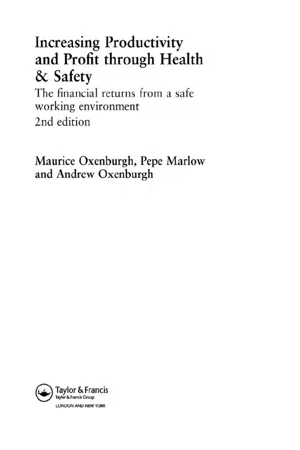
Increasing Productivity and Profit through Health and Safety
The Financial Returns from a Safe Working Environment
- 208 pages
- English
- ePUB (mobile friendly)
- Available on iOS & Android
eBook - ePub
Increasing Productivity and Profit through Health and Safety
The Financial Returns from a Safe Working Environment
About this book
In all workplaces the health and safety of employees is closely linked with the company's profitability. Human resource strategies for improving the health and safety of people in the workplace do not necessarily cost money - in fact they usually save money.
A practical book based on the authors' combined consultancy experience, Increasing
1 Introduction
1.1 More ergonomics!
What! another book on ergonomics? After all, there are already many excellent texts on ergonomics, for both the specialist and the non-specialist, so is this book any different? Well, yes. This is not a book about solving ergonomics problems; it is a book to encourage expenditure on ergonomics solutions by those who hold the purse strings. The methodology for these solutions is through cost-benefit analysis; after all, ‘good ergonomics is good economics’.
When we are asked by friends and others not connected with occupational health and safety what book are we writing, the reply is that the book is to show that good working conditions are good for business. Inevitably they look astonished and say ‘well of course that is so’. This book sets out to explain what the layperson knows intuitively; that better working conditions lead to increased safety and higher productivity and profit.
Primarily this book is for those people who deal directly with people at work: human resource and personnel departments, senior management, middle management and supervisors. But, as we all want to get our ideas accepted, ergonomists and other occupational health and safety practitioners should know how to put their ideas into an economics and productivity context as well as an injury prevention context – this book is for you, too. To put it crudely, money talks and we, the practitioners, at times need to use the same language.
As eventually all work comes down to people, even those whose work is seemingly remote from people, for example accountants, will find that they need to look more closely at the people side of business – people are an asset, not just a cost.
In many ways this book is an update of the first edition, (Oxenburgh, 1991), which was written at the beginning of the 1990s. The objective of the first edition was to give many case studies (over 60) to show that ergonomics and occupational health and safety can improve the working conditions of employed people without reducing the profitability of the enterprise. A cost-benefit analysis was derived for about half of these cases, and the present book contains a more detailed analysis of the costs for implementing ergonomics solutions and for quantifying the benefits than was possible previously. The costs derive from the implementation of better working conditions while the benefits come from a safer workplace with lower injury costs, higher productivity, reduced warranty costs, improved staff retention, multi-skilling and so on.
In the first edition a generic tool, the Productivity Model, was developed for costbenefit analysis. This model was based on ideas originally developed by Dr Paula Liukkonen of Stockholm University. The paper form of the model, included with the book, was subsequently produced as a computer program and a basic version of this software, productAbilityBasic, is included with the present edition.
1.2 The objective of this book
The objective is simple: to improve the working conditions of employed people including safety, training, lack of discrimination and other aspects that lead to a pleasant and healthy life at work. The methodology is through showing that productivity and profit for the enterprise are not incompatible with good working conditions for its employees.
In 1959 the International Labour Conference adopted Recommendation No. 112, which defined the purposes of an occupational health service as:
- protecting the workers against any health hazard which may arise out of their work or the conditions in which it is carried on
- contributing towards the workers’ physical and mental adjustment, in particular by the adaptation of the work to the workers and their assignment to jobs for which they are suited
- contributing to the establishment and maintenance of the highest possible degree of physical and mental well-being of the workers.
These are still valid aims.
We will not be discussing wage issues per se, although wages and variation in wages are factors used in cost-benefit analysis. Our experience is that there is not necessarily a link between safe working conditions and remuneration. One of the first tasks one of the authors (Maurice Oxenburgh) had when he entered the field of occupational health and safety was to dissuade managers and unions from the view that it was quite satisfactory to have dusty and dirty working conditions for labourers as long as you paid them ‘dirt money’ in recompense. He actually won that battle.
What the authors of this book propose is a system to encourage management to assess their workers more carefully, particularly with regard to their value to the enterprise. This is not a management tool in isolation but a supplement to other management tools. Moreover, we are restricting our view to what an enterprise may do (microeconomics) rather than the wider society (macroeconomics).
Many of the accounting tools used to manage workplaces are based on legislation, taxation and/or cost reduction and thus only measure expense. These systems ask questions such as: can we reduce our tax burden? Can we out-source a function of our business and reduce costs? These are essential questions but do not address productivity and profitability, only potential loss. The objective of this book is more optimistic: it is to enable management to understand clearly that good working conditions lead to improved productivity and profit. ‘Good ergonomics is good economics.’
Even when safety and risk management audits identify workplace hazards, the bare cost of correction may deter management from making the necessary finances and resources available. Identifying a potential problem or hazard may be accompanied by cost avoidance (doing nothing) rather than the benefits of doing something. The value of a cost-benefit analysis is that it is a tool to ensure that the benefits of an intervention are measured in the same way as the costs and overcome the cost avoidance impulse.
Quite unashamedly this book, as did its predecessor, accentuates the role of the worker. There is a large body of literature for measuring the cost of the non-worker side: energy, raw materials, rent, maintenance, sales, communication and so on. We do not deal principally with that side of industry, although the occupational health and safety practitioner must be aware of these costs in discussions when requesting resources for a safety program. These aspects are further discussed in Chapters 2 and 4.
What this book does not say is that cost-benefit is the only tool to be used or, even more importantly, that if a project is not cost-effective it need not go ahead; this latter point is discussed in Chapter 7. Cost-benefit analysis is simply a tool to assist in the implementation of occupational health, safety and ergonomics interventions for better working conditions. There are many tools and this is just one of them, although we do believe that, when used correctly, it is a powerful tool.
1.3 Cost-benefit analysis models for occupational health and safety
This book essentially addresses ‘how to encourage management to put in place better working conditions through using economics arguments’. No claim is made that this is a new approach, as others have trodden this path before. The following is a brief synopsis of some of the steps taken over the past few years.
From the mid-1970s, Professor Nigel Corlett (Corlett, 1976) discussed cost and benefits from human resources studies, with a seminal paper in 1988 (Corlett, 1988). Discussing various parameters for such a costing, he noted:
In the nature of things any evaluation is only partial. This can be from inadequacies and insufficiencies in models, in variables and in methods. What is unnecessary is that they should be deliberately insufficient in their perspective. Such a state can arise when models are imposed on situations, not adapted to the cases under investigation. To leave cost-benefit analysis to accountants, to economists, even to ergonomists, is to build in a cause for failure. The utility of professionals, particularly in combination, is undoubted but the understanding of what has to be measured can come only with the aid of those involved. This applies particularly to the involvement of lower management and relevant segments of the work-force, including representatives.
With the advent of participatory ergonomics, Professor Corlett’s words are even more pertinent and in Chapter 3 we note that the role of the workforce, as well as management, is essential when collecting relevant information for a cost-benefit study.
We have already mentioned that Dr Paula Liukkonen of Stockholm University was instrumental in helping Swedish industry to examine the costs of occupational health and safety. We believe that she was the first to codify these costs in a form that enterprises could use to improve working conditions. Most of her work was published in Swedish but she has summarised some of her ideas in English (Kupi et al., 1993).
Dr Arne Aarås has done some remarkable work in controlling and reducing musculoskeletal illnesses in a telephone wiring company, and has looked at the costbenefit of this project (Spilling et al., 1986). Comparing a seven-year period prior to the ergonomics intervention with a seven-year post-intervention period, he showed that there was a saving of about nine times the outlay for ergonomics improvements measuring only injury and labour turnover reduction. He did not calculate other productivity factors although some may have added to the cost-benefit ratio. The length of the study and its results, in both injury prevention and cost-effectiveness, have been a highlight in this field.
It is commonplace nowadays that before governments introduce safety legislation they make a cost-benefit prediction. This is often in response to industry saying that it cannot afford whatever is proposed – almost a knee-jerk reaction to any thought of expenditure to benefit workers. In a paper on the economics of the introduction of a safe manual handling code of practice (Oxenburgh and Guldberg, 1993) the methodology used was to determine what unsafe lifting was in terms of the code and thus what the code would do in preventing injury. A statistically determined cross-section of workplaces was surveyed by a team of investigators who measured the number of unsafe lifting practices (i.e. lifts addressed and ‘corrected’ by the code). The cost to correct each unsafe lift was determined and the cost expanded to an estimate of the entire industry and related to the estimated savings in back injuries. The limitation of the methodology is that small errors in the original measurements become greatly magnified in the expansion to an entire industry. As is so often the case, the authors had no opportunity to measure the actual costs after the code was introduced to determine whether the original methodology, and the estimates based on this methodology, were correct.
Professor Guy Ahonen has surveyed 340 small and medium-sized companies in Finland in order to examine and develop their occupational health and safety conditions. The results of the questionnaires were analysed through the use of the Productivity Model, and he compared the individual companies with the best in their industry group based on sickness absence; a ‘best practice’ methodology. Ahonen was then able to estimate the benefit to an enterprise of reducing the absence rate both in the actual savings and in productivity increase (Ahonen, 1998).
Professor Ahonen and his colleagues have also used the Finnish version of the Productivity Model to estimate the economic costs of alternative treatments of acute back pain, the costs of smoking and of ageing within the Finnish population. He has since developed a further computer model, derived from our earlier model, mainly for use in the Scandinavian market. It is known as ‘The Potential’ and is available in Swedish, Finnish and English (details are given in the References).
A very useful step forward in occupational health and safety costing was made by Dr Per Dahlén. He used activity-based costing to derive the cost drivers for injury and thus the allocation of those costs. Although he was looking mainly at the costs of absenteeism, labour turnover and training, he did introduce some productivity factors. These productivity factors were re-working, scrap and overtime due to the use of unskilled labour (Dahlén and Wernersson, 1995).
Dr Hal Hendrick, who has worked in industry for many years and is a past President of the International Ergonomics Association, has been very keen to see costing included in the evaluation of ergonomics interventions. He has collected some very useful case studies, his own as well as those of others, to illustrate this point and has published these cases through the Human Factors and Ergonomics Society (Hendrick, 1996). His message is that business needs ergonomics and costing is one method to drive the point home.
Dr Alison Heller-Ono has used cost-benefit analysis to substantiate the involvement of participatory ergonomics in the workplace (Heller-Ono, 2001). In several workplaces she has instituted an ‘Ergonomics Task Force’ encompassing up to a dozen workers from all levels from senior management to shop floor workers. One particular workplace was an office where the injuries were musculoskeletal to the upper limbs (cumulative trauma disorder). After an initial training period on basic ergonomics given by Heller-Ono, the ‘Ergonomics Task Force’ went to work to improve the conditions of the office workers and to meet safety and health standards. The method for financial analysis was return on investment (see Chapter 2) and Heller-Ono has followed this workplace over a four-year period. Each year of the process has been compared with the previous year and substantial benefits were observed each year, so that by the fourth year the return on investment was over $5 for each dollar spent.
It is unfortunate that although several people, as above, have published financial results from ergonomics interventions there has been very little development of generic models (models that can be used generally rather than specific to a particular situation). In 1996 Dr Marcel Knotter from NIA (The Netherlands Institute for the Working Environment) conducted a survey to see where and how many models are available, but the results of the survey have not been published.
A breakthrough to develop generic cost-benefit models that can be used by employers should have come about through a specific conference on the subject (Mossink and Licher, 1997). The papers at the conference were mainly regarding the costs and benefits one would like to measure in an enterprise/industry sector or on the effects of legislation. With the possible exception of two papers out of over 50, there were no general models to help enterprises implement occupational health and safety policies and procedures. The two papers were those of Dr Paula Liukkonen, who has a deep understanding of the factors that make up cost and benefits in industry (her model is not available in English), and the present authors’ Productivity Model.
The fact that generic cost-benefit analysis tools are in short supply does not mean that some form of costing is not used by occupational health and safety practitioners, rather than only by research workers, as discussed above. For his thesis Michael Morrissey surveyed, by questionnaire, occupational health and safety practitioners in Australia (Morrissey, 2002). These people came mostly from larger companies and he found that about 75% of respondents had used some form of costing. However, on closer analysis the costing used was mostly based on the direct wage costs, with the indirect costs (lowered productivity, overtime, product damage and so on) often ignored. As we note throughout this book, it is often the indirect costs, not the direct costs, that are major cost factors and it is from savings in these indirect costs that benefits flow from an intervention.
Morrissey’s survey, valuable in itself, points to the unfortunate fact that costbenefit analysis is not generally used by occupational health and safety practitioners and, with the possible exception of Finland, we think that this may be the situation generally.
Although we suspect that cost-benefit analysis models for occupational health and safety have been developed by some large enterprises for their internal use, they have not been published or otherwise made generally available. It seems unfortunate that there are not more models developed for occupational health and safety on the market so that users would be able to choose that which best fits their needs. Models that are not suitable are, for example, engineering ones that derive only from the technology of the design or process and do not express the effect on, and the effect of, the workers and other persons concerned. It is at least partly to fill this gap that the Productivity Assessment Tool (and its predecessor, the Productivity Model) has been developed.
1.4 Productivity Assessment Tool
In a review of the first edition of this book a reviewer (Thompson, 1995) commented that we had overlooked the area of ‘senior management commitment to safety as a business objective equatable to quality and profit’. If senior management really has this equal commitment to safety (a rare quality in practice although not in word) then cost-benefit analysis is not required. Cost-benefit analysis for occupational health and safety practice is a tool to convince otherwise sceptical management that the value of people must not be underestimated and that workers are their key to profit.
The emphasis in the Productivity Assessment Tool is on employees and the costs and benefits that their employment brings to the enterprise. It is not the only tool, but one of many, that can be used to bring home the notion that people should be treated humanely and work safely. It is reasonably obvious that the nee...
Table of contents
- Cover Page
- Title Page
- Copyright Page
- About the Authors
- Foreword
- Acknowledgements
- 1 Introduction
- 2 Economics for the Non-Economist
- 3 Information Sources
- 4 The Productivity Assessment Tool
- 5 Case Studies
- 5A Industrial Cleaning: Safer at a Lower Cost
- 5B Permanent or Precarious Employment? The Hospitality Industry
- 5C Why Lift Patients when There’s a Better Way? Reducing Back Injuries in the Health Industry
- 5D Large-Scale Experiments: Valuable but Not Easy to Carry Out
- 5E Manual Handling
- 5F Personal Protective Clothing and Equipment
- 5G Prevention and Rehabilitation
- 6 New Supervisory Systems
- 7 Ethics
- 8 Installing and Running the Productivity Assessment Tool
- Glossary
Trusted by 375,005 students
Access to over 1.5 million titles for a fair monthly price.
Study more efficiently using our study tools.
Frequently asked questions
Yes, you can cancel anytime from the Subscription tab in your account settings on the Perlego website. Your subscription will stay active until the end of your current billing period. Learn how to cancel your subscription
No, books cannot be downloaded as external files, such as PDFs, for use outside of Perlego. However, you can download books within the Perlego app for offline reading on mobile or tablet. Learn how to download books offline
Perlego offers two plans: Essential and Complete
- Essential is ideal for learners and professionals who enjoy exploring a wide range of subjects. Access the Essential Library with 800,000+ trusted titles and best-sellers across business, personal growth, and the humanities. Includes unlimited reading time and Standard Read Aloud voice.
- Complete: Perfect for advanced learners and researchers needing full, unrestricted access. Unlock 1.5M+ books across hundreds of subjects, including academic and specialized titles. The Complete Plan also includes advanced features like Premium Read Aloud and Research Assistant.
We are an online textbook subscription service, where you can get access to an entire online library for less than the price of a single book per month. With over 1.5 million books across 990+ topics, we’ve got you covered! Learn about our mission
Look out for the read-aloud symbol on your next book to see if you can listen to it. The read-aloud tool reads text aloud for you, highlighting the text as it is being read. You can pause it, speed it up and slow it down. Learn more about Read Aloud
Yes! You can use the Perlego app on both iOS and Android devices to read anytime, anywhere — even offline. Perfect for commutes or when you’re on the go.
Please note we cannot support devices running on iOS 13 and Android 7 or earlier. Learn more about using the app
Please note we cannot support devices running on iOS 13 and Android 7 or earlier. Learn more about using the app
Yes, you can access Increasing Productivity and Profit through Health and Safety by Maurice Oxenburgh,Penelope S.P. Marlow,Andrew Oxenburgh in PDF and/or ePUB format, as well as other popular books in Business & Sustainability in Business. We have over 1.5 million books available in our catalogue for you to explore.