This book explores the outcomes of Sweden's aim to create a 'drug-free society' on the lived realities, health, and welfare of people who use drugs, and on the dynamics of Swedish drug use. Drawing on a wealth of empirical data, including extensive interview testimony and participant observation from years of fieldwork conducted in Sweden, the book debunks the widely-believed myth that Sweden is a progressive, liberal, inclusive state. In contrast to its liberal reputation, Sweden has criminalised the use of drugs and allows for compulsory treatment for those with drug dependencies. The work argues that Swedish law and policy cannot be demonstrated to have decreased drug use as intended, with the law used instead as a means with which to displace people who use drugs from public spaces in Sweden's cities. And where the law has failed in its ambition to decrease drug use, Swedish law and policy have increased and exacerbated the problems, dangers, and harms that can be associated with it. People who use drugs in Sweden experience considerable and endemic difficulties with health, violence, abuse, and social exclusion, stigma, and discrimination as a result of Sweden's drug laws, policies, and discourses.
eBook - ePub
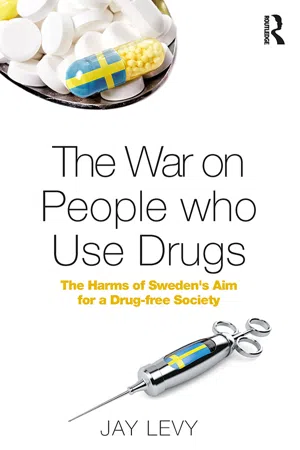
The War on People who Use Drugs
The Harms of Sweden's Aim for a Drug-Free Society
- 144 pages
- English
- ePUB (mobile friendly)
- Available on iOS & Android
eBook - ePub
1 Historical, legal, discursive precedent
This chapter is principally an historical genealogy of the political debates that immediately preceded, and resulted in, the introduction of Sweden’s 1988 legislation criminalising the use of drugs and allowing for medicalised detention and forced treatment of those with drug dependencies. Sweden’s 1988 legislation resulted in people who use drugs being directly criminalised, as opposed to being criminalised indirectly through legislation criminalising possession, supply, and other activities surrounding drug use. I focus here also on how these debates, both those which occurred in government and those which took place in the media, came to redefine how drugs and people who use them were viewed in Sweden; this redefining came to inform the view that compulsory medicalised detention for people with drug dependencies was imperative.
I begin by discussing the context in which the debates took place. Concern surrounding drug use in the 20th century in Sweden was by no means in a vacuum, and I focus on various moral panics that set the stage for an increase in popular and political concern surrounding not just drugs, but what drugs came to represent for Sweden: an alien threat to the normative, rational, disciplined folkhemmet. I concentrate on how criminalising the use of drugs, and legislating to allow for compulsory care for people with drug dependencies came to be seen as essential steps to be taken in Sweden’s pursuit of a drug-free society, and in so doing I focus on which groups and stakeholders were instrumental in the debates surrounding the topic. I focus also on which groups came to be sidelined and silenced, and how.
Moral panic in the People’s Home: racism, HIV/AIDS, and drugs
‘[It is] not surprising that irrational and exaggerated fears have grown up about immigrants, drugs and perhaps – the international sex trade’.
(Gould 2001: 453)
Within Sweden, Swedish people are felt to have a long tradition of drug use. Indeed, one respondent with the Swedish police emphasised that ‘the rage of the Vikings came from the beer and [psychoactive] substance with[in] mushrooms’ (Interview, Stockholm Police [Narcotics Division Team Leader]; also see Boekhout van Solinge 1997). Alcohol use is seen to be inherent to Swedishness, with the acceptable use of alcohol in Sweden marked by binge drinking and its use as a psychoactive drug (drinking to get drunk), as opposed to moderate drinking patterns found elsewhere in Europe (discussed further in the following chapters); indeed, Swedish people are not felt (and often do not feel) to be capable of moderating their intake of alcohol and other substances (Van der Giessen and Van Brussel 1996). Further, levels of non-alcoholic substance use dramatically increased in the 1950s and 1960s, when prescription of opiates and amphetamines ‘went totally out of control’ (Van der Giessen and Van Brussel 1996; also see Lenke and Olsson 2002; Lindberg and Haynes 2000; UNODC 2006). High levels of diversion/leakage of prescription drugs to the illicit market compounded concerns in Sweden as to the rise of the use of untraditional and ‘un-Swedish drugs’, feeding into worries regarding drug spread and foreign practices and patterns of drug use.
‘There was an era of hedonism, Sweden is a part of the world, of course, like any other nation, and anybody who lived in the sixties, I did, I was a teenager then… it was a time when it was very cool to be liberal, have a liberal attitude towards drugs’.(Interview, RNS)
‘What happened in the late fifties and early sixties, in Sweden, it was like we had an explosion of drugs… pills that they used to lose weight… It got a whole generation addicted to these types… of substance, and we also of course had, we had cannabis, we had, in the middle of the sixties and late sixties we had a huge problem in Sweden with heroin’.(Interview, Stockholm Police [Narcotics Division Team Leader])
‘During the sixties in Sweden, we had a period for like 10, 15, 20 years when we were very liberal in Sweden… we had these legal prescription programmes. Any doctor could prescribe any drug of choice. But it was no programme or no regulation… then it turned into become this repressive, restrictive drug policy that we still have’.(Interview, Chair and Founder of Svenska Brukarföreningen)
Although this ‘explosion of drugs’ was arguably an hyperbole unjustified by the real situation (Hallam 2010), it seems to have precipitated a broader moral panic in Sweden (Boekhout van Solinge 1997). Statistics illustrating stabilising or decreasing drug use were claimed to be misleading (Gould 1989; also see Boekhout van Solinge 1997), and focus was not on statistics or evidence per se, but on emotive and ideological assertions, on the implications of the use of certain drugs and on who was associated with these drugs. It is not surprising that declarations of Stockholm being ‘awash with amphetamines’ (Gould 1989) caused alarm, with the visibility of public drug scenes, perceived as corrupting and polluting the clean and orderly folkhemmet, resulting in further concern.
‘In the eighties and the nineties, it was a very big population in T-Centralen [Stockholm’s central subway station]… a very open selling, and so they had to do something’.(Interview, KRIS)
Concerns surrounding drugs were coupled with a fear of the foreign1 (Gould 1996; Hallam 2010): foreign drugs, foreign practices, foreign people, foreign cultures; all of these fears intersected with Sweden’s relative geographical and political isolation and with Sweden’s historical efforts to maintain an ordered folkhemmet. Panic surrounding drug use was racialised and xenophobically associated with Sweden’s rapidly increasing migrant populace (see Pred 2000), with immigrants and foreign states seen to be the cause of the inflow of new and dangerous substances and practices (Gould 1996; Gould 2001).
‘We are a little corner, way up north, in Sweden; we have been a society with very little influence from the outside. So when narcotics came to Sweden, when drugs came to Sweden, it scared a lot, I mean “what is this? What is happening to our youth, what is happening to”, you know, the same old moral panic.’(Interview, Chair of RFHL)
Swedish fear of foreign substances (and peoples) was compounded by concerns surrounding economic instability during the 1970s (Lenke and Olsson 2002) and furthermore a fear of the newly erupting HIV/AIDS pandemic and concern about its spread to the normative population from and by groups constructed to be deviant and dangerous. People who use drugs were rendered as dangerously unpredictable, with racialised generalisations informing racist stereotypes of hypersexualised, alien drug users, ‘whose unpredictable lifestyle hindered compliance’ with HIV testing and prevention interventions (Baldwin 2005: 76; also see Månsson et al. 2000; Tammi 2005b; Vallgårda 2007). The crude conflations of these fears and panics in the media and in state-run information campaigns drew on Swedish racist and xenophobic discourse, no doubt fed by Sweden’s history of eugenically informed social construction and engineering; these were narratives of drug using, foreign people of colour infecting Swedes, both at home and abroad (Henriksson and Ytterberg 1992).
Legislation came at a time when drug use – and all it was associated with – seemed to threaten to undermine an orderly, safe, homogeneous folkhemmet. Several narratives fed through into legislation and its discursive justifications, all with a backdrop of a ‘successfully socially constructed’ drug issue (Lenke and Olsson 2002: 67). It was far from difficult in Sweden to scapegoat and problematise people who use drugs and those with dependencies as necessitating control in such a climate of instability and fear (Gould 1989), especially in the context of Sweden’s history of problematising, containing, and controlling such communities.
The commissions and remiss responses: creating a drug-free society
Swedish parliament noted the arguably unachievable and utopian ambition to achieve a ‘drug-free society’ in 1977 (Anker 2007) and a 1984 bill explicitly detailed this aim (UNODC 2006); indeed, during the legal debate and campaigns that led up to legislation, there were constant references to the aspiration for a ‘drug-free society’.
In 1988 Sweden criminalised the use of drugs, it becoming a criminal offence to have drugs in one’s bloodstream. This was coupled with a widening of existing LVM (lagen om vård av missbrukare [‘The Law for the Care of Misusers/Abusers’]) legislation, allowing for the compulsory treatment of those with drug and alcohol dependencies. The expanded LVM legislation is perhaps consistent and unsurprising given Sweden’s history of control, prohibition, and temperance (Anker 2007; Gould 1989; Lindberg and Haynes 2000), and can be seen as an outcome of an historical ‘cultural desire for order’ (Gould 1989: 731), a social order that has been achieved through strikingly violent and invasive means, as described in this book’s Introduction. Sweden’s prohibitionist laws on drug use are focussed primarily on three areas: reducing the number of people commencing drug use, encouraging people who use drugs to cease drug use, and reducing the supply of drugs (EMCDDA 2010; Hallam 2010).
The criminalisation of the use of drugs and the introduction of (renewable) six months compulsory care for those with dependencies were preceded by two government commissioned reports that went out on remiss consultation. Sweden’s remiss consultations are the process through which numerous parties may contribute to political debate and discussion that results in legislative change. Initially, the government will commission a Commission investigation, which investigates the issue in question and is then published; it is at this point that interested parties, stakeholders, and organisations can then respond to the report and to proposals with their views, criticisms, and suggestions and/or demands. Following this, a Bill is drawn up, which is then subject to parliamentary vote, and legislation is then passed (or not). It is to these commissioned reports and remiss consultations that I now turn my attention:
Criminalising use
Swedish governments have historically opposed criminalising the use of drugs, considering it to be out of keeping with traditional policy not to legislate against something that affects only the individual, not broader society (Gould 1989).2 From 1982, political opposition (to the governing Social Democratic Party) had annually raised the issue of criminalising the use of drugs, with key governmental figures also supporting a tougher approach to drugs and drug users (Gould 1989). Having regained power in the early 1980s, the Social Democrats launched a remiss Commission report which proposed a slight strengthening of the penal law but importantly did not recommend criminalising the use of drugs, as was being demanded by opposition parties (Gould 1989). Criticism and protests resulted from political opposition and NGOs (Lenke and Olsson 2002), the latter of which is discussed further below. Some concern was expressed during the remiss consultation that a criminalisation of the use of drugs would push the perceived problem of drug use underground, exacerbating difficulties and dangers for people who use drugs; but following the remiss consultation a proposal to criminalise the use of drugs was reviewed by parliament. It was argued that ‘the overall effect would be to maximize the possibility of people who used drugs giving up the habit or seeking help and support’ (Gould 1989: 733).
The best way to tackle perceived influxes of dangerous substances, therefore, was seen to be to focus on the consumer, on demand for drugs (Anker 2007; Gould 1989; Gould 2001), a focus notably advocated by the founder of a prohibitionist Swedish NGO called RNS (riksförbundet Narkotikafritt Samhälle [‘Association for a Drug-Free Society’]), Nils Bejerot (discussed further below), who believed that ‘the drug user was the irreplaceable element in the drug chain’ (UNODC 2006: 13). It was ambitiously asserted by RNS that once demand was undermined and eliminated, the whole ‘drugs pyramid’ would simply collapse:
‘narkotika pyramiden [the drugs pyramid], our policy is based on this idea that without the base, which is the consumers, we wouldn’t have a problem and… our policy is based upon this… If there are buyers they will, there will always be sellers’.(Interview, IOGT-NTO; previously RNS)
‘As long as there’s a market, you can never stop the supply of drugs. The drugs will always be there. But if the consumers, if the need for drugs decreased, the amount of drugs will decrease. Simple market economy.’(Interview, Stockholm Police [Narcotics Division Team Leader])
‘Their perspective is always more repressive, if you take away the people on the street, you don’t have any problem with drugs. So put them into jail, put them into custody, put them into the forests of northern Sweden, and there they can be. And if you take it away, the drug dealers will disappear.’(Interview, RFHL)
‘The aim of Swedish drug policy is to achieve a drug-free society; drug users are said to be controlled by their drugs and may need compulsory care and treatment to free them of their addiction; policy measures focus upon consumers, since without them, there would be no market; abstention is the goal of treatment; and there is a concern about drugs flooding into the country from overseas.’(Gould 2001: 450)
The law criminalising use of drugs eventually allowed for the possibility of prison sentences in 1993, four years after the criminalisation of the use of drugs came into being (UNODC 2006); this legislation also allows for stopping, searching, and compulsory blood and/or urine testing of people suspected of having used drugs (Hallam 2010). As the first below-quoted respondent argues, it is the possibility of prison which allows for such invasive interventions. Swedish drug law is thus designed to operate as a deterrent and intervention (Hallam 2010), and as a punitive measure (though the first respondent quoted below claims that incarceration solely for drug use does not occur):
‘a person that has been caught and convicted for using drugs, that person will never go to prison. It’s a technical thing, because if Swedish police… should be able to do something by force, for instance, take you into the police station, and leave a sample of urine, or a sample of blood… there has to be prison within the potential punishment’.(Interview, Stockholm Police [Narcotics Division Team Leader])
‘It was very, very difficult for police to search people [before the law], because they have no right to do it.’(Interview, Founder of KRIS)
‘[The argument] grew and became very strong...
Table of contents
- Cover
- Half Title
- Title Page
- Copyright Page
- Table of Contents
- List of figures
- Acknowledgements
- Glossary, acronyms, and abbreviations
- Introduction
- 1. Historical, legal, discursive precedent
- 2. Reimagining drugs (and people who use them)
- 3. Dynamics and displacement of Swedish drug use
- 4. Service provision and harm reduction
- 5. Experiences of service and healthcare provision
- 6. The outcomes of Sweden’s war on people who use drugs
- Conclusions: Harm exacerbation, social exclusion, and violence
- Bibliography
- Index
Trusted by 375,005 students
Access to over 1.5 million titles for a fair monthly price.
Study more efficiently using our study tools.
Frequently asked questions
Yes, you can cancel anytime from the Subscription tab in your account settings on the Perlego website. Your subscription will stay active until the end of your current billing period. Learn how to cancel your subscription
No, books cannot be downloaded as external files, such as PDFs, for use outside of Perlego. However, you can download books within the Perlego app for offline reading on mobile or tablet. Learn how to download books offline
Perlego offers two plans: Essential and Complete
- Essential is ideal for learners and professionals who enjoy exploring a wide range of subjects. Access the Essential Library with 800,000+ trusted titles and best-sellers across business, personal growth, and the humanities. Includes unlimited reading time and Standard Read Aloud voice.
- Complete: Perfect for advanced learners and researchers needing full, unrestricted access. Unlock 1.5M+ books across hundreds of subjects, including academic and specialized titles. The Complete Plan also includes advanced features like Premium Read Aloud and Research Assistant.
We are an online textbook subscription service, where you can get access to an entire online library for less than the price of a single book per month. With over 1.5 million books across 990+ topics, we’ve got you covered! Learn about our mission
Look out for the read-aloud symbol on your next book to see if you can listen to it. The read-aloud tool reads text aloud for you, highlighting the text as it is being read. You can pause it, speed it up and slow it down. Learn more about Read Aloud
Yes! You can use the Perlego app on both iOS and Android devices to read anytime, anywhere — even offline. Perfect for commutes or when you’re on the go.
Please note we cannot support devices running on iOS 13 and Android 7 or earlier. Learn more about using the app
Please note we cannot support devices running on iOS 13 and Android 7 or earlier. Learn more about using the app
Yes, you can access The War on People who Use Drugs by Jay Levy in PDF and/or ePUB format, as well as other popular books in Law & Comparative Law. We have over 1.5 million books available in our catalogue for you to explore.