Originally published in 1985. Detailed exploration of the dynamics of language within social psychology forms a social psychology of language which is distinct from other approaches. This volume presents some of the growing body of research in this area, with many theoretical models and ideas - chapters consider the relationship between language and social situations, looking at cognitive structures in how communication between individuals develops in childhood and beyond, how it defines social situations, influences others, expresses feelings and values, evokes social categorizations and how it can break down.
eBook - ePub
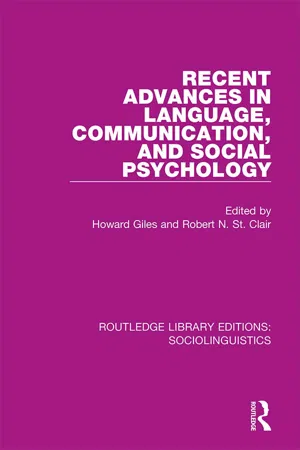
Recent Advances in Language, Communication, and Social Psychology
- 310 pages
- English
- ePUB (mobile friendly)
- Available on iOS & Android
eBook - ePub
Recent Advances in Language, Communication, and Social Psychology
About this book
Information
1 Introduction
Howard Giles
University of Bristol
Those fascinated by the importance and complexities of language in social life might look to social psychology for some insights. After all, much of an individual’s behaviour occurs in a social context, is manifest linguistically, mediated by cognitive processes, and was afforded central focus of attention by the pioneers of social psychology (see Farr, 1980). While language studies figure prominently in many areas of psychological inquiry such as in cognition, psycholinguistics and in development (albeit asocial and non-communicative in the former cases), detailed explorations of the dynamics of language within social psychology have been conspicuous by their absence over the last couple of decades, as has been argued elsewhere (Giles, 1979). Admittedly there were certain individuals who were important exceptions (e.g., Michael Argyle, Roger Brown and Wallace Lambert), and also a few books and research topics (such as nonverbal communication, persuasion, and group interactional analysis), but an examination of mainstream journals and influential texts in social psychology in the early 1970s suggested that language held at the most a peripheral status within that discipline. Correspondingly, a perusal at this time of the multidisciplinary endeavour, sociolinguistics, demonstrated a comparable neglect in its journals and texts of a coherent social psychological approach. Important exceptions were again apparent with regard to the study of bilingualism and forms of address, and it is true that some sociolinguists (e.g., William Labov, Lesley Milroy and Carol Scotton) have emphasized the role of social-psychological constructs, such as attitudes, identities, and motivations, in their analyses.
The complex reasons why a “social psychology of language” has never really gelled historically (apart from in Canada, see for example Gardner & Kalin, 1981) have been the topic of some debate in the literature (e.g., Fraser & Scherer, 1982a). As yet, unfortunately, such speculations appear incomplete and unconvincing. Suffice it to say, however, that there are many indications that it has arrived as a distinctive, complementary approach to those of the sociology of language, anthropological linguistics, sociolinguistics, and so forth. In the forthcoming Social Science Encyclopaedia (Routledge & Kegan Paul), there will be a separate entry for the “social psychology of language”. Indeed, research activity since 1977 has grown enormously and, as will be seen from the plethora of theoretical models and ideas conveyed in this present volume, blossomed considerably in recent years. Indications of the sudden outgrowth are evident in the advent of numerous edited books in the discipline (e.g., Fraser & Scherer, 1982b; Markova, 1978; Rommetveit & Blakar, 1979; St. Clair & Giles, 1980), the appearance in 1982 of an international series of monographs devoted to it (published by Edward Arnold), the emergence of two international Conferences on this perspective at Bristol in 1979 and 1983 attracting enthusiastic participation world-wide, as well as the establishment of the Journal of Language and Social Psychology as a coherent forum for this speciality in 1982. Interestingly, an active “interpersonal communication” branch of the International Communications Association has developed with an implicit social psychological bias.
Given an overlap on many topics by both sociolinguists and social psychologists (e.g., relationships between language and social situations, sex roles, ethnicity), what then is the social psychology of language? It lies essentially in two domains, theoretical and methodological. Theoretically, researchers are interested in the ways in which the production and reception of language behaviours are mediated by cognitive organizational processes. Aspects of cognitive organization which appear in the ensuing chapters of this book include perceived goal structures, situational construals, cognitive monitoring, causal attributions, etc., and the interactive roles they play in determining, for instance, speaking and listening strategies. Given that social-psychological theories are mostly about the complexities and dynamics of cognitive organization and the representation of the social world and social structure, this perspective broadens the explanatory scope of language study. For example, social identity theory (Tajfel & Turner, 1979) proposes that we desire to belong to social categories which afford us a positive social identity. It articulates the conditions under which group members will search for, or even create, dimensions (linguistic and nonlinguistic) along which they are positively differentiated from relevant outgroups. This, then, enables us to help explain why some groups maintain their own language, dialects, and nonverbal styles while other lose them and assimilate towards the communicative patterns of a more powerful group (Giles & Johnson, 1981).
Methodologically, the social psychology of language utilizes, for the most part, the experimental method characteristic of general psychology (see Giles, 1983). Such a procedure is extremely useful in its potential for replication and rigorous control of extraneous variables as well as in its capacity to allow more exact specifications of the conditions under which certain language patterns are emitted, and the types of responses people afford particular language behaviours in specific contexts. This methodology is, of course, complemented by case study and naturalistic observation techniques, as can be seen later in this volume, not to mention ethogenic analyses (Harre & Secord, 1972) all of which are openly encouraged as an eclectic means of extending our data base (Robinson, Giles, & Smith, 1980). In addition, the discipline, as again will become apparent, has techniques (electronic and questionnaire format) for measuring complex psychological states and dispositions (e.g., ideologies, personalities), attitudes, attributions, cognitive structures, and representations, etc.
Moving beyond the conceptual concerns and boundaries of a social-psychological perspective, the present volume is a further articulation of this emerging approach with respect to a wide range of language behaviours (e.g., eye gaze, language intensity, politeness routines), social processes (e.g., aggression, persuasion, stereotyping), methodological and analytical procedures (e.g., case studies, naturalistic observations, electronic measurements under laboratory conditions), and theoretical formulations (e.g., constructivist, expectancy, speech act approaches). Our guiding theme is to study the crucial and creative role of cognitive structures in elucidating how communication between individuals develops in childhood and beyond (Chapters 3 & 4), functions in and defines social situations (Chapters 7 & 10), expresses feelings and values (Chapter 6), influences others (Chapters 8 & 9), evokes social categorizations, inferences and behavioural reactions (Chapter 5), and how it can break down (Chapter 2).
We make no pretence whatsoever at covering all major areas important to the future development of a social psychology of language; that has been attempted in large measure by us elsewhere (Giles, Robinson & Smith, 1980; Robinson, 1983; Scherer & Giles, 1979). Our intention here has been, somewhat akin to the Advances edited by Fraser and Scherer (1982b), to provide a forum for some of what we believe to be the most innovative and interesting scholars in the field to introduce and discuss their most recent findings and theoretical orientations in more or less extended fashions. A further Advances to that of Fraser and Scherer was deemed necessary and fruitful for a variety of reasons. First, there is, happily, a proliferation of group research traditions which scientific articles can rarely do justice to within the confines of single journal issues. Second, and relatedly, whilst pursuing the developmental, socioclinical, situational, conversation structural, and interpersonal accommodation themes inherent in the Fraser and Scherer volume further, and in ways which draw somewhat more furtively from areas of mainstream social psychology (see McKirnan, 1983; Taylor, 1982), we wish to cast our net even more diversely into other areas as well, including for example the relationships between language and attitude change, the elderly, emotions, intergroup behaviour, reinforcement and communication breakdown. Third, we wish, by means of a large number of the chapters herein as well as the volume title, to underline the fact that significant advances in this area could not maintain their impressive momentum if devoid of explicit and detailed recourse to the complex relationships between language and communication processes. Finally, Fraser and Scherer (1982a) imply that the study of language is a more integral and accepted component of European social psychology compared to its peripheral status in the United States. While this may well be true, a subordinate aim of the present volume is to underscore the view that a social psychology of language is alive and thriving beyond the confines of Europe too.
Without further ado, let us provide a flavour of what is to follow in this volume. Rolv Blakar (Chapter 2) provides a useful scene-setter by arguing for the fundamental importance of a communication perspective for understanding human behaviour which is on a par with historical, economic, sociological analyses. He also underlines the need, so often unappreciated by researchers, to define communication operationally, and to provide a conceptual framework in terms of the preconditions necessary for it to occur successfully. Prime attention amongst the preconditions is given to the desire to negotiate shared meanings and to take into account the perspective of the other. His so-called “social developmental” model, and the empirical research deriving from it, is extremely interesting because of its implications for handling communication failure in general, and the use of language in schizophrenic families in particular. Indeed, the examination of “abnormal” patterns of communication in the socioclinical sphere is not only a welcome advent in the social psychology of language in its own right but is also important with respect to its implications for “normal” language functioning.
Barbara O’Keefe and Jesse Delia (Chapter 3) continue the focus on the importance of creating and maintaining shared meaning in the analysis of communication, and pay particular attention to the developmental-interactional processes by which children and adults learn to acquire the formal codes of language. They argue cogently that communication must invoke more than a knowledge of the linguistic code and the sociocultural rules for its use. It must deal with the ongoing processes of interpretation and social coordination as well as the development of behavioural strat egies to fulfil the perceived goals of the encounter. They deal with these issues within their own constructivist model of communication and report some of their most recent findings in this vein. As with the previous chapter, they highlight lucidly the negotiative character of interaction and the need to take into account the role and identity needs of the other, as well as certain dimensions of complexity in cognitive structures.
Jean Berko Gleason and Rivka Perlmann (Chapter 4) also focus upon the development of communication as a social phenomenon. However, they pay attention to the environments that surround children learning to talk and particularly to the ways in which children acquire social variation in speech. These scholars provide an in-depth discussion of the roles of speech interactions between children and their mothers and fathers in the acquisition of communicative competence. Their research, naturalistic and laboratory oriented, provides much needed insight into how children structure their linguistic environments, identify social markers, cope with politeness routines, and resolve various cognitive burdens characteristically associated with the acquisition of language.
Richard Sebastian and Ellen Ryan (Chapter 5) discuss how the various speech cues of ethnicity, social class, and age (the emphasis here being not on children but on the other, quite unexplored end of the life span) affect attitudes and can lead to certain types of discriminatory behaviour. On this basis of their extensive empirical research, they propose two distinct mechanisms which may explain evaluative responses of individuals to speech. The negative affect mechanism postulates that speaker denigration stems directly from the discomfort aroused by the unintelligibility of various speech sounds and sequences. The other mechanism involves the use of voice cues to make (usually negative) inferences about the membership of a speaker in one or more (outgroup) categories. This chapter provides a timely breakthrough into the complex process whereby listeners make multiple classification of speakers from voice cues and highlights the possible processes involved (unlike most of the descriptive, atheoretical work in this area).
Bruce Brown and Jeffrey Bradshaw (Chapter 6) continue the focus on interpersonal perception from voice cues with particular emphasis on how such features can be instrumental in uncovering information about personality and emotions. Not only have they conducted an extensive review of the literature—with even re-analyses of some of the data conducted with exemplary statistical rigour—but they have also added to their paralinguistic quest by providing useful commentaries on the need for an integrated theory of emotions as expressed through voice (yet another underdeveloped topic). Their emerging research paradigm which is highly sophisticated methodologically is not only allowing them access now to naturally occurring communications in highly sensitive social arenas but also inducing them to explore the intriguing domain of self-deception theory.
Patterns of speech and their relationships with visual interaction is the theme which James Dabbs concentrates upon (Chapter 7). A conversation, he argues, may have both social and intellectual functions. The former deals with the establishment and maintenance of social bonds whilst the latter deals with information about the world. In conversing, both the social and intellectual parameters of speech are interwoven within the pragmatic contexts of communicative use. What is significant however is Dabbs’s findings regarding how these patterns of visual and vocal information are sequenced and temporally intercalated. Hence, the way in which words are strung together with interludes of sound and silence and changing facial expression provides functional insight into how communication goes far beyond a mere structural focus on verbal forms.
Michael Burgoon and Gerald Miller (Chapter 8) are particularly concerned with how norms and expectations of usage are developed through language in different contexts. In this contribution, they have summarized their extensive empirical researches and placed them informatively in the context of numerous propositions and corollaries on the interpretation of expectancy in the language of persuasion. For example, they propose (and have data to suggest) that the use of language variables in a message, which co...
Table of contents
- Cover
- Half Title
- Title Page
- Copyright Page
- Table of Contents
- List of Contributors
- 1. Introduction: Howard Giles
- 2. Towards a Theory of Communication in Terms of Preconditions: A Conceptual Framework and Some Empirical Explorations: Rolv M. Blakar
- 3. Psychological and Interactional Dimensions of Communicative Development: Barbara J. O’Keefe and Jesse G. Delia
- 4. Acquiring Social Variation in Speech: Jean Berko Gleason and Rivka Y. Perlmann
- 5. Speech Cues and Social Evaluation: Markers of Ethnicity, Social Class, and Age: Richard J. Sebastian and Ellen Bouchard Ryan
- 6. Towards a Social Psychology of Voice Variations: Bruce L. Brown and Jeffrey M. Bradshaw
- 7. Temporal Patterns of Speech and Gaze in Social and Intellectual Conversation: James M. Dabbs, Jr.
- 8. An Expectancy Interpretation of Language and Persuasion: Michael Bur goon and Gerald R. Miller
- 9. Pragmatics Versus Reinforcers: An Experimental Analysis of Verbal Accommodation: Howard M. Rosenfeld and Pamela K. Gunnell
- 10. Interpersonal Accommodation and Situational Construals: An Integrative Formalisation: Peter Ball, Howard Giles and Miles Hewstone
- Index
Trusted by 375,005 students
Access to over 1.5 million titles for a fair monthly price.
Study more efficiently using our study tools.
Frequently asked questions
Yes, you can cancel anytime from the Subscription tab in your account settings on the Perlego website. Your subscription will stay active until the end of your current billing period. Learn how to cancel your subscription
No, books cannot be downloaded as external files, such as PDFs, for use outside of Perlego. However, you can download books within the Perlego app for offline reading on mobile or tablet. Learn how to download books offline
Perlego offers two plans: Essential and Complete
- Essential is ideal for learners and professionals who enjoy exploring a wide range of subjects. Access the Essential Library with 800,000+ trusted titles and best-sellers across business, personal growth, and the humanities. Includes unlimited reading time and Standard Read Aloud voice.
- Complete: Perfect for advanced learners and researchers needing full, unrestricted access. Unlock 1.5M+ books across hundreds of subjects, including academic and specialized titles. The Complete Plan also includes advanced features like Premium Read Aloud and Research Assistant.
We are an online textbook subscription service, where you can get access to an entire online library for less than the price of a single book per month. With over 1.5 million books across 990+ topics, we’ve got you covered! Learn about our mission
Look out for the read-aloud symbol on your next book to see if you can listen to it. The read-aloud tool reads text aloud for you, highlighting the text as it is being read. You can pause it, speed it up and slow it down. Learn more about Read Aloud
Yes! You can use the Perlego app on both iOS and Android devices to read anytime, anywhere — even offline. Perfect for commutes or when you’re on the go.
Please note we cannot support devices running on iOS 13 and Android 7 or earlier. Learn more about using the app
Please note we cannot support devices running on iOS 13 and Android 7 or earlier. Learn more about using the app
Yes, you can access Recent Advances in Language, Communication, and Social Psychology by Howard Giles,Robert N. St. Clair in PDF and/or ePUB format, as well as other popular books in Sprachen & Linguistik & Sprachwissenschaft. We have over 1.5 million books available in our catalogue for you to explore.