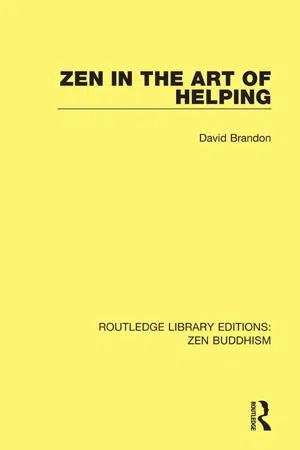
A succinct, uncompromising study of what it means to help other people, this book, first published in 1978, examines the helping process in the light of the principles of Zen Buddhism. Emphasizing the Zen precepts of true compassion, newness and Taoistic change, it explains how a helper can break down the artificial barriers that serve to separate people and hinder the helping process. As the teachings of Zen demonstrate, real compassion involves a selflessness and respect that can bring helper and helped together.
- 132 pages
- English
- ePUB (mobile friendly)
- Available on iOS & Android
eBook - ePub
Zen in the Art of Helping
About this book
Information
1 Introduction
10.4324/9781315619699-1
A wise friend advised against being clever in writing this book. He wanted me to avoid being too intellectual. He was afraid that I might drown the readers in a torrent of quotations from obscure Japanese and Chinese sources; that I might develop the whole Zen theme as a trendy contribution to the coffee table.
I have to travel light; to throw away my squirrel-like desire to gather nuts from authois who have written wisely and profoundly. The task is to dig deeply into my own nature and express segments of direct experience without inflating the ego or becoming intensely subjective. I want to write more from intuition than from cognitive reflection.
This means throwing away the desire to impress or to express ideas simply because they may provoke or sound good. Truth lies as frequently in the cliché and the banal as in the witty remark. I shall try to be honest and stay close to my direct experience. I shall repeatedly throw carefully contrived nets over the gossamer and elusive notions of Zen, Taoism and Nowness and hear the loud laughter of the Zen Masters as they cry out ‘Live rather than define’. Zen Masters had a profound disrespect for everything — especially the written word. They were and are the Houdinis of conceptualization and philosophical speculation. That was their nature not mine.
I have no intention of being bullied by the term Zen. I wish to use it to describe a whole effervescent flavour in living. I want to use it more widely than simply describing a particular school of Buddhism. About four or five years ago, it occurred to me that Zen had much nutrition to give to my other love — social work. The periods of meditation helped to quieten my mind and enabled a clearei perception of clients. It seemed that I could travel closer to my own essence as well as theirs.
The nature of Zen does not lie in scholarship, philosophy, in the Buddhist doctrine, and not even in zazen [sitting meditation], in other words Zen. It lies in one thing alone, namely seeing into the Buddha nature that is in each person. 1
This is close to what Quakers talk about when they refer to ‘the inner light in every man’. The contribution of that idea deepened as the years went by. The helping process is essentially about exploring that light inside yourself and being a source, at best unintended, of others finding their own.
At first, Zen had been a tool to satisfy the cravings to become a ‘better’ person. I was more relaxed, more serene. But very soon I was led to question the ultimate source of this craving to be better. Why was it so important to improve psychologically, to be different, to change? Why did I have to deny the darker side of my being, to be so dissatisfied with my present condition? What drives me on so relentlessly?
Shakespeare's King Lear was an early guide. It posed very basic questions about the nature of man. What is man when divested of pomp and circumstance, pride, social role and prestige, clothes, lands and even sanity? Does an individual have anything special or unique, anything which makes his separation from others explicable?
Working with the suffering of the elderly and the isolated, first as a nurse and latterly as a social worker, the history of individuals seemed remarkably similar to each other and to mine. The differences seemed mainly cosmetic. At depth men and women went through broadly similar processes — the having of children, suffering and joy, facing sickness, bereavement and death.
Early in my social work career I became preoccupied with the problem of homelessness. These men and women had very little. They had been through the Lear process and divested themselves or been divested of almost everything — families, social relations, adequate clothing and money, proper food and shelter. I spent years talking to people who lived in derelict houses, under rail bridges and in parks. Little stuck to them. They were and are concerned with the immediate, the present moment and the coming minutes — the next meal, the next handout, the next bed.
It is no accident that so many of the world's great religious leaders chose to be drifters, to be without a settled home, to wander across the face of the earth. ‘The foxes have holes, and the birds of the air have nests; but the Son of Man hath nowhere to lay his head.’
2
Having a home can mean a narrowing of vision; having too comfortable an armchair to travel anywhere in. Religious leaders have to float ideologically, to challenge prevailing and fixed views of life. The mortgage can easily be society's secret weapon against radicalism and iconoclasm.
Homes take people away from many of the great waves and turbulences of existence. They are harbours with central heating. They can persuade people that life is warmer, less restless and disruptive than a view out of a picture window will allow. To the homeless such feelings are no insurance or refuge. Everyday the homeless man looks for shelter from the wind and rain. Everyday he is sensitive to changes in the weather, to the different seasons. Life blows him like an autumn leaf.
3
The cost is unromantic. He pays for his shelterlessness through bronchitis, frost-bite and TB; through alcoholism and crawling fleas. He can readily become an object of social charity, a piece of plasticine to be kneaded and shaped by the social services. He can persistently be defined as a ‘malingerer’, a ‘beggar’. His sense of humanity can be speedily eroded.
The primary condition for constructive restlessness lies in following the middle way. To grow in mind and body and to live iconoclastically, it seems necessary to have neither too much nor too little. The poor are eternally preoccupied with the pangs of hunger and sodden with the rain; the wealthy spend their time acquiring and protecting what they already have — a state of satiation: adequate protection against the winds of life. Only a man who is not imprisoned by the weight of his possessions and yet not possessed with the need continuously to find food and shelter can ask and live out important questions. ‘Who am I?’ ‘Where am I going?’ ‘What is another?’ ‘What is the nature of life?’ These questions and the living of them are the nature of Zen — whatever you may wish to call it.
Homeless men and women are great teachers. I wish they had had a more patient and diligent student. I found unlearning very difficult. I held on tightly to my sets of answers in situations where they became increasingly irrelevant.
In the following pages I shall try to avoid covering the trail with too many attachments, opinions and words, words and words.
Alone in mountain fastness,
Dozing by the window.
No mere talk uncovers Truth:
The fragrance of those garden plums!
(Bankei, 1622—93)
4
In this book I want to explore five major areas where the helping process can be illuminated. There are a particular group of people who help for a living — professional helpers like nurses, doctors, social workers, teachers. But all of us throughout our lives help and are helped. I want to apply the Zen blow-lamp to that process and see helping as a way of living and being rather than as a particular job or career. I want to object strongly to the aridity of much that passes for professionalization and technologization particularly in the helping professions.
I would be sad if this book were seen as yet another attempt at developing a helping superego. The way of Zen is not to reach out after our Superman fantasies, to explore feelings of ‘being good’ and denying our shadow self but to become more human. We learn to accept our fallibility; our anger and impatience.
I want to try uncovering the heart of Zen which is your own feelings and deep concern. This is a concern about intuition and compassion, much of which bubbles loudly in social work, medicine, teaching, in Christianity, the guts of Islam and the belly of Hinduism. Even though you had never heard the word before, you already know a great deal of Zen.
Hindering is rarely examined in relation to helping. In our hearts we know that we frequently offer little assistance to people and even, sometimes, hinder them. We demand that our clients suit our ideas of them rather than pursue their own pathways of personal growth — interfering rather than intervening. Helpers turn their clients into dependants; change them into passive consumers in what Ivan Illich calls ‘iatrogenesis’. This simply means the capacity of helping organizations and helpers to hinder their users, to undermine their processes of self-help. Our craving for status, security and power conflicts directly with the provision of a truly helping service.
I sit on a man's back, choking him and making him carry me, and yet assure myself and others that I am very sorry for him and wish to ease his lot by all possible means — except by getting off his back. 5
The real kernel of all our help, that which renders it effective, is compassion. I want to discuss the nature of compassion. What moves our desire to help and heal? What is the relationship between our intentions and the results of our actions? This links closely with the summation of love and compassion — which in Zen is called Satori or enlightenment.
Nowness permeates the followers of Zen. It gives both life and energy. It relates directly to our notions of mental health — the ability to put the maximum of energy into the present moment is a large component of mental wellness. About the past I can do little; about the future hardly anything; only now can I make decisions.
Change is the hub of helping. We strive earnestly to achieve better conditions, insights, feelings for ourselves and others. I want to explore the implications and nature of Taoistic change, a change which begins from being rather than from becoming, a change which is as much concerned with our own hearts as with the situation of others and the wider social structures and institutions.
The last chapter is called Zen fruit. I want to outline the practical contributions which a Zen perspective may make to the development of caring services. How can we encourage the carers to challenge the basic nature of the services in which they work? How can we find daily nutrition in our ordinary lives? How can we constantly challenge current perceptions of reality from the basis of our experience?
2 What is Zen?
10.4324/9781315619699-2
Zen cannot be defined. It is not a ‘thing’ to be surrounded or reflected by words. When the last word is trowelled into the prison it escapes and laughs away on the horizon. As one of the great texts has it: ‘When we know what Zen is, we see it everywhere (and what is everywhere is nowhere). How shall we point to it, when it is in the very finger with which we are pointing?’ 1
Describing Zen is like trying to lassoo clouds. Zen is a Japanese word simply meaning meditation. It is the name of a school of Buddhism stemming from the confluence between the intensely pragmatic Chinese philosophy of Taoism and Indian Buddhism probably brought by the monk Bodhidarma to China in the sixth century AD. It may well be that many of the numerous stories surrounding Bodhidarma are myths. Alan Watts even questions whether he actually introduced Buddhism to China at all. 2
The stories indicate an intensely enigmatic figure as far away as possible from the conventional picture of the religious missionary. He seemed intent on provoking and annoying the Chinese whom he met. He either directly discouraged students who came to study with him or set them outrageously difficult tests. This famous four-line Zen stanza was attributed to him but was actually written much later: 3
A special tradition outside the scriptures;
No dependence upon words and letters;
Direct pointing at the soul of man;
Seeing into one's own nature, and the attainment of Buddhahood.
Whatever the historical truth about Bodhidarma, the early Ch'an Masters (Chinese for Zen) were often harsh, eccentric figures demanding strict obedience from their pupils. They were great iconoclasts challenging every orthodoxy not simply from words but from the bowels of their being. Zen became very important particularly in Northern China and even more significant in the development of Japan some centuries later.
Zen permeated and permeates many aspects of Japanese life. Its influence and questioning about the root and source of all life is seen in the freshness of the paintings of Hokusai and Hiroshige. We can see it in the sweeping calligraphy — a seemingly paradoxical combination of intense spontaneity and vitality as well as strict discipline. It is also found in bonzai tree-growing, in gardening and landscaping; in the haiku poems which blossomed from Basho and many others; in the tea ceremony, fencing, judo, Aikido but most of all in the sheer art of living. 4 5 6
Zen was lived by thousands of Masters and their students over many centuries. The living gave life. Each Master handed down a liberating form and message and a keen eye to the growth and understanding of his students. The Masters were their own men. Sometimes they behaved outrageously, spontaneously. They pointed the way to enlightenment; cajoled, encouraged and shocked their students into seeing their own nature. These Masters were practical men who mixed periods of intense meditation with cultivating the land to grow their own food and cooking and stone-breaking.
Zen is a way of awakening which makes no claims for a monopoly. The avowed intent is to set men free from their delusions about the world and themselves. Man is bound to the wheel of Samsara, the circle of self-frustrating effort. We are ourselves a part of the knot which we see...
Table of contents
- Cover
- Routledge
- Halftitle Page
- Copyright Page
- Title Page
- Copyright Page1
- Contents
- Preface
- Halftitle Page1
- 1 Introduction
- 2 What is Zen?
- 3 Hindering
- 4 Compassion
- 5 Nowness
- 6 Taoistic Change
- 7 Zen fruit
- Notes
Trusted by 375,005 students
Access to over 1.5 million titles for a fair monthly price.
Study more efficiently using our study tools.
Frequently asked questions
Yes, you can cancel anytime from the Subscription tab in your account settings on the Perlego website. Your subscription will stay active until the end of your current billing period. Learn how to cancel your subscription
No, books cannot be downloaded as external files, such as PDFs, for use outside of Perlego. However, you can download books within the Perlego app for offline reading on mobile or tablet. Learn how to download books offline
Perlego offers two plans: Essential and Complete
- Essential is ideal for learners and professionals who enjoy exploring a wide range of subjects. Access the Essential Library with 800,000+ trusted titles and best-sellers across business, personal growth, and the humanities. Includes unlimited reading time and Standard Read Aloud voice.
- Complete: Perfect for advanced learners and researchers needing full, unrestricted access. Unlock 1.5M+ books across hundreds of subjects, including academic and specialized titles. The Complete Plan also includes advanced features like Premium Read Aloud and Research Assistant.
We are an online textbook subscription service, where you can get access to an entire online library for less than the price of a single book per month. With over 1.5 million books across 990+ topics, we’ve got you covered! Learn about our mission
Look out for the read-aloud symbol on your next book to see if you can listen to it. The read-aloud tool reads text aloud for you, highlighting the text as it is being read. You can pause it, speed it up and slow it down. Learn more about Read Aloud
Yes! You can use the Perlego app on both iOS and Android devices to read anytime, anywhere — even offline. Perfect for commutes or when you’re on the go.
Please note we cannot support devices running on iOS 13 and Android 7 or earlier. Learn more about using the app
Please note we cannot support devices running on iOS 13 and Android 7 or earlier. Learn more about using the app
Yes, you can access Zen in the Art of Helping by David Brandon in PDF and/or ePUB format, as well as other popular books in Social Sciences & Regional Studies. We have over 1.5 million books available in our catalogue for you to explore.