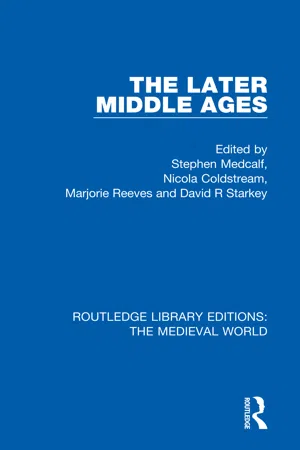
Originally published in 1981, The Later Middle Ages bridges the gap between modern and medieval language and literature, by introducing the social and intellectual milieu in which writers like Chaucer, Malory and Margery Kempe lived. It provides a unified and coherent account of the culture of late medieval England, and of the problems involved in viewing it, in relation to English literature. The book covers the history of ideas and education, art and architecture, and changes in the social, economic and political structure.
- 330 pages
- English
- ePUB (mobile friendly)
- Available on iOS & Android
eBook - ePub
The Later Middle Ages
About this book
Information
1 On reading books from a half-alien culture
… it is a real book: i.e., it’s not like a book at all, but like a thunder-clap.1 (C. S. Lewis)
Difficulties in understanding
Reading a book is a complex thing to do; giving a true reading of a book inimitably complex. Even now as I am writing, I am trying to talk about our common world; but you are trying to understand me, to put yourself at the centre from which a cobweb of language half-creates my world. There is a gap between the two meanings, mine and yours; but it can be to all intents and purposes closed, because we are contemporaries, sharing a common language, and because I am not writing an ambitious work of art or self-expression.
But in this book we are dealing with Piers Plowman, Troilus and Criseyde, Morte Dart hur, Skelton’s poems. In reading these great and ancient works, the gap between author’s and reader’s meaning may be very wide, and ways of closing it are various and unsatisfying. One school of thought might let the author’s side be lost, arguing that a poem is a public work and should be read as what it means to us, the only permissible discussion being critical discussion of the structure and internal relations of the words as we hear and understand them. An opposite school would devote its time to transporting the modern reader across the gap, arguing that the medium of a poem is the meaning of its words in the context in which it was written, its subject matter is the life of its own period, its structure is something governed by the aesthetic criteria of its own age, and its purpose is its author’s speaking as he intended to the audience he designed.
These are extreme views, both despairing of closing the gap. Less extreme practitioners may try to bring one side or the other closer in; either rendering the poem into its modern equivalent (as Dryden did with Chaucer) or calling up scholarship to make the modern reader acquire medieval reading habits.
In this book, trying to set both medieval literature and its modern readers in the context of the medieval world (both inner and outer) and its values, its notion of the arts and its social organization, we tend towards the last approach. But, as this first chapter will try to show, we think that the dispute can be transcended. And, although both medieval studies and the co-operation between disciplines are at such a point that we hope what we shall have to say is novel and interesting at any level of scholarship, in trying to resolve the dispute we have primarily in mind not the professional medievalist but the common reader who inhabits all of us. We should like to move at the level of such annotated texts appealing to a wide range of readers as John Burrow’s English Verse 1300–1300, A. C. Cawley’s Canterbury Tales, Cawley and Anderson’s Pearl, Cleanness, Patience and Sir Gawain and the Green Knight, A. V. C. Schmidt’s Piers Plowman, and R. T. Davies’s Mediaeval English Lyrics and Corpus Christi Play of the English Middle Ages. In particular, we remember H. G. Wells’s Mr Polly, the person who has little or no experience of medieval English, who has encountered medieval culture and found it distant and mysterious, yet ‘had the strangest sense of being at home – far more than he had ever been at home before.’2
Those differences of approach, which we hope to transcend, and which seem scholarly or critical, rest on two profounder disagreements, about personality and about words.
What is it, first, for a word to mean something? It is not a question that much troubles us (though perhaps it ought) as long as we stay within the borders of our native language and culture. It is when we move outside – or as in the case of England between 1330 and 1550, half-outside – when we find ourselves making implausible, or suspect we are making plausible but false, interpretations of books that the questions begin. To understand a word, must one know the whole structure of the language, even of the culture, of which it is a part? Or does one begin with single words, with mysterious particular flashes of intuition about their relation to our common world? How far, indeed, is our common world itself composed of atoms that we can be sure of reaching, put together in different constructions by different cultures, and how far is it made visible only by the projections of our forming consciousness?
We know, at least, that we notice things by naming them. But what should we notice in using unfamiliar names? In reading from the General Prologue to The Canterbury Tales the description of April, when
… the yonge sonne
Hath in the Ram his half cours yronne3
we may have help from the picture for April in the Duc de Berry’s Très Riches Heures, in which above the duke’s castle of Dourdan the blue sky merges with no particular break (that might indicate a different world) through clouds to a king in a chariot holding the sun: then beyond a space marked for a calendar are the heavens, spangled with stars and divided into sections of the zodiac with the Ram and the Bull. But should we refer the words primarily to some such representation? Or to our own knowledge of the stars and the young spring sun? Or to a date in the calendar, rhetorically decorated? Or to something more conceptual, only to be understood in a whole structure of alien ideas, experiences and symbols? Or to something mysteriously between all these? How much weight should we give to the fact that Chaucer’s contemporaries believed that each of the heavenly bodies was guided – not indeed by any physical being, nor by a god, but by an intelligence? In what way should we take the not quite formulable sense that much medieval poetry gives, of an outer world alive, active, and yourself a living part of it?
The second fundamental question is: what is it to be a person? Are we atomic individuals, independent substances only externally related, communicating by constructions and works of art placed between us? In that case, reading a book is like contemplating an artefact designed to elicit such and such responses in the reader, and if the artefact does not work we legitimately adjust it. Or are we beings who exist partly in terms of each other, capable of and needing radical empathy, so that our languages, even over a gap of time, are relations partly internal to ourselves, intuitively understood? In that case, reading a book is entering the truth of someone else’s mind, and, if we cannot enter, it is we ourselves who must change.
But these profound disagreements are complicated by a matter of history: namely, that different ages tend to take different sides on them, and the Middle Ages in particular probably felt less sense than we now do of individual isolation, had a different sense of inner and outer, and a greater sense of a common way of thinking in a shared and stable world. But does that make the gap that separates them from us narrower (if in fact they wrote with a certain assumption of givenness and community) or wider (if in fact we cannot share their assumptions)?
Chaucer, for example, in writing as he did about the sun, was not creating a personal image but drawing on an inherited language. In fact, he was following closely Guido delle Colonne’s Latin History of the Destruction of Troy: ‘sol maturans sub obliquo zodiaci circulo cursum suum sub signo iam intraverat arietis’4 (‘the hastening [or, ripening] sun in the sloping circle of the zodiac had already entered his course under the sign of the ram’). But evidently Chaucer has altered it: he has done something extremely characteristic of his age, by having given (as it was put then) a new sense to an old matter. How much, then, of the effect we receive – the effect of a stately dance, of gorgeousness and assurance in an objectively meaningful and stably recurrent world – is our general and alien reaction to medieval rhetoric, how much what is specifically meant in this passage? How much relates to the matter Chaucer draws from his culture, how much to the sense, the bloom he has created as a particular craftsman? When, as often in Chaucer, there is a contrast between the original and the new version, when we know or suspect irony, then it becomes imperative to know (as with Betjeman’s poetry in our time) what and how many levels there are. In this case Chaucer seems, by translating or changing maturans into ‘young’, bringing out of cursum, ‘course’, its latent sense of ‘run’, and shortening the whole phrase, to have enhanced the sun’s speed, increased our sense of its personality, and added to the eagerness of the passage. If this is a right account, there is no irony or distancing: everything he has done has enhanced the original meaning, and indeed made vivid to us a sense of the world we only barely receive from Guido delle Colonne. But it does not seem to be so when he writes, one can scarcely but think in parody,
… the brighte sonne loste his hewe;
For th’orisonte hath reft the sonne his light;
This is as much to seye as it was night.5
orisonte] horizon
How, then, do we decipher? How much do we need to decipher?
When the business of deciphering ancient scripts was first seriously undertaken, it was thought that Egyptian hieroglyphics would give up their meaning if you traced your own train of associations from what they seemed naturally to present to you, on the general assumption that they were presenting wisdom. This was in fact in th...
Table of contents
- Cover
- Half Title
- Title Page
- Copyright Page
- New Preface to the Later Middle Ages
- Original Title Page
- Original Copyright Page
- Table of Contents
- Illustrations
- Preface
- 1 On reading books from a half-alien culture
- 2 The ideal, the real and the quest for perfection
- 3 Inner and outer
- 4 Art and architecture in the late Middle Ages
- 5 The age of the household: politics, society and the arts c. 1350-c. 1550
- Epilogue: from Troilus to Troilus
- Index
Trusted by 375,005 students
Access to over 1.5 million titles for a fair monthly price.
Study more efficiently using our study tools.
Frequently asked questions
Yes, you can cancel anytime from the Subscription tab in your account settings on the Perlego website. Your subscription will stay active until the end of your current billing period. Learn how to cancel your subscription
No, books cannot be downloaded as external files, such as PDFs, for use outside of Perlego. However, you can download books within the Perlego app for offline reading on mobile or tablet. Learn how to download books offline
Perlego offers two plans: Essential and Complete
- Essential is ideal for learners and professionals who enjoy exploring a wide range of subjects. Access the Essential Library with 800,000+ trusted titles and best-sellers across business, personal growth, and the humanities. Includes unlimited reading time and Standard Read Aloud voice.
- Complete: Perfect for advanced learners and researchers needing full, unrestricted access. Unlock 1.5M+ books across hundreds of subjects, including academic and specialized titles. The Complete Plan also includes advanced features like Premium Read Aloud and Research Assistant.
We are an online textbook subscription service, where you can get access to an entire online library for less than the price of a single book per month. With over 1.5 million books across 990+ topics, we’ve got you covered! Learn about our mission
Look out for the read-aloud symbol on your next book to see if you can listen to it. The read-aloud tool reads text aloud for you, highlighting the text as it is being read. You can pause it, speed it up and slow it down. Learn more about Read Aloud
Yes! You can use the Perlego app on both iOS and Android devices to read anytime, anywhere — even offline. Perfect for commutes or when you’re on the go.
Please note we cannot support devices running on iOS 13 and Android 7 or earlier. Learn more about using the app
Please note we cannot support devices running on iOS 13 and Android 7 or earlier. Learn more about using the app
Yes, you can access The Later Middle Ages by Stephen Medcalf,Nicola Coldstream,Marjorie Reeves,David R Starkey in PDF and/or ePUB format, as well as other popular books in Literature & Literary Criticism. We have over 1.5 million books available in our catalogue for you to explore.