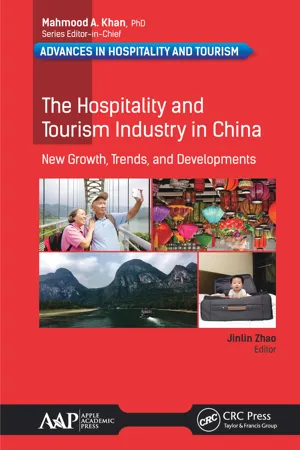
Here is an insightful look into the great changes in the hospitality and tourism industry in China in recent years. The steady growth of the GDP in China, the increasing middle-income population, lifestyle changes of the Chinese people, and fast infrastructure development (speed trains, airports, highways, and seaports, linking many mega cities, mid-level cities, and townships) have all had a significant effect on the Chinese hospitality industry, which is booming in China. With much more money in their pockets, the Chinese are spending more than 60% of their disposable income on food and travel. International food and hotel chains have responded by increasing their presence in China, and in turn, new domestic restaurant and hotel chains have sprung up to compete for the business. With chapters by scholars from various universities in China and the United States, these issues and more are covered in this new volume. Readers will gain a true understanding of the current development of Chinese hospitality and tourism industry.
eBook - ePub
The Hospitality and Tourism Industry in China
New Growth, Trends, and Developments
- 362 pages
- English
- ePUB (mobile friendly)
- Available on iOS & Android
eBook - ePub
About this book
Information
Index
BusinessChapter 1
Budget Hotels in China: Recent Development, Changes, and Challenges
LIANPING REN
Institute for Tourism Studies, Macao, China
Institute for Tourism Studies, Macao, China
Contents
| Abstract |
| 1.1 Introduction |
| 1.2 Key Domestic Players in the Budget Hotel Sector in China |
| 1.3 Recent Acquisitions within the Budget Hotel Sector |
| 1.4 International Players and International Collaboration/Strategic Alliance |
| 1.5 Further Tiering of the Budget Hotel Sector |
| 1.6 Concluding Remark |
| Keywords |
| References |
Abstract
This chapter provides an overview of the development of the budget hotel sector in China. It reviews the historical development of this hotel sector in the past 20 years since the establishment of the first Jinjiang Inn in Shanghai, and describes the key players of this hotel sector. Recent development trends and the intense competition in this sector are also discussed.
1.1 Introduction
Development of the hotel industry as a whole started only after the reform and opening policy in China in 1978 (Zhang et al., 2005). Over the years, the Chinese hotel industry has undergone fast and dynamic development. Up until the beginning of the new century, public attention has been mainly on the number of star-rated hotels, statistics of which are mainly released by the China National Tourism Administration (CNTA). However, recent years have seen huge development in nonstar-rated hotels. According to Travel Daily (2015), the total number of star-rated hotels, up to the second quarter of 2015, was 11,282, including 96 One-Star hotels, 2,507 Two-Star, 5,447 Three-Star, 2,424 Four-Star, and 808 Five-Star hotels. On the other hand, according to the statistics released jointly by the Ministry of Commerce, People’s Republic of China (PRC), and the China Hotel Association (2015), the number of mid-scale and lower scale budget hotels accounted for 45% of the total hotel numbers in China. Another 45% of the hotels are other types such as folk-style inns and small-scale but unique featured boutique hotels, both of which are not star rated. The majority of these hotels bear domestic brands. The above statistics have highlighted the portion of budget hotels out of the total number of hotels in China. Although most of the One-Star and Two-Star hotels in China, as rated by the Chinese Star Rating System, resemble the idea of budget hotels or limited service hotels, they are not included in the statistics for budget hotels. As a matter of fact, ever since the start of budget hotel development, the number of star-rated hotels, especially those under three stars, decreased significantly.
The concept of budget hotels is relatively new in China. It started only at the turn of the century with the opening of the first Jinjiang Inn in Shanghai in 1997 (Li, 2009). Prior to the establishment of the first Jinjiang Inn, there were a small number of hotels or hotel chains that resembled the idea of budget hotels, including Xinya Star, which was later acquired by Jinjiang Inn. But the scale and the standard of these hotels were not those of budget hotels strictly speaking. In China, the term “budget hotel” is interchangeable with “economy hotel,” as Cai (2004) noted. On many occasions, it is also referred to as “limited service” or even “selective service” hotels, in comparison to its “full service” counterpart. Recent statistics released by Inntie and other websites have changed the term “budget hotel” into “limited service hotels,” to include the mid-level hotels developed mostly by budget hotel chain companies, which provide upgraded room features and core service, but retain the idea of a no-frill hotel product.
Although budget hotels in China started late, its rapid development over the past 15 years or so has led to a lot of “wows” in the industry, domestically and internationally. Up to January 1, 2016, the numbers of hotels and hotel rooms that have been opened to the market have come to 21,481 (hotels) and 196,915 (rooms), respectively. The number of hotels of this type is almost double than that of the star-rated hotels. The table below shows the development trend and growth rate of budget hotels in China from 2005 to 2015. This hotel sector gained tremendous growth from 2005 to 2008, almost doubling the total hotel numbers every year. The growth pace slowed from 2009, but it has remained a double-digit growth rate up to now (Table 1.1).
1.2 Key Domestic Players in the Budget Hotel Sector in China
Budget hotels in China are dominated by hotel chains. Over the years, the biggest names of budget hotel companies have been Home Inns, Huazhu, 7 Days Inn, and Jinjiang Inn. These companies have been on the top of the list consistently for the past decade. Other frequently heard names of budget hotel brands include Green Tree, Super 8, Vienna Hotels, 99 Hotel, Pod Inn, and so on. The majority of the well-known budget hotels and hotel
TABLE 1.1 Growth Rate of Budget Hotels and Rooms from 2005 to 2015 (Inntie, 2016)
| Year | Hotels | Rooms | Growth (%) |
|---|---|---|---|
| 2005 | 522 | 56,854 | 193.13 |
| 2006 | 906 | 98,817 | 73.81 |
| 2007 | 1,698 | 188,788 | 91.05 |
| 2008 | 2,805 | 312,930 | 65.76 |
| 2009 | 3,757 | 412,840 | 31.93 |
| 2010 | 5,120 | 544,210 | 31.82 |
| 2011 | 7,314 | 747.045 | 37.27 |
| 2012 | 9,924 | 981,712 | 31.41 |
| 2013 | 12,727 | 1,235,833 | 25.89 |
| 2014 | 16,375 | 1,525,471 | 23.44 |
| 2015 | 21,481 | 1,969,145 | 29.08 |
companies are Chinese indigenous brands, with a few exceptions such as Super 8, Ibis, and Holiday Inn Express. The following table shows the top 10 budget hotel brands in China, according to the latest statistics released by Inntie.com (2016). The statistics are based on hotels that have been opened up to January 2015 (Table 1.2).
Most of the companies listed above, however, have only undergone about 10 years of development or less. Jinjiang Inn is probably the oldest budget hotel brand in China, starting from 1997. But its expansion has not been the fastest. A possible reason could be that Jinjiang Inn undertakes more direct management rather than other business modes such as management contracts or franchising. Another possible reason could be that Jinjiang Inn is the only brand under the Jinjiang International Hotel Group, which has focused on full service hotel products since the start of hotel development in China. However, the recent acquisition and merger activity undertaken by the Jinjiang International Hotel Group is going to change its status in both the budget hotel sector and the hotel industry as a whole. This will be discussed later.
Home Inn is known as the second budget hotel chain in China according to time sequence. The first Home Inn was established in Beijing in 2002. The company gained tremendous growth, especially after 2004. It was listed on NASDAQ in 2006. Based on the budget hotel brand of Home Inn, the company has expanded to a mid-level hotel product such as Yitel, which is sold at a price between Three- and Four-Star hotels in China. Acquisitions
TABLE 1.2 Top 10 Budget Hotel Brands in China, by ...
Table of contents
- Cover
- Half Title
- Title
- Copyright
- Contents
- About the Editor
- Advances in Hospitality and Tourism Book Series
- About the Series Editor
- List of Contributors
- List of Abbreviations
- Acknowledgments
- Preface
- 1. Budget Hotels in China: Recent Development, Changes, and Challenges
- 2. Co-Creating Value with Chinese Hotel Owners: Based on a Governance Mechanism Theory
- 3. Development of International Brand Hotels on Hainan Island
- 4. The Expansions of Chinese Companies in the Foreign Hospitality Industry
- 5. Chinese Hotel Mergers and Acquisitions (M&As)
- 6. New Developments of the Chinese Restaurant Industry
- 7. E-Tourism Evolutionary Effect: Studying E-Tourism in China
- 8. The Development and Change of the Cruise Industry in China Over the Decade (2006-2016)
- 9. Profile and Trend of the Exhibition Industry in China
- 10. Tourism Higher Education in China: Profile and Issues
- 11. Leisure Agriculture and Rural Tourism Development in China (2006-2016)
- 12. A Review of Studies on China Tourism Destination Competitiveness During the Past Decade
- Index
Trusted by 375,005 students
Access to over 1.5 million titles for a fair monthly price.
Study more efficiently using our study tools.
Frequently asked questions
Yes, you can cancel anytime from the Subscription tab in your account settings on the Perlego website. Your subscription will stay active until the end of your current billing period. Learn how to cancel your subscription
No, books cannot be downloaded as external files, such as PDFs, for use outside of Perlego. However, you can download books within the Perlego app for offline reading on mobile or tablet. Learn how to download books offline
Perlego offers two plans: Essential and Complete
- Essential is ideal for learners and professionals who enjoy exploring a wide range of subjects. Access the Essential Library with 800,000+ trusted titles and best-sellers across business, personal growth, and the humanities. Includes unlimited reading time and Standard Read Aloud voice.
- Complete: Perfect for advanced learners and researchers needing full, unrestricted access. Unlock 1.5M+ books across hundreds of subjects, including academic and specialized titles. The Complete Plan also includes advanced features like Premium Read Aloud and Research Assistant.
We are an online textbook subscription service, where you can get access to an entire online library for less than the price of a single book per month. With over 1.5 million books across 990+ topics, we’ve got you covered! Learn about our mission
Look out for the read-aloud symbol on your next book to see if you can listen to it. The read-aloud tool reads text aloud for you, highlighting the text as it is being read. You can pause it, speed it up and slow it down. Learn more about Read Aloud
Yes! You can use the Perlego app on both iOS and Android devices to read anytime, anywhere — even offline. Perfect for commutes or when you’re on the go.
Please note we cannot support devices running on iOS 13 and Android 7 or earlier. Learn more about using the app
Please note we cannot support devices running on iOS 13 and Android 7 or earlier. Learn more about using the app
Yes, you can access The Hospitality and Tourism Industry in China by Jinlin Zhao in PDF and/or ePUB format, as well as other popular books in Business & Hospitality, Travel & Tourism Industry. We have over 1.5 million books available in our catalogue for you to explore.