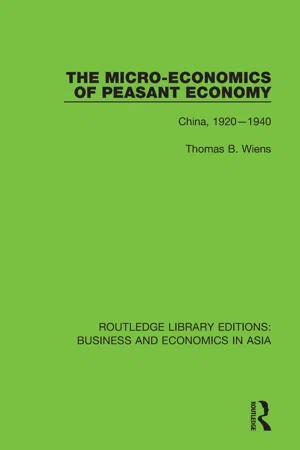
The objectives of this study, first published in 1982, are to elaborate a micro-economic model which adequately explains the interrelationships among economic forces determining the distribution of income in a peasant economy in the early stages of transition to industrialization. It also examines the development of the 'dual economy', an economy composed of a large peasant agricultural sector with its ancillary handicraft sector, both traditional in techniques and institutions, and a small but growing modern industrial sector.
- 528 pages
- English
- ePUB (mobile friendly)
- Available on iOS & Android
eBook - ePub
The Micro-Economics of Peasant Economy, China 1920-1940
CHAPTER VI. THE AGRICULTURAL PRODUCTION FUNCTION AND FACTOR PRODUCTIVITY IN PREWAR CHINESE AGRICULTURE
If Chinese peasant families were deploying their resources In such a way as to even approximately maximize some (utility) function of family income, however qualified or constrained by risk aversion or other influences, the systematic relationships should exist among the marginal value productivities of factors of production and their market prices. We have previously described the probable nature of these relationships, and. have shown the extent to which the Chinese institutional structure facilitated maximizing behavior. It remains to examine the available data for evidence of the relationships hypothesized.
The primary difficulty lies in estimating the marginal value productivities of the various productive factors, that Is, the Impact on family Income of small increases or decreases in the productive use of labor, land or capital, individually, with use of other factors held constant. We are obviously not in a position to experiment, but must deduce the principles of change from comparisons of situations in which many elements differ. Since we are further handicapped by dependence on cross-sectional comparisons, we are also generally unable to examine the situations of single farms at more than one point In time.
Under these circumstances, we must assume that it is possible to define and mathematically describe a “production function”, a set of relationships between “inputs” (productive factors in use) and farm “outputs” (physical quantity or market value of products resulting), which is shared by large samples of farmers. Such a “production function” could be at best a simplified mathematical approximation of a myriad different relationships. It Is a relatively easy exercise to derive such a summary measure; it is more difficult by far to ensure that it is a genuine measure of the complementarities and substitutabilities among the factors of production, of marginal productivities and returns to scale, such as pertain to individual farms. The largest proportion of the work in this and the following chapter attempts to deal with the latter problem.
There are two different (but not entirely Inconsistent) ways to approach the problem of estimating production functions, which we will term the “neoclassical” and the “activity analysis” approaches. If the amount of commodity X produced is x, and the amounts of inputs A1, A2, …,An used in its production are a1,a2..,an, then the production function is the relationship x = f(a1,a2,..,an). The “neoclassical” approach assumes that this function is a continuous function of continuous variables. Moreover, if we vary the use of inputs in such a way as to hold output constant at some level xo, and so define a hypoersurface in input space, it is assumed that In the usual case this surface will be convex to the origin, that is, that increasing amounts of one Input are required to keep output constant in the face of constant decreases in the use of another input (an increasing marginal rate of substitution).1 The activity analysis approach differs from the neoclassical in assuming neither a continuous function nor continuously divisible variables, although neither are necessarily ruled out. Replacing the production function as such are sets of techniques or activities, indicating relationships between inputs and outputs such that (1) for any particular technique, input proportions are fixed (rather than continuously variable); (2) if more than one technique exists for producing any type of commodity, techniques may be used in combination to permit effective substitutability of inputs. However, in this case the constant output surfaces are discontinuous, composed of Intersecting planar surfaces, which individually are characterized by constant marginal rates of substitution, and are characterized by convexity only vis á vis the location of the various planes composing the isoquant. The productive relationships here cannot be even theoretically described by a single equation,* as was the case for the neo classical production function.
* Although any single plane, describing the relationship among n techniques in n factor space, may be described by a single linear equation.
Since the neoclassical production function can be regarded as either a curvilinear approximation to the isoquant of activity analysis or as the limiting case of an infinite number of techniques encompassing all permutations of input proportions, the reader may Judge the above discussion superfluous. We have, however, two reasons for emphasizing the differences between the two approaches: First, the activity analysis approach is in most respects truer to the peasant’s own perception of the process of decision making in production, and is a more accurate description of the production process in theoretical terms in the “real world” of finite numbers of techniques available to each individual producer, for which reasons it has been employed in our earlier theoretical discussion. Yet the neoclassical approach is both more tractable and more frequently employed in actual econometric estimation of productive relationships. It is obviously important to be aware that the latter is an approximation of the former, often a poor approximation and sometimes totally misleading. Second, when data are sufficiently detailed and disaggregated, an activity analysis approach to empirical estimation may be distinctly preferable, and will in fact be used in the following chapter. Since the data there employed is limited to small samples drawn from a few villages in a single region, the large-sample, all-China analysis of this chapter should help set a context for what follows.
Source and Form of Data
The data employed in the estimation of production functions in this chapter was derived from that published in the Statistical Volume of John L. Buck’s Land Utilization in China (see the discussion on pp. 8 – 10 of Chapter I), representing the results of a survey conducted between 1929 and 1933 of a cross-sectional sample of about 16,000 farms. We have taken as our basic units of observation the averages of data for each locality at the farm level, as grouped by size of farm. Since there were on average five size groups per locality (with the range of farm size for each group differing from locality to locality), totalling 100 farms per locality, this gave us a total of 750 observations.* This in turn was subdivided into samples covering the eight crop regions (see Table 6.1) determined by Buck, which have been analyzed separately in order to reduce cross-sectional variation in agricultural technologies determined by geographical, climatic and cropping factors (which tend to coincide)and to reduce the Impact of variance in excluded factors of production (such as climate and soil characteristics) which would otherwise tend to bias estimates based on regression analysis.
* As the data are in the form of group means, we have in estimation corrected for heteroskedasticity by using the square root of the number of observations in each group as weights to unbias estimates of the covariance matrix.
TABLE 6.1 CHARACTERISTICS OF EIGHT CROP REGIONS*

Discussion of the precise derivation of each variable used of from the Buck data Is confined to Appendix VI-A. We confine ourselves here to discussion of variables actually used in the following analysis. These variables (the means of which are listed by region in Table 6.2) were, for the ith observations:
TABLE 6.2 MEAN VALUES OF INPUT RATIOS BY REGION*

Qi = production of crops, in terms of kilograms of grain-equivalent?
DG1 = percent of cultivated acreage double-cropped per farm (or crop acreage divided by cultivated acreage, minus one);
Ii = percent of cultivated acreage irrigated per farm;
Ti = tenancy rate (percent of land rented per farm);
Li = man-equivalents of farm labor per year (with idle time deducted);
Fi = organic fertilizer (nightsoil and manure) produced on farm;
Ci = cultivated acreage (excluding idle or fallow land);
Ai = labor animal units (defined in terms of feed consumption, as a proxy for maintenance cost).
Discussion of the Individual variables in turn follows:
(1) Qi, the “output” variable in what follows, is a measure of the equivalent in terms of the major local grain of all farm produce (excluding products of animal husbandry). Equivalency was defined in weight in the case of other grains, in terms of calorific equivalent in the case of legumes and tubers, and price equivalence for all other products.2 The use of such a composite variable is more suitable for a subsistence than for a market economy, and can ...
Table of contents
- Cover
- Half Title
- Title Page
- Copyright Page
- Original Title Page
- Original Copyright Page
- Table of Contents
- Tables
- Figures and Graphs
- Preface
- Frontmatter
- I Introduction
- II A Theory Of Distribution In The Agrarian Sector
- III The Land Market In Prewar China
- IV The Loan Market In Prewar China
- V The Labor Market In Prewar China
- VI The Agricultural Production Function And Factor Productivity In Prewar Chinese Agriculture
- VII An Activity Analysis Approach To Productivity Measurement, Mi-Ch’Ang Village Sample
- VIII Summary And Conclusions
- II-A Proof of Relation between Number of Constraints and Number of Techniques
- II-B Factor Allocation in the Presence of Uncertainty
- III-A Choice-Theoretic Approaches to Rental Deposits
- IV-A Average Family Incomes and the Distribution of Income in the Chinese Peasant Economy
- V-A Estimation Procedure for Industrial Wage Structure Model
- V-B Relationship between Capital/Land Ratio and Size of Farm
- VI-A Notes on Data Derived from John L. Buck, Land Utilization in China, Statistical Volume
- VI-B Weighted Output Data and the Estimation of an Aggregate Production Function
- VI-C Specification of Land in Production Function Estimation
- VI-D Locality Intercepts
- VI-E The Simultaneous Equation Problem in the Estimation of the Chinese Agricultural Production Function
- VI-F Response to Fertilizer Applications and Technological Change in China
- VI-G Grain Prices in Prewar Chinai Data and Sources
- Notes
- Bibliography
Trusted by 375,005 students
Access to over 1.5 million titles for a fair monthly price.
Study more efficiently using our study tools.
Frequently asked questions
Yes, you can cancel anytime from the Subscription tab in your account settings on the Perlego website. Your subscription will stay active until the end of your current billing period. Learn how to cancel your subscription
No, books cannot be downloaded as external files, such as PDFs, for use outside of Perlego. However, you can download books within the Perlego app for offline reading on mobile or tablet. Learn how to download books offline
Perlego offers two plans: Essential and Complete
- Essential is ideal for learners and professionals who enjoy exploring a wide range of subjects. Access the Essential Library with 800,000+ trusted titles and best-sellers across business, personal growth, and the humanities. Includes unlimited reading time and Standard Read Aloud voice.
- Complete: Perfect for advanced learners and researchers needing full, unrestricted access. Unlock 1.5M+ books across hundreds of subjects, including academic and specialized titles. The Complete Plan also includes advanced features like Premium Read Aloud and Research Assistant.
We are an online textbook subscription service, where you can get access to an entire online library for less than the price of a single book per month. With over 1.5 million books across 990+ topics, we’ve got you covered! Learn about our mission
Look out for the read-aloud symbol on your next book to see if you can listen to it. The read-aloud tool reads text aloud for you, highlighting the text as it is being read. You can pause it, speed it up and slow it down. Learn more about Read Aloud
Yes! You can use the Perlego app on both iOS and Android devices to read anytime, anywhere — even offline. Perfect for commutes or when you’re on the go.
Please note we cannot support devices running on iOS 13 and Android 7 or earlier. Learn more about using the app
Please note we cannot support devices running on iOS 13 and Android 7 or earlier. Learn more about using the app
Yes, you can access The Micro-Economics of Peasant Economy, China 1920-1940 by Thomas B. Wiens in PDF and/or ePUB format, as well as other popular books in Business & Business General. We have over 1.5 million books available in our catalogue for you to explore.