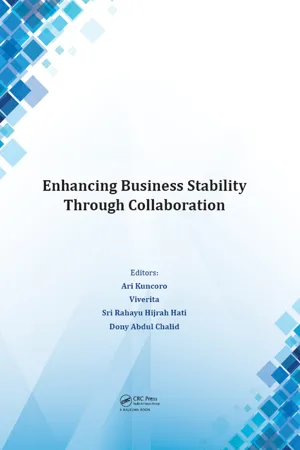
Business practices in emerging markets are constantly challenged by the dynamic environments that involve stakeholders. This increases the interconnectedness and collaboration as well as spillover effect among business agents, that may increase or hold back economic stability. This phenomenon is captured in this proceedings volume, a collection of selected papers of the 10th ICBMR 2016 Conference, held October 25—27, 2016 in Lombok, Indonesia. This ICBMR's theme was Enhancing Business Stability through Collaboration, and the contributions discuss theories, conceptual frameworks and empirical evidence of current issues in the areas of Business, Management, Finance, Accounting, Economics, Islamic Economics, and competitiveness. All topics include aspects of multidisciplinarity and complexity of safety in research and education.
eBook - ePub
Enhancing Business Stability Through Collaboration
Proceedings of the International Conference on Business and Management Research (ICBMR 2016), October 25-27, 2016, Lombok, Indonesia
- 502 pages
- English
- ePUB (mobile friendly)
- Available on iOS & Android
eBook - ePub
Enhancing Business Stability Through Collaboration
Proceedings of the International Conference on Business and Management Research (ICBMR 2016), October 25-27, 2016, Lombok, Indonesia
Exploring the hablumminannas in Muslim consumers’ religious behavior
Department of Management, Faculty of Economics and Business, State Islamic University (UIN) Syarif Hidayatullah, Jakarta, Indonesia
ABSTRACT: This research is intended to explore the hablumminannas (relationship among human beings) in the Muslim Consumers’ Religious Behavior (MCRB) model. Different from other previous studies on Muslim religiosity that mostly apply a one-to-one measurement of Christian or Western terminologies, this study applies an Islamic concept derived from the Quran and Hadith. 378 data sets were analyzed by using structural equation modeling. The finding shows that consumers have high levels of hablumminannas behavior, and the development measurement of the MCRB’s constructs proves to be valid and has achieved an acceptable goodness-of-fit to the model. By analyzing the MCRB, marketers are able to plan a suitable marketing strategy in Muslim marketplaces. This research is limited to only exploring the hablumminannas behavior as the continuity of previous research of hablumminallah (relationship with Allah) measurement within the third-order Confirmatory Factor Analysis (CFA) of MCRB model, while the complete measurement will be analyzed in a further research.
1 INTRODUCTION
Religion is one form of sub-culture that gives its members the identification that influences their behavior, including their preferences and purchase decisions (Essoo & Dibb, 2004). Religious affiliation and commitment to religious beliefs and practices influence consumer behavior (Delener, 1990). Muslims have strict religious guidelines with regard to consumption and use. God commands Muslims to consume only things that are halal (religiously permissible) and good (Quran 23:51). Halal products are those that are compliant to the sharia (Islamic law), that is, they do not involve the use of haram (prohibited) ingredients, the exploitation of labor or the environment, and are not harmful or intended to harm (Omar et al., 2012). As Indonesia has the largest Muslim population in the world, Indonesian law also requires halal products intended for consumption, use, or wear to be in accordance with the Islamic law (Rangkuti & Wright, 2013). Since religiosity is viewed as the degree to which beliefs in specific religious values and ideals are held and practiced by an individual, also affecting the buying consumption pattern in so many ways (Delener, 1990), it is important for marketers to analyze the Muslim Consumers’ Religious Behavior (MCRB) in the targeted Muslim market such as Indonesia.
Stark and Glock defines the five core dimensions of religion constituting a general frame of reference for empirical research: the intellectual, the ideological, the ritualistic, the experiential, and the consequential dimension (Stark & Glock, 1968). Glock’s five-dimensional model of religiosity is the most established model in the sociology of religions, even though there remains a scientific controversy concerning empirical evidence for his model of religiosity (Huber & Huber, 2012). Several studies have been carried out on the Muslim religiosity; however, the studies are often simply translated from the Western or Christian religiosity into Islamic terminology. The following example is that of an item taken from an international study which is used as an indicator for the Islamic belief based on Stark and Glock’s (1968) model of religiosity (Hassan, 2008): ‘Only those who believe in the Prophet Mohammad can go to heaven’. The original wording of the item developed by Glock to measure Christian religious belief is as follows: The belief in Jesus Christ as Savior is absolutely necessary for salvation’. However, unlike Jesus, Mohammad has no divine status. He is seen as a role model for Muslims rather than as somebody to be believed in. In short, a simple translation of indicators from the respective items of other religions can lead to measurement problems and to false interpretations of results (El-Menouar & Stiftung, 2014).
Thus, this research proposes a new model of MCRB that is derived from the Holy Quran and Hadith as the two main sources of Islamic teaching. The good behavior of a Muslim is shown from the level of his/her engagement behavior in daily life, which is related to his/her belief (iman or faith) and his/her rituals (ibadah or worship) (Mansoer, 2008; Aisyah, 2014, 2015, 2016a, 2016b). Majmu’ Fatawa Ibnu Taimiyah book, volume 10:658 also explains that akhlakul karimah (praiseworthy behavior) of a Muslim is built based on his/her relationship framework as a human being with Allah (hablumminallah) which is related to his/her obligation to implement Allah’s commands, and his/her relationship framework with other human beings (hablumminannas) which is related to his/her obligation to fulfill other human being rights, whether Muslim or non-Muslim. These two frameworks describe the criteria of being a good or an obedient Muslim (Wibowo, 2010).
So as to maintain continuity of previous research on hablumminallah (the relationship with Allah) measurement within the third-order Confirmatory Factor Analysis (CFA) of the MCRB model (Aisyah, 2016b), this research is limited to only exploring the hablumminannas behavior. The measurement of the Muslim religiosity needs to address the hablumminannas context. The context of hablumminannas is precisely about everything in the world and hereafter, which is essentially about the facts of nature of human life (personality, habit, event, and causes), which have always been related to the purpose of the implementation of religious teaching (Hidayat, 2009:3). It has already been explained before that the dimensions of Islamic teaching are about belief (iman or faith) and ritual (ibadah or worship) aspects which reflect on a praiseworthy behavior (akhlakul karimah) of a Muslim. A Muslim who has strong faith will be obedient in carrying out his/her worship/ritual activities, which will in turn make him/her become a praiseworthy person. A praiseworthy Muslim will have good relationships with himself, other human beings, and the natural surroundings. Thus, the hablumminannas behavior is an ethical behavior which is internalized with Islamic values and embodied into humans’ daily life habit (Mansoer, 2008; Aisyah, 2014, 2015, 2016a).
This research will establish whether:
1. Muslim consumers have a high level of hablumminannas behavior.
2. it is possible to validate the MCRB measurement model by using a third-order factorial validity.
3. it is possible that the third-order CFA model of MCRB achieves a goodness-of-fit to the model.
This paper is organized as follows: first, the theoretical framework from previous MCRB literatures; second, the structural equation modeling used in this study and the hypothesized model; third, the methodology, data sources and model estimations; and fourth, summaries and discussions of the results.
2 THEORETICAL FRAMEWORK
2.1 MCRB
Based on Tawhidi String Relations (TSR) methodology (Choudhury, 2006), the social relationship’s theme in Islam is related to the main message in the Holy Qur’an, that is, the oneness of Allah. The knowledge inside Al Qur’an is believed as the absolute truth that contains all human needs as a comprehensive guideline. The teaching of Al Qur’an is implemented by the Prophet Muhammad in his daily life. In Islam, the Prophet Muhammad’s behavior is recorded in the Hadith as the second knowledge source of Islam. The Holy Qur’an and Hadith are continuously generated into the world’s system which occurs into the life of human beings through a learning process called the shuratic process. The shuratic process shows an interactive, integrative, and evolutionary learning process that is interrelated with Islamic law in the world system and tends to be a consultative and dynamic process that will go on until hereafter (Harahap, 2008). Thus, it is clear that Islam, as a way of life, always relates the world with the afterlife.
Religious behavior is someone’s attitudes towards his religion in general; not ...
Table of contents
- Cover
- Half Title
- Title Page
- Copyright Page
- Table of Contents
- Preface
- Acknowledgments
- Keynote speakers and organizing committee
- Accounting
- Economics
- Finance
- General and strategic management
- Human resource management
- Marketing
- Author index
Trusted by 375,005 students
Access to over 1.5 million titles for a fair monthly price.
Study more efficiently using our study tools.
Frequently asked questions
Yes, you can cancel anytime from the Subscription tab in your account settings on the Perlego website. Your subscription will stay active until the end of your current billing period. Learn how to cancel your subscription
No, books cannot be downloaded as external files, such as PDFs, for use outside of Perlego. However, you can download books within the Perlego app for offline reading on mobile or tablet. Learn how to download books offline
Perlego offers two plans: Essential and Complete
- Essential is ideal for learners and professionals who enjoy exploring a wide range of subjects. Access the Essential Library with 800,000+ trusted titles and best-sellers across business, personal growth, and the humanities. Includes unlimited reading time and Standard Read Aloud voice.
- Complete: Perfect for advanced learners and researchers needing full, unrestricted access. Unlock 1.5M+ books across hundreds of subjects, including academic and specialized titles. The Complete Plan also includes advanced features like Premium Read Aloud and Research Assistant.
We are an online textbook subscription service, where you can get access to an entire online library for less than the price of a single book per month. With over 1.5 million books across 990+ topics, we’ve got you covered! Learn about our mission
Look out for the read-aloud symbol on your next book to see if you can listen to it. The read-aloud tool reads text aloud for you, highlighting the text as it is being read. You can pause it, speed it up and slow it down. Learn more about Read Aloud
Yes! You can use the Perlego app on both iOS and Android devices to read anytime, anywhere — even offline. Perfect for commutes or when you’re on the go.
Please note we cannot support devices running on iOS 13 and Android 7 or earlier. Learn more about using the app
Please note we cannot support devices running on iOS 13 and Android 7 or earlier. Learn more about using the app
Yes, you can access Enhancing Business Stability Through Collaboration by Ari Kuncoro,Viverita,Sri Rahayu Hijrah Hati,Dony Abdul Chalid in PDF and/or ePUB format, as well as other popular books in Business & Business General. We have over 1.5 million books available in our catalogue for you to explore.