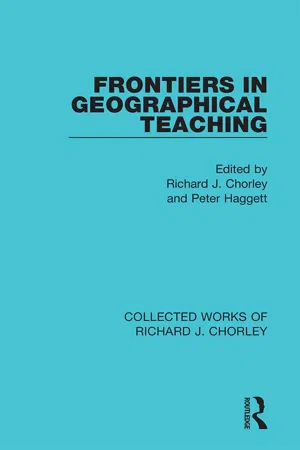
Originally published in 1965 and with a second edition in 1970. Building upon the original two Madingley Hall seminars for teachers of non-university geography in 1965, this book presents an updated research picture of the 1970 transatlantic perspective. Answering the questions "What is happening in geography" and "What impact does this have on school geography", this provided a real link for students who were then making the increasingly difficult transition from school to university geography. Originally receiving a hostile reaction from British journals, the book's diagnosis and prognosis were a forerunner of developments in methodological changes of the discipline. This work collects a series of essays delineating geographic concepts in terms of the philosophic underpinnings, assessment of the geomorphic system, climatology, and social economic and historical changing trends. Techniques are reviewed including quantitative methods for geomorphology and social geography, fieldwork both in urban areas and land-use surveys, and finally in physical planning. Final analyses examine and contrast the teaching methods and courses in American and British High Schools, Colleges and Universities.
eBook - ePub
Frontiers in Geographical Teaching
- 396 pages
- English
- ePUB (mobile friendly)
- Available on iOS & Android
eBook - ePub
Frontiers in Geographical Teaching
About this book
Information
PART ONE
CONCEPTS
CHAPTER ONE
Changes in the Philosophy of Geography
E. A. WRIGLEY
Lecturer in Geography, University of Cambridge
It is perhaps a platitude that a perennial problem of geography, true of many subjects but felt very acutely in geography, has been to find a satisfactory way of organizing the welter of observational material with which geographers commonly deal. It may prove helpful to look back to some solutions to this problem offered in the past as a background to contemporary developments, and to pay especial attention to the writings of Vidal de la Blache, since both his successes and his final failure are very instructive.
‘CLASSICAL’ GEOGRAPHY
Modern geography is often said to begin with two important early nineteenth-century German scholars, von Humboldt and Ritter.1 These two men saw eye to eye in many things and agreed in pouring scorn on their predecessors because they dealt with geographical information in such a haphazard and unsystematic fashion. They gave clear expression to a view of geographical methodology which remained dominant for most of the nineteenth century. It was still the guiding principle of Friedrich Ratzel, at least in his earlier writings in the 1880’s, and was shared by many who were not geographers. It is indeed a pointless exercise at this comparatively early date to distinguish between those who were geographers and those who were not. Humboldt would not fit any label conveniently. Buckle in the early chapters of his History of Civilisation in England (1857–61) gives a succinct account of the new attitude.
This conception of the organization of geography, which may conveniently be labelled the ‘classical’1 view since it held sway during the formative period of modern geography in the nineteenth century, was straightforward and simple. Men like Humboldt and Ritter considered the writings of earlier geographers to be defective because they were largely descriptive and were in their view very ill-organized.2 They considered the scientific organization of knowledge to be a two-stage affair: a first stage which consisted of the careful assembly of detailed and accurate factual material; and a second in which the material was given coherence and made intelligible by being subsumed under a number of laws which should express the relationships of cause and effect to be found in the phenomena as simply and concisely as possible.3 The vital feature of any science was this second stage. Without it any branch of learning was simply pigeon-holing and antiquarianism. This was a first main characteristic of ‘classical’ geography. Status in the world of learning depended on the successful formulation of laws enabling the material to be organized and made intelligible. If geography were to be worthy of ranking with the sciences it must succeed in establishing such laws. It must go on, as Ratzel put it, airing his Latin tags, rerum cognoscere causas,4 to know the causes of things.
1 This claim is conventional and perhaps convenient, but it is quite possible to argue the case for a later date; for example for the work of Vidal de la Blache.
A second chief prop of the ‘classical’ view of geography was the conviction1 that in the final analysis there was no difference methodologically between what would now be called the social and the physical sciences. In both cases the ultimate aim was the formulation of laws expressing the universal operation of cause and effect.2 It was widely agreed that the subject matter was vastly more diverse and complicated in the study of societies than, say, in physics and that it might be much longer before satisfactory formulations of laws could be made, but the Newtonian model was assumed, though often implicitly rather than explicitly, to be appropriate. The denial of the methodological unity of all knowledge, and particularly the assertion of a special position for the study of social change and functioning in the writings of men like Dilthey and Max Weber, still lay in the future. This is important because it largely obviated a difficulty which has been much more keenly felt by geographers in the last two generations, namely the problem of running in harness, as it were, physical geography and social geography. Since the methodology of the social sciences is now very commonly held to be different from that of the physical sciences (for example, the possibility of formulating universally valid laws descriptive of social functioning is often denied, and Weberian ‘ideal’ types and middle-order generalizations advocated in their stead), there are clearly problems in asserting the unity of geographical knowledge and particularly of geographical methodology. During the period of ‘classical’ geography no difficulties could arise on this score because the general methodology of all branches of the subject could be held to be the same.
1 The term ‘classical’ is used here in a different sense from that employed by Hartshorne for whom the deaths of Humboldt and Ritter in 1859 mark the end of the ‘classical’ period.
2 E.g. ‘A systematic organization of material is seldom to be found in them (the older type of geographies). … They contain at bottom only an arbitrary, unorganized and unsystematic compilation of all sorts of noteworthy phenomena, which in the different parts of the globe appear to be especially striking. … The description of Europe is begun with either Portugal or Spain because Strabo began his narration in this order. The facts are arranged like the pieces of a patchwork quilt, now one way, now another, as if each disconnected piece could stand by itself’ (Ritter, 1862, pp. 21–2).
3 E.g. ‘In proportion as laws admit of more general application, and as sciences mutually enrich each other, and by their extension become connected together in more numerous and more intimate relations, the developments of general truths may be given with conciseness devoid of superficiality. On being first examined, all phenomena appear to be isolated, and it is only by the result of a multiplicity of observations, combined with reason, that we are able to trace the mutual relations existing between them’ (Humboldt, 1849, Vol. 1, p. 29).
4 ‘But this deeper conception (of geography) cannot possibly remain content with description but must, following the irresistible example of all natural sciences, within whose sphere it developed in the most intimate relationship, go on from description to the higher task of “Rerum cognoscere causas”’ (Ratzel, 1882, Vol. 1, p. 5).
A third general point on which the writings of the ‘classical’ geographers show agreement in the main is that a prime object of geographical study is to investigate the ways in which the physical environment affects the functioning and development of societies.3 This is not to suggest that this was the main theme of all their works. There were many in which it appeared rarely; some of a specialist nature in which it did not appear at all; and in some works of geographical methodology it was firmly rejected. But, from a general view, this appears to be the third necessary support of the ‘classical’ attitude to geography.1 It gave point to all the subsidiary lines of investigation and it made it perfectly clear why geography must have both a physical and social side. Some knowledge of both is obviously vital to any attempt to understand this matter. Given the first two main characteristics of ‘classical’ geography, the belief in the necessity of formulating laws expressing relationships of cause and effect and the conviction that the basic methodology of both social and physical sciences is the same, it is very reasonable to feel that one of the most promising lines of investigation to pursue is the explanation of social change and function by reference to features of the physical environment. In the early decades after the publication of the Origin of Species this type of work, while it might be modified, was also encouraged and strengthened by a flow of new concepts, as may be seen in much of Ratzel’s large output.
1 Shared of course by many contemporaries, for example A. Comte and J. S. Mill.
2 ‘In regard to nature, events apparently the most irregular and capricious have been explained, and have been shown to be in accordance with certain fixed and immutable laws. This has been done because men of ability and, above all, men of patient, untiring thought have studied natural events with the view of discovering their regularity: and if human events were subjected to a similar treatment, we have every right to expect similar results’ (Buckle, 1857, Vol. 1, p. 6).
3 ‘Only having a firm methodological principle can protect it (geography) from going astray: the clear commitment to the central theme of the relationship between the forms of terrestrial phenomena and mankind’ (Ritter, 1862, p.28).
The Erdkunde gained Humboldt’s warm approbation because of its success in showing the influence of the environment ‘on the migrations, laws, and manners, of nations, and on all the principal events enacted upon the face of the earth’ (Humboldt, 1849, Vol, 1, p. 28).
Ratzel subtitled his great work Anthropo-geographie: oder Grundzüge der Anwendung der Erdkunde auf die Geschichte.
The story of the decline and fall of the ‘classical’ conception of geography is a most interesting chapter in intellectual history. By the end of the century it was widely attacked for its rigidity, because it was wedded to what came to be called geographical determinism (although this was not an accurate criticism to level at the major figures of the group), and because the new ideas about methodology in the social sciences made its whole approach to the understanding of social action and social change seem unrewarding.2 ‘Classical’ geography has left a considerable legacy. It can be seen, for example, in the continuing arguments about what are usually termed ‘possibilism’ and ‘probabilism’, which are rooted in the ‘classical’ attitude to the subject, and are open to much the same objections as the ‘classical’ system. Or again, it can be seen in the layout of many textbooks which begin with such things as solid geology and climate and progress through vegetation and soils to settlement, agriculture, industry and transport—a perfectly logical sequence of exposition in ‘classical’ terms,1 but less so if the ‘classical’ view is abandoned.
1 It is interesting that Hettner once wrote to Joseph Partsch that what first attracted him to geography was the idea of the dependence of man on nature and described his surprise at discovering how little this entered into his teaching when he went to study under Kirchoff at his first university, Halle (Heidelberger Geographische Arbeiten, 1960, p. 77).
2 It is interesting to note that Hettner knew Max Weber in the years when both men were at Heidelberg.
‘REGIONAL’ GEOGRAPHY
The reaction against ‘classical’ geography took many forms: some essentially a development from it, like the writings of Hettner; some in opposition to it, like Brunhes’ ideas;2 some developed along new lines without close reference to it. The work of Vidal de la Blache falls best perhaps in the last category.3 It is of the greatest importance and may serve as an introduction to the ‘post-classical’ world, and to what may be termed the ‘regional’ view of the nature of geography.
Vidal saw that it made little sense to set the physical and social environments of man over against one another, as it were, and examine the way the former influenced the latter, still less to do this in a systematic fashion in the hope that general laws describing the relationships could be discovered. Instead he propounded a different idea. Whereas in the ‘classical’ view the study of the physical environment and the study of society were riveted to each other because a main purpose of geographical study was to investigate the conditioning of society by environment, in Vidal’s scheme they were linked because they were inseparable. Any physical environment in which a society settles is greatly affected by the presence of man, the more so if the society has an advanced material culture. The plant and animal life of France, to take an obvious example, was vastly different in the nineteenth century from what it would have been if there had been no settlement there by man. Equally, the adjustment of each society to the peculiarities of the local physical environment, taking place over many centuries, produces local characteristics in that society which are not to be found elsewhere. Man and nature become moulded to one another over the years rather like a snail and its shell. Yet the connexion is more intimate even than that, so that it is not possible to disentangle influences in one direction, of man on nature...
Table of contents
- Cover
- Half Title
- Title Page
- Copyright Page
- Original Title Page
- Original Copyright Page
- Contents
- Foreword
- Acknowledgements
- Part I Concepts
- Part II Techniques
- Part III Teaching
- Selective Index
Trusted by 375,005 students
Access to over 1.5 million titles for a fair monthly price.
Study more efficiently using our study tools.
Frequently asked questions
Yes, you can cancel anytime from the Subscription tab in your account settings on the Perlego website. Your subscription will stay active until the end of your current billing period. Learn how to cancel your subscription
No, books cannot be downloaded as external files, such as PDFs, for use outside of Perlego. However, you can download books within the Perlego app for offline reading on mobile or tablet. Learn how to download books offline
Perlego offers two plans: Essential and Complete
- Essential is ideal for learners and professionals who enjoy exploring a wide range of subjects. Access the Essential Library with 800,000+ trusted titles and best-sellers across business, personal growth, and the humanities. Includes unlimited reading time and Standard Read Aloud voice.
- Complete: Perfect for advanced learners and researchers needing full, unrestricted access. Unlock 1.5M+ books across hundreds of subjects, including academic and specialized titles. The Complete Plan also includes advanced features like Premium Read Aloud and Research Assistant.
We are an online textbook subscription service, where you can get access to an entire online library for less than the price of a single book per month. With over 1.5 million books across 990+ topics, we’ve got you covered! Learn about our mission
Look out for the read-aloud symbol on your next book to see if you can listen to it. The read-aloud tool reads text aloud for you, highlighting the text as it is being read. You can pause it, speed it up and slow it down. Learn more about Read Aloud
Yes! You can use the Perlego app on both iOS and Android devices to read anytime, anywhere — even offline. Perfect for commutes or when you’re on the go.
Please note we cannot support devices running on iOS 13 and Android 7 or earlier. Learn more about using the app
Please note we cannot support devices running on iOS 13 and Android 7 or earlier. Learn more about using the app
Yes, you can access Frontiers in Geographical Teaching by Richard J. Chorley, Peter Haggett, Richard J. Chorley,Peter Haggett in PDF and/or ePUB format, as well as other popular books in Naturwissenschaften & Geographie. We have over 1.5 million books available in our catalogue for you to explore.