- 192 pages
- English
- ePUB (mobile friendly)
- Available on iOS & Android
eBook - ePub
About this book
This book represents an illustrated, critical analysis of filmmaker Oliver Stone and his works, placing him in the tradition of American political artists. Oliver Stone—polemicist, leftist, artist, and—surprisingly for politically conservative America—mainstream director—is one of the most controversial American filmmakers in Hollywood. His films i
Information
One
Stone’s Dilemma: A Platonist Seeking Postmodern “Truth,” or the Quandary of the Left-Wing Intellectual in Hollywood
I beiieve that the highest ethic is the Socratic one, from the dialogues of Socrates, which says, "Know thyself."
—Oliver Stone1
We have not... to risk the adventure alone; for the heroes of all time have gone before us; the labyrinth is thoroughly known; we have only to follow the thread of the hero-path. And where we had thought to find an abomination, we shall find a god; where we had thought to slay another, we shall slay ourselves; where we had thought to travel outward, we shall come to the center of our own existence; where we had thought to be alone, we shall be with all the world.
—Joseph Campbell2
Oliver Stone's body of work provides a vision of thirty years of American political life. But more than offering a compendium of American events and political history, Stone's films combine a liberal critique with philosophical and mythical musings on the nature of the human condition and on the evolution of human consciousness. His films, individually and collectively, assert that we live in an age of fragmentation and secularization, separated from our world, ourselves, and each other. It is a world, according to Stone, where technology and bureaucracy have rationalized all gods and devils out of existence.3 Despite the fruits of modern enlightenment, we wander lost in a world without meaning. Stone's films speak to our desire for cosmic connectedness and to one of the most profound rhetorical exigencies of all, the need to transcend self and death in the belief in something more. His films long to proclaim with "conviction that the entire system of the world forms a single, integrated system united by universal principles, that all things in the world consequently share in a common 'good order,' in short that the universe or ouranos is 'well turned out.'"4
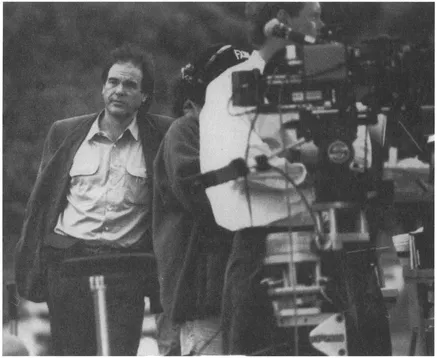
Oliver Stone on the set of JFK, a film he produced, directed, and cowrote. Copyright © 1991 Warner Bros. Inc., Regency Enterprises V.O.F. and Le Studio Canai + .
The central myth running through Stone's work is that of the fallen idealist/savior (Christ/Adam/Hector/Achilles), killed, maimed, or disillusioned in a seemingly senseless sacrifice; John Kennedy and Jim Garrison in JFK, Jim Morrison in The Doors, Richard Boyle in Salvador, Ron Kovic in Born on the Fourth of July, Barry Champlain in Talk Radio, Sergeant Elias in Platoon. The "fall" of these saviors represents America's loss of innocence, while the halfhearted resurrection offered by and to many of them represents, on one level, a sinfully unredeemable America. Jim Garrison fails to change anything with his uncovering of the plot to kill Kennedy in JFK. Platoon's Sergeant Elias is an ineffectual Christ figure overpowered by the Devil, Sergeant Barnes. And by killing Barnes, Chris Taylor, the protagonist of Platoon, may himself have defected to the "bad" side. Talk Radio's Barry Champlain suffers a meaningless murder. Although Ron Kovic, in Born on the Fourth of July, eventually finds his true political voice, he remains trapped in a crippled body for life. Richard Boyle, the classic anti-hero in Salvador, yearns for a salvation we are unsure he ever finds. Jim Morrison in The Doors, one of America's visionary "saviors" of the 1960s, self-destructs from drugs, alcohol, and excess. Mickey and Mallory Knox in Natural Born Killers, by their murder of the Navajo Indian shaman, lose their last chance at transformation and redemption. And even Wall Street's Bud Fox, although he eventually chooses "the good," is presented as a much less fascinating figure than Gordon Gekko, the incarnation of the Devil himself.
On another level, however, Stone's archetypal heroes, willing to live life in the extreme—whether it be in a Southeast Asian jungle, on the ledge of a building, or on the edge of the psyche's unconscious abyss—offer the only hope for transcendence, for moving culture from the current age of ego consciousness into the next era of transconsciousness. It is there on the edge that Stone's archetypal heroes meet themselves in the most terrible battle of all—the internal battle of the soul. This is tricky terrain to negotiate, however, and lacking models for transcendence in an era of postmodernity, these heroes often remain rough sketches of what the next generation of heroes, given the right spiritual ammunition, may look like. As we will see, the journey outward—of action, energy, and rage—so often undertaken by Stone's protagonists is slowly being replaced over the course of his films by the journey inward, a journey marked by inaction, silence, and the slow dawning of enlightenment.
Stone's films often personify the evils to be found in the universal story of Pandora's box and their manifestation in the cultural story of America's post-Camelot fall from grace. Indeed, every film Stone has made, both before and after the release of JFK, dates America's political and social demise as starting with Kennedy's assassination, the event, which in Stone's view, started Vietnam, Three of Stone's films, Platoon, Heaven and Earth, and Born on the Fourth of July, are explicitly about Vietnam, whereas all of his films reference Vietnam or Kennedy's assassination. In Talk Radio, for example, just before radio talk-show host Barry Champlain is about to be murdered by a crazed neo-Nazi, Champlain explains to his girlfriend, Laura, why their relationship would never work: "I'm too old for you Laura. I mean, you don't know about Vietnam, Easy Rider, The Beatles." Laura responds, "Start over, Grandpa." Champlain replies, "I can't. I'm inside of this thing and you're not." Stone, like his protagonist Champlain, is "inside of this [Vietnam] thing." In his films, then, this is both his and our frame of reference. Richard Boyle, in Salvador, in an extended diatribe against U.S. involvement in Central America, asked a U.S. colonel, "Is that why you guys are here? Some kind of post-Vietnam experience, like you need a rerun or something?" Vietnam is the backdrop for Stone's portrait of The Doors, and even in Wall Street and Natural Born Killers, two films seemingly divorced in time and subject matter from Vietnam and Kennedy's assassination, the turbulent events of the 1960s and early 1970s provide the critical canvas for their visions of America.
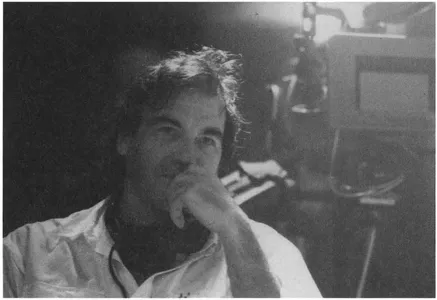
A seemingly fatigued yet contemplative Oliver Stone on the set of his 1991 film The Doors. Copyright © 1991 Tri-Star Pictures, Inc.
Taken as a whole, Stone's films are somewhat of an anomaly, however, in that they offer a unified mythic vision in the midst of postmodern fragmentation. His portrait of thirty years of American life, however, as we will see, draws on perennial philosophy, Jungian psychology, and universal mythology in order to critique and extend social constructions of the current postmodern condition. Before turning to the cultural and transcultural stories told individually and collectively by Stone's films, it is helpful to first explore Stone's success with negotiating a working relationship in Hollywood as a writer, producer, and filmmaker.
Oliver Stone: Screenwriter and Filmmaker
Although Hollywood routinely draws from the American cultural and political scene for ideas and perspectives, this scene usually provides no more than a backdrop to highlight personal dramas of tragedy and triumph. It is rare to find a filmmaker like Oliver Stone whose films do not simply allude to historical issues and personae but actually use them as bases for persuasive arguments about the American political scene.
Drawing on Hollywood's dedication to the topical and its historical commitment to the politically mainstream "social problem film," Stone usually manages to walk a fine line between heavy-handed propaganda and apolitical entertainment by fictionalizing and universalizing historical events and individuals. He successfully negotiates and exploits the tension in Hollywood between topicality and political centrality by infusing political and cultural issues with his own brand of liberal critique, while creating dramatic narratives and characters that tingle and sizzle with energy and rage. It is this ability, in part, that accounts both for Stone's success in negotiating a profitable working relationship with Hollywood and, as we will see, for his films' power and popularity.
Stone was born in New York City on September 15, 1946, to a Jewish father and a French Catholic mother. By his own concession, he was raised Protestant as "the great compromise."5 His political outlook on life, however, was adopted from his stockbroker father, a man whom he describes as a "conservative in an intelligent sense," who "ultimately ... was an apologist—a defender of the Cold War." As a result, Stone "grew up really frightened of the Russians," whom his father had created "as a nightmare image" for him as a child. As Stone explained it, "At the age of ten, I thought that Roosevelt was the bad guy and John Maynard Keynes was the Devil."6 He considered himself a "Goldwater Republican" upon entering Yale University. His politics, however, changed sometime thereafter.
After dropping out of Yale in 1965, Stone took a teaching position at Free Pacific Institute in Cholon, Vietnam. He later joined the U.S. Merchant Marine, volunteered for the 25th Infantry Division of the U.S. Army in 1967, and was eventually awarded the Bronze Star for Valor and a Purple Heart for his tour of duty in Vietnam. When he returned to the States, he reentered college, studied film at New York University under Martin Scorsese, and graduated with a B.F.A. in 1971. Stone has said of Scorsese, his mentor and friend, "He was someone on an equal wave of nuttiness. And he helped channel the rage in me."7
Stone received his first recognition as a screenwriter. In 1978 he won an Oscar for Best Script and the Writers' Guild Award for Best Screenplay for his screenplay adaptation for Alan Parker's Midnight Express (1978). The film was based upon the real-life story of a young American imprisoned in Turkey for drug smuggling. Stone's second produced screenplay, Conan the Barbarian (1982), was coscripted with the film's director, John Milius. Stone also wrote the screenplay for Brian De Palma's Scarface (1983) and coscripted Hal Ashby's Eight Million Ways to Die (1986).
Despite the awards Stone received for his screenwriting, many of these early screenplays were criticized for their racist undertones. Midnight Express, The Year of the Dragon, and Conan the Barbarian, in particular, provoked charges of racism because the protagonists' emotions were not detached from the films themselves. In recent interviews, Stone has responded to the c...
Table of contents
- Cover
- Half Title
- Title
- Dedication
- Copyright
- Contents
- List of Photographs
- Acknowledgments
- Introduction
- 1 Stone's Dilemma: A Platonist Seeking Postmodern "Truth," or the Quandary of the Left-Wing Intellectual in Hollywood
- 2 Betrayal in the Garden and Death of the Dream
- 3 Descent into Hell: The Vietnam Nightmare
- 4 After the Fall: (Self-)Portraits of the Tortured Artist-Visionary
- 5 Meeting the Shadow and the Journey Home
- 6 Final Thoughts
- Filmography
- About the Book and Author
- Index
Trusted by 375,005 students
Access to over 1.5 million titles for a fair monthly price.
Study more efficiently using our study tools.
Frequently asked questions
Yes, you can cancel anytime from the Subscription tab in your account settings on the Perlego website. Your subscription will stay active until the end of your current billing period. Learn how to cancel your subscription
No, books cannot be downloaded as external files, such as PDFs, for use outside of Perlego. However, you can download books within the Perlego app for offline reading on mobile or tablet. Learn how to download books offline
Perlego offers two plans: Essential and Complete
- Essential is ideal for learners and professionals who enjoy exploring a wide range of subjects. Access the Essential Library with 800,000+ trusted titles and best-sellers across business, personal growth, and the humanities. Includes unlimited reading time and Standard Read Aloud voice.
- Complete: Perfect for advanced learners and researchers needing full, unrestricted access. Unlock 1.5M+ books across hundreds of subjects, including academic and specialized titles. The Complete Plan also includes advanced features like Premium Read Aloud and Research Assistant.
We are an online textbook subscription service, where you can get access to an entire online library for less than the price of a single book per month. With over 1.5 million books across 990+ topics, we’ve got you covered! Learn about our mission
Look out for the read-aloud symbol on your next book to see if you can listen to it. The read-aloud tool reads text aloud for you, highlighting the text as it is being read. You can pause it, speed it up and slow it down. Learn more about Read Aloud
Yes! You can use the Perlego app on both iOS and Android devices to read anytime, anywhere — even offline. Perfect for commutes or when you’re on the go.
Please note we cannot support devices running on iOS 13 and Android 7 or earlier. Learn more about using the app
Please note we cannot support devices running on iOS 13 and Android 7 or earlier. Learn more about using the app
Yes, you can access Oliver Stone's America by Susan Mackey-kallis,Susan Mackey Kallis in PDF and/or ePUB format, as well as other popular books in Social Sciences & Sociology. We have over 1.5 million books available in our catalogue for you to explore.