-
The Federal Republic of Nigeria is bordered by the countries of Benin to the west, Chad to the north-east, Cameroon on the east, Niger to the north, and the Gulf of Guinea to the south.
-
Nigeria has the largest population in Africa, with about 185 million citizens, making it the seventh largest country by population in the world.
-
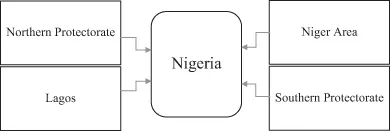
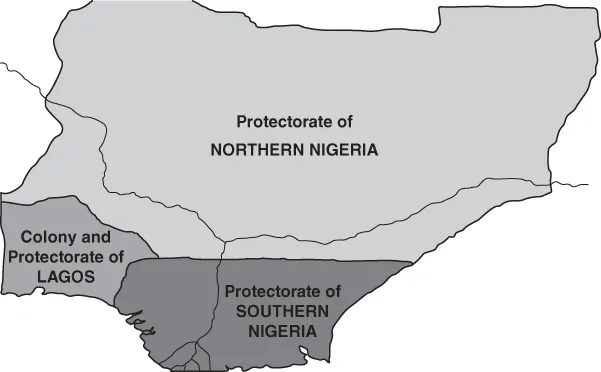
It started as 3 protectorates, and later morphed into 2 protectorates, 3 regions, 4 regions, 12 states, 19 states, 21 states, 24 states until it became 36 states, and the Federal Capital Territory which includes the capital, Abuja.
-
Hausa, Igbo, Yoruba and Ijaw are the largest of more than 500 ethnic groups in Nigeria.
-
The official language is English, but there are over 250 local languages and dialects.
-
The south of Nigeria is mostly populated by Christians, and the north is mostly Muslims, with a minority of people practicing indigenous faiths.
-
The coastal city of Lagos is the largest in Nigeria, and saw significant growth as one of the largest centers for trans-Atlantic slave trade from the sixteenth to the nineteenth century. The slave trade forced thousands of able-bodied Nigerians against their will to live in plantations in Brazil, Cuba, Trinidad and parts of the United States until 1833, when the British government prohibited all trade in human beings.
-
Lord Lugard amalgamated the Northern and Southern protectorates and named it Nigeria in 1914. However, the anti-colonial movement became active under the leadership of Herbert Macaulay, who was considered the father of Nigerian nationalism. The independence movement won more and more ground. Names such as Dr. Nnamdi Azikiwe, Chief Obafemi Awolowo, Sir Ahmadu Bello, Chief Anthony Enahoro and Sir Tafawa Balewa are closely associated with Nigeria’s independence, which was won on October 1, 1960.
-
In May 1967, the Eastern Region declared independence as a state called the Republic of Biafra, under the leadership of Lt. Colonel Emeka Ojukwu. The Nigerian Civil War began as the official Nigerian government side (dominated by soldiers from the north and west) attacked Biafra (southeastern) on 6 July 1967 at Garkem. The 30-month civil war, with a long siege of Biafra and its isolation from trade and supplies, ended in January 1970. Estimates of the number of dead in the former Eastern Region are between 1 and 3 million people, from warfare, disease, and starvation.
-
The formal education system includes six years of basic elementary schooling, three years of junior secondary education, and three years of senior secondary education. Many schools are over-capacity, and literacy rates among children and adults are higher than the global average.
-
An oil boom began in the 1970s. Nigeria is now the 12th largest producer of petroleum in the world and the 8th largest exporter, and has the 10th largest proven reserves. The country joined OPEC in 1971. Petroleum plays a large role in the Nigerian economy, accounting for 40% of GDP and 80% of government earnings. However, agitation for better resource control in the Niger Delta, its main oil producing region, has led to disruptions in oil production and prevents the country from exporting at 100% capacity.
-
There are three systems of law: Common Law, Customary Law, and Sharia Law. These systems, along with the Supreme Court of Nigeria, attempt to address the pervasive crime and corruption that we will discuss in Chapter 8.
-
Nigeria is a founding member of the African Union and a member of many other international organizations, including the United Nations, the Commonwealth of Nations and OPEC.
-
Nigeria is the 20th largest economy in the world, worth more than $500 billion and $1 trillion in terms of nominal GDP and purchasing power parity respectively. It overtook South Africa to become Africa’s largest economy in 2014. The 2013 debt-to-GDP ratio was 11%.
-
Nigeria is considered to be an emerging market by the World Bank. It has been identified as a regional power on the African continent, a middle power in international affairs and has also been identified as an emerging global power. Nigeria is a member of the MINT group of countries, which are widely seen as the globe’s n...