eBook - ePub
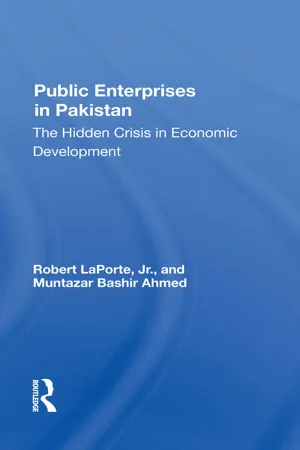
Public Enterprises In Pakistan
The Hidden Crisis In Economic Development
- 219 pages
- English
- ePUB (mobile friendly)
- Available on iOS & Android
eBook - ePub
Public Enterprises In Pakistan
The Hidden Crisis In Economic Development
About this book
This book contains a study of the economics and management of public enterprises in Pakistan. It examines their performance, organizational behavior, relationships with other government organizations outside of the sector, and the issues that confront the public enterprise sector and the government.
1
Public Enterprises in Pakistan
Introduction
This is a study of the economics and management of public enterprises in Pakistan. As a result, it will examine the performance of these public organizations, their organizational behavior, their relationships with other government organizations and organizations/groups outside of the public sector, and the issues confronting both the public enterprise sector and the Government of Pakistan.
By definition, a public enterprise is both "fish and fowl" in that it has a public and a private side. It might also be described as an organization with a "split personality"--its public side mandates that it pursue public goals and objectives while its private side requires that earning profits is the paramount measure of its success. As a consequence, public enterprises create difficulties but also offer opportunities for governments.
Both the economics and management of public enterprises have been and continue to be topics of debate and disagreement in Pakistan. As with the parliamentary form of government, the public enterprise concept is a transplant. Developed in Great Britain and Europe in the late 19th century, it was introduced to South Asia in the early 20th century. Its history, therefore, predates the independence of Pakistan. A concern of this study is the evolution of the public enterprise concept and the use of public enterprises over the past 40 years in Pakistan.
Some fundamental questions might occur to the reader at this point. What is a "public enterprise"? How important are public enterprises to a country's economic and political systems? Why study them in the first place? To answer these and other questions, we will first turn our attention to public enterprises in the South Asian context and then examine public enterprises in Pakistan. These sections will be followed by examining: state involvement in the economy; the role of public enterprises in the economy; the size of the public enterprise sector in Pakistan; the involvement of public enterprises in the economy--a sector-by-sector analysis; and the methodology used in this study.
Public Enterprises in South Asia: The Pursuit of Efficiency
The use of public enterprises to produce and transport goods and provide services in South Asia dates back to the British colonial period. With the independence of Pakistan and India in 1947, and Ceylon (now Sri Lanka) in 1948, all three countries expanded state involvement in their economies and public enterprises were the means employed. The reasons for creating public enterprises have varied over time.
The British sought to improve the administration and management of government activities by creating semi-autonomous government units (public enterprises) so as to avoid the bureaucratic red tape and inertia which existed in the government departments in undivided India. It was thought that public enterprises could pursue public goals and objectives most efficiently because they had a private or business dimension to them. They were considered to be potentially more efficient because they possessed autonomy from government rules and regulations relating to personnel and financial management and the day-to-day operations of these organizations were not subjected to the same kind of detailed bureaucratic scrutiny as government departments. Public enterprises were supposed to be income earners for the government and achieve commercial objectives (profit). Government departments, on the other hand, were subject to established rules and procedures which prevented them from operating in a commercial fashion.
Other reasons for creating public enterprises emerged after independence. In both India and Ceylon, pursuit of ideology dictated state ownership and the public enterprise form was used to administer either nationalized (formerly private) firms or new activities which the governments of both countries felt should be undertaken by the public sector. On the other hand, in Pakistan public enterprises were established because of the absence of alternative organizations (a weak private sector). Given the demand for goods and services, Pakistan created public enterprises to fill critical voids in its economy. But the underlying managerial theme upon which all these reasons was based was the desire of these governments to pursue their political, social and economic goals most efficiently and the public enterprise form was seen as the way to accomplish them.
An indication of this kind of thought during the early post-World War Π period is reflected in a statement written by Wolfgang Friedmann on the theory of public industrial enterprise:
The public corporation in the form in which it has been developed ... is the most systematic attempt so far to define the structure of public enterprise in contemporary society.... It is based on the recognition of the participation of the State in economic enterprise.... It further recognizes that complex industrial enterprises are not suitable for administration by government departments and by civil servants not trained for the job. It therefore aims at a balance between the flexibility and autonomy enjoyed by private commercial enterprise and the responsibility to the public as represented by ministers and parliament. The classical definition is that given by President Roosevelt in his message to Congress of 1933 asking for the establishment of the Tennessee Valley Authority; "A Corporation clothed with the power of government but possessed of the flexibility and initiative of a private enterprise."1
Although Friedmann provides a definition of public enterprise in its ideal form, focusing on the positive results which can be derived from government intervention in the heavy industry and manufacturing sectors of economy using this kind of organization, other scholars have stressed the heterogeneous nature of public enterprises. Leroy P. Jones states that:
Public enterprise is a hybrid organization whose understanding requires a multidisciplinary perspective. As an "enterprise" it sells its output. It therefore performs functions (e.g. production, finance and marketing) that are the concern of management specialists and is subject to the pressures of various markets, which are studied by economists. On the other hand, as a "public" organization, it is owned and/or controlled by the government or its agent. It is therefore subject to direct and indirect pressures from bureaucrats, politicians, and the public at large--groups studied by experts in public administration, political science, law and sociology.... Public enterprises .. . are themselves a heterogeneous group, varying both within and across countries. As hybrids, public enterprises share characteristics of traditional government units and private business enterprises, with some being closer to one pole than to the other.2
Depending upon the country, the terms employed to identify these organizations varies. "Parastatal," "state enterprise," "state-owned enterprise," "semi-autonomous government enterprise," "government enterprise," "public sector enterprise" and "public enterprise" are terms used to indicate those government organizations which possess some measure of autonomy from government.3
The relationships between public enterprises and government also vary by the type of public enterprise. Some have legally defined relationships which are contained in their charters granted by the government. Statutory public corporations fall within this category. Others have more limited grants of autonomy and remain within the bureaucratic structure of a ministry. Departmental commercial undertakings in Pakistan are examples of this group. Still others have the legal status of joint stock companies which report to holding corporations within a particular ministry. Finally, in Pakistan, as well as in other countries, there are numerous boards and authorities which maintain semi-autonomous relationships with a specific government department or ministry. The variations in the grants of autonomy from government account for variations in the extent to which these organizations can develop business-type management systems and successfully pursue commercial objectives. The World Bank uses the term "state-owned enterprise" to capture the totality of state involvement in the economy through these organizations:
The term "state-owned enterprise" covers all state-owned i...
Table of contents
- Cover
- Half Title
- Title
- Copyright
- Dedication
- Contents
- List of Tables, Diagrams and Graphs
- Acknowledgments
- About the Authors
- Abbreviations
- 1 Public Enterprises in Pakistan
- 2 The Socioeconomic Performance of Public Enterprises
- 3 The Commercial Performance of Public Enterprises
- 4 The Environmental Context of Public Enterprises
- 5 The Management of Public Enterprises
- 6 Conclusions: Dealing with the Hidden Crisis in Economic Development
- Appendixes
- Bibliography
- Index
Trusted by 375,005 students
Access to over 1.5 million titles for a fair monthly price.
Study more efficiently using our study tools.
Frequently asked questions
Yes, you can cancel anytime from the Subscription tab in your account settings on the Perlego website. Your subscription will stay active until the end of your current billing period. Learn how to cancel your subscription
No, books cannot be downloaded as external files, such as PDFs, for use outside of Perlego. However, you can download books within the Perlego app for offline reading on mobile or tablet. Learn how to download books offline
Perlego offers two plans: Essential and Complete
- Essential is ideal for learners and professionals who enjoy exploring a wide range of subjects. Access the Essential Library with 800,000+ trusted titles and best-sellers across business, personal growth, and the humanities. Includes unlimited reading time and Standard Read Aloud voice.
- Complete: Perfect for advanced learners and researchers needing full, unrestricted access. Unlock 1.5M+ books across hundreds of subjects, including academic and specialized titles. The Complete Plan also includes advanced features like Premium Read Aloud and Research Assistant.
We are an online textbook subscription service, where you can get access to an entire online library for less than the price of a single book per month. With over 1.5 million books across 990+ topics, we’ve got you covered! Learn about our mission
Look out for the read-aloud symbol on your next book to see if you can listen to it. The read-aloud tool reads text aloud for you, highlighting the text as it is being read. You can pause it, speed it up and slow it down. Learn more about Read Aloud
Yes! You can use the Perlego app on both iOS and Android devices to read anytime, anywhere — even offline. Perfect for commutes or when you’re on the go.
Please note we cannot support devices running on iOS 13 and Android 7 or earlier. Learn more about using the app
Please note we cannot support devices running on iOS 13 and Android 7 or earlier. Learn more about using the app
Yes, you can access Public Enterprises In Pakistan by Robert Laporte,Muntazar Bashir Ahmed in PDF and/or ePUB format, as well as other popular books in Economics & Development Economics. We have over 1.5 million books available in our catalogue for you to explore.