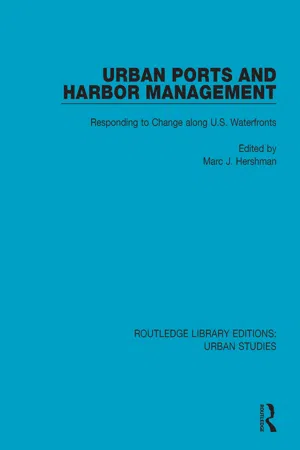
The essays in this book, first published in 1988, explore the changes that have occurred in the modern harbour in the 1970s and 1980s and the many roles of the public port in stimulating or responding to these changes. The goal of this study is to understand the modern harbour and public port and the contemporary pressures on them. The contributors' disciplines range among geography, law, business, political science, and marine affairs.
eBook - ePub
Urban Ports and Harbor Management
Responding to Change along U.S. Waterfronts
- 364 pages
- English
- ePUB (mobile friendly)
- Available on iOS & Android
eBook - ePub
About this book
Information
Part I
OVERVIEW
Chapter 1
HARBOR MANAGEMENT: A New Role for the Public Port
Marc J. Hershman*
Along the coasts and Great Lakes of the United States, there are 1,435 navigable waterways, harbors, and river stretches—places where boats or ships can take refuge from open water. Most harbors contain ports, those public or private facilities where vessels can moor and exchange people, cargo, or provisions, and most harbors are adjacent to towns or cities.1 This book is concerned primarily with the harbors of the United States that contain public port facilities and in which a public port agency† operates.
This chapter introduces the harbor, its multiple uses and conflicts, and the current fragmented management system, followed by a description of harbor management. Harbor management is a new concept in the United States, one that stresses multiple use and conservation of harbor resources, and encourages consensus among public and private interests. Harbor management requires vision and leadership and the formation of a common purpose. It contrasts sharply with the present management system which is contentious, costly, and divisive.
The chapter then focuses on the public port agency as one of the major players in harbor management and details its powers and functions. The public port agency figures prominently in many activities that take place in the harbor and is often the catalyst for change and the community promoter. The public port can make substantial contributions to harbor management in the years to come.
*Thanks to Pat Jones, Lucinda Tear, and Lee Rees for research assistance on port numbers, functions, and powers, respectively. This chapter builds on a paper by M. J. Hershman, S. Euston, and M. Rohan (1983).
†Public port agencies are known by many names: port authorities, dock boards, harbor commissions, transportation departments, navigation or terminal districts, city bureaus or divisions, and others. Although their powers and organizational form differ, they are a public organization, created by law, with primary responsibility over waterfront and maritime activities, and in many cases, airports, economic development, etc. Their powers, structure and operations are discussed later in this chapter, and in greater detail in Chapters 10 and 14. When the word Port or Ports is used alone in this book and capitalized, it refers to the public port agency. When not capitalized, the word has its usual meaning—that part of the harbor where vessels can moor and exchange people, cargo, or provisions.
DIVERSITY OF INTERESTS IN THE URBAN HARBOR
Virtually all uses of the sea, lakes, and rivers are dependent on harbors. For example, fisheries, boating, marine research, and shipping activities all require harbor facilities and services. Close to one-half of the U.S. population lives near harbors, and demands for shoreside public amenities have increased dramatically in recent years. Harbors are natural environments supporting important marine biological resources, and they are subject to natural hazards and pollution risks affecting resident populations. In addition, increasing dependence on foreign trade (about 25 percent of the GNP in recent years) makes the harbor important to nearly all consumers and producers in the nation. As Hershman and Bittner point out in Chapter 2, harbors in the United States have been used and reused in servicing people's changing needs throughout the nineteenth and twentieth centuries.
People value the harbor for reasons beyond its “use” potential. It is more to them than a marine highway or a fluid environment. It is a source for renewal and refreshment adjacent to the busy urban grid. It provides visual release from the tension caused by dense urban images. It offers exotic experiences that are esthetic, educational, and dramatic—the function and fittings of ships and boats, the joinder of vessel and skyline, the clatter and bustle of cargo transport, the habitat for marine wildlife, the language and customs of maritime workers. The harbor and its symbols—the bridges, statues and towers—evoke for many the memories of arrival, departure, safety, and home; of great historic events; of linkages with faroff lands; of adventure and risk-taking on the sea; of escape and freedom. As Melville wrote in Moby Dick, “Thousands of mortal men” throughout the city are “fixed in ocean reveries” and discontented unless they “get just as nigh the water as they possibly can without falling in.” The harbor is one of the great cultural resources of a port city because it affects the spirit, energy, and expressiveness of its people. As Fleming observes in Chapter 3, there is a diverse port community that creates and nurtures this cultural resource.
Those who use and appreciate the harbor will demand more from it in the future. Changes in vessels and cargo-handling technology, especially changes associated with the container revolution, require improved navigational capacity and marine terminals. These changes are discussed by Mayer in Chapter 4 and by Chilcote in Chapter 6. The new water resources legislation of 1986, discussed by Hershman and Kory in Chapter 5, authorizes forty-one additional navigation dredging projects in order to meet these new transportation needs.
Harbors are changing in other ways as well. The conversion of obsolete port and industrial facilities into residences, shops, restaurants, parks, and promenades is a well-established trend which continues to change small and large harbors from work places to urban and tourist amenities. Randall and Goodwin present the rationale and results of this conversion process in Chapters 7 and 13, respectively. The maintenance of fish-related industries and the growth of small boat moorages will continue to demand shore locations, as Goodwin describes in Chapters 8 and 9, respectively. In addition, environmental agencies along with civic and conservation organizations increasingly advocate better protection of wildlife and water quality, and the consideration of these issues is now institutionalized. Hershman and Kory discuss the federal environmental regulatory framework in Chapter 5, and Wessel and Hershman outline experience with wetlands mitigation projects in Chapter 12.
Given the diversity and intensity of harbor use, and the way harbors are valued by city dwellers, it should not be a surprise that conflicts are common. Major issues concern: 1) community and environmental impacts from development projects at the water's edge (see Chapter 12), 2) competition between recreation and industry for scarce shoreline space (see Chapter 13), 3) pollution of harbor waters from land or vessel sources, 4) obsolete, vacant, and decayed port and industrial facilities that are dangerous and unsightly, and 5) debates over the expenditure of scarce public funds and the “return on investment” expected from harbor improvement projects, described by Dowd in Chapter 10.2 As a result of these and related conflicts and issues, new forms of planning have evolved, discussed later in this chapter and by Chasan and Dowd in Chapter 11. And questions of governmental performance are raised with regard to federal agencies (see Chapter 5) and in respect to public port institutions by Olson in Chapter 14.
Since the late 1970s, each issue noted above has been raised in Elliott Bay, the main harbor for the city and Port of Seattle. At terminal 91, which is adjacent to two affluent neighborhoods on bluffs overlooking the terminal, neighborhood activists fought a Port plan to transform the piers into a container operation because of their concern over noise, glare, traffic, and other impacts. At that same terminal, the Port and the state Department of Ecology strongly disagreed over the use of contaminated dredged materials as fill between two adjacent piers. In particular, they disagreed whether the plastic liner separating harbor waters and fill material would adequately protect against leachate, or seepage that might occur from the fill to the water. At the south end of the harbor, a coalition of city officials and community groups successfully pressed the Port of Seattle to provide public access sites along the Duwamish River in at least eight different locations where the Port had plans for developing terminals. They were seeking nature refuges, bike trails, elevated viewpoints, boat launching ramps, and other amenities in the midst of the maritime industrial zone of the harbor. Finally, along the central waterfront, that part of the harbor adjacent to the downtown central business district, there are finger piers and warehouse buildings that are underused or vacant, in disrepair, dangerous and unsightly, crying for demolition or revitalization. While they sit there, sharp debate continues over the nature of the uses that should occur: housing, hotel, park/open space, international trade center, maritime-related office, water-dependent uses. When the Port of Seattle purchased some of the land and disclosed that office and hotel uses were being considered for the site, they were challenged on whether public funds were appropriate for such uses and whether the private sector should be doing this kind of redevelopment.
These issues are not unique to Seattle, nor are they unique to the harbor setting. They are a reflection of structural changes occurring in contemporary U.S. society requiring adjustments in many sectors, including changes in technology, reduction in industrial capacity, consolidation of industrial facilities, demands for in-city recreation, high regard for a quality environment, and greater scrutiny over public expenditure.3
Allocation of harbor resources occurs through a mixture of private and public decision making. Private sector decision making plays a critical part in the use of harbors, because the source of capital for many marine terminals and mixed-use complexes is often private (see Chapter 3). However, it is rare to find shoreline investments that do not involve some form of public subsidy and a substantial amount of public scrutiny through agency review. Public agencies usually own the water bottoms and manage the navigable waters as a commons for all the people. Within the public sector questions of the public interest are raised and significant influence is exercised over private investment. Public agencies are often themselves developers, as in the case of port infrastructure, city shoreline parks, and public marinas.
Harbor decision making by public agencies is split by level of government and by functions. Many agencies at the federal, state, and local levels have jurisdiction in the harbor (see Chapter 5; National Academy of Sciences 1976; Marcus 1976). The jurisdiction of some agencies is limited to the land side; for others it is limited to the water side. Some agencies are concerned only about living resources; others are concerned solely with pollution issues. A few public entities have mandates to develop resources and land; others have mandates to protect and preserve natural resources. Even coastal zone management agencies, intended to be comprehensive in their approach, often are not, because they usually have no capital-improvement capability. Conflicts among these diverse harbor agencies are common and often result in long delays, stalemates, and lawsuits. It is fair to conclude that the harbor decision-making process is greatly fragmented, highly adversarial, and more costly to society than necessary.
Society wastes resources, misses opportunities, and consumes energy unnecessarily because of this situation. Many promising resource development opportunities do not get considered. Often only the large-scale and well-funded project developers, with skilled legal assistance, prevail. Project opponents believe they must stall or kill projects because they see no way to achieve their objectives within the harbor, except through obstructing others’ projects. The situation in most harbors is similar to that in Elliott Bay. The urban harbor is an arena of conflict over land use and environmental issues, rather than a forum for strategic planning to meet the objectives of many parties and to form a common vision for the harbor.
EXPERIMENTS IN HARBOR MANAGEMENT
In some harbors, attempts are underway to establish a comprehensive harbor management scheme in order to achieve multiple objectives and resolve multiple-use problems through coordinated land and water use policies and public and private investment decisions within a limited geographical area. Typically, many diverse parties work together to develop the harbor management scheme, to take implementation actions, and to evaluate and revise the scheme as necessary. The primary harbor issues relate to the timing, location, and scale of port and waterfront growth and how this affects environmental and public use values.
Three approaches to harbor management have emerged in the United States since the late...
Table of contents
- Cover
- Half Title
- Title Page
- Copyright Page
- Table of Contents
- Preface
- Acknowledgments
- PART I. OVERVIEW
- PART II. THE SETTING
- PART III. DIVERSE ACTIVITIES
- PART IV. CHANGING TIMES
- Glossary
- Index
Trusted by 375,005 students
Access to over 1.5 million titles for a fair monthly price.
Study more efficiently using our study tools.
Frequently asked questions
Yes, you can cancel anytime from the Subscription tab in your account settings on the Perlego website. Your subscription will stay active until the end of your current billing period. Learn how to cancel your subscription
No, books cannot be downloaded as external files, such as PDFs, for use outside of Perlego. However, you can download books within the Perlego app for offline reading on mobile or tablet. Learn how to download books offline
Perlego offers two plans: Essential and Complete
- Essential is ideal for learners and professionals who enjoy exploring a wide range of subjects. Access the Essential Library with 800,000+ trusted titles and best-sellers across business, personal growth, and the humanities. Includes unlimited reading time and Standard Read Aloud voice.
- Complete: Perfect for advanced learners and researchers needing full, unrestricted access. Unlock 1.5M+ books across hundreds of subjects, including academic and specialized titles. The Complete Plan also includes advanced features like Premium Read Aloud and Research Assistant.
We are an online textbook subscription service, where you can get access to an entire online library for less than the price of a single book per month. With over 1.5 million books across 990+ topics, we’ve got you covered! Learn about our mission
Look out for the read-aloud symbol on your next book to see if you can listen to it. The read-aloud tool reads text aloud for you, highlighting the text as it is being read. You can pause it, speed it up and slow it down. Learn more about Read Aloud
Yes! You can use the Perlego app on both iOS and Android devices to read anytime, anywhere — even offline. Perfect for commutes or when you’re on the go.
Please note we cannot support devices running on iOS 13 and Android 7 or earlier. Learn more about using the app
Please note we cannot support devices running on iOS 13 and Android 7 or earlier. Learn more about using the app
Yes, you can access Urban Ports and Harbor Management by Marc J. Hershman in PDF and/or ePUB format, as well as other popular books in Social Sciences & Human Geography. We have over 1.5 million books available in our catalogue for you to explore.