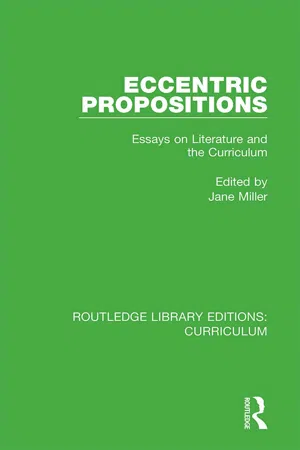
Originally published in 1984. This book charts important changes brought about by teachers in the way literature is read and written about in schools. Rooted in experiences of inner-city schools, it is extremely practical and especially valuable for the multi-ethnic classroom. The writers, all of whom are experienced teachers of English, believe, however, that all schools need to respond to the cultural, racial and linguistic diversity of British society, whether their own populations are homogeneous or mixed. By concentrating on real classrooms, real lessons and real children, the book shows how particular ideas can be put into practice. It approaches theories of reading and of literature through specific examples of lively and successful practice and argues the ease for the centrality of literature and literacy to the curriculum. The book includes lists of resources: books to read with children and books for teachers to read for themselves to deepen their understanding of the ideas and their confidence in adapting them for their own classrooms. Throughout the book continuities are emphasized: between life and literature, between reading and writing, and between learning to read, becoming better at it, and studying literature.
- 296 pages
- English
- ePUB (mobile friendly)
- Available on iOS & Android
eBook - ePub
About this book
Information
1 That’s not right. Look!
There’s no Daddy in this book
Maura Docherty
When Theo was three months old, I, one of his hearing parents, was quite sure he was deaf. It transpired that he was not. Strangely, I have had no such fear about Theo as a potential reader; I have never been anything but perfectly certain that he would learn to read and come to enjoy literature. Given the number of children who never learn to read at all, or not to a level to satisfy their personal needs, and those others who can read but don’t, my unwarranted confidence and high expectation probably grow out of my own love and high regard for literature and my strong hope that this activity – reading – will occupy as large a place in Theo’s life as it does in mine.
Until the time when I was able to observe a very young learner in a home setting my experience of early reading had been limited to working with young children who had to start the first round of learning to read in a formal school setting, or with those children who came to school able to read and who then developed their skills in the classroom.
I have always felt that because of the nature and the conditions of conventional classroom instruction the first of these two groups had a very difficult task, while the second group often had to progress as readers in a far less congenial and stimulating language environment than they had probably experienced in their preschool years. I believe this applies to whatever stage the children were at in their physical, cognitive and linguistic development. School is a very strange and difficult place to learn to read. Most children succeed despite the constraints, but few are left with any strong love of literature.
Margaret Clark,1 in her study of young children who had learned to read before going to school, dismissed the idea that they were merely a group of unusually intelligent children or that their precocious reading development was simply attributable to parental pressures or expectations. She saw the more important factor as the stimulating language context in which reading stories took place in their pre-school family life. Most of the children had an interested adult to talk to and read with, access to good reading material at home and from the library and very few had ‘suffered’ any formal teaching. Many schools may try to simulate these conditions, but most teachers have not the time nor the resources nor the confidence to support their children in this way.
Bettelheim notes,
The worst aspect of the way reading is presently taught is the impression the child receives during his earliest years in school that skills like decoding are what reading is all about. There is nothing wrong with teaching a skill as long as it is not done in ways that do damage to the purposes for which the particular skill is needed or desirable. But the teacher’s emphasis on decoding and word recognition – and these are all she can emphasise since the utter emptiness of the text does not permit her to stress meaning - gives the child the idea that these are all-important.2
Like Bettelheim, I believe that the learning of real literature should begin in the home and continue uninterruptedly through school. What I wanted to see through my study of Theo in his home environment were generally applicable features of this home reading which might make me a better teacher of literature in school, and might increase my understanding of the learning process. ‘The way the learning to read is experienced by the child will determine how he will view learning in general, how he will conceive of himself as a learner and even as a person,’ says Bettelheim. If this is so, the experienced reader-support has a huge responsibility to build up in the child positive attitudes towards himself as a learner.
Closely observing Theo learning to read has allowed me to understand better the complementary role the experienced reader has in supporting the efforts of the learner to carry out his own task of learning to read, a task he can come to through reading with another interested reader, and, most importantly, the crucial part real literature plays in the whole process.
What I shall describe here is the early progress of one pre-school reader in order to indicate his ability to control and phase his development towards becoming a reader (in the conventionally held sense of the word). I will present this in the context of shared high expectation of pleasure from both the experienced reader-support and the learner, a familiarity and confidence with books, and a constant supply of stimulating and varied stories. Jane and Peter have never been invited.
Margaret Meek3 says that ‘children learn to read by discovering what to do and making the most of the help they are given…. There is only one rule: avoid frustration and enjoy the time that you spend together and the books that you share.’ Reading, she says, is whole-task learning, right from the beginning. ‘From first to last the child should be invited to behave like a reader, and those who want to help him should assume that he can learn and will learn, just as happened when he began to talk.’
I needed to find out what was going on in order to chart the development of my case-study towards literacy. I decided to set down anything significant as it occurred, placing his reading development in the context of his general language development. I made frequent video recordings of Theo sharing books with his father or with me, audio tapes of his conversations, and noted in a journal any particular items which I took to be especially significant as they occurred in these sessions, particularly features I recognised as growth points in his development. I looked for and noted any readerly behaviour, observable indications of his comprehension of what a book was about and how he approached reading as an activity.
For instance, I noted his movement from ‘Read a book’ (1.6) to ‘Read a story’ (2.2) to ‘Read Postman Pat’s Rainy Day’, and an occasion when he picked up a book with pictures but no words, The Snowman, and said ‘Can you say words?’ (3.0). I also noted when book language and ideas intruded into his life, such as when he was eating his soup and remarked ‘It’s just right’ (Goldilocks and the three bears), and when he took to chanting ‘Why should I?’ (The Tale of Thomas Mead), or ‘The wind blows me up and up’ (2.9 The Wind Blew), and when on a shopping trip he called out ‘I see an avocado pear and I mash it up to eat’ (3.0 Avocado Baby).
Theo’s world of books was supporting not just his linguistic development but the development of his ideas and concepts, and broadening his experience in the way books can at a very early stage, helping him to become a reader and explore the real world through its representation in his books at the same time.
Seeing a dog with a sharp-pointed nose one day he said, ‘Look, Mammy, a fox’, his experience at that time not being wide enough to tell him that a dog on a lead was unlikely to be a fox (2.2). Six months later, and after many more stories, his reaction to a large dog which had entered the garden was a more tentative ‘Mammy, is that a wolf?’ His further reading was making him aware of greater possibilities, as were TV and trips to the zoo, and he was striving to reconcile these different types of information in his everyday life. Children come to an understanding of their world by reflecting on their own experiences and relating them to any new information they encounter in books.
I also looked carefully at the interaction between adult and child and the nature of the collaboration from which I expected Theo to move through literature to literacy. The study began when Theo was two. He is the only child of working parents, for both of whom reading is an important part of life. As Bettelheim says, ‘we read regularly for both enjoyment and meaning and from a feeling that reading enriches our experience’, and we probably inevitably offer Theo this view of reading, underlining it by always looking for stimulating literature for him, and on our trips to the library letting him choose appealing stories. Reading together is an experience we all enjoy very much and at any time, not simply at bedtime, often hearing an urgent whisper at dawn – ‘Read a book, Daddy’.
Theo’s familiarity with books has given him great confidence in handling them, and he has developed certain rituals, such as removing the dust-wrappers, examining the endpapers, noting his name if it is written in, and, most recently, looking for a ‘contents’ page. He usually repeats the title and the author’s name; a few seem to have appealed to him particularly, such as John Burningham and Helen Oxenbury, and he often points to a book and says the name of one or the other (though not always correctly). From an early age he has adopted a kind of classification system of his own. ‘Pictures’ and ‘no pictures’, ‘Daddy’s/Mammy’s book’ and ‘Theo’s book’, again usually distinguished by the presence or absence of pictures, Theo’s always having pictures in them.
From the start of his reading life we have always encouraged Theo to choose what he wanted to read from our own wide selection of children’s literature. In his first two years Theo was given lots of glossy hardboard books, designed for very young children. Many had single illustrations on each page, usually with the name printed in large letters underneath – farm animals, etc. – but Theo seemed to lose interest in most of these at a very early age, though a few have remained favourites, Helen Oxenbury especially, and the Zebby books, which each contain a little story. Rather incomprehensibly, the Ahlbergs’ A Place to Play became an early and enduring favourite, possibly because it contained so much detail in the illustrations.
This last example seems to suggest that children’s literature cannot be successfully ‘staged’ according to age groups, as the Ahlbergs’ book was aimed at a much older level than Theo was at when it attracted him. For Theo there was no graduated series of simple-harder-harder material. He chose what he wanted from the bookshelf and we simplified or improvised at first until he became familiar with the pictures and layout and then gradually we supplied closer and closer approximations of the actual contents, as he asked for them, eventually reaching the word by word reading. Ultimately he exerted control, in that if we tried to go too fast or got too involved he would lose interest.
Theo dictate...
Table of contents
- Cover
- Half Title
- Title Page
- Copyright Page
- Original Title Page
- Original Copyright Page
- Contents
- Acknowledgments
- Contributors
- Introduction: Jane Miller
- 1 That’s not right. Look! There’s no Daddy in this book: Maura Docherty
- 2 Story in its writeful place: Sue May
- 3 What books tell girls: a memoir of early reading: Marion Glastonbury
- 4 Diverse melodies. A first-year class in a secondary school: Tony Burgess
- 5 The language of literature: Richard Exton
- 6 Reading literature with a slow learner: Judith Graham
- 7 Cook a poem – a poetry tasting: Heather Kay
- 8 Poetry in the first three years of secondary school: Paul Ashton and David Marigold
- 9 Literature in the fourth and fifth years of the secondary school: Maureen Worsdale
- 10 Comics and magazines for schoolchildren: Paul Hoggart
- 11 Comprehension. Bringing it back alive: Bob Moy and Mike Raleigh
- 12 Learning poetry: Terry Furlong
- 13 Dealing with a set book in literature at 16+: David Jackson
- 14 Media studies: Andrew Bethell
- 15 For their own purposes – reading African and Caribbean literature with young black people: John Lee
- 16 A better A level: Peter Través
- 17 Literature and new courses in Further Education colleges: Mary Collins
- 18 Using community-published writing in the classroom: Gerry Gregory
- Index
Trusted by 375,005 students
Access to over 1.5 million titles for a fair monthly price.
Study more efficiently using our study tools.
Frequently asked questions
Yes, you can cancel anytime from the Subscription tab in your account settings on the Perlego website. Your subscription will stay active until the end of your current billing period. Learn how to cancel your subscription
No, books cannot be downloaded as external files, such as PDFs, for use outside of Perlego. However, you can download books within the Perlego app for offline reading on mobile or tablet. Learn how to download books offline
Perlego offers two plans: Essential and Complete
- Essential is ideal for learners and professionals who enjoy exploring a wide range of subjects. Access the Essential Library with 800,000+ trusted titles and best-sellers across business, personal growth, and the humanities. Includes unlimited reading time and Standard Read Aloud voice.
- Complete: Perfect for advanced learners and researchers needing full, unrestricted access. Unlock 1.5M+ books across hundreds of subjects, including academic and specialized titles. The Complete Plan also includes advanced features like Premium Read Aloud and Research Assistant.
We are an online textbook subscription service, where you can get access to an entire online library for less than the price of a single book per month. With over 1.5 million books across 990+ topics, we’ve got you covered! Learn about our mission
Look out for the read-aloud symbol on your next book to see if you can listen to it. The read-aloud tool reads text aloud for you, highlighting the text as it is being read. You can pause it, speed it up and slow it down. Learn more about Read Aloud
Yes! You can use the Perlego app on both iOS and Android devices to read anytime, anywhere — even offline. Perfect for commutes or when you’re on the go.
Please note we cannot support devices running on iOS 13 and Android 7 or earlier. Learn more about using the app
Please note we cannot support devices running on iOS 13 and Android 7 or earlier. Learn more about using the app
Yes, you can access Eccentric Propositions by Jane Miller in PDF and/or ePUB format, as well as other popular books in Didattica & Didattica generale. We have over 1.5 million books available in our catalogue for you to explore.