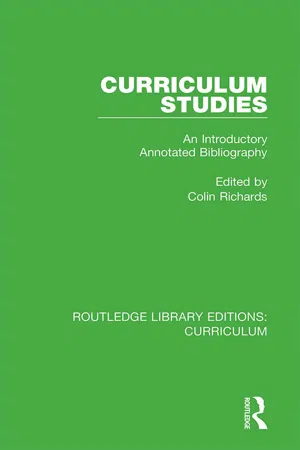
Originally published in 1978 and as a second edition in 1984. The greatly enlarged second edition of the bibliography contains sections on curriculum history, curriculum management, 'official' publications, and journals. It also added expanded sections on the sociology of the curriculum and on curriculum evaluation, assessment, and accountability, reflecting the continuing development of curriculum studies in the United Kingdom, the interest shown in the curriculum by scholars in other areas of educational enquiry, and the rapid changes in the socio-cultural context in which the curriculum is discussed, designed and transacted.
- 96 pages
- English
- ePUB (mobile friendly)
- Available on iOS & Android
eBook - ePub
About this book
Information
1 Curriculum Studies
Introductory texts
1 GORDON, P. (Ed.), The Study of the Curriculum, Batsford Academic and Educational, 1981
Yet another introduction and restatement of the views of the London Institute ‘school’ of curriculum studies (see 5). The book is divided into three sections (‘Values and the Curriculum’, ‘Historical and Political’ and ‘Curriculum Planning’) and each chapter has suggestions for further reading and questions for the reader to consider. Intended as a textbook and reads like one!
2 JENKINS, D. and SHIPMAN, M., Curriculum: An Introduction, Open Books, 1976
A useful, though uneven, attempt to put the curriculum in socio/historical context and curriculum studies in an academic context. Curriculum studies is characterised as eclectic, unstable but potentially usable: an apt summary description of the book itself.
3 KELLY, A., The Curriculum: Theory and Practice, (second edition) Harper and Row, 1982
A useful overview of thinking within the field of curriculum studies in Britain and of the influences and constraints impinging on the planning, management and evaluation of the curriculum. Re-organizes and up-dates the material in the first edition and contains a new chapter on ‘The Political Context’. Attempts to reconcile ‘a proper measure of external control’ with ‘the natural and essential evolution of the curriculum from within’ the schools.
4 KERR, J. (Ed), Changing the Curriculum, University of London Press, 1968
Based on a series of lectures (by Kerr, Hirst, Charlton, Taylor and Musgrove) dealing with the problem of curriculum reform and the contributions of the disciplines of education to the study of the curriculum. A valuable collection, now inevitably dated, especially the papers on curriculum reform and the contribution of sociology.
5 LAWTON, D. et al., Theory and Practice of Curriculum Studies, Routledge and Kegan Paul, 1978
A decidedly uneven collection of papers originally written as a series of lectures for diploma students. Exemplifies the London Institute’s multidisciplinary approach to curriculum studies with philosophical, psychological, sociological and historical contributions. More about ‘theory’ than about ‘practice’ in curriculum studies.
6 SKILBECK, M., Basic Questions in Curriculum, E. 203, Curriculum Design and Development, unit 2, Open University Press, Milton Keynes, 1976
A clearly written, genuinely introductory examination of five major questions (e.g. What shall I teach? Why shall I teach it?). Distinguishes between a problem-centred view of curriculum studies and an applied discipline view.
7 SMITH, B., STANLEY, W. and SHORES, J., Fundamentals of Curriculum Development, Harcourt, Brace and World, New York, 1957
A classic (and massive) American text. Introductory chapters useful for putting the school curriculum in a very broad socio/cultural context. Also useful is part three devoted to discussing basic forms of curriculum organisation — subject, activity and core.
8 TABA, H., Curriculum Development: Theory and Practice, Harcourt, Brace and World, New York, 1962
Another classic American text of considerable length which provides an overview of a particular style of curriculum thinking developed in the U.S.A. during the late 50s and early 60s. Though now dated and inappropriately compendious, it contains some useful chapters, especially the second part on the process of curriculum planning.
9 TAYLOR, P. and RICHARDS, C, An Introduction to Curriculum Studies, NFER, Windsor, 1979
An introductory synthesis attempting to provide an overall framework in which the beginning student can locate key issues and major pieces of work. Attempts to give students an initial ‘sense’ of the field and a ‘feel’ for its concerns and complexities. Contains plentiful references and suggestions for further reading.
More Advanced Texts
10 EISNER, E., The Educational Imagination: On the Design and Evaluation of School Programs, Collier-Macmillan, 1979
A superb book, beautifully written and full of insights into teaching, learning and the curriculum. Its main concern is to discuss the uses of artistic forms of understanding and reflection in the design and evaluation of curricula, but it raises many other issues. Written for an American readership, but English readers must not be put off by this. Its clarity, incisiveness and subtlety are best appreciated by students who have already read (endured?) the standard introductions to curriculum studies.
11 GOODLAD, J. et al., Curriculum Inquiry: The Study of Curriculum Practice, McGraw-Hill, New York, 1979
Provides a conceptual framework for the study of curriculum practice, aspects of which are filled out by various co-authors. The framework involves two sources of data for curriculum planning (‘funded knowledge’ and ‘conventional wisdom’), four domains (societal, institutional, instructional and personal/experiential) in which decisions are made, and curricular transactions and interpretations. Research and case-studies illustrating aspects of the model are discussed. A sophisticated attempt to conceptualise the social, political and technical aspects of curriculum practice.
12 STENHOUSE, L., An Introduction to Curriculum Research and Development, Heinemann, 1975
More an introduction to Stenhouse than an introduction to curriculum studies. It’s a fascinating, insightful and at times difficult text which examines the field from one particular perspective. Particularly valuable on curriculum design issues and on development from an ‘insider’s’ perspective. Not a book for the absolute beginner but essential for those some way into the field.
General Readers and Conference Papers
13 FINCH, A. and SCRIMSHAW, P. (Eds.), Standards, Schooling and Education, Hodder and Stoughton/Open University Press, 1980
A useful collection of articles focusing on values in education, standards, schooling and social change, and controlling the curriculum. Contains a wide variety of educational/political perspectives, carefully marshalled by the editors who provide valuable introductions. Contains only one paper specially written for the book. A complementary reader to that edited by REEDY and WOODHEAD (18).
14 GALTON, M. (Ed.), Curriculum Change: The Lessons of a Decade, Leicester University Press, Leicester, 1980
A rather disappointing collection of essays examining aspects of Kerr’s curriculum model a decade or so on from its original publication (see 4). The collection is loosely put together: as the editor admits, ‘no attempt was made to brief each contributor except in general terms with a mandate to look both backward and forward on the curriculum scene’. Contains an interesting essay by Kelly: ‘From innovation to adaptability: the changing perspective of curriculum development’ and an updated defence of rational curriculum planning by HIRST: The Logic of Curriculum Development.
15 GOLBY, M. et al. (Eds.), Curriculum Design, Croom Helm, 1975
A valuable collection of papers collected as a reader for an OU course on curriculum design and development. The papers have been carefully selected and examine the nature of knowledge, psychological perspectives on the curriculum and approaches to curriculum planning and evaluation. The main arguments of each paper are summarised and an introductory overview provided. See also HARRIS (16).
16 HARRIS, A. et al. (Eds.), Curriculum Innovation, Croom Helm, 1975
Comments as per GOLBY (15), with the papers here being organized in terms of ‘styles of curriculum development’, ‘curriculum development at national level’, ‘curriculum development at local level’, ‘innovation and the teacher’ and ‘strategies of innovation’.
17 HOOPER, R. (Ed.), The Curriculum: Context, Design and Development, Oliver and Boyd, Edinburgh, 1971
An interesting series of papers of uneven quality and relevance originally collected for the first OU course on the curriculum. A comparison of this collection with those of HARRIS and GOLBY (15 and 16) illustrates changing emphases within curriculum studies and the development of a distinctive English (as opposed to American) tradition.
18 REEDY, S. and WOODHEAD, M. (Eds.), Family, Work and Education, Hodder and Stoughton/Open University Press, 1980
A collection of readings concerned with the processes of socialization and learning throughout life. Most of the readings are introductions to, or summaries of research on, topics concerned with childhood, work, ageing, and the future of society. A valuable reminder of the severe limitations of formal curricula in influencing the processes of child and adult socialization.
19 RICHARDS, C. (Ed.), New Contexts — For Teaching, Learning and Curriculum Studies, Association for the Study of the Curriculum, Horwich, 1977
A series of conference papers contributed by teachers, lecturers and advisers. Management, innovation, educational policy-making, curriculum research and evaluation are some of the issues discussed. An eclectic, usually readable collection.
20 RICHARDS, C. (Ed.), Power and the Curriculum, Nafferton Books, Driffield, 1978
Papers from the Inaugural Conference of the Association for the Study of the Curriculum. Issues examined include curricula as means of social control, educational contraction...
Table of contents
- Cover
- Half Title
- Title Page
- Copyright Page
- Original Title Page
- Original Copyright Page
- Contents
- Introduction
- 1 Curriculum Studies
- 2 The Socio-cultural Context
- 3 Curriculum History (compiled by David Hamilton)
- 4 Curriculum Agents and Agencies
- 5 Curriculum Design
- 6 Curriculum Development
- 7 Curriculum Management (compiled by Ken Shaw)
- 8 Curriculum Evaluation, Assessment and Accountability
- 9 Curriculum ‘Theory’ and Research
- 10 ‘Official’ Curriculum Publications
- 11 Curriculum Journals
- 12 Addendum
- Author and Editor Index
Trusted by 375,005 students
Access to over 1.5 million titles for a fair monthly price.
Study more efficiently using our study tools.
Frequently asked questions
Yes, you can cancel anytime from the Subscription tab in your account settings on the Perlego website. Your subscription will stay active until the end of your current billing period. Learn how to cancel your subscription
No, books cannot be downloaded as external files, such as PDFs, for use outside of Perlego. However, you can download books within the Perlego app for offline reading on mobile or tablet. Learn how to download books offline
Perlego offers two plans: Essential and Complete
- Essential is ideal for learners and professionals who enjoy exploring a wide range of subjects. Access the Essential Library with 800,000+ trusted titles and best-sellers across business, personal growth, and the humanities. Includes unlimited reading time and Standard Read Aloud voice.
- Complete: Perfect for advanced learners and researchers needing full, unrestricted access. Unlock 1.5M+ books across hundreds of subjects, including academic and specialized titles. The Complete Plan also includes advanced features like Premium Read Aloud and Research Assistant.
We are an online textbook subscription service, where you can get access to an entire online library for less than the price of a single book per month. With over 1.5 million books across 990+ topics, we’ve got you covered! Learn about our mission
Look out for the read-aloud symbol on your next book to see if you can listen to it. The read-aloud tool reads text aloud for you, highlighting the text as it is being read. You can pause it, speed it up and slow it down. Learn more about Read Aloud
Yes! You can use the Perlego app on both iOS and Android devices to read anytime, anywhere — even offline. Perfect for commutes or when you’re on the go.
Please note we cannot support devices running on iOS 13 and Android 7 or earlier. Learn more about using the app
Please note we cannot support devices running on iOS 13 and Android 7 or earlier. Learn more about using the app
Yes, you can access Curriculum Studies by Colin Richards in PDF and/or ePUB format, as well as other popular books in Education & Education General. We have over 1.5 million books available in our catalogue for you to explore.