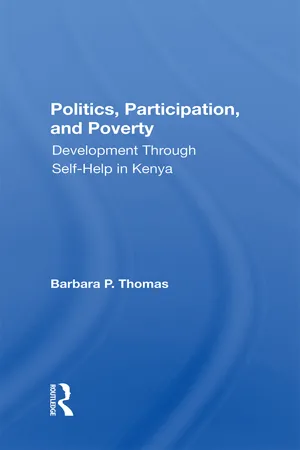
eBook - ePub
Politics, Participation, And Poverty
Development Through Self-help In Kenya
- 228 pages
- English
- ePUB (mobile friendly)
- Available on iOS & Android
eBook - ePub
Politics, Participation, And Poverty
Development Through Self-help In Kenya
About this book
Focusing on the distribution of benefits in relation to class, ethnicity, and gender, this book explores the methods to which the rural poor can organize themselves to participate in economic and social development and examines the roles that self-help organizations play in the political economy of Kenya. Dr. Thomas looks at the competition for pow
I
Organizing the Rural Disadvantaged
We must organize ourselves for self-help projects.
We must look ahead and think about our future.
Assistant Chief Soin Location
Critical Issues
How can the rural poor organize themselves to participate in economic and social development and to assure themselves an equitable share of its benefits? This question addresses one of the most intractable problems of modern times: the persistence of widespread rural poverty throughout much of the Third World. The World Development Report, 1980 of the World Bank states that more than 780 million people in developing countries live in absolute poverty. Of these three-fourths are in the rural areas of Africa, Asia and Latin America.1 Moreover, The World Development Report, 1983 indicates that the per capita income of low-income countries in Africa is likely to be lower by the end of the 1980's than it was in 1960, and The World Development, 1984 suggests that in sub-Saharan Africa the number of people living in poverty at the end of the century is likely to increase by nearly 70 per cent over 1980 figures.2
In Rural Poverty
What underlies this rural poverty? Efforts to find the answers are legion. Some analysts have concluded that the causes are structural and originate in the dependency relationships of many Third World nations with developed countries and the consequent draining of resources to more affluent nations. They focus on international terms of trade, debt servicing, capital flows, trade and protectionism, interest rates, and energy costs.
Others have suggested that there has been an investment bias toward industrial growth and urban areas, despite the high proportion of the population involved in agriculture and resident in the rural areas. One analyst, Michael Lipton, suggests that in many countries agriculture has received much less investment than is warranted by its share of the national product and employment or by considerations of equality, and he concludes that neglect of the rural sector has perpetuated the poverty of many nations.3
Some have noted the difficulties in improving conditions for the rural poor given their limited resources and narrow economic base. Others have pointed out that rural development requires organizations as well as resources and that it is necessary to begin by building strong organizational structures. Some analysts have voiced concern about the mode of seeking development - national plans and centrally administered projects. Still others have emphasized political will, vested interests, and behavior of the elite as major causes of rural poverty. Whatever the cause or mix of causes, the inadequacies of many policies and programs for generating rural growth and development are apparent, Many economies have barely kept up with their rapid population growth. In some instances, large sums of money spent on rural development projects have yielded little improvement in welfare and productivity to the people who should have benefitted from them. Problems encountered in fostering economic and social change have often seemed insurmountable and progress in rural development minimal.
These difficulties have generated widespread concern about stagnation or deteriorating conditions in many areas around the world as well as interest in new approaches for fostering rural development. This interest has been directed toward decentralized development planning, toward local participation in planning and implementation, and toward the use of local institutions and organizations for development purposes. It is currently reflected in the focus of United Nations' organizations and donor agencies on extension services, bank credit and loans for small farmers, and improved marketing structures. Third World governments are modifying national plans to incorporate procedures for fostering rural participation in development planning and implementation, and donor agencies are establishing criteria for insuring local-level participation in their development programs.
In Organizing the Rural Poor
Although scholars may differ in regard to the underlying causes of development or underdevelopment, most agree that development efforts to date have not achieved notable success. The emphasis on large-scale projects, centralized plans, and top-heavy bureaucracies has failed to improve the levels of productivity and the quality of life for vast numbers of rural people. Other approaches and new initiatives are necessary. Among these is a fresh look at local-level organizations. Can local-level organizations contribute to the development process? If so, in what ways? What functions do they serve? What kinds of issues arise in the process of using local organizations to foster development?
Some scholars have emphasized the central role of local organizations. Hunter and Jiggins state that, "The area of local participation and local decision is the most critical in the whole development process."4 Analysts from Development Alternatives, a research and consulting firm in Washington, D.C., have advised that the keys to project success are small farmer involvement and resource commitment, which are most actively generated through local organizations and groups.5
Local organizations may be defined as voluntary associations or institutionalized groups in which membership is based on common interest and is attained simply by joining.6 There are many types, among them cooperatives, credit societies, neighborhood or community development associations, water-sharing associations, or women's groups. They are accountable primarily to their members and work largely by consensus and persuasion.
These local organizations can serve a variety of functions. Four are particularly important in the context of development efforts. First, they are information channels or conduits, directing information, concerns, and opinions from individuals to the appropriate authorities. The reverse flow is also important. Organizations can effectively convey ideas and information from the government or other agencies to the individual household. As Uphoff points out, they help meet the challenge of linking development efforts at "higher" levels to the needs and capabilities of individuals and households.7
Second, local organizations can help mobilize resources for development purposes. These resources may be in the form of labor, cash, or material, and they may constitute a significant impetus to development efforts. Without organizations these resources would remain idle and unused.
Third, local organizations can mobilize their membership for collective action. This is usually in the form of group activity in order to achieve a public good and carries with it a range of concerns about the illogic of collective action, the incentives for individuals to be "free riders" and the difficulties organizations face in obtaining fair contributions from all those who benefit from their goods and services. These problems are noted particularly in situations in which organizations are attempting to provide rural infrastructure and amenities.
Fourth, organizations can change power and resource allocations. As Chen has pointed out, there is a fundamental relationship between the power structure and the distribution of resources.8 She suggests that the rural poor do not participate effectively in shaping their environment because they are powerless. Through organized, collective efforts, the rural poor can begin to redress the disparities in power and in the distribution of resources.
A number of issues arise in regard to local-level organizations. These include issues of local control, of commitment, of accountability, and of credibility. They include questions pertaining to support systems, to linkages with other organizations both horizontally and vertically, and to the relative merits of traditional organizations or "modern" ones. They include structural issues concerning the purpose, composition and leadership of specific organizations.9 If local organizations constitute a critical ingredient in the development process, it is necessary to build their capacity to anticipate and influence change, solve problems, implement decisions and act effectively within their environment. Thus, an underlying objective in an analysis of the role of local-level organizations in the development process, is to determine ways to strengthen them.
In Understanding the Actors
Recent studies of peasant behavior offer useful insights for interpreting local-level development in Kenya.10 Some examine the development of capitalism, the commercialization of agrarian relations, the growth of a centralizing state, and the response of peasants to external forces impinging upon traditional village life.11 They suggest that traditional behavior has been transformed by outside intrusions, most particularly in the form of external wage labor, commodity marketing mechanisms, and involvement with cash. Some observe that these changes are harmful to peasants, and they stress issues of peasant insecurity and survival. Others suggest that, in an environment characterized by both competition and cooperation, peasants find ways to benefit from these changes and pursue their own interests vigorously.12
Still other scholars suggest that the influence of the market has been overemphasized in the African context.13 They suggest that prevailing theories account inadequately for peasant modes of production based on an "economy of affinity" in which familial and other communal ties are the basis for the organization of activities, decisionmaking and resource transfers. Peasant autonomy, rather than control by external institutions of market and state, is hindering rural change.
Understanding the impact of Western imperialism and capitalism on Kenya is critical. It is also important to consider conditions existing within Kenyan societies before their contact with the West. These conditions may be physical or environmental, they may be socio-political or economic. For example, Kenyan tribes responded to the arrival of settlers, in part, according to the existing economic system. The most important factor of production was land, the quality of which affected both the intensity of the colonial thrust and the response of the indigenous residents. Persons occupying highly productive land reacted differently from those occupying marginal or unproductive lands.
Population/land ratios also affected tribal response to the impact of colonialism. Among the Kikuyu in Central Kenya there was considerable population pressure which pre-dated the arrival of foreign settlers. Settler colonialism greatly aggravated this situation but did not initiate the adverse land/man relationship, Among the Kipsigis in Western Kenya, the land/man ratios were not a problem, and the Kipsigis were able to accommodate colonialism far more easily than were the Kikuyus.
Little work has been done on rural voluntary associations and the roles they play in providing the structures for adaptation to a cash economy and to a centralized state system.14 Some analysts have suggested that the process of social mobilization and the increasing outward orientation of a village diminish the residents' involvement in traditional rural institutions and local-level self-help groups.15 Evidence from Kenya suggests that it is important to look at indicators other than outward orientation to determine involvement in traditional institutions. These may include levels of communal solidarity and the nature and level of resources available to a community. Among the Kikuyu, the largest ethnic group in Kenya, for example, there is a high level of outward orientation, and there is a high level of involvement in self-help groups.
Scott suggests that rural voluntary associations are a response to "subsistence problems when other courses fail."16 In Kenya this is not necessarily the case. Such groups are, in many areas, long-standing ways of organizing the factors of production and are utilized over time, regardless of the acuteness of subsistence needs. They allow people to seize hold of new opportunities in ways which may be impossible or difficult for a farmer to do alone. In some instances, they may be "re-active" institutions with a protective, risk-diminishing function. In others, they may have new functions related to opportunities offered in an expanding socio-economic situation. They may also simultaneously serve both functions. For example, they may be attempting to deal with imperfect market structures in enterprising or imaginative ways.
Analysis of rural organizations in Kenya must consider the long-term structural conditions which have led to their formation and evaluate their adaptability in meeting new needs. It does not assume that they are transitory phenomena which will disappear under the impact of development. Such analysis must examine a variety of issues concerning voluntary associations including their relationship to an emerging class structure, their roles as adaptive mechanisms and their usefulness for reaffirming ethnic, village, or community concerns.
Drawing on economically derived models of socioeconomic change, many analysts observe the potential for peasants, particularly landless peasants, to share common interests and a common role in the organization of the means of production at the bottom of the socioeconomic structure. They suggest that, to varying degrees depending on specific circumstances, peasants are developing class consciousness through conflicts with superior and more powerful classes over the distribution of economic rewards.
We would argue that in Kenya a class analysis must be supplemented by consideration of other variables. At the present time small farmers do not perceive themselves as members of a single class, nor do they ...
Table of contents
- Cover
- Half Title
- About the Book and Author
- Title
- Copyright
- Dedication
- Contents
- List of Tables
- List of Figures and Maps
- Preface
- Acknowledgments
- CHAPTER I - ORGANIZING THE RURAL DISADVANTAGED
- CHAPTER II - A FRAMEWORK FOR EXAMINING SELF-HELP: NATIONAL, HISTORICAL, AND COMMUNITY PERSPECTIVES
- CHAPTER III - THE ROLE OF SELF-HELP IN THE POLITICAL PROCESS
- CHAPTER IV - PATTERNS OF ACCESS AND ADVANTAGE IN SELF-HELP: THE PROVINCE, THE DISTRICT, AND THE LOCAL COMMUNITY
- CHAPTER V - SELF-HELP COMMUNITY PROJECTS: FROM RHETORIC TO REALITY
- CHAPTER VI - SELF-HELP AND RURAL STRATIFICATION: WHO WINS AND WHO LOSES?
- CHAPTER VII - WOMEN'S SELF-HELP ASSOCIATIONS: AGENTS FOR CHANGE OR TECHNIQUES FOR SURVIVAL?
- CHAPTER VIII - DEVELOPMENT DILEMMAS: THE POLITICS OF PARTICIPATION IN SELF-HELP
- EPILOGUE - HARAMBEE REVISITED, 1985
- BIBLIOGRAPHY
- INDEX
Trusted by 375,005 students
Access to over 1.5 million titles for a fair monthly price.
Study more efficiently using our study tools.
Frequently asked questions
Yes, you can cancel anytime from the Subscription tab in your account settings on the Perlego website. Your subscription will stay active until the end of your current billing period. Learn how to cancel your subscription
No, books cannot be downloaded as external files, such as PDFs, for use outside of Perlego. However, you can download books within the Perlego app for offline reading on mobile or tablet. Learn how to download books offline
Perlego offers two plans: Essential and Complete
- Essential is ideal for learners and professionals who enjoy exploring a wide range of subjects. Access the Essential Library with 800,000+ trusted titles and best-sellers across business, personal growth, and the humanities. Includes unlimited reading time and Standard Read Aloud voice.
- Complete: Perfect for advanced learners and researchers needing full, unrestricted access. Unlock 1.5M+ books across hundreds of subjects, including academic and specialized titles. The Complete Plan also includes advanced features like Premium Read Aloud and Research Assistant.
We are an online textbook subscription service, where you can get access to an entire online library for less than the price of a single book per month. With over 1.5 million books across 990+ topics, we’ve got you covered! Learn about our mission
Look out for the read-aloud symbol on your next book to see if you can listen to it. The read-aloud tool reads text aloud for you, highlighting the text as it is being read. You can pause it, speed it up and slow it down. Learn more about Read Aloud
Yes! You can use the Perlego app on both iOS and Android devices to read anytime, anywhere — even offline. Perfect for commutes or when you’re on the go.
Please note we cannot support devices running on iOS 13 and Android 7 or earlier. Learn more about using the app
Please note we cannot support devices running on iOS 13 and Android 7 or earlier. Learn more about using the app
Yes, you can access Politics, Participation, And Poverty by Barbara P. Thomas,Barbara Thomas-Slayter in PDF and/or ePUB format, as well as other popular books in Economics & Political Economy. We have over 1.5 million books available in our catalogue for you to explore.