- 304 pages
- English
- ePUB (mobile friendly)
- Available on iOS & Android
eBook - ePub
About this book
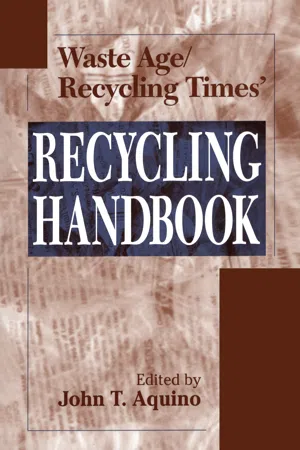
This definitive Handbook, authored by the publishing division of the leading and the largest association in the field of waste management, provides information on virtually every aspect of recycling. The chapters, written by leading international authorities, cover such topics as collection of recyclables, recycling costs, safety in recycling facilities, available technology for collection and processing of waste products, and profitability of waste products.
Introductory material in the form of "waste profiles" is included at the beginning of the Handbook, providing an excellent general reference on all of the various recyclables, from newspapers to batteries. The Handbook also covers legislative issues related to recycling, including legislation in Germany, France, Britain, and Canada, and how these overseas regulations affect recycling in the United States.
Information
1
Waste Product Profiles
By Chaz Miller, recycling manager for the Environmental Industry Associations, Washington, D.C.
What are the components of the waste stream? What are their characteristics? What are the markets for these materials as recyclables? This chapter is primarily composed of a series of profiles by Chaz Miller, recycling manager for the Environmental Industry Associations, Washington, D.C. These profiles are brief, factual listings of the solid waste management characteristics of materials in the waste stream. Each profile highlights a product, discusses how it fits into integrated waste management systems, and provides current data on recycling and markets for the product. These profiles were originally written in 1993 and 1994. They have been updated by the author for this book, using the latest price information and 1993 data published in late 1994 by the U.S. Environmental Protection Agency in Characterization of Municipal Solid Waste in the United States: 1994 Update. The chapter concludes with an article on the issue of “quality” recydables, which, although it includes interviews with individuals that were conducted in 1991, provides advice that is still useful today.
Glass Containers
Glass Container Solid Waste Facts
Weight: In 1993, glass containers constituted 12.2 million tons or 5.9% of the municipal solid waste (MSW) stream before recycling. The average weight of a glass bottle is one-half pound.
Volume: Glass containers comprised 1.5% of landfilled MSW by volume in 1993. Whole glass containers have a density of 156 pounds per cubic yard. Crushed glass can have a density of up to 2,700 pounds per cubic yard.
Recycling Rate: 20-25% (1991).
Recycled Content: 30% (includes in-house scrap, 1991).
Value: Glass containers have a low per-ton value. Currently, glass container plants will pay $40—$55 per ton (clear bottles), $20—$55 (brown bottles), and $0—$20 (green bottles), while processors generally only pay $10—$20 per ton for clear or brown and $0 for green. Nonglass container markets generally pay less than $5 per ton.
Amount Available for Recycling: In 1990, U.S. production was 10.3 million tons or 41.1 billion containers. The actual amount of imported containers is unknown, although estimates range from 750,000 tons to 1.25 million tons.
Food containers are 33% of U.S. production; beer bottles are 31%; beverage containers are 22%; wine and liquor bottles are 9%; the remainder is cosmetic and pharmaceutical bottles. Imported containers are primarily beer, wine, and liquor bottles.
Two-thirds of American-produced bottles are “flint” (clear), one quarter are “amber” (brown), and the remainder are various shades of green and a very small amount of blue bottles. At least half of imported bottles are green.
Glass Containers and Integrated Waste Management
Source Reduction: Source reduction of glass containers is primarily achieved through refillable bottles. However, American consumer preference for “convenience” has led to a precipitous decline in the production of refillable containers in the last 20 years. Today, the major market for refillables is beer consumed on premises in bars and restaurants. (Note: lightweighting is often considered source reduction. Glass container manufacturers, like all package manufacturers, constantly seek to use less material to make bottles. However, volume reduction is true source reduction for solid waste management.)
Recycling: Glass containers are highly recyclable and can be made back into glass containers with little loss of material.
Composting: Glass is nondegradable. MSW compost operations will attempt to exclude glass by hand-picking or mechanical means, or will grind it into a grit-like substance.
Incineration: Glass is noncombustible and generally forms a slag on incinerator equipment. In addition, the abrasiveness of glass causes problems with grates and conveyor equipment.
Landfilling: Glass is nonbiodegradable and chemically inert.
Glass Recycling Past and Present
The glass container industry has always used in-house scrap (“cullet”) as raw material because it melts at a lower temperature than virgin raw materials. When improvements in the production process caused a decline in the amount of in-house cullet, manufacturers started using post-consumer cullet as a raw material. The first organized attempt to collect post-consumer glass bottles occurred in Bridgewater, NJ, in 1968.
Beverage container deposit legislation, originally intended to reduce litter, spurred glass recycling by providing a stable supply of high-quality cullet. Because deposits caused a loss of market share, the glass container industry promoted curbside collection systems as the most efficient way to collect all types of glass containers. This effort paid off in 1990 when New Jersey announced a glass recycling rate of 53%, the highest in the nation. In addition to curbside programs, bars and restaurants are also prime areas for glass recycling programs.
Markets for Glass Containers
The primary market for glass containers is the 73 glass container manufacturing plants in the United States. Other markets include road construction, either on the surface (“glasphalt”) or as a roadbase aggregate; filler in storm drain and French drain systems; fiberglass production; abrasives; glass foam; and glass beads for reflective paint.
Limitations to Glass Recycling
Very Strict Raw Material Specifications: Contaminants in glass container production include:
- noncontainer glass which is chemically different from container glass;
- mixed-color glass (melting mixed-color glass produces off-color bottles and can lead to a foaming reaction in a furnace);
- ceramics such as coffee cups and swing-top closures found on several imported beers; and
- heat-resistant glass (both ceramics and heat resistant glass do not melt at the temperatures used in a glass container furnace and show up in a bottle as a “stone” or other defect).
Color Separation: Efficient mechanical systems for color separation are currently nonexistent. As a result, glass must be color-separated by hand. This is expensive and time-consuming.
Other limitations to glass recycling include a glut of green containers, due to large numbers of imported green bottles and limited American production of green bottles; potentially high transportation costs; broken glass contamination of other recyclables in some collection systems; and the very low costs for virgin raw materials such as sand and limestone.
Sources
- Characterization of Municipal Solid Waste in the United States: 1990 Update, U.S. Environmental Protection Agency.
- Current Industrial Report - Glass Containers, Series M32G - Final 1990 Report (Bureau of Census, Department of Commerce).
- Glass Packaging Institute.
- New Jersey Office of Recycling, 1990 Report.
- NSWMA Technical Bulletin 85-6.
- Waste Age’s Recycling Times, March 10, 1992.
- Resource Recycling Technologies.
- U.S. Industrial Outlook 1991 - Cans and Containers (Department of Commerce).
****************************
Newspapers
Newspaper Solid Waste Facts
(NOTE: Newsprint is the paper itself. Newspapers are what newsprint becomes after it is printed on.)
Weight: In 1993, newspapers constituted 12.9 million tons, or 5.9% of the municipal solid waste (MSW) stream before recycling.
Volume: In 1993, newspapers comprised 4.0% of the volume of land-filled MSW.
Recycling Rate: In 1991, 52% of the newspapers consumed in the U.S. were recycled. In 1988, 33% were recycled.
Recycled Content: Newsprint can be composed of 0% to 100% recycled fiber. In 1991, recycled newsprint consumed 11.5% of the newspapers sold in the U.S.
Value: Newspapers have gone from a low to negative per-ton value in the early 1990s when, in many parts of the country, processors had to be paid to take newspapers. In 1994, old newspaper (ONP) prices increased drastically, with processors generally paying $10–30/ton. Mill prices for baled, curbside-collected newspaper range from $60—$100 per ton (prices as of December 1993).
Amount Available for Recycling: U.S. newsprint production capacity was 7 million tons in 1991, with total North American capacity of 18.5 million tons. Due to overexpansion and the effects of the recession on newspaper sales, the newsprint industry currently has excess production capacity. Over 50% of the newsprint consumed in the U.S. is imported from Canada.
In 1993, 7 million tons of newspaper were collected but went un-recycled. This is 4.3% of MSW after recycling.
Newspapers and Integrated Solid Waste Management
Source Reduction: Source reduction is hard to achieve for newspapers. Paper can be lightweighted and downsized, but significant additional lightweighting seems unlikely. Newsprint production decreases primarily when an economic recession causes fewer ads to be printed, resulting in fewer newspaper pages. As a result of the recession, newsprint consumption for 1991 was down by 600,000 tons compared to 1990 figures.
Recycling: Newspapers are highly recyclable and can be manufactured back into newsprint, using the two most common methods of deinking: flotation and washing. However, because the recycling process shortens paper fibers, a newspaper can be recycled a maximum of six to eight times before the fibers are too short to be used. Virgin pulp will always be necessary for newsprint production.
Composting: Newspaper is organic and highly compostable with only trace amounts of ink in the compost.
Incineration: Newspaper is easily combustible. A pound of newspaper has 7,500 Btus (compared to 4,500–5,000 Btus for an average pound of MSW).
Landfilling: Newspapers, like most materials, degrade very slowly in a modern landfill.
Current Newspaper Recycling Efforts
Traditionally, newspapers are the most recycled product in America. For decades, volunteer organizations raised funds by collecting newspapers when market demand was high. In 1970, the response to the first Earth Day led to an increased emphasis on recycling. Many municipalities, primarily in the Nor...
Table of contents
- Cover
- Half Title
- Title Page
- Copyright Page
- Table of Contents
- 1. Waste Product Profiles
- 2. Recycling and The State and Federal Governments
- 3. What does Recycling Really Cost?
- 4. Markets
- 5. Recycling Collection and Vehicles
- 6. Safety Issues
- 7. Management/Strategy Issues
- 8. Effect of Overseas Regulations on U.S. Recycling
- 9. Case Studies
- Acronyms and Abbreviations
- Index
Trusted by 375,005 students
Access to over 1.5 million titles for a fair monthly price.
Study more efficiently using our study tools.
Frequently asked questions
Yes, you can cancel anytime from the Subscription tab in your account settings on the Perlego website. Your subscription will stay active until the end of your current billing period. Learn how to cancel your subscription
No, books cannot be downloaded as external files, such as PDFs, for use outside of Perlego. However, you can download books within the Perlego app for offline reading on mobile or tablet. Learn how to download books offline
Perlego offers two plans: Essential and Complete
- Essential is ideal for learners and professionals who enjoy exploring a wide range of subjects. Access the Essential Library with 800,000+ trusted titles and best-sellers across business, personal growth, and the humanities. Includes unlimited reading time and Standard Read Aloud voice.
- Complete: Perfect for advanced learners and researchers needing full, unrestricted access. Unlock 1.5M+ books across hundreds of subjects, including academic and specialized titles. The Complete Plan also includes advanced features like Premium Read Aloud and Research Assistant.
We are an online textbook subscription service, where you can get access to an entire online library for less than the price of a single book per month. With over 1.5 million books across 990+ topics, we’ve got you covered! Learn about our mission
Look out for the read-aloud symbol on your next book to see if you can listen to it. The read-aloud tool reads text aloud for you, highlighting the text as it is being read. You can pause it, speed it up and slow it down. Learn more about Read Aloud
Yes! You can use the Perlego app on both iOS and Android devices to read anytime, anywhere — even offline. Perfect for commutes or when you’re on the go.
Please note we cannot support devices running on iOS 13 and Android 7 or earlier. Learn more about using the app
Please note we cannot support devices running on iOS 13 and Android 7 or earlier. Learn more about using the app
Yes, you can access Waste Age and Recycling Times by John T. Aquino in PDF and/or ePUB format, as well as other popular books in Technology & Engineering & Environmental Science. We have over 1.5 million books available in our catalogue for you to explore.