- 246 pages
- English
- ePUB (mobile friendly)
- Available on iOS & Android
eBook - ePub
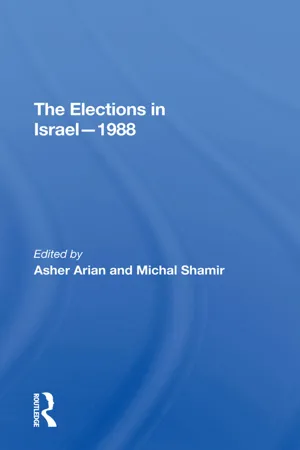
The Elections In Israel1988
About this book
Forty years after becoming an independent state, Israel is still involved in deadly strife with many of its Arab neighbors and with the Palestinians under its military control. The protracted Arab-Israeli conflict is one of the most fundamental features of the Israeli experience; it overshadows economic and social decisions, and often sets the poli
Information
1
Introduction
Asher Arian and Michal Shamir
I
Forty years after becoming an independent state, Israel is still involved in deadly strife with many of its Arab neighbors and with the Palestinians under its military control. The protracted Arab-Israeli conflict is one of the most fundamental features of the Israeli experience; it overshadows economic and social decisions, and often sets the political agenda. Not surprisingly, the conflict is not only an outcome of the hostility between the protagonists, but also a major resource within the system; those who control the timing and extent of security actions, and those who influence the content and form of communication about this issue, are often advantaged. Using the Arab-Israeli conflict as the organizing concept of this volume, we focus on how reactions to the conflict are reflected in voting behavior and coalition negotiations.
Barzilai and Russett open this collection by showing that the incidence of armed violence closely follows the political calendar in Israel: military action increases during the year or so immediately before the elections. This finding replicates studies of other countries, especially the United States. It is also similar to the finding that as elections approach, the economy is usually rejuvenated by injections of government money. (After the elections, the politicians take it back—especially during the second year, which is far enough from the next election to encourage them to make the country live more within its means.)1
The security issue clearly dominated Israel's 1988 campaign. National consensus is a valued goal, and division is indicated by discourse within generally accepted parameters. Former senior army officers became involved in the debate over the territories in an unprecedented manner. First, the Peace and Security Council, with some 200 reserve officers with the rank of colonel or higher, announced that the security of the country would be furthered by exchanging territories for peace. The reaction came promptly: the smaller Security and Peace Council, also made up of senior reserve officers, stated that holding the territories was necessary for the security of the country.
Symbols have also been affected by the conflict. Herzog shows that the map of Israel has been widely used in political symbolism since before the establishment of the state. The symbol is constant, but the emotional and political content imparted to the map by different groups has varied greatly.
II
The 1988 elections were held on November 1, about a year after the beginning of the intifada (the Arab uprising in the territories which Israel had captured in the Six Day war). It was widely expected that the elections would be a referendum on the future of the territories. The country was more polarized than ever, and the platforms of the two major parties presented clear, opposing choices. While the forecast of a crucial election was not unreasonable, it turned out to be very wrong; those who had anticipated little change in Israel's political stalemate were closer to the mark.
The intifada forced most Israelis to think more realistically about the future of the territories and their inhabitants. It spotlighted obvious anomalies which had largely been ignored. International pressure increased for Israel to take a more conciliatory position toward the Palestinians. Much of the world's mass media gave negative treatment to Israel's attempted suppression of the intifada.
The two major parties offered clearly opposing views of the future. Labor came out in favor of offering territory for peace, and hinted at a form of confederation with the kingdom of Jordan—thus relinquishing control over the territories while avoiding the creation of a Palestinian state. The Likud spoke simultaneously of three apparently irreconcilable goals—achieving peace, retaining the territories, and preventing foreign sovereignty in them.
Four of the chapters (Barzilai, Shamir & Arian, Peled and Lustick) look into the effect of the protracted Israeli-Arab conflict on the Israeli electorate in 1988. Barzilai examines the responses of a national sample just after the elections. Shamir and Arian focus on change within a sample interviewed twice—just as the intifada began, and again on the eve of the elections. Peled studies support for the extreme right-wing parties, and links it to conflicts in the labor market.2
Rabbi Meir Kahane's Kach party did not run in 1988. On the basis of the amended election law, changed after the 1984 election, the Central Elections Committee disqualified the party because of its racist and antidemocratic stand. A new ultra-nationalist list, Moledet (Homeland), led by former General Rehavam "Gandhi" Ze'evi, won two seats. Moledet called for the transfer of the Arabs from the territories to Arab countries—a concept that had been introduced into political discourse by Kahane.
Some of the votes which might have gone to Kach were probably won by other parties on the extreme right; however, it is certain that many did not. As Peled points out, pre-election polls indicated that Kahane would have won three seats—yet the extreme right gained only two, and there is no evidence of how much of this increase came from would-be Kahane voters. In development towns, which were Kahane's strongholds, reinterviews conducted by Peled revealed that the Likud and the religious parties were the major beneficiaries of Kach's disqualification.
The Jewish voters in the studies by Barzilai and Shamir/Arian said quite clearly that the intifada had affected their choices. Barzilai shows that Israel's use of force in the territories is the major explanatory variable in predicting vote choice. In the Shamir/Arian survey, 55 percent said that the intifada had changed their opinions regarding security and politics; about one-fourth said their views had become more moderate, while one-third said their positions had hardened. Fifty-nine percent thought that the national mood had become worse, and 41 percent reported that their own mood had soured. Only four percent thought that the intifada improved the national mood and their own mood. Thirteen percent said that the intifada had strengthened their desire to live in Israel, while nine percent said that the uprising had decreased it. About half thought that the intifada would have an impact on the coming elections; of these, two-thirds thought that the intifada would work in the Likud's favor.
The intifada also unleashed forces among the Arabs—both Israeli citizens and those in the territories. The Arab Israelis seemed to identify more fully than in the past with the nationalistic aspirations of the Palestine Liberation Organization; the Arabs in the territories were galvanized into believing that they could play a major role in determining their political future. The intifada also gave the PLO leaders living outside Israel's jurisdiction a new political opportunity, just when it seemed that the organization had been eclipsed. Lustick considers the effect of the uprising on the Israeli Arab electorate, and concludes that the Arabs participated in the elections in order to further their individual preferences; that they were divided among themselves explains the blurred effect of their vote.
III
The 1988 election results (see Table 1.1) were not markedly different from the outco...
Table of contents
- Cover
- Half Title
- Title
- Copyright
- Contents
- Acknowledgments
- 1 Introduction
- Part One War and Symbols in a Protracted Conflict
- Part Two Voting Behavior in a Protracted Conflict
- Part Three Adaptation to Changing Conditions
- Part Four Protracted Conflict and the Formation of Government
- Glossary
- List of Editors and Contributors
- Index
Trusted by 375,005 students
Access to over 1.5 million titles for a fair monthly price.
Study more efficiently using our study tools.
Frequently asked questions
Yes, you can cancel anytime from the Subscription tab in your account settings on the Perlego website. Your subscription will stay active until the end of your current billing period. Learn how to cancel your subscription
No, books cannot be downloaded as external files, such as PDFs, for use outside of Perlego. However, you can download books within the Perlego app for offline reading on mobile or tablet. Learn how to download books offline
Perlego offers two plans: Essential and Complete
- Essential is ideal for learners and professionals who enjoy exploring a wide range of subjects. Access the Essential Library with 800,000+ trusted titles and best-sellers across business, personal growth, and the humanities. Includes unlimited reading time and Standard Read Aloud voice.
- Complete: Perfect for advanced learners and researchers needing full, unrestricted access. Unlock 1.5M+ books across hundreds of subjects, including academic and specialized titles. The Complete Plan also includes advanced features like Premium Read Aloud and Research Assistant.
We are an online textbook subscription service, where you can get access to an entire online library for less than the price of a single book per month. With over 1.5 million books across 990+ topics, we’ve got you covered! Learn about our mission
Look out for the read-aloud symbol on your next book to see if you can listen to it. The read-aloud tool reads text aloud for you, highlighting the text as it is being read. You can pause it, speed it up and slow it down. Learn more about Read Aloud
Yes! You can use the Perlego app on both iOS and Android devices to read anytime, anywhere — even offline. Perfect for commutes or when you’re on the go.
Please note we cannot support devices running on iOS 13 and Android 7 or earlier. Learn more about using the app
Please note we cannot support devices running on iOS 13 and Android 7 or earlier. Learn more about using the app
Yes, you can access The Elections In Israel1988 by Asher Arian,Michal Shamir in PDF and/or ePUB format, as well as other popular books in Politics & International Relations & Middle Eastern Politics. We have over 1.5 million books available in our catalogue for you to explore.