- 304 pages
- English
- ePUB (mobile friendly)
- Available on iOS & Android
eBook - ePub
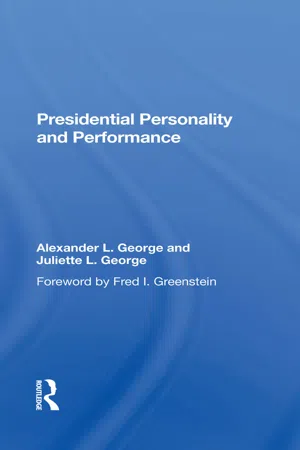
Presidential Personality And Performance
About this book
This book, which examines the leadership styles and decisionmaking practices of presidents from Woodrow Wilson to Bill Clinton, reflects the authors interest for over half a century in the impact of personality on the political behavior of our political leaders. Its contents range from the story of the Georges collaboration on their pioneering stud
Information
1
The Psychoanalyst and the Biographer
Juliette L. George and Alexander L. George
WE WELCOME THE OPPORTUNITY afforded by publication of this new edition of our effort to study the life of Woodrow Wilson in the light of psychoanalytic theory to set down a few thoughts on the general problem of the relevance of psychoanalysis to the biographer's work.
It has often been noted that there exists a gap, which can never be bridged, between the range of data available to the psychoanalyst and that available to the biographer. For this reason, some have concluded that biographers cannot make effective use of psychoanalysis.
The analyst has the opportunity of learning in detail from the patient himself the unconscious feelings, wishes and fantasies which are the wellspring of his behavior. He has the object of his inquiry on his couch, providing the necessary material in the form of descriptions of his life experience, transference reactions, dreams and free associations.
The biographer, on the other hand, has no such access to his subject's intimate thoughts through personal contact. In those rare cases in which his subject is alive and willing to provide him information, the biographer who ventured to ask for the sort of personal revelation which the analyst routinely requires of his patient doubtless, and understandably, would be given short shrift indeed. Almost always even when his subject is alive and always when he is dead, the biographer is at the mercy of a finite and distressingly incomplete body of information.
The force of this argument cannot be denied. It must be admitted that no biographer can "psychoanalyze" his subject because he is not in possession of that data pertaining to the subject's unconscious without which psychoanalysis in the classical sense is not possible. However, those who rely on this obvious point to substantiate the argument that psychoanalysis is therefore of no use in the biographer's enterprise overlook two important facts. They overlook, first, that "psychoanalysis" refers not only to a therapy for personality disorders: it also denotes a theoretical system of psychology, based on empirical clinical observation, which accounts for the structure, functioning and development of human personality. They overlook, second, that there is a crucial difference in the respective tasks of the psychoanalyst and the biographer, a difference which makes it possible for the biographer to work effectively on the basis of data which would not suffice for the purposes of the psychoanalyst.
The psychoanalyst is bent upon a therapeutic result with his patient, upon a reawakening in the analytic situation of unresolved conflicts with a view to providing the patient an opportunity to achieve more satisfactory solutions than those he originally adopted. The biographer, on the other hand, is spared the difficult task of attempting to alter his subject's personality. He wishes only to comprehend it and to transmit his comprehension to an audience of readers by means of a written narrative. These two facts are of paramount importance in the controversy about the feasibility of applying psychoanalytic theory to biographical material.
Psychoanalytic psychology comprehends individual human behavior in terms of the history and development and the past and present relationships of the id, the ego and the superego which, it claims, comprise the human psyche. By now, psychoanalysts have studied these complex relationships in thousands of cases in which patients have provided data about their unconscious processes and in which the psychoanalytic procedure has served as a method of research as well as a method of cure.
Certain types of readily observable behavior have been related to certain causal factors and varieties of conflict. Adequate understanding of analytic theory and experience sensitizes the biographer (as well as the analyst in his task) to the types of material to watch for as he examines the data available to him. The large body of published clinical data gathered by psychoanalysts over the past few generations puts at the biographer's disposal clues as to the possible significance of certain patterns of behavior or habits or traits of character of which he might otherwise take no notice.
The biographer's need is satisfied by this access to diagnostic hypotheses. The therapist's task, however, only begins with diagnosis, for he has the job of helping his patient achieve a more satisfactory distribution of his instinctual energies, one which will eliminate the need to invest so large a proportion of his emotional capital in maintaining repressions and struggling, consciously or unconsciously, to realize unrealizable infantile fantasies. To achieve this goal, he embarks with his patient upon an exploration of the patient's unconscious. If the therapeutic collaboration is successful, the patient will become aware of his repressed impulses and will learn to deal with them more expeditiously, consciously. The analyst's relentless pursuit of his patient's unconscious fantasies is necessitated by the fact that in order to renounce the unattainable infantile pleasures around which are woven the fantasies which hold him in thrall, the patient must confront his past and his deepest impulses with courage and feeling.
For his part, the analyst has in most instances long since known what ails his patient. Their intensive work together is not primarily to provide material for the analyst's diagnosis—although undoubtedly his diagnosis becomes more exact as the material unfolds—but to enable the patient to grow and change.
Indeed, psychoanalysts are usually able to perceive the essential dynamics of the patient's personality and the general nature of his problems very early in the treatment situation, even before the patient has produced the dreams, free associations and transference reactions which reveal in detail the contents of his unconscious.
Freud once remarked that, try as he may, a person cannot conceal what is motivating him—all manner of surface behavior expresses the basic constellation of unconscious impulses. Again, in a paper on analytic technique, Freud noted that "it is not difficult for a skilled analyst to read the patient's hidden wishes plainly between the lines of his complaints and the story of his illness." Some contemporary training analysts—e.g., Franz Alexander and Leon Saul—hold that the analyst can and should discern the patient's central conflict and the basic outlines of his personality in the very first interview or, at the most, in the first few interviews, which usually consist largely in the patient's account of his difficulties and an initial narrative of significant life experiences.
For the analyst, then, to "read" the patient's unconscious and to understand what his problems are is apparently the least onerous part of his task. The real challenge is to induce the patient to change, and it is in connection with that part of the analytic endeavor that the patient must come to know the contents of his unconscious. (Some analysts claim that even for therapeutic purposes, it is often unnecessary to reconstruct the patient's unconscious infantile past; that, however, is strictly a point of therapeutic technique and not of concern in this context.)
A biographer, unless ne is singularly unfortunate (in which case even a conventional biography will prove difficult), usually has considerable data about the way his subject feels and reacts to the problems of life, and he has even more detailed knowledge about his subject's actions in various situations. Indeed, he has available to him material which the analyst customarily does not have relating to the actual impact of his subject on other people, and he has more accurate evidence of how his subject actually interacts with others in reality since his materials include not only his subject's impressions of certain sequences of events but those of other people as well. In short, he often has at his disposal considerable data of a character which is meaningful in terms of psychoanalytic hypotheses, and these can be an invaluable aid to interpretation.
To argue the possibility of the fruitful application of psychoanalytic theory to biography is by no means to suggest that all biographers can or should attempt it. To master psychoanalytic theory takes many years of study. To apply it to biographical materials in a useful fashion is an extraordinarily difficult task which makes many demands upon the biographer not only as a scholar but as a human being.
The biographer's raw material customarily is locked up in books and files. There will usually be letters to and from the great man—the scrawl of the schoolboy writing to his parents, the ardent letters of the young man to his wife-to-be or perhaps to a friend in whom he confides his views of the world and his notion of his own place in it, the workaday correspondence with those associated with him in the conduct of his business. There will be newspaper accounts of his activities, memoranda by contemporaries, both friend and foe, telling the story of their association with the great man. If the political figure be of the mid-twentieth century or later, the biographer will be able to see and hear him at first hand by means of recordings and films, to study his gestures, his facial expressions, and personally to experience the impact of his public "style." Perhaps there are books written by the subject, or diaries revealing secret hopes and preoccupations. There will be official records—transcripts of meetings in which the great man participated and of speeches he made. There will be books of reminiscences by people who stood in various relationships to the biographical subject—adviser, wife, political rival, political supporter, journalist, friend. Each may have encountered a different facet of the great man so that he emerges in many different lights, and there is the further complication that each account will be colored by the idiosyncrasies of its author and also by his motives for undertaking to write it.
All this mass of material the biographer lets flow freely into him. He is the medium through whom the chaotic raw data is digested, ultimately to be rendered back in an orderly verbal re-creation of an intelligible human being, his individuality revealed. Insofar as the biographer correctly perceives and succeeds in expressing the logical connections among disparate facts, the subject of his biography will achieve a new life, vouchsafed to any who care to read about it. Only the biographer who has been able to filter the data through his own personality without in the end distorting it in consequence of its tortuous passage can perform this creative task.
It is, indeed, an extraordinary function that the biographer sets out to fulfill in relation to his subject. To perform it satisfactorily, he must possess, in addition to that devotion to diligent scholarship the need for which has been abundantly discussed in works of historiography, qualities of mind and spirit which have been less thoroughly explicated. Certainly biographers have been told often enough that they ought to be "unbiased" and that they ought to aim at presenting the "truth." The actual processes involved, however, the vicissitudes of the data between the time the biographer first encounters them and the time he finally transmutes them into a synthesized account, generally have been left untackled on the theory that these are manifestations of artistic creativity and that the essence of artistic creativity defies analysis. In short, the most vital aspect of the biographer's enterprise, the nature of the processes involved in his perception and digestion of the data, has been neglected.
The biographer wishes to understand the man whose life he is studying. In order to grasp why his subject behaved as he did in various situations, the biographer wishes to know him emotionally, to be able to experience vicariously the feelings which his subject experienced at various junctures of his life. He wishes to be able to participate in his subject's emotional experience sufficiently to comprehend it, but not to become so intensely involved that he is unable to stand back and dispassionately evaluate that experience in the full context of reality. In order to achieve his objective of conveying some truth about the human being he is studying, the biographer, as the psychoanalyst, must have the capacity for both involvement with and detachment from his subject. He must be involved in order to gain understanding of his subject's reactions; he must be detached in order to evaluate and analyze.
As the data flow into him, the biographer gradually builds a picture of what kind of person his subject was, what his characteristic attitudes and defenses were and how they developed, what made him anxious, what gratified him, what goals and values he adopted, how he went about pursuing them and so on.
At first, the biographer's picture of his subject is vague and sketchy, but as he becomes steeped in the data, more and more details are limned in, providing increasing points of reference. Then when he comes upon a situation in which the subject's behavior is somewhat puzzling, he pauses and attempts to project himself into his subject via the personality picture of him he has formed: how would a given situation or problem—perhaps it is some sort of political challenge or provocation—feel to the subject? The biographer, having saturated himself in knowledge of the times in which his subject lived and the external realities of his situation, now "listens" to the data from the inside, as it were, from the point of view of the interior reactions of his subject. If his image of the subject's personality has been well and sensitively derived and his insight into the nature of the problem at hand is accurate, the biographer is likely to achieve an understanding of how the subject experienced the external problem. The behavior, perhaps previously unfathomable, will then seem logical in terms of the inner psychological reality which produced it.
By empathizing, the biographer reaches his subject's feelings in a given situation. Giving free rein to his faculties, both conscious and unconscious, he next tries to grasp the logical connections between the emotions thus perceived and the subject's whole life history. Now he must subject the inferences which his intuition has yielded to strict, rational scrutiny in an attempt to evaluate their validity.
If his data are sufficient and he has functioned well in empathizing, in intuiting and finally in rigorously examining his conclusions, the biographer is now in a position to interpret the bit of historical evidence to which he has been addressing himself. The interpretation will be consonant with all that he knows about his subject, and it, and all the insights which contributed to its formulation, will enable him to develop and refine his mental image of his subject. That, in turn, will improve his ability to cope with the next problem of interpretation, for he will face it with an enriched awareness of his subject.
This is an iterative process. The biographer is constantly re-examining and revising his earlier interpretations of his subject's behavior with improved hypotheses gained from his expanding familiarity with and understanding of the data. His view of his subject gradually achieves an internal consistency as he works and reworks the material.
The foregoing account of the way in which the biographer goes about his work applies also to the way the psychoanalyst works—this aspect of his functioning has been fully described in psychoanalytic literature.1 Many historians, however, undoubtedly would consider it merely word juggling: of course the biographer must empathize and intuit, they might reply. The real question is, how do you do it? What, since erudition alone obviously is not the answer, makes some people good at it and others inept? It is all very well to say that the biographer has in mind a picture of his subject's personality and that if this picture has been sensitively derived he will be able to project his own consciousness into his subject's feelings. The riddle lies precisely in what has been glossed over in the phrase, "if this picture has been sensitively derived": what, indeed, contributes and what detracts from the biographer's ability to be sensitive?
In this area, psychoanalysis has much to offer the historian which is novel to his accustomed way of thinking. Everything which psychoanalysts have discovered about what impairs or facilitates an analyst's ability to "see" his patient—all the phenomena of what is known in psychoanalytic theory as countertransference—holds also for what impairs or facilitates a biographer's ability to "see" his subject truly and fully.
In order to understand his subject, the biographer must maintain that same attitude of freely hovering attention that Freud prescribed for analysts vis-à-vis their patients. If an analyst's capacity to maintain that attitude is impaired by anxious, hostile or guilty reactions to the patient deriving from unresolved problems of his own life experience, his understanding of the patient is impeded by his countertransference reactions. So too is the biographer's understanding of his subject reduced when the materials at hand elicit irrational irruptions from his own past. If that happens he is likely to produce that familiar phenomenon—the biography more revealing of its author than of its subject.
Analyst and biographer both must be able to participate without inhibition in the feelings of their subjects and this ability depends upon the range and quality of their emotional resonance as well as upon their rational equipment. Non- or even anti-psychoanalytically oriented biographers perforce also use their emotional endowment but, being unaware of that fact or denying it, they are in a poorer position to engage in full self-scrutiny for the purpose of eliminating distortions of perception and interpretation arising out of their own idiosyncrasies.
The psychoanalytic theory of human development is widely recognized as a rich source of hypotheses concerning human behavior. Within the past few generations, the fields of education, sociology, psychology and anthropology have been transformed by the impact of analytic conceptions. It would seem natural, then, that the historian and biographer, who wish not merely to describe but to account for the behavior of people individually and collectively, would seek to absorb and make use of this new body of knowledge. Some half century after Freud's formulation of the basic tenets of psychoanalytic theory, however, it must be conceded that there have been few noteworthy psychoanalytically oriented biographies. Why is this so?
For one thing, there are few first-rate psychoanalysts with the time and interest to do full-length biographical studies (Erik Erikson, who wrote an excellent biography of Luther, is one of the notable few); and there are few first-rate biographers with the time, interest and capacity to master analytic theory. Psychoanalytic theory cannot be used successfully by analysts as a short cut which reduces the need for painstaking historical research and the most scrupulous attention to the social setting in which the biographical subject lived. Nor can biographers inadequately grounded in psychoanalytic theory successfully appropriate bits and pieces of it to "explain" their protagonists. Numerous biographical atro...
Table of contents
- Cover
- Half Title
- Title
- Copyright
- Dedication
- Contents
- Foreword
- Acknowledgments
- Introduction: An Overview
- 1 The Psychoanalyst and the Biographer
- 2 Some Uses of Dynamic Psychology in Political Biography: Case Materials on Woodrow Wilson
- 3 Writing Psychobiography: Some Theoretical and Methodological Issues
- 4 Woodrow Wilson and Colonel House: A Reply to Weinstein, Anderson, and Link
- 5 Assessing Presidential Character
- 6 Presidential Management Styles and Models
- Index
Trusted by 375,005 students
Access to over 1.5 million titles for a fair monthly price.
Study more efficiently using our study tools.
Frequently asked questions
Yes, you can cancel anytime from the Subscription tab in your account settings on the Perlego website. Your subscription will stay active until the end of your current billing period. Learn how to cancel your subscription
No, books cannot be downloaded as external files, such as PDFs, for use outside of Perlego. However, you can download books within the Perlego app for offline reading on mobile or tablet. Learn how to download books offline
Perlego offers two plans: Essential and Complete
- Essential is ideal for learners and professionals who enjoy exploring a wide range of subjects. Access the Essential Library with 800,000+ trusted titles and best-sellers across business, personal growth, and the humanities. Includes unlimited reading time and Standard Read Aloud voice.
- Complete: Perfect for advanced learners and researchers needing full, unrestricted access. Unlock 1.5M+ books across hundreds of subjects, including academic and specialized titles. The Complete Plan also includes advanced features like Premium Read Aloud and Research Assistant.
We are an online textbook subscription service, where you can get access to an entire online library for less than the price of a single book per month. With over 1.5 million books across 990+ topics, we’ve got you covered! Learn about our mission
Look out for the read-aloud symbol on your next book to see if you can listen to it. The read-aloud tool reads text aloud for you, highlighting the text as it is being read. You can pause it, speed it up and slow it down. Learn more about Read Aloud
Yes! You can use the Perlego app on both iOS and Android devices to read anytime, anywhere — even offline. Perfect for commutes or when you’re on the go.
Please note we cannot support devices running on iOS 13 and Android 7 or earlier. Learn more about using the app
Please note we cannot support devices running on iOS 13 and Android 7 or earlier. Learn more about using the app
Yes, you can access Presidential Personality And Performance by Alexander L George,Juliette L George in PDF and/or ePUB format, as well as other popular books in Politics & International Relations & International Relations. We have over 1.5 million books available in our catalogue for you to explore.