Defining entertainment tourism
Entertainment tourism has attracted attention from industry and academics (Adeboye, 2012). There are many entertainment products, such as talk shows, concerts, magic performances, dance performances, and so on. Different scholars understand entertainment tourism differently. On one hand, Hughes (2000) defined entertainment as a subset of art performance. On the other hand, Xu (2010) believed that entertainment was a subset of tourism products with the objective of providing an unforgettable experience. Gambling is one of the entertainment products. It provides joy and enhances the attractiveness of a place (Loi & Pearce, 2012). According to McCarthy (2002), gambling is one of the driving forces for economic growth in many countries.
Entertainment is one of the attractions on many tours. Despite the fact that tourism and entertainment are two different industries, both industries share some common areas. Mathieson and Wall (1982) defined tourism as “temporary movement to destinations outside the normal home and work-place, the activities undertaken during the stay, and the facilities created to cater for the need of tourists” (p. 1). According to this definition, the tourism industry includes travel agents and operators, transportation and the associated facilities, hotel accommodations, and site attractions.
Attractions are an important part of the tourism industry. Attractions allow tourists to explore the sights, infrastructures, and wonders of a place. Attractions include but are not limited to arcades, art museums, heritage sites, zoos, parks, botanical gardens, cultural attractions, casinos, and so forth. Some hotels in Southern Europe include entertainment shows to increase the attractiveness of the hotel. The goal is to impress the customers, which can be achieved via the services provided by the hotel, and to make the money paid by the customers worthwhile.
Recreation and entertainment activities include bird watching, fishing, horse riding, golfing, and educational visits to entertainment spots. These facilities hire workers to maintain, manage, operate, and promote the facilities. Hence, recreation and entertainment has become one of the fastest-growing industries in the world. According to the Hospitality Industry Education Advisory Committee (2016), the expected labor hired from this industry is over 20,000 annually.
The attractiveness of a destination comes from different sources, one of which is the perceived ability of a destination to fulfill and satisfy tourists’ needs. Mayo and Jarvis (1981) related destination attractiveness to the decision-making process and the associated happiness. In particular, destination attractiveness was defined as a consolidation of travel benefits and the perceived travel benefits of traveling to the particular destination. As individuals thought the destination was able to deliver on their needs, they would become more attracted to the destination and would identify the place as a potential travel destination (Hu & Ritchie, 1993).
Attractions are not only a crucial part of tourism, but also are the driving force of tourism. According to Robinson, Lück, Smith, Lackey (2013, p. 3), tourist attractions are:
The most important component in the tourism system. They are the main motivators for tourist trips and are the core of the tourism product. Without attractions, there would be no need for other tourism services. Indeed, tourism as such would not exist if it were not for attractions.
Many tourist attractions are connected to entertainment. For example, some tourist attractions include areas for the audience to engage or attempt to captivate emotions through perceptive stimulations. Most theaters, museums, and historical sites could be classified as tourist attractions, but not all entertainment venues are tourist attractions.
Vogel (2014) defined entertainment as things that could stimulate, encourage, and generate enjoyable distractions. In fact, entertainment could generate more than distractions. It could be fascinating and charming. The corresponding word in Latin, tenare, means something that could catch you and your soul. Therefore, even when life is not perfect, entertainment provides something people can enjoy and look forward to. This creates the ultimate reason for demanding entertainment products and services. This is the main characteristic of many entertainment attractions, such as cinemas, sports events, theme parks, and so on (Chen, 2012).
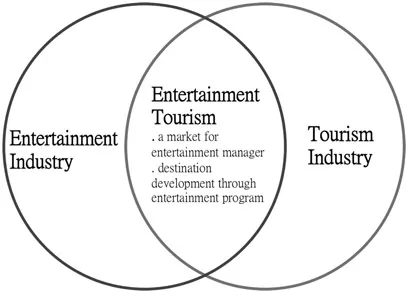
There are many categories within the entertainment industry. Some entertainments do not require any entertainment venues, such as media, Internet, and video games. It would be hard to classify these entertainment activities as tourism. On one hand, tourism provides potential markets to entertainment. On the other hand, the development of tourism depends on entertainment. The parts where the two overlap are entertainment tourism (See Figure 1.1 ).
Figure 1.1 Entertainment-based tourism
The entertainment industry has changed rapidly during the last decade; in particular, the destinations were changing rapidly (Minton, 1998). Entertainment destinations can be defined as places tourists travel to for entertainment activities. The classic example is Branson in Missouri, which was the second most popular destination in the United States in the early 1990s (“Utopia, Missouri”, 1994). Recently, entertainment has included a variety of shows, such as concerts, musicals, music and medieval festivals, magic and street performances, circuses, comedy, and so on. Furthermore, other activities, such as sports events, theater, dancing, clubbing, and theme park visits, are also included in entertainment (Besciu, 2013). Las Vegas is another classic example with a particular focus on entertainment activities. The attractions in Las Vegas not only include the casinos, but also live performances. The purpose of the live performances is to lure tourists to stay in the hotel or to gamble in the casino afterwards. Hotels further provide other entertainment products, such as theme parks, virtual reality experiences, and so on (Hughes & Benn, 1997).
Las Vegas provides a wide range of entertainment products, such as night-life, shows, exhibits, museums, theme parks, pool parties, and so on. In the old days, many hotels included bars, lounges, and showrooms to retain guests. However, ever since Club Rio created the revolutionary first mega nightclub in Las Vegas, the city has been rapidly developing the nightclub business. Various mega nightclubs, such as RA at Luxor, Studio 54 at MGM, Run Jungle at Mandalay Bay, and C2K at the Venetian, were opened afterwards, and Las Vegas developed a whole new market (Stein, 2011). According to Gelt (2011), this business grew at an annual rate of 20% from 2007 to 2011 and became one of the main attractions of the city. Over 40% of visitors claimed to have visited a nightclub, a bar, or a lounge during their stay (Las Vegas Convention and Visitors Authority, LVCVA, 2012).
A profile of the entertainment tourism industry
Tourism and entertainment are two important sectors in the service industry. On one hand, international tourist arrival has grown steadily. There were roughly 25 million international tourist arrivals in 1951, and this number increased to over 500 million in 1995 and over 1 billion in 2015. Furthermore, roughly 10% of the jobs in the world come from the tourism sector, and around 30% of international exports of services come from tourism (UNWTO, 2016). On the other hand, the entertainment sector is an important part of international business. The revenue generated from the entertainment and media market globally was close to USD 1.6 trillion in 2013 and was forecasted to reach USD 2.1 trillion in 2017 (Bond, 2013). In the United States, people spend over USD 200 billion a year on entertainment (Chen, 2012). These numbers have increased academics’ and practitioners’ attention. In particular, they want to know the functions of the two industries, the relationships between the two industries, and the role played by the service industry under these contexts, which involves much intangible and emotional content (Klassen, Russell, & Chrisman, 1998).
Entertainment tourism is becoming more popular these days (Adeboye, 2012). It encourages tourists to travel around the world to have fun. Entertainment includes popular performing arts, such as concerts, musicals, magic performances, dancing performances, and so on (Hughes, 2000). Entertainment activities are tourism products created to satisfy the needs of tourists and to create an unforgettable experience (Xu, 2010). Entertainment is an important part of many gambling destinations. Gambling, when combined with entertainment, creates a fascinating image and products for the gambling business (Loi & Pearce, 2012). This combination has become the vehicle for economic growth in destinations such as Singapore, the United States, Australia, and Europe. Furthermore, this combination has been used as a repositioning strategy for destinations that depend heavily on gambling (McCarthy, 2002).
Live entertainment is an additional attraction to tourists. People sometimes travel abroad to watch live shows or performances. This action is not limited to international travel, but also includes domestic travel. For example, in 2010, two Finnish girls traveled all the way from Western Finland to Helsinki, a place in Eastern Finland, to watch a live performance. This activity is classified as domestic tourism (Goeldner & Ritchie, 2012). Big concerts attract both domestic and international tourists, which creates demand for short term accommodation during those periods.
Entertainment zones are defined as nightlife areas located at former commercial or industrial areas, underutilized retail corridors, and underdeveloped waterfront. These areas are a by-product of the growth of greedy developments, such as corporate skyscrapers, freeways, parking lots, and mega retail chain stores. They exist around areas such as museums, convention centers, stadiums, and casinos. This urban nightlife is not sophisticated, expensive, and “high-end”, limited to the upper class. It is more simple and “down-to-earth” for the general population, who want to drink, dance, and have fun (Campo & Ryan, 2008).
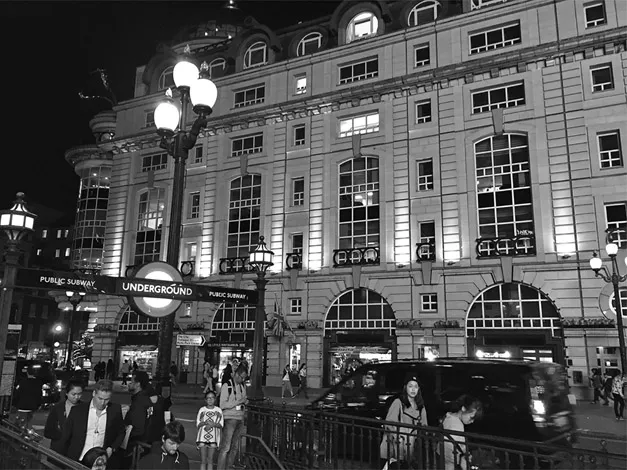
In the United Kingdom, particularly London, tourism is important. In 2015, over 30 million tourists, including domestic and international tourists, traveled to London (VisitBritain, 2016). One particular attraction is the Soho area, which is located in the West End of London. The whole area is only around 3 square kilometers; therefore, walking around the area is feasible. Furthermore, the area is surrounded by Oxford Street, Regent Street, Leicester Square, and Charing Cross Road, which are all famous and popular tourist attractions. Soho in London is famous for live performances, from great musicals to street performance; from great dinners to fascinating nightlife; from popular bars, such as The O Bar and Bar Soho, to casual pubs and secret bars. One can also find great theaters, such as the Prince Edward Theatre and the Prince of Wales Theatre. Until 2015, over 14 million people visited Soho in London and spent over 600 million pounds (see Figure 1.2 ) (Society of London Theatre, 2016).
In the United States and Italy, there have been many innovations in retail shopping and leisure centers. This is especially true in Italy. According to the Ministry of Industry, over 40% of the total space in shopping centers is allocated to extra-retail services (Ministero delle Attivita’ Produttive, 2002). Due to architectural features and synergetic effects, particularly the trinity of synergy among retail, food and beverage, and entertainment, these shopping and leisure centers eventually became tourist attractions and community centers (Beyard, Braun, McLaughlin, Philips, & Rubin, 2001). Furthermore, the integrated features of these shopping and leisure centers allow people to enjoy cinema, restaurants, live performances, exhibitions, and fitness centers all in one safe and weatherproof environment. In Las Vegas, many resorts advocate celebrity chef restaurants, multimillion-dollar shows, boutique shops, nightclubs, and spas. These amenities have become one of the revenue centers of modern resorts (Vora, 2007).
Figure 1.2 Entertainment zones in London
In Hong Kong, Lan Kwai ...