![]()
1 Introduction
The nexus of social innovation, sustainable consumption and societal transformation
Julia Backhaus, Audley Genus and Julia M. Wittmayer1
1 Background
Globalised consumption and production patterns contribute to environmental change and damage, most noticeably in the form of anthropogenic climate change, resource depletion and the pollution of water and air. In addition to environmental degradation, societies worldwide are facing deep challenges including political unrest, instability or even crises, a widening gap in income and security between wealthier and poorer population segments and the erosion of social cohesion in the face of mass migration. It has been argued (Lundvall forthcoming) that these are not isolated phenomena but consequences of a global, capitalist system which emphasises the pursuit of economic growth based on market competition as measured by indicators such as GDP. Despite global, national and local efforts to protect the environment and citizens from the hazardous effects of an – in terms of spread and volume – ever-expanding global market for capital, services and goods, ‘bad news’ appears to outweigh ‘good news’, whereas a relatively small number of people make enormous financial gains. In a number of countries, the political establishment struggles between hardening frontlines dividing those who support national(istic) approaches and those who promote international cooperation to face the crises and challenges of the twenty-first century.
Until recently, there seemed to be a global consensus on the necessity to undertake concerted action on climate change, as stipulated for example in the Paris Agreement that was signed at COP21 in 2015. With the impending withdrawal of the United Kingdom from the European Union (‘Brexit’) and the 2016 presidential election in the USA, the global political context has since become less predictable. US policies under President Trump have changed and are expected to change further, with climate change ‘denial’ a pervasive element of relevant discourses in the historically largest national emitter of greenhouse gases. Also, the UK government department responsible for climate change and energy affairs (DECC) was disbanded, soon after Theresa May became prime minister in July 2016 and absorbed into the business ministry. The focus of energy policy was redirected towards reducing costs for consumers and business rather than ‘green’ subsidies, technologies and targets. While these developments make for a bleak outlook from the perspective of sustainable consumption and development, other developments serve as beacons of hope for many.
An imperative is to devise effective measures to reduce consumption, for example, but not restricted to, high carbon-emitting sectors such as energy, transport and food (IPPC 2014; Genus and Thorpe 2016). There have been notable policy developments concerning sustainable consumption in the European Union, for example, and some remarkable policies undertaken by and in EU states. For instance, in relation to mobility, one can point to the French ‘bonus/malus’ private vehicle tax/credit scheme and the city-wide Paris Velib bicycle-sharing initiative, particulates badges and environmental zones banning the biggest polluters from German cities, and in the UK to the national level Carbon Plan of 2011 and the central London congestion charge. In the energy sector, the number of energy cooperatives and other community energy projects aimed at energy sovereignty and sustainability has risen steeply, often benefitting from national subsidy schemes. In the food sector, labelling schemes developed and implemented by public–private, multi-stakeholder platforms seek to address persistent problems with respect to human and animal welfare as well as environmental protection. Next to policy-led or policy-driven developments, interest in sustainable business models is high, with companies and scientists invested in optimising solutions for shared value creation. In addition, ‘transformative science’ has become a catch phrase for interventions at various levels that aim to test and promote more sustainable ways of living. Last but not least, countless civil society initiatives have sprouted, reviving old or pioneering new approaches to sustainable living, including solidarity, open source or peer-to-peer approaches to production and consumption.
In recent years, EU policy-makers have identified social innovation as a potentially effective approach for tackling grand societal challenges such as those connected to water, climate change and energy as well as to the production of goods (BEPA 2010, 2014; European Commission 2013a, 2013b; Science Communication Unit 2014): social innovation ‘can provide local answers to complex social and societal challenges mobilising local actors’ (European Commission 2013b: 10). The EU can be considered to have followed in the footsteps of Latin America, which has a much longer tradition of fostering social innovation to address policy problems and market failures (Rey de Marulanda and Tancredi 2010). In European policy circles, social innovation emerged as a potential solution to the needs of citizens at the local level and to challenges for which conventional markets are ill-adapted (Mulgan et al. 2007). In line with this reasoning, the European Commission has allocated an increasing budget to researching and understanding social innovation in Europe (see European Commission 2013a; n.d.).
One of these research projects is TRANSIT (Transformative Social Innovation Theory). In collaboration with SCORAI Europe (Sustainable Consumption Research and Action Initiative Europe – which is a body with roots in an earlier EU-funded project known as SCORE! and closely connected with the North American SCORAI network). TRANSIT jointly organised a workshop where most of the contributions to this book were presented and discussed. The workshop was inspired by the intriguing nexus between social innovation, sustainable consumption and societal transformation. It built on theoretical considerations, such as the current pervasiveness of the notion of ‘transition’ and what moving ‘beyond transition’ could bring to the study of past or ongoing changes and to influencing current practices, ideas and actors. The workshop also explored this nexus through case studies of social innovation and sustainable consumption as well as of policies which influence these at different sub-national, national and international scales. Through contributions, presentations and discussions, participants scrutinised the practice and relevance of social innovation and sustainable consumption initiatives and whether they have some transformative and widely beneficial real-world consequences.
2 Aims
Building on the workshop contributions, this book provides timely coverage of the nexus between social innovation, sustainable consumption and societal transformation. It explores this nexus through discussion of cornerstone concepts as well as providing empirical observation and critical reflections on developments in practice. It brings together theoretical and empirical contributions on questions such as: What is social innovation and how can it contribute to sustainable consumption or societal transformation? What is the transformative potential of social innovation initiatives vis-á-vis incumbent institutions and dominant practices? How might societies unlock the full potential of social innovation for sustainable consumption?
The book provides a space for developing a better understanding of the merits of different perspectives on societal change in relation to social innovation which can both positively and negatively contribute to sustainable or reduced consumption in defined sectors or across social practices, space and time. The discussions are enriched by contributions from academic researchers, practitioners and ‘pracademics’ bringing diverse knowledge and experience to bear on issues of concern. Empirical contributions focus on disentangling, and thereby contributing to a further understanding of, the relation between social innovation, sustainable consumption and societal change. The case studies show the various ways in which ‘social innovation’, ‘transition’, ‘transformation’ and ‘sustainable consumption’ are understood or practised across several European countries. Through these empirical cases, authors probe the possibility and the difficulty inherent in ‘doing things differently’ from business-as-usual. These also highlight the point that practitioners in social innovation initiatives challenge yet at the same time are subject to prevailing, dominant institutions, which they reproduce.
The core aims of the book are:
• to analyse the relations between social innovation(s) and sustainable consumption and to identify ways in which social innovation in practice can contribute effectively to sustainable consumption;
• to critically reflect on the relations between social innovation(s) and societal transformation and to assess the transformative potential of social innovation initiatives vis-á-vis incumbent institutions and dominant practices.
3 The nexus of social innovation, sustainable consumption and societal transformation
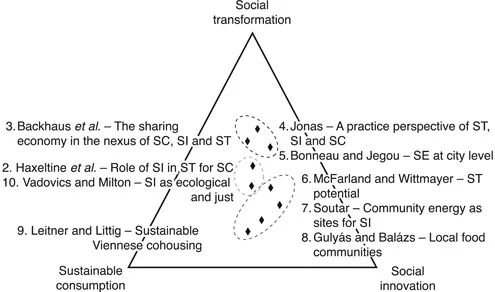
The book revolves around the three key themes of social innovation, sustainable consumption and societal transformation and their nexus (see Figure 1.1). The following paragraphs introduce each key theme to stimulate thinking about them individually and interrelatedly, and to articulate their salience to the work and concerns of the book. In the further course of the book, each contributory chapter positions itself in relation to these three elements. The contributions come from diverse disciplinary backgrounds, including amongst others innovation studies, sociology and geography, and employ a range of methodological approaches, sometimes in a cross- or trans-disciplinary way.
3.1 Social innovation
Research on social innovation is not coherent in terms of disciplinary focus or approach. Rather the phenomenon is approached from different perspectives and therefore also defined in different ways. Sociological contributions most often identify social innovations as new practices or new combinations of practices (e.g. Howaldt and Kopp 2012). Approaching the phenomenon from urban studies, Moulaert and colleagues (2005) distinguish between three dimensions of social innovation such as (1) satisfaction of human needs presently unmet, (2) changes in social relations and (3) empowerment. A recent review identified changing social relations or systems as well as the goal of addressing or solving a socially relevant problem as common themes across distinct bodies of literatures grappling with this topic (Van der Have and Rubalcaba 2016). Relevant to the themes of the book are certainly those authors who connect social innovation to social change (Cajaiba-Santana 2014) or more specifically to societal transformations (Haxeltine et al. 2016; Avelino et al. 2017; Pel and Bauler 2014). The latter authors (as part of the TRANSIT research project) approach social innovations as changes in social relations, involving new ways of doing, organising, knowing and framing and consider transformative social innovations as those that challenge, alter or replace dominant institutions.
Figure 1.1 Positioning of chapter contributions in relation to the nexus of social innovation, sustainable consumption and societal transformation.
3.2 Sustainable consumption
Current lifestyles in the Western world and among the affluent everywhere are based on patterns of overproduction and overconsumption, already exceeding several of the physical boundaries of our planetary system (Rockström et al. 2009) and leading to the exhaustion of natural resources and climate change. While the global, capitalist economy is facing several systemic, interrelated crises, research and action on more sustainable consumption patterns and lifestyles aims to explore and experience what it means to live a happy, healthy and sustainable life (Backhaus et al. 2011). Recurring themes are ‘one planet living’, ‘a footprint of 1.0’ or ‘a good life’, and points of attention include infrastructures, policy frameworks, governance approaches, business models and communities that foster or achieve more sustainable – or reduced – consumption (Genus and Thorpe 2016). In recent years, sustainable consumption research has increasingly concerned itself with social inequalities and the identification and creation of sustainable consumption ‘corridors’ (Di Giulio and Fuchs 2014) or of a ‘safe and just operating space for humanity’ (Raworth 2012). Another central theme has been to challenge the notion that (un)sustainable consumption – and related policies – should be focused on the attitudes, behaviour, and choices of the individual consumer, the so-called ‘ABC’ approach (Shove et al. 2012; Shove and Walker 2014). Rather, it is argued that a focus on unsustainable practices should be adopted, drawing attention to collective conventions and cultures of practice in everyday living, in which complexes of related practices are recognised (e.g. working in an office, using a computer and automobile transport), each comprising material, symbolic and knowledge elements. How and to what extent these may be undone and more sustainable practices embedded are questions which demand much of institutional entrepreneurs – whether these be policy-makers, social movements or businesses, currently mainstreaming or operating on its fringes or in its basement (Genus 2016).
3.3 Societal transformation
Societal transformations can be conceptualised as fundamental, persistent and irreversible change across society (Avelino et al. 2014). The use of the term ‘transformation’ draws on the work of Karl Polanyi (1944) who described the rise of the market economy and the ideology of economic liberalism as the ‘great transformation’. As such, societal transformation exceeds radical change in individual societal or socio-technical sub-systems, which are commonly referred to as system innovation or transition. While some scholars have discussed transitions at a more aggregated level (Rotmans and Loorbach 2010), others suggest that transition thinking encapsulates the (illusion of) intentional societal change (Stirling 2014). In relating societal transformation to sustainable consumption, several of the book’s chapters reflect on questions related to intentionality, empowerment and the intended and unintended (side-)effects of social innovations. To be transformative, these kinds of innovations should enable or bring about new relations between politics, society, science and the economy (WBGU 2011), globally and in people’s everyday lives. This may sound highly visionary and universal. However, the tension between local innovations and such grand ambitions calls into question the boundaries of effective putative societal change and the means by which it is to be achieved. Moreover, the question is posed as to the possible political purposes of utopian ‘imaginaries’ (Jasanoff and Kim, 2013), for example, employed as persuasive or coercive co-opting devices and of the nature and distribution...