Roman-Period and Byzantine Nazareth and its Hinterland presents a new social and economic interpretation of Roman-period and Byzantine Nazareth and its hinterland as a whole, showing the transformation of a Roman-period Jewish village into a major Byzantine Christian pilgrimage centre.
Although Nazareth is one of the most famous places in the world, this is the first book on Roman-period and Byzantine Nazareth by a professional archaeologist, the only book to consider the archaeology of Nazareth in the context of its adjacent landscape, and the first to use contemporary archaeological methods and theory to explore Nazareth's archaeology. Taking as his starting point a systematic survey of the valley between Nazareth and the Roman town of Sepphoris, Dark offers an interpretation of communities elsewhere in the Roman world as networks of interlocking cells, with interactions along routeways being more important in cultural and economic terms than the relationship between urban centres and their surrounding countryside. His conclusions have implications for the wider archaeology of the Roman and Byzantine worlds, as well as for archaeological theory, and demonstrate the importance of Nazareth to world archaeology.
This unique book will be invaluable to those interested in Nazareth and its surrounding landscape, as well as to archaeologists and scholars of the Roman and Byzantine worlds.
Nazareth is famous today as the childhood home of Jesus Christ, of religious significance to more than two billion Christians worldwide, constituting over a third of the global population. Because of this, and in light of the role of Christianity in global history in general since the Roman period, it must be considered one of the most historically significant places in the world. However, although written sources provide only limited information about Nazareth before the medieval period (Chapter 2), there has been surprisingly little archaeological work in the modern city of the same name (Chapters 5 and 6), usually assumed to be identical to Roman-period Nazareth.
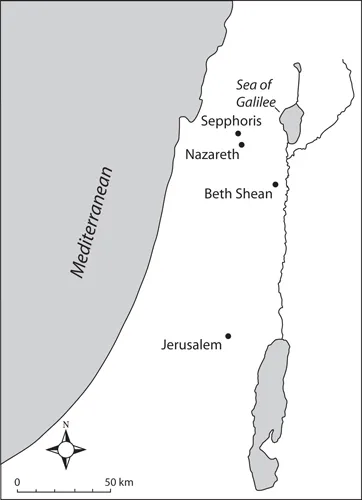
FIGURE 1.1 General map showing the location of Nazareth (based on maps by Talbert 2000, Survey of Israel).
This lack of archaeological attention has encompassed both the Roman-period settlement, of direct relevance to understanding the biblical descriptions, and to an even greater extent its Byzantine successor. The latter, assuming that one accepts that ancient and modern Nazareth are identical, is identified in textual sources as having become a Christian pilgrimage centre (Chapter 2). Yet while recent scholarship has drawn attention to the importance of pilgrimage in shaping the world of Late Antiquity, and many, even minor pilgrim centres have been the subject of large-scale archaeological research (e.g. Politis 2012; Fiema 2003), the archaeology of Byzantine Nazareth has been largely overlooked. This volume, therefore, seeks to answer some basic research questions about Roman-period and Byzantine Nazareth. When did the Roman-period settlement found by earlier scholars in central Nazareth begin? What sort of place was it in terms of scale, religious and cultural identity, social organisation and economy? To what extent did these alter over time and, if so, why? What was its relationship to the surrounding countryside and to the nearby town of Sepphoris (see Figure 1.1), occupied in both the Roman and Byzantine periods? How and why did any of these differ in the Byzantine period, and when and why did the Byzantine settlement come to an end? Was this settlement the Nazareth of the Gospels and/or that of Late Roman and Byzantine pilgrimage accounts? What is its significance to understanding the Roman and Byzantine empires and world archaeology?
It may seem surprising that such straightforward questions remain unanswered. However, no book-length synthesis by a professional archaeologist has ever been published on Roman-period or Byzantine Nazareth, and the last scholarly book wholly about the archaeology of Nazareth in these periods was written by a Franciscan monk (Bagatti 1969) half a century ago. Since then, the lengthiest academic accounts are a 47-page chapter in Joan Taylor’s 1993 book Christians and the Holy Places (Taylor 1993, 221–268) and a 29-page discussion by Yardenna Alexandre in her 2012 final report on the rescue excavation for the Israel Antiquities Authority (IAA) at Mary’s Well (Alexandre 2012, 1–12, 139–157). Despite occasional local heritage conferences in the city (Yazbak and Sharif 2012, 2013), there has been no scholarly attempt at considering its archaeology as a whole, except in the context of brief overviews primarily concerned with evidence for the early first century AD settlement as a context for biblical studies (Riesner 2017; Strange 2018, 38–40; 2014b).
This contrasts with the intensity of research by both Israeli and international teams on Sepphoris (for a recent summary, see Chancey 2013), or the Jezreel valley south of Nazareth, where the ongoing Jezreel Expedition, directed by Norma Franklin (University of Haifa) and Jennie Ebeling (University of Evansville), has recorded a multi-period landscape, including cisterns, tombs, rock-cut tombs, agricultural and industrial installations, terrace- and village-walls and quarries (Ebeling and Franklin 2016; Ebeling et al. 2012).
No previous study has tried to integrate an analysis of the archaeology of Nazareth’s rural hinterland with that of the modern city (although Avner Raban’s survey in the 1980s did encompass both areas in a descriptive fashion: Sion 2016), nor has there been any discussion of Nazareth’s archaeology using contemporary archaeological theory as this has developed since the 1960s (Renfrew and Bahn 2008; Bentley et al. 2008; Dark 1995). Consequently, although archaeologists working across the former Roman world have fruitfully transferred fieldwork methods between many geographical areas (Dyson 2003, esp. 9–10, 37–42, 53–54), no archaeological fieldwork on Nazareth has broken away from a site-centric and text-driven methodology, studying it as a place devoid of landscape context. Such archaeological analysis of Nazareth in the Roman or Byzantine period as has taken place has, therefore, been within research agendas and conceptual frameworks which might be considered narrow and often outdated in wider archaeological research.
The valley between Nazareth and Sepphoris
Although its significance has previously been overlooked, Nahal Zippori, the broad valley immediately north of Nazareth (between it and the Roman town of Sepphoris, c. 5 km away), provides the only good farmland easily accessible from the area of the modern city. On all other sides, topography constrains movement by foot or cart, cutting off easy access to the south by a steep ridge of mountains, in places a sheer cliff. To the north-west, near ‘Illut, a deep valley also limits travel, as do the steep hills to the east and west of what is today central Nazareth. For this reason, during the Roman and Byzantine periods, the farmland of any settlement located within the limits of modern Nazareth is likely to have been in that part of Nahal Zippori nearest to it, or on the adjacent hillslopes and under what is today Nazareth, rather than in the Jezreel Valley to the south or to the east or west.
To achieve its research objectives, this volume combines a new programme of archaeological fieldwork (the Nazareth Archaeological Project) in the part of Nahal Zippori between modern Nazareth and Sepphoris, and in modern Nazareth itself, with data from other archaeological work in Nazareth and elsewhere. It aims to synthesise all current archaeological knowledge about the Roman and Byzantine periods in the study area, including evidence previously overlooked or given little significance by previous scholars, with the exception of that from the Sisters of Nazareth site in central Nazareth (to be considered in a separate volume). All of these sources are then used, in the context of contemporary archaeological theory and comparison with sites and finds elsewhere, to build new interpretations of Nazareth and its surrounding landscape.
Using this new approach to the archaeology of Nazareth and its landscape enables a re-evaluation of existing interpretations, and a greater understanding of their relevance to wider research questions in the archaeology of the Roman and Byzantine worlds. It will be shown that although, of course, the role of Nazareth in early Christianity is well known, the archaeology of Nazareth and its hinterland has implications for other areas of research, from (for example) studies of cultural identity to the economy and spatial structure of the Roman provinces.
A reinvestigation of the archaeology of Nazareth and its hinterland is assisted by the facts that most of Nahal Zippori remains open farmland (see Chapter 3), and so available for archaeological survey, and that those working at Sepphoris (Lapp 2016; Meyers and Meyers 2013) and Tel Jezreel (Grey 2014; Moorhead 1997) have paid much attention to chronological and typological studies of pottery. This, combined with studies by other scholars on Galilee, provides the Nazareth area with a relatively well-understood ceramic sequence for the Roman and Byzantine periods compared with most parts of the Middle East (Magness and Schindler 2015; Ma’oz 2010; Loffreda 2008a, b; Berlin 1997, 2006; Adan-Bayewitz 1993, 2003; Magness 1993, 2012; Díez Fernández 1983). The pottery of Galilee from the Late Hellenistic to the Byzantine period is also usefully contextualised by wider studies (Jackson et al. 2012; Gunneweg 1987; Gunneweg et al. 1983; Hayes 1972, 1980, 1994, 2000a, b, 2005) and by archaeological studies of both earlier and later pottery in the region (e.g. Gittin 2015; Taxel 2014; Vroom 2014; Avissar 2009; Avissar and Stern 2005; Lapp 1961).
This gives a firm ceramic framework on which to base the archaeological dating of even small abraded vessel body sherds found in archaeological fieldwalking, a method well-suited to the modern landscape of the valley. This study further benefits from the fact that Galilee has, of course, attracted archaeologists for over a century, and there have been many excavations and surveys in the region (Negev and Gibson 2005, 47–52, 488–489; Frankel et al. 2001, 3, 13; Cohen 1997; Golomb and Kedar 1971; Amiran 1956). Such projects continue to yield much important information about the Roman and Byzantine periods (Fiensy and Strange 2014; Leibner 2009, 2010, 2018; Zangenberg 2010).
As elsewhere in the eastern Mediterranean, most excavation in Galilee has focused on impressive structures such as the baths at Hamat Gad...
Table of contents
Cover
Half-Title
Series
Title
Copyright
Contents
Figures
Plates
Acknowledgements
Abbreviations
1. Introduction: Purpose and perspectives
2. Texts and topography: Nazareth in context
3. A liminal landscape?: Living between Nazareth and Sepphoris in the Roman and Byzantine periods
4. A divided land: Interpreting the landscape
5. Jewish village to Christian pilgrimage centre: Nazareth in the Roman and Byzantine periods
6. Beneath the basilica: The Church of the Annunciation site
7. Reinterpreting Roman and Byzantine Nazareth
Appendix 1: Survey data
Appendix 2: Glass vessels from Nazareth in Western European and North American collections
Trusted by 375,005 students
Access to over 1.5 million titles for a fair monthly price.
Study more efficiently using our study tools.
Frequently asked questions
Yes, you can cancel anytime from the Subscription tab in your account settings on the Perlego website. Your subscription will stay active until the end of your current billing period. Learn how to cancel your subscription
No, books cannot be downloaded as external files, such as PDFs, for use outside of Perlego. However, you can download books within the Perlego app for offline reading on mobile or tablet. Learn how to download books offline
Perlego offers two plans: Essential and Complete
Essential is ideal for learners and professionals who enjoy exploring a wide range of subjects. Access the Essential Library with 800,000+ trusted titles and best-sellers across business, personal growth, and the humanities. Includes unlimited reading time and Standard Read Aloud voice.
Complete: Perfect for advanced learners and researchers needing full, unrestricted access. Unlock 1.5M+ books across hundreds of subjects, including academic and specialized titles. The Complete Plan also includes advanced features like Premium Read Aloud and Research Assistant.
Both plans are available with monthly, semester, or annual billing cycles.
We are an online textbook subscription service, where you can get access to an entire online library for less than the price of a single book per month. With over 1.5 million books across 990+ topics, we’ve got you covered! Learn about our mission
Look out for the read-aloud symbol on your next book to see if you can listen to it. The read-aloud tool reads text aloud for you, highlighting the text as it is being read. You can pause it, speed it up and slow it down. Learn more about Read Aloud
Yes! You can use the Perlego app on both iOS and Android devices to read anytime, anywhere — even offline. Perfect for commutes or when you’re on the go. Please note we cannot support devices running on iOS 13 and Android 7 or earlier. Learn more about using the app
Yes, you can access Roman-Period and Byzantine Nazareth and its Hinterland by Ken Dark in PDF and/or ePUB format, as well as other popular books in Sciences sociales & Archéologie. We have over 1.5 million books available in our catalogue for you to explore.