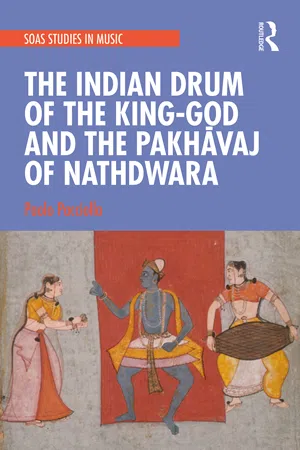
The book studies the evolution of the ancient drum m?da?ga into the pakh?vaj, crossing more than 2,000 years of history. While focusing on the Nathdwara school of pakh?vaj, the author joins ethnographic, historical, religious and iconographic perspectives to argue a multifaceted interpretation of the role and function of the pakh?vaj in royal courts, temples and contemporary stages. Furthermore, he offers the first analysis of the visual and narrative contents of its repertoire.
- 190 pages
- English
- ePUB (mobile friendly)
- Available on iOS & Android
eBook - ePub
The Indian Drum of the King-God and the Pakhāvaj of Nathdwara
About this book
Information
1 Introduction
Background
My first journey to India, in 1995, brought me to Bhubaneshvar, the capital of Orissa. I had been attracted to India by the repertoire for solo tablā and intended to learn it as well as khyāl singing. I was also deeply interested in advaita Vedānta philosophy which I had been studying for a few years and wished to understand better. Orissa seemed the right place to go since I could study tablā drumming and khyāl singing and visit one of the main monasteries founded by Shankaracharya, the great saint and philosopher of the 8th century c.e., at Puri. Furthermore, my wife intended to study Odissi dance with the famous dancer Sanjukta Panigrahi who lived in Bhubaneshvar.
Bhubaneshvar is an expanding city with a medieval old town and in 1995 was like a village, since Orissa was away from the main touristic routes. I soon started studying khyāl singing with Ragunath Panigrahi, husband of Sanjukta and himself a famous musician, but I was discouraged from studying tablā, since, I was told, the main local drum was the mardala and it had an ancient tradition while the tablā had been adopted only recently. The mardala, or the Odissi pakhāvaj, is the barrel drum accompanying the Odissi dance and, immediately captured by its sound, which was similar to that of the tablā but lower in register, I started studying with guru Banamali Maharana, an excellent musician, considered the main representative of the mardala tradition.
Banamali Maharana’s house was in the middle of the old town, and to attend his lessons I had to pass near beautiful temples such as the Lingaraj, the Ananta Vasudeva, and the Vaital Deul. I thus had the chance to admire their architectural structures and the many figures of gods, celestial musicians (gandharvas) and dancers (apsaras), and human performers carved on their walls. Seeing these every day was so inspiring that I developed a strong interest in Indian art and architecture.
Busy with many things to do and to learn, I never went to Shankaracharya’s monastery, but during one of my visits to the temples, I met a knowledgeable Mahārāja of the a, the monastic order founded by Svāmī Vivekananda, with whom I had numerous conversations on advaita Vedānta and Indian culture.
When I arrived in Bhubaneshvar, Odissi dance was in full bloom and there were many opportunities to attend performances and listen to the mardala, which was, in fact, essential to the dance but also dependent on it, in the sense that it did not have a repertoire for solo recital and all the compositions were connected to dance. It was in its essence an accompanying instrument. While Odissi dance had been recognized as a classical dance form, Odissi music, notwithstanding the work done by musicians and scholars in order to obtain recognition from the government, had not yet been included in the list of national classical forms. Banamali Maharana was among those musicians and he was then working towards the creation of a solo mardala repertoire, considered an indispensable feature of a classical drumming tradition.
My introduction to the mardala and my subsequent discovery of its important historical role in the temple music of Orissa attested by the numerous representations on the walls of the temples, opened the way to the world of Indian barrel drums and led me in turn to the dhrupad pakhāvaj, which I discovered had an older tradition and, moreover, a rich repertoire for solo recital.
In 1996, when I returned to India with a scholarship from the Indian Council for Cultural Relations to study khyāl singing at New Delhi, I expected to start studying the pakhāvaj of the dhrupad tradition too, but the real training did not start until 2000. It was not an easy task to find a pakhāvaj guru in the capital. I took a few lessons from the famous pakhāvaj player Gopal Das and then continued to study with a young tablā and pakhāvaj player, who had a more effective didactical approach.
Every day, I used to go to the Sangeet Natak Akademi’s library and audio/video archives for my research. There I met a tablā player of the Delhi gharānā who recommended that I go to the Kathak Kendra and to Svāmī Ram Kishore Das, a very high-ranking pakhāvajī – pakhāvaj player – and main disciple of the famous Pagal Das, and study with him.
I decided to follow the kind advice of the tablā player, and the next day I went to the Kathak Kendra, wishing to meet Svāmī Ram Kishore Das. He was in his classroom teaching his students and welcomed me and the porter who had guided me to his room. I explained that I had received some training in mardala but I was now interested in learning the dhrupad pakhāvaj. He replied that I should first listen to his music and he started playing for me in a very joyful and vibrant way. After quite a few minutes he ended his solo and invited me to play something for him. His style was powerful, rich and expressive, and I felt shy to play but I could not refuse and did so to the best of my ability. At the end of that musical meeting he told me that he was prepared to teach me, in his house, and under the traditional teaching system of guruśiṣyaparamparā, based on the direct relationship of the teacher (guru) with the disciple (śiṣya).
I accepted his invitation and went to his house at Shakarpur, a quarter of East Delhi where many musicians and dancers lived, since it is cheap and near to the centre. There, after offering me tea and sweets, he sat on his wooden seat, cross-legged in front of the pakhāvaj in meditative attitude, and played a sweet and clear stroke – the most resonant and important one, called dha – and taught me the first lesson: the sound of the pakhāvaj is equivalent to the monosyllable Om. This was to me an unexpected way to begin, but it was in line with the fact that he was a musician and ascetic (Svāmī). After a few lessons including music, as well as frequent references to mythology, literature and yoga, I decided to keep studying with Svāmī Ram Kishore Das because I wished to learn the language and repertoire of the pakhāvaj and study its association with meditative practices and religious rituals. From 2000 to 2003, I had extensive and intense discussions with him in the course of my daily meetings in his house or in theatres where he had to accompany musicians or kathak dancers. During those years I had the opportunity to meet and speak with several musicians and dancers but also to yogis and leaders of religious sects.
Svāmī Ram Kishore Das was a musician, but also an ascetic. He had long hair, used to wear an ochre robe and always drew a red tilaka on his forehead as a sign of devotion to Rāma and Hanumān. He had received training under ascetics and more than once told me that all the main representatives of his school (gharānā), the Avadhi gharānā, based at Ayodhya in Uttar Pradesh, were ascetics who had been playing the pakhāvaj as a path to enlightenment. He introduced me to the mythical, literary and ‘religious’ world of the pakhāvaj in a simple way, through his own way of life, through quotations from the epics, the courtly and devotional literature and from the oral tradition of the world of Svāmīs he came from, and with the aid of the many posters of gods, heroes and kings hanging on the walls of his house. In his vision, the pakhāvaj was identical with the ancient mṛdaṅga, the drum which resounded in Rāma’s capital Ayodhya and was played both by kings such as Arjuna, and devotees such as Hanumān. He considered the pakhāvaj as a spiritual instrument, a drum having a soul, and its playing as a form of yoga leading to a state of supreme beatitude. Furthermore, according to him, it was a drum capable of telling stories – which he translated to me and a very few other privileged friends through words and gestures – and reciting prayers.
The basic idea of this study is rooted in the time spent with Ram Kishore Das but it evolved and became clearer when I was working on the book La gioia e il potere. Musica e danza in India (2008). Indeed, while writing about music in ancient and medieval courts, I read theatre and music treatises, many literary – epics, Purāṇas, dramas – and philosophical sources – Upaniṣads, yoga, Tantra, Śaiva, Vaiṣṇava texts – and looked at numerous representations of musical scenes carved on the walls of temples or painted in manuscripts and miniatures. The information provided by these sources helped me to realize that the mṛdaṅga – of which the pakhāvaj was a recent version – was considered the most important and auspicious drum in ancient India, at least from about the 3rd or 2nd century b.c.e. onward, and, at the same time, that it constituted an important element of a complex network of symbolical relationships. The view of the pakhāvaj that Ram Kishore Das embodied and transmitted to me with great passion and care was clearly connected to the world of ancient courts, and to ideas, canons and symbolical associations, expressed in ancient and medieval literature and represented in theatre and visual arts. To discover the presence of ancient ideas and symbols in a contemporary musical tradition was extremely interesting but at the same time problematic. Indeed, it raised several questions.
Was the world of the pakhāvaj presented by Ram Kishore Das exclusive knowledge of the Avadhi gharānā, whose main representatives were ascetics (sādhus), or was it part of the pakhāvaj heritage shared by all the gharānās? Considering that the system of the gharānās had developed during the 19th century, was it a centuries old oral tradition or had it been recently fashioned?
From the visual sources I had already collected and the corresponding description given by the Nāṭyaśāstra, it was clear that the mṛdaṅga had not always had the same organological features. Indeed, while from the 2nd century b.c.e. until the end of the 1st millennium c.e. it had been composed of a set of three drums, at the beginning of the 2nd millennium it had become a single barrel drum taking slightly different shapes according to the region. Furthermore, during the medieval period, other names were added to the ancient name mṛdaṅga, such as mardala or pakhāvaj, more recent or vernacular alternatives. In the light of organological changes, what was the constant crucial feature of the mṛdaṅga?
The technique of the mṛdaṅga, as it had been described in the Nāṭyaśāstra, was very similar to that of the contemporary pakhāvaj, but was its repertoire ancient too? And how ancient? What was the influence of Islam on its language and repertoire? And how could that influence be ascertained given the lack of textual sources in Sanskrit, Persian and other languages?
Many people, including musicians, used to pay respect to Ram Kishore Das, but it was only partially due to his musical abilities. Indeed he was a Svāmī, and Svāmīs are respected and feared. The status of the pakhāvaj player in Indian musical society is higher than that of the tablā player, since the drum is recognized as an ancient instrument and it is linked to the dhrupad style and devotional music, but it is nevertheless low since it is considered an accompanying instrument and it includes leather, an impure material. How can we explain the present-day low status of the drum and its previous high rank?
All these questions could be subsumed under a wider one: what is the relationship of the present-day mṛdaṅga – the pakhāvaj – with its past? This main question gives rise to the following sub-questions: why was the mṛdaṅga considered auspicious? Why was it associated with kings and kingship? Why was it linked to gods and so closely connected to the sphere of sacred music and meditative practices such as yoga? Is its contemporary repertoire connected with the ancient world presented by pakhāvajīs? Does the relationship of the drum with kings and gods influence its repertoire?
Fieldwork among pakhāvajīs
While addressing these questions it became immediately clear to me that my research had to follow two divergent routes: on the one hand I had to further investigate the present-day practice of the pakhāvaj and, on the other, I had to deepen my research on the history of the drum, its myths and symbolism.
In order to investigate the experience of the contemporary pakhāvaj player, I decided to meet representatives of the main schools (gharānās) of pakhāvaj – the Kudau Singh, the Nana Panse and the Nathdwara schools – and collect information on their heritage and their personal views on the drum, its antiquity and ‘symbolical world’. Since, unfortunately, Svāmī Ram Kishore Das died in 2007, I could no longer rely on his knowledge and his help in introducing me to other pakhāvajīs of his own or other gharānās. However, during two fieldwork trips – from November 2011 to April 2012, and from November 2012 to April 2013 – I managed to interview and converse with Pandit Dalchand Sharma, Prakash Kumavat and Bhagwat Upreti of the Nathdwara gharānā, Ravishankar Upadhyay, Ramakant Pathak, Ramashish Pathak and sons, Shrikant Mishra, Akilesh Gundecha and Manik Munde, all of them belonging to different branches of the Kudau Singh gharānā, and with Baldeep Singh, leader of the Punjab gharānā which he himself had recently revived. I tried to meet important representatives of the Nana Panse gharānā but it was not possible. Nevertheless, I received some information about it from Ramakant Pathak, who told me that before entering the Kudau Singh gharānā he had received training in the Nana Panse gharānā, and from Kalyanray Mahārāja and his sons, Harirai Gosvāmī and Wagdish Gosvāmī, religious leaders of the Puṣṭimārg sect and good pakhāvaj players, who told me that they had received extensive training in Nana Panse gharānā at Indore. While, over several months, I had numerous conversations with Dalchand Sharma – excluding Bhagwat Upreti whom I met twice – I met all the other musicians only once. These one-off meetings, however, took the form of long conversations or semi-structured interviews.
All the pakhāvajīs identified the pakhāvaj with the ancient mṛdaṅga and hence considered it one of the most ancient musical instruments of Indian classical music, reported stories or legends connected to it, associated it and its repertoire with the gods Śiva, Viṣṇu and Gaṇeśa, and attributed to it the quality of auspiciousness. Almost all of them asserted that there were strong links between the instrument and the spheres of the ‘religious’ – associating it to gods and mentioning a particular kind of composition conceived as prayers, such as the stuti parans (compositions mixing the syllables referring to the strokes on the drum with the Sanskrit text of a prayer) – and with royal courts – associating the drum with the heavenly court of Indra, the king of gods. While some of them linked their school to court music exclusively (Ravishankar Upadhyay, Ramashish Pathak of the Kudau Singh gharānā), others told me that it had some relationship with temples, worship and yoga (Ram Kishore Das, Ramakant Pathak, Shrikant Mishra, Kalyanray Mahārāja and his sons). The position of the Nathdwara gharānā was unique since it had been, until the 20th century, a musical tradition connected to the worship of Kṛṣṇa in the temple of Nathdwara.
The new data collected were broadly consistent with the view of the pakhāvaj presented by Ram Kishore Das – a world of royal courts, where the drum was a symbol of power and sovereignty, and temples, where it was a spiritual drum representing God. Even though none of the musicians interviewed had proposed any explanation of its symbolism, since their views were based on the unquestionable truth that they had inherited from their musical tradition and from myths, it was clear that the pakhāvaj was not simply a musical instrument but a symbol of an ancient world which no longer existed on Indian soil but was still alive in the minds of the pakhāvajīs. A striking aspect shared by all of them was that the connections of the drum with gods and royal courts were not conceived as secondary but as very crucial aspects of t...
Table of contents
- Cover
- Half Title
- Series Page
- Title Page
- Copyright Page
- Dedication
- Table of Contents
- List of figures
- List of music examples
- List of audio files
- List of video files
- Acknowledgments
- Notes on the transcriptions and transliteration
- 1. Introduction
- 2. A drum between courts and temples
- 3. The pakhāvaj in contemporary India
- 4. Auspicious drumming
- 5. The drum of the King-God
- 6. From mṛdaṅga to pakhāvaj
- 7. The Nathdwara gharānā: playing the pakhāvaj for Nāthjī
- 8. The repertoire
- 9. The solo pakhāvaj recital
- 10. Conclusion
- Bibliography
- Index
Trusted by 375,005 students
Access to over 1.5 million titles for a fair monthly price.
Study more efficiently using our study tools.
Frequently asked questions
Yes, you can cancel anytime from the Subscription tab in your account settings on the Perlego website. Your subscription will stay active until the end of your current billing period. Learn how to cancel your subscription
No, books cannot be downloaded as external files, such as PDFs, for use outside of Perlego. However, you can download books within the Perlego app for offline reading on mobile or tablet. Learn how to download books offline
Perlego offers two plans: Essential and Complete
- Essential is ideal for learners and professionals who enjoy exploring a wide range of subjects. Access the Essential Library with 800,000+ trusted titles and best-sellers across business, personal growth, and the humanities. Includes unlimited reading time and Standard Read Aloud voice.
- Complete: Perfect for advanced learners and researchers needing full, unrestricted access. Unlock 1.5M+ books across hundreds of subjects, including academic and specialized titles. The Complete Plan also includes advanced features like Premium Read Aloud and Research Assistant.
We are an online textbook subscription service, where you can get access to an entire online library for less than the price of a single book per month. With over 1.5 million books across 990+ topics, we’ve got you covered! Learn about our mission
Look out for the read-aloud symbol on your next book to see if you can listen to it. The read-aloud tool reads text aloud for you, highlighting the text as it is being read. You can pause it, speed it up and slow it down. Learn more about Read Aloud
Yes! You can use the Perlego app on both iOS and Android devices to read anytime, anywhere — even offline. Perfect for commutes or when you’re on the go.
Please note we cannot support devices running on iOS 13 and Android 7 or earlier. Learn more about using the app
Please note we cannot support devices running on iOS 13 and Android 7 or earlier. Learn more about using the app
Yes, you can access The Indian Drum of the King-God and the Pakhāvaj of Nathdwara by Paolo Pacciolla in PDF and/or ePUB format, as well as other popular books in Medios de comunicación y artes escénicas & Etnomusicología. We have over 1.5 million books available in our catalogue for you to explore.