Language is of central importance in children's development and vital for their success at school and in the world beyond. Designed for the many professionals involved in encouraging language development, Early Language Development, originally published in 1990, will enable them to get to grips with the practical issues of helping children with language difficulties.
John Harris provides an invaluable summary of recent research on language development and how it relates to the practical concerns of language assessment and language teaching. Readers are given a clear account of the ways in which research has expanded our understanding of just what language is and how this has led to different approaches to language assessment. Various theories of language development are summarised and discussed in terms of their implications for language teaching. Dr Harris also describes different ways of encouraging language development and explains how teachers and therapists can overcome the special problems faced by children with particular difficulties, such as visual impairment, hearing impairment, general learning difficulties, and environmental deprivation.
With its emphasis on the relevance of research-based knowledge to practical concerns, the book provides a useful bridge between the world of research and practice. It will be of particular interest to teachers of young children, speech therapists, and child psychologists, as well as to students taking courses on child development, and to parents of young children.
Psycholinguists, studying the rapid and apparently effortless acquisition of language by ordinary children, have addressed two major issues: what are the patterns of growth and change which characterise a child's increasing mastery of language? And, second, how does such change come about? The first question may look relatively straightforward, for it simply involves providing a description of the changes in children's language and communicative skills during that period in which they are learning the language used by those around them. But the complexity of the problem becomes much more apparent when one watches and listens to young children. Here are two giris, aged 4 years and 6 months and 4 years and 10 months.
Siobhan: will you please will you give me the scissors and then I can have the stool and you have this? uh? yes and I'll be your best very friend
Heather: I'm cutting your pictures I am not that's my picture
Siobhan: this?
Heather: not this is my picture this
Siobhan: hope you won't cut this wee favourite picture out that I cut I'm gonna cut these ones out so you'd better give them to me very fast
Heather: You've cutted them then (Heather hides the scissors).
(McTear 1985:123)
While the language which these children are using is easily recognisable as English, it is also readily apparent that it is very different from the language of most adults. But exactly how is it different from adult language? And in what ways does it differ from the language of children much younger than Heather and Siobhan? To answer these questions it is necessary to consider the various component skills and the different kinds of social and conceptual knowledge which underlie language. For example, Heather and Siobhan clearly have learned the meaning of a large number of words and they are able to string words together into sentences, although by the yardstick of 'correct grammar' some of the sentences contain glaring errors. They are able to express relatively complex meanings, although these meanings are concerned with their current interests and needs, rather than abstract concepts or events that are distant in terms of time or space. Perhaps most noticeably, they are becoming adept at using language to influence each other through requests, rejections, polite forms ('please') and more direct commands.
One of the main foci of research efforts into children's language acquisition has been the elaboration of descriptive systems. Such systems have resulted in a clearer understanding of just what language is, and perhaps more importantly, they have resulted in a better understanding of the skills and abilities which are implicated in production and comprehension of language at various ages. This concern with descriptions of language is also of central importance for teachers, therapists and clinicians working in the area of language disability. There are two reasons for this. First, a detailed and comprehensive description of the course of normal language acquisition is essential for accurate identification and assessment of children who do not learn language in the normal way or at the same speed as other children. Second, planning and evaluating attempts to remediate language learning with these children will be better organised if teachers and therapists have a clear understanding of the patterns of 'normal' language development.
The question of how developmental change comes about has received rather less attention than the issue of what changes. Theories of language acquisition have very often gone hand in hand with the emergence of different solutions to the problem of how best to describe language. As views on what a child needs to learn in order to become a language user have changed, so it has become necessary to modify our explanation of the mechanisms involved in the acquisition process. What language is determines how language can best be described and the different descriptions have framed our understanding of the sequence of skills and abilities which reflect competence at different stages of language development. The skills and abilities which characterise successive stages of developmental change constitute the data which any theory of acquisition must address. A developmental theory is centrally concerned with the mechanisms which explain how a child achieves successive levels of competence.
The major impact of theories of language acquisition has been upon the intervention procedures which have been employed with language-disordered children. As approaches to language description, methods of identification, and the assessment of language-disordered children have changed, so, too, there have been considerable advances regarding the most appropriate ways of helping children with language difficulties. The major contemporary theories of language acquisition are described in Chapters 4 and 5, while Chapters 9 and 10 present different approaches to language intervention.
The first part of the book is concerned with contemporary approaches to describing children's language. It is divided into three chapters which deal with the different descriptive systems; the first considers language as a rule-governed system for expressing meanings in sounds; the second looks more closely at meaning and the semantic representation of meaning in children's early language; and the third chapter examines how the rule system and meanings expressed in language operate within the wider context of interpersonal communication and social understanding.
Structural approaches to language description
From a rather narrow perspective, language might be characterised as a continuous sequence of sounds produced by the expulsion of air through the throat and mouth; as the air passes through the larynx, the vocal cords vibrate at different frequencies and the shape of the mouth and position of the tongue also influence the sounds that emerge. Structures in the ear are sensitive to the airwave vibrations produced in this way and make the detection of speech sounds possible.
Remarkably, the production of soundwaves makes it possible for speakers to encode extremely complex messages and for listeners to decode messages with a high degree of accuracy. The ability to encode and decode the meanings in the sound sequence indicates that both speakers and listeners know the rules by which meanings are translated into sounds; this is referred to as 'grammatical knowledge'. Grammar is concerned with the way in which sounds are organised or structured to communicate meaning.
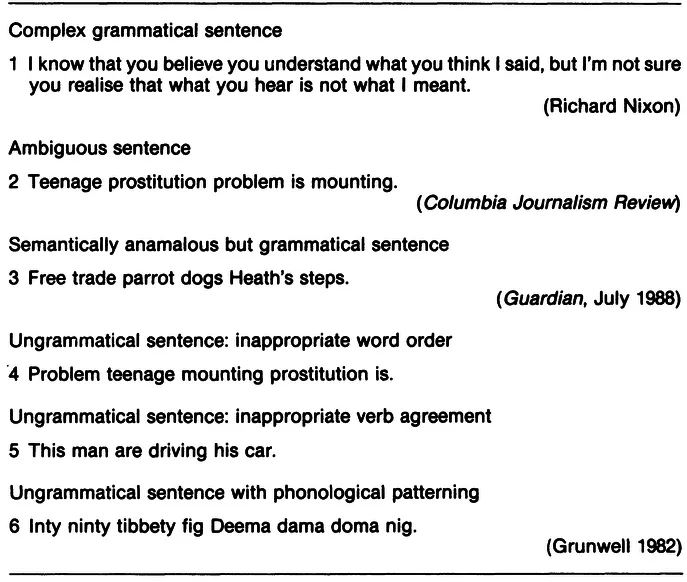
Perhaps the most important and challenging aspect of grammatical knowledge is that it facilitates productivity; that is to say, given the finite number of discrete sounds which occur in any language, a speaker who knows the grammar of the language can produce and understand an infinite range of novel but grammatically correct and meaningful sentences. Grammatical knowledge makes it possible to discriminate well-formed from ungrammatical sentences, even when such sentences are unnaturally convoluted, and to recognise ambiguous and semantically anomalous sentences (see Figure 1.1).
Figure 1.1 Examples of grammatical and ungrammatical sentences
Grammatical rules can be thought of as comprising three interrelated components or subsystems which operate at different levels. Beginning with a sequence of sounds which is produced when a speaker utters a sentence, it is possible to identify within any given language a restricted number of sounds which carry meaning, and rules which describe permissible sound sequences; these sounds are referred to as 'phonemes' and rules governing the combination of phonemes represent the first level of grammatical description. In Sentence 6 above, although this is not a grammatical sentence, the sounds are derived from English and they are organised according to the phonemic rules of English.
Individual sounds can be organised into strings which constitute recognisable words. There is also an intermediate level of analysis which is more general than the specification of phonemic strings and more detailed than the separation of words from non-words. For example, a word such as 'sportsman' can be broken down into separate elements, only some of which count as words in their own right; sport s man. Alternatively, more elements can be added to make a longer word, as in 'unsportsmanlike' (un sport s man like). Each of the elements in the word comprises a phoneme or sequence of phonemes which significantly alters the meaning of the word. These elements are referred to as 'morphemes'.
The third subsystem of a grammatical description is concerned with the way in which words can be ordered in sequences to express more complex meanings. Descriptions at this level are concerned with the rules of syntax.
In summary, a description of the grammatical rules which specify the way in which a sentence is structured from discrete sounds includes:
Phonemes - rules for generating strings of sounds to produce morphemes.
Morphemes - rules for combining and modifying individual words.
Syntax - rules for ordering and modifying separate words within sentences.
This chapter will deal with each of these three subsystems separately, beginning with descriptions of children's language in terms of phonological rules.
Phonological rules
A description of the way in which sound variations contribute to meaning is fundamental to an understanding of language as a rule-governed system. There are a number of different ways in which linguists have approached this problem (Grunwell 1982). First, there is the area of traditional segmental phonology, which is concerned with the specific sounds that occur in a given language and the ways in which these can be sequenced to produce words. However, words can also be pronounced with different degrees of stress or emphasis, and the way in which intonation varies over words in a sentence can influence meaning. For example, compare 'John hit Bill and then Mary hit him,' with 'John hit Bill and then Mary hit him.' The way in which stress is used to influence sentence meaning is referred to as prosodic phonology (Grunwell 1982) or supra-segmental phonology (Crystal 1981).
A third area is known as sociophonology and is concerned with the way in which speakers modify pronunciation in response to the perceived characteristics of different social situations. Fourth, the area of metaphonology is concerned with the extent to which children and adults are aware of the significance of the phonological system - for example, in relation to rhyming words, puns and the social significance of variations in accent. Limitations of space mean that this section will concentrate on segmental phonology as a key area of language description.
Segmental phonology
Segmental phonology is concerned with the rules which can be devised to describe the regularities that occur in a language with respect to the sound sequences that count as words. In any language it is possible to identify phonemic strings which are words - for example, in English, 'cat', 'big', 'bicycle', 'navigate' - and strings which are potential words since they conform to the same rules as real words. In English, such non-words are 'splug', 'clant', 'wilop'. There are also words from other languages which are not permissible in terms of English phonology - for example, 'tsetse' and 'pneumatic'. While such loan words have been incorporated into English in terms of spelling, native English speakers invariably modify the pronunciation of the initial consonant pairs to avoid inadmissible sequences o...
Table of contents
Cover
Half Title
Title Page
Copyright Page
Original Title Page
Original Copyright Page
Dedication
Contents
List of illustrations
Preface
Part one Describing Children's Language
Part two Explanations of Language Development
Part three Language Assessment
Part four Approaches to Language Teaching
References
Name index
Subject index
Trusted by 375,005 students
Access to over 1.5 million titles for a fair monthly price.
Study more efficiently using our study tools.
Frequently asked questions
Yes, you can cancel anytime from the Subscription tab in your account settings on the Perlego website. Your subscription will stay active until the end of your current billing period. Learn how to cancel your subscription
No, books cannot be downloaded as external files, such as PDFs, for use outside of Perlego. However, you can download books within the Perlego app for offline reading on mobile or tablet. Learn how to download books offline
Perlego offers two plans: Essential and Complete
Essential is ideal for learners and professionals who enjoy exploring a wide range of subjects. Access the Essential Library with 800,000+ trusted titles and best-sellers across business, personal growth, and the humanities. Includes unlimited reading time and Standard Read Aloud voice.
Complete: Perfect for advanced learners and researchers needing full, unrestricted access. Unlock 1.5M+ books across hundreds of subjects, including academic and specialized titles. The Complete Plan also includes advanced features like Premium Read Aloud and Research Assistant.
Both plans are available with monthly, semester, or annual billing cycles.
We are an online textbook subscription service, where you can get access to an entire online library for less than the price of a single book per month. With over 1.5 million books across 990+ topics, we’ve got you covered! Learn about our mission
Look out for the read-aloud symbol on your next book to see if you can listen to it. The read-aloud tool reads text aloud for you, highlighting the text as it is being read. You can pause it, speed it up and slow it down. Learn more about Read Aloud
Yes! You can use the Perlego app on both iOS and Android devices to read anytime, anywhere — even offline. Perfect for commutes or when you’re on the go. Please note we cannot support devices running on iOS 13 and Android 7 or earlier. Learn more about using the app
Yes, you can access Early Language Development by John Harris in PDF and/or ePUB format, as well as other popular books in Psychology & Emotions in Psychology. We have over 1.5 million books available in our catalogue for you to explore.