The mood of the international grain market changed remarkably in the decade before this book was originally published in 1986. In the early 1970s, which were years of buoyancy and high prices, the concern was with feeding the starving millions and subsequently, in the United states, with the use of the grain embargo weapon to put pressure on the Soviet Union. In the mid-1980s, after a long period in which the recession kept prices down, the climate was much gloomier. The book considers the state of the major supplier countries and their particular problems. It charts the changes in the market and discusses major issues of international concern. It concludes by surveying prospects for the market.
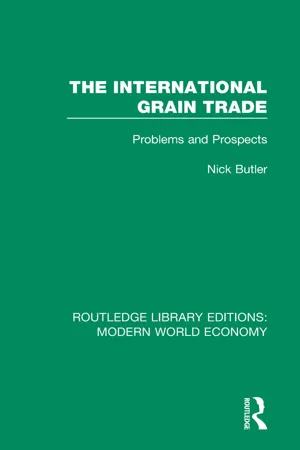
- 184 pages
- English
- ePUB (mobile friendly)
- Available on iOS & Android
eBook - ePub
1 INTRODUCTION
Like clothes or popular music, political issues, however serious, are vulnerable to the fluctuating tides of fashion and to the shortness of the span of public attention. Ten years ago the food crisis was an issue in fashion. Commissions, task forces, research institutes, charitable bodies, diplomats and politicians were all involved. A dozen new institutions to analyse the problem of food security and agricultural development were set up within a period of less than three years. A World Food Conference was convened in Rome, provoking a bureaucratic contest in Washington as to whether the State Department or the Department of Agriculture was to lead the American delegation. Henry Kissinger, who won the contest, committed the United States to work for policies which would ensure that by 1985 ‘no child in the world would go to bed hungry’. As a consequence of the rise in prices in 1972 and 1973, the Soviet decision to purchase grain on the world market instead of relying solely on domestic supplies, and the American decision to limit exports in order to protect domestic consumers in a period of rising inflation, insecurity of supply appeared to be a permanent feature of the world food trade, affecting all importers, especially those least able to pay the demanded price, or to store reserve stocks as insurance.
In the frantic search for countervailing leverage after the assertion of OPEC’s influence in the winter of 1973/4, food power became an object of active discussion and advocacy in the United States. Exporters of a scarce commodity, in this case grain, must according to the simple logic employed at the time have a corresponding power to grant or deny supplies. Despite the powerful intellectual demolition work done by Emma Rothschild and others,1 food power retained its attractions until its use and dramatic failure when an embargo on grain supplies was imposed after the Soviet invasion of Afghanistan.
By that time the issue of security of supply, born of fears of absolute shortage and a shortage artificially created by the exercise of food power, had lost its fashionable appeal as well. Years of good harvests, the introduction of stability to the Soviet-American relationship and the depressant effect of recession on demand took food from the headlines, and from the pages of all but a few academic journals.
There is another element to be considered in examining why food supply attracted so much attention in the 1970s. The years after 1973 were the age of the forecaster. The oil crisis caused every business and every government to consider the outlook for years ahead. The 1975 recession ended years of growth in which the need to plan for anything other than continuing expansion appeared unnecessary. Suddenly the supply of basic necessities appeared uncertain – not just for political reasons, such as the Arab embargo on oil exports, but also because of physical limits. The adjective ‘finite’ became inseparable from the noun ‘resources’. Long-term projections typically involved graphics with two diverging lines of demand and supply — the former usually well above the latter as the date on the bottom axis approached 2000. The simple equations based on population growth, per capita consumption requirements and physically limited supply showed unsurprisingly that by the end of the century, if not sooner, the world would have too little oil, wood, land and food. As one forecaster put it at the time, 2001 would be closer to the stone age than to the sort of world Stanley Kubrik had imagined.
In the mid-1980s it all looks remarkably different. For almost all the key traded commodities prices are at or near ten- or twenty-year lows reflecting an underlying imbalance of supply — pushed up in many instances by technical advance — and effective demand, demand, that is to say, backed by the purchasing power required to produce or import. A decade of recession, and low growth has restricted and stunted that effective demand.
But recession alone is an insufficient explanation of why the forecasts of the 1970s now look so unconvincing. In the case of food, and to some degree in relation to many other commodities, forecasters assumed that the world market was a single entity. In grain at least reality does not match that assumption. Instead there exists a two-tier market — between different countries and also within individual countries, particularly in the Third Word. The trading sector comprises the main exporters of grain and a variety of developed and developing country importers, including now most of the centrally planned nations of the Communist bloc, while the non-trading sector accounts for those communities — nations, regions, villages — which scrape an existence without recourse to the purchase of any agricultural goods which they themselves do not produce. For them, the choice of self-sufficiency is not a deliberate, political one, but rather a choice imposed by economic necessity. The absence of purchasing power keeps hundreds of millions of individuals away from the markets which could supply their needs. Even those Third World countries which do import grain on a regular basis and in growing amounts use it to supply only a fraction of their populations, usually the urbanised minority. Rural communities have little or no link with the world market and huge though their potential needs undoubtedly are, they go unfulfilled whether the United States and Europe have surpluses or not.
The trading market has undoubtedly expanded in the last decade but it still accounts for perhaps no more than 60 per cent of the world’s population. The extent to which that figure is maintained or increased must be one of the key questions for any forecast. The scale of actual participation in the markets will probably be the crucial factor conditioning future price levels and determining the fortunes of the farm sector in western developed countries.
For the moment the trading sector of the market finds itself in the depths of a recession which no one anticipated a decade ago. Stocks of wheat and coarse grain continue to rise even after an exceptional withdrawal of American land from production in 1983. World prices in real terms are at levels unseen since the 1950s. In the United States where farmers lack much of the financial protection available to their European cousins there is serious talk of farm poverty and of bankruptcy arising from debt, reminiscent of the worst of the scenes of the 1930s described by Steinbeck. The expansion of man’s ability to produce has not been matched by the development of man’s ability to manage the economy of the world in ways which would permit the efficient distribution of that production. Though there is a flow of concessionary and free food in aid, the trickle of charity has solved neither the problems of supply, and the suppliers, nor those of demand, and the hungry.
This book is not intended as a further contribution to the growing literature, some of it of very high quality, on the food needs and agricultural problems of the non-trading half of the world. Its aim instead is to examine and to try to explain how the grain market works and how it might develop. Though the emphasis is therefore on the developed countries, the analysis and the history of the last few years demonstrate clearly that just as a divided and partial world market contributes to the current set of problems, so an extension of that market can offer a contribution to their solution.
The Economies of the Grain Trade
As a business, grain is difficult to reconcile with the smooth logical mechanisms of trade as described by the economic textbooks. Costs are certainly lower in the United States than in Europe, but it has been Europe which has consistently expanded its production in the last two decades. Nor does the imbalance of supply and demand in the trading sector have the effect on output which the standard assumptions would lead one to expect. Production has continued to grow in volume even when prices have been low and falling. Though unit production costs have dropped as a consequence of technical advances, that fall in itself has been far from sufficient to compensate for the fall in prices.
If the grain market is determined by something more than simply the balance of supply and demand, it cannot be mistaken for a cartel. There are a limited number of exporters to the world market — the United States, the EEC, Canada, Australia and Argentina— but no agreement on either floor prices (below which grain would not be sold) or quotas (dividing the world market between the five). In the absence of either, competition for markets in times of surplus is fierce and contributes itself to the weakness of trading prices. Five trading firms dominate the flow of grain around the world, but they appear to exercise little influence over prices.
Instead of a hidden hand, as defined by Adam Smith, there is an open hand offering a fistful of dollars, francs, pounds or Deutschmarks as export subsidies. Competitive protectionism is the dominant characteristic of the grain market, its influence extending over the last two decades to affect not just the domestic markets of the countries concerned but also the world market. The international grain trade has become by default the buffer between the decisions of national governments, absorbing the strain of fluctuations in national supply or demand. European policy using variable levies as a means of controlling the influence of trade on domestic producers and consumers is the clearest example but almost all countries to one degree or another have sought protection from variations of supply levels or price in the international market.
Apart from the very special case of the defence industries (in economic terms a public good, not a trading industry), agriculture has received more support consistently across countries with a wide range of political systems (many of them inherently hostile to public sector interventionism) than any other single sector of the economy. For those not familiar with agriculture, this always comes as a surprise and requires some explanation. Concern with security of supply — the risks that war will restrict trade routes and that the flow of food necessary to feed armies and peoples will be halted — has long obsessed those countries whose economies and territories do not in normal circumstances (i.e., without subsidy) produce adequate indigenous supplies. A concern with security of supply in this sense is nothing new, but can be traced back to the concern with import dependence expressed by the rulers of the medieval city states, and to even earlier times.
Even in an age of trade and open supply, with shipping routes probably as secure as they have ever been, the concern has remained. Few countries are prepared to trust the provision of a basic commodity to others.
Mixed with that concern go two other factors — one economic and one political. In economic terms agriculture has won support as the disadvantaged section of rapidly growing industrial economies. Productivity developments, economies of scale and changing patterns of demand have shifted wealth to the urban, industrial economy at the expense of the rural sector, with its instabilities of climate and of crops, its high fixed costs, and its low returns on investment. Though recession and the effects of financial support for the CAP may have concealed that effect in Britain in recent years, no analysis can ignore the desire to balance town and country as a motivation of central government economic policy in any modern industrial economy. In Japan, rice prices are subsidised not to encourage the production of yet more rice but to support the income levels of the rice farmers in particular areas which would otherwise rest at a subsistence level unacceptable in a prosperous advanced economy. The pattern is repeated in France, Britain, West Germany and the United States. Even strong measures of farm income support, such as the CAP, have failed to eliminate the differential. In France, statistics just produced show the French farmer remaining a poor relative to his cousins in industry. Income may be higher under the CAP than it was forty years ago and land values may be increasing, but absolute earning levels are still below those in car production or computer software or the public sector. The increase in land values may have permitted borrowing, but the increasing capital value can only be realised if the land, the farmer’s basic capital asset, is sold.2
The political factor is relevant, and is probably more complex than the simple model, which sees only the massed ranks of farmers gathered in the National Farmers Union, or the American Farm Bureau or the French farm organisations, would suggest. As a whole the rural community has lost population but not political strength. Political structures have been slow to reflect migration trends, and rural areas, whether in France or the United States, still command a disproportionate share of political influence. Britain, with its regular boundary commission reports shifting the geography of parliamentary seats to match the flow of people, is probably less susceptible to this than many other developed countries. In the United States, jealously protected rights of the individual states have maintained much of the original construction of the Constitution. As reported in chapter 2, 30 senators come from farm states. In France rural constituencies are still crucial in any election, and no French government can go too far in offending rural interests, of which the farmers’ lobby is by far the best organised. For many years the influence of the minority parties in successive West German coalitions has institutionalised the support for relatively high farm prices within the European Community expressed through the policies and speeches of such farm ministers as Dr Josef Ertl, from the Free Democrats, and his successor Herr Ignaz Kiechle from the CSU. With over 80 per cent of all grain production consumed within the boundaries of the producing countries the political decision to support the farm sector might appear to be of marginal importance in international terms. Protectionism in general, however, and the specific form which it has taken in the last few years, has had the effect of making even more unstable the flow of trade, which in a sector vulnerable to climate and disease is inherently susceptible to fluctuations. Protection transfers most, if not all, of that instability on to the 17 per cent or so of world grain output which is traded internationally and thus to the countries dependent on that trade for a significant proportion of their supplies or income. Ten years ago that instability was described in terms of the dangers of rising prices forcing the poorer importers out of the market. Now it can be seen more clearly in the export of surpluses by the EEC regardless of the price depressant effect on other exporters.
With the secure boundary fence of variable levies, none of the price effect in either direction finds its way back to the European producer. Without price signals from the market, only the politically determined price judgements of the European farm ministers exist to indicate to farmers what should or should not be produced.
The evidence of the last few years is that the farm ministers’ conclusions are more likely to reflect a balancing of interests between the farm sectors of the various member states (and between various groups within the agricultural sector) than a balance of supply and demand.
The grain market is therefore an issue of importance which goes beyond intellectual curiosity or any general concern over the misallocation of resources which excessive subsidy and protection implies. Though less than a fifth of output is traded, that trade represents a vital interest for both exporters and importers. The United States has earned over $20 billion in each of the last three years from agricultural exports, the bulk of them grain, which alone has balanced 2 million barrels per day of oil imports. The Chinese imported 13 million tons of grain in 1983, to supply the cities of the coast, and the armies stationed on the northern border with the Soviet Union. Australia and Canada rely on grain production for export as a means of sustaining many rural communities in both countries. The Soviet Union, regularly importing 30 million tons a year and in the 1984/5 crop year over 50 million tons, may only buy 5–10 per cent of its annual needs from outside, but even that small percentage is crucial if the alternative is a small cut in supplies to either the makers of bread or the farmers of livestock.
Over the last decade the importance of trade has spread further. In ...
Table of contents
- Cover
- Half Title
- Title Page
- Copyright Page
- Original Title Page
- Original Copyright Page
- Table of Contents
- List of Tables
- Editorial Statement
- Preface
- 1 Introduction
- 2 The United States
- 3 Europe: the Common Agricultural Policy and World Markets
- 4 The Soviet Union
- 5 The Grain Trade and the Failure of International Control
- 6 The Grain Trading Companies Susanna Davies
- 7 US–European Agricultural Trade Relations
- 8 Prospects for the World Grain Trade: the Chinese Market
- 9 Prospects for the World Grain Trade: the South-East Asian Market
- 10 Conclusion
- Summary Tables
- Bibliography
- Index
Trusted by 375,005 students
Access to over 1.5 million titles for a fair monthly price.
Study more efficiently using our study tools.
Frequently asked questions
Yes, you can cancel anytime from the Subscription tab in your account settings on the Perlego website. Your subscription will stay active until the end of your current billing period. Learn how to cancel your subscription
No, books cannot be downloaded as external files, such as PDFs, for use outside of Perlego. However, you can download books within the Perlego app for offline reading on mobile or tablet. Learn how to download books offline
Perlego offers two plans: Essential and Complete
- Essential is ideal for learners and professionals who enjoy exploring a wide range of subjects. Access the Essential Library with 800,000+ trusted titles and best-sellers across business, personal growth, and the humanities. Includes unlimited reading time and Standard Read Aloud voice.
- Complete: Perfect for advanced learners and researchers needing full, unrestricted access. Unlock 1.5M+ books across hundreds of subjects, including academic and specialized titles. The Complete Plan also includes advanced features like Premium Read Aloud and Research Assistant.
We are an online textbook subscription service, where you can get access to an entire online library for less than the price of a single book per month. With over 1.5 million books across 990+ topics, we’ve got you covered! Learn about our mission
Look out for the read-aloud symbol on your next book to see if you can listen to it. The read-aloud tool reads text aloud for you, highlighting the text as it is being read. You can pause it, speed it up and slow it down. Learn more about Read Aloud
Yes! You can use the Perlego app on both iOS and Android devices to read anytime, anywhere — even offline. Perfect for commutes or when you’re on the go.
Please note we cannot support devices running on iOS 13 and Android 7 or earlier. Learn more about using the app
Please note we cannot support devices running on iOS 13 and Android 7 or earlier. Learn more about using the app
Yes, you can access The International Grain Trade by Nick Butler in PDF and/or ePUB format, as well as other popular books in Business & Business General. We have over 1.5 million books available in our catalogue for you to explore.