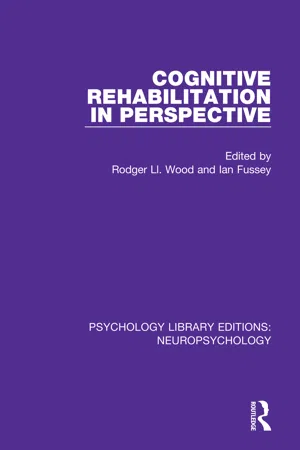
Originally published in 1990, this book constitutes an objective evaluation of different cognitive rehabilitation techniques in relation to different types of brain injury at different stages of recovery. Various forms of cognitive rehabilitation are reviewed and clinical techniques are evaluated on the basis of their ability to restore functional independence or produce behaviour change, and improve aspects of cognitive ability.
- 280 pages
- English
- ePUB (mobile friendly)
- Available on iOS & Android
eBook - ePub
Cognitive Rehabilitation in Perspective
About this book
Information
PART 1
INTRODUCTON
Chapter 1
Towards a Model of Cognitive Rehabilitation
R.Ll. Wood
Introduction
Cognitive or neuropsychological rehabilitation utilizes an assortment of procedures to improve or restore a diverse collection of abilities and skills. However, there is an absence of rules that inform the cognitive rehabilitation therapist which procedures to apply and under what circumstances. Consequently, many of the training tasks used by practitioners of cognitive rehabilitation to restore cognitive or functional abilities owe more to a dogmatic belief that the methods work than to any scientific formula which links the training task to a cognitive theory of information processing, on the one hand, and a neuropsychological system of analysis and retraining, on the other. The result of this apparently heuristic approach to conceptualizing a clinical model of cognitive rehabilitation is an unnecessary and undesirable variation in the quality of procedures employed to represent cognitive rehabilitation and a very limited fund of reliable information that will allow practitioners to evaluate the clinical utility of the methods used.
To some extent the pot pourri of methods, procedures and techniques that represent cognitive rehabilitation can be explained by the lack of a clear conceptual basis of what ‘cognition’ means and, parri passu, what cognitive rehabilitation should be attempting to do. There is no common frame of reference to describe cognitive rehabilitation procedures themselves or the rationale upon which they are based. Some practitioners adopt a psychometric perspective to training, while others use a behavioral (conditioning) paradigm, or a psychotherapeutic approach to improve awareness, understanding and, by implication, social or functional adaptivity.
Traditionally, psychologists have avoided intangible and nebulous processes such as ‘thinking’ because they were seen as mentalistic and, therefore, unscientific by the behaviorally dominated psychology of the 1940s and 50s. Cognitive events, such as memory and perception, were addressed as relatively circumscribed phenomena, distinct from each other and separate from behavior. Consequently, recent efforts at restoring higher cortical functions in man following brain injury have suffered from the absence of a conceptual framework. The notion of cognition has, in many cases, been over-simplified and practitioners of cognitive rehabilitation have dissected and compartmentalized fragments of the cognitive process, working on those fragments as though they were ends in themselves rather than simply a means to an end (‘cogs’ in the vastly more complex cognitive system).
Perhaps part of the solution to this dilemma can be found by considering what the terms ‘cognition’ and ‘rehabilitation’ mean. The dictionary definition of cognition is ‘a mental act or process by which knowledge is acquired’, while rehabilitation is defined as ‘helping people who are physically or mentally disabled, readapt to society’. Using the terms ‘cognition’ and ‘rehabilitation’ in tandem implies, therefore, that a clinical procedure is being used to train individuals to acquire knowledge which can be utilized to help them readapt to society!
Establishing definitions is a simple but useful exercise because it provides a perspective on what cognitive training procedures are intended to do. They are not intended to invest individuals with artificial capabilities, the value of which is to change a score on some psychometric scale of ability. On the contrary, they are intended as a method for changing behavior by reducing the social handicap imposed by cognitive disability. During their short occupational history, most cognitive rehabilitation therapists have come to realize that there is little merit in training patients on artificial cognitive tasks, such as how to complete block design assemblies or learn word lists, unless these activities lead to some meaningful improvement in functional skills, self-initiation of cognitive strategies, or greater spontaneity and organization of behavior. This greater awareness of the social impact of cognitive impairment has influenced current approaches to the remediation of memory problems. The chapters by Finset and Andresen (Chapter 5) and Deelman, Berg and Koning-Haanstra (Chapter 6) reflect this move away from attempts to train some assumed memory process in favor of the development of behavioral strategies that obviate the problems of memory.
Diller (1987) suggests that the early focus on artificial aspects of cognitive recovery may have been a consequence of the different backgrounds and methods that have traditionally surrounded neuropsychologists and rehabilitation therapists. The former have been pre-occupied with an analysis of impairment, identified by responses to standardized tests, while the latter have primarily been concerned with disability and the limitations imposed by that disability on acts of daily living. Diller points out that there are no data which relate cognitive impairment to cognitive disability and, because of their traditional laboratory and experimental approach, neuropsychologists have problems ‘translating the language of impairment into a language of disability without a complex chain of assumptions’ (Diller, 1987, p. 4).
Ironically, the growing awareness of what cognitive rehabilitation is not (the development of artificial intellectual skills) has perplexed many cognitive rehabilitation therapists; an enormous conceptual gulf exists between devising training tasks for artificial abilities, compared to improving those intangible cognitive processes such as reasoning, judgement and insight that are the cognitive fabric of human behavior. The efforts of Evyatar et al. (Chapter 8) and von Cramon and Matthes-von Cramon (Chapter 7) represent a step forward in the development of a systematic approach to help promote concept formation, hypothesis testing and reasoning ability which many would regard as the pre-requisites of judgement and social adaptability. It is possible to argue, however, that the strategies forming part of these training procedures are simply an extension of sophisticated computer games software on one hand and the skills that form the basis of certain behavioral procedures (shaping and chaining) on another. The key to successful rehabilitation of such intangible cognitive functions is whether or not the concepts can be translated into actions which improve social adaptability. In many respects this represents the antithesis between declarative and procedural approaches to learning and rehabilitation discussed by Wood (1990b).
Consequently, while cognitive rehabilitation is regarded by many as an important component of brain injury rehabilitation, it still lacks a coherent scientific framework to integrate treatment methods and direct therapy activities towards the achievement of realistic treatment goals. This lack of a clear perspective for cognitive rehabilitation seems to underlie Diller’s thoughtful and provocative comment in the introduction to Neuropsychological Rehabilitation (Diller, 1987). He stated that some neuropsychologists are sceptical about the theoretical or scientific basis of cognitive remediation and supports attempts to ‘create a clinical discipline where none now exists’ (p. 9). The scepticism of cognitive rehabilitation comes not only from the ranks of neuropsychologists but from other health-care professionals (c.f. Butler and Namerow, 1988). These concerns cannot be ignored, and in order for cognitive rehabilitation to find its proper place in brain-injury rehabilitation, some attempt must be made to provide it with a clinical perspective which has a sound conceptual foundation upon which to base treatment procedures.
The Search for a Model
The term ‘model’ has been used loosely in the clinical literature on cognitive rehabilitation. It has been applied to a collection of procedures used to restore cognitive function (e.g. Gianutsos and Gianutsos, 1979; Bracy, 1983; Wilson, 1987) and again to describe specific milieus is which combinations of procedures are applied, usually in the context of a psychotherapeutic frame of reference (Ben-Yishay and Diller, 1983; Prigatano, 1986). In other cases, efforts have been made to devize treatment methods in relation to underlying mechanisms of cognitive dysfunction (Sohlberg and Mateer, 1987), and finally, attempts have been made to integrate the milieu approach with a systems approach under the banner of neurobehavioral techniques which try to relate injury characteristics to learning disabilities that interfere with progress in rehabilitation and prejudice social outcome (Wood, 1989).
Another way of approaching cognitive rehabilitation has been provided by Diller and Gordon (1981). They offered three alternative ways of analysing rehabilitation problems in order to address their consequences: (1) the psychometric model, (2) the biologist’s model and (3) the engineer’s model. The psychometrist analyses the components of cognitive disability in relation to specific tasks by means of neuropsychological tests. The biologist employs a hypothesis-testing approach which seeks to elicit what aspects of the task cause a patient difficulty and then develops hypotheses about the cause of the defect by observing other tasks or situations where the same pattern of difficulty is displayed. The engineer employs an ergonometric approach to understand how the interaction between the person and task produces difficulties, in order to establish which features of the environment are rewarding or punishing to the person. The difference between the biologist and engineer is that the former tries to educate the person as to the nature of their deficit and ways to overcome it (c.f. Ben-Yishay and Diller, 1983; Prigatano, 1986), while the latter changes the environment, manipulates stimuli and focuses on reinforcement to accelerate learning or reduce the frequency of inappropriate social habits (c.f. Malee, 1983; Wood, 1987).
This way of formulating how cognitive deficits impact behavior helps provide a rationale for different treatment approaches. The ‘neurobehavioral approach’, for example, is a combination of the biological and engineering models while the Bracy, Gianutsos and Wilson methods appear to subscribe to the psychometry model. The educational focus of the Ben-Yishay and Diller and Prigatano approaches, helping patients to become more aware of their problems and hence control or adapt to them more effectively, is closely related to Diller’s biological model, except that a biologist would adopt a more rigorous functional analysis of the cognitive problem than appears to be reflected in the various forms of milieu therapy. In this respect, the attention-performance training methods described by Sohlberg and Mateer (1987) are more in line with a biological approach.
Another perspective for cognitive rehabilitation has been provided by Gross and Schutz (1986) who presented a hierarchical model which takes account of the learning difficulties presented by patients with different forms of brain injury. At the lowest level of the hierarchy, Gross and Schutz recommend an environmental control model, similar to Diller’s engineer. The next stage, described as a stimulus-reinforcement conditioning model, is even more behavioral in character and is similar to the neuro-behavioral approach applied by Wood (1987) in which complex behaviors are reduced to their component parts. A higher level of training involves the application of basic cognitive and social skills in a realistic setting. This stage, called the skills-training model, assumes that adaptive functional and social skills can be obtained through practice, very much of the spirit of the procedural learning tradition proposed by Dickinson (1980) and Wood (1990a). The final step in their hierarchy is described as a strategy-substitution model, which is designed to ameliorate the problems imposed by cognitive disability and corresponds closely to the recommendation of Miller (1984) who regarded amelioration as a ‘much more sensible and potentially attainable goal than restitution’ (p. 79).
Wilson (1988) also considered cognitive models used in rehabilitation. She remarked on the potential of a procedural learning model in cognitive rehabilitation, citing the work of Baddeley (1982) and Schacter and Glisky (1986) as examples where this operates in a memory-retraining context. However, while acknowledging the contribution of behavioral psychology in generating a technology of learning, Wilson expressed doubts about the relevance of its underlying theory. She recommended that a model for cognitive rehabilitation should combine the principles and technologies of cognitive psychology, neuropsychology and behavioral psychology, rather than be limited to any one tradition or theoretical perspective.
Wilson used the analogy of the sinfonía hemispherical model, derived from the work of Buffery and Burton (1982). This compares the brain to an orchestra and brain damage to a situation which might arise should several of the strings section die just before the concert. Four strategies are offered to explain how the orchestra could deal with this problem. They include (1) recruiting new members (the substitution or regeneration argument), (2) changing the repertoire so that the missing musicians are not required (the engineer or environmental control argument), (3) asking other musicians to learn the violin (the plasticity or reorganizational argument) and (4) asking other instrument sections to play the violin parts (another variant of functional adaptation which stresses the achievement of goals without giving too much thought to the mechanisms by which the goals are achieved). The value of this approach is difficult to assess because the different models lack a central scheme linking training to underlying mechanisms presumed to produce cognitive dysfunction. As such the model would more realistically be described as a set of procedures based on different theories of neuronal recovery rather than a coherent approach to the retraining of cognitive processes presumed to underlie behavior.
In order to combine these often disparate approaches into a model which has both scientific respectability and clinical utility, we need to adopt an operational perspective on the role of cognition in behavior and recognize how information-processing systems mediate learning. The role of attention also needs to be considered because this is clearly important to any formulation of brain-behavior relationships. Attention seems to integrate the physiological mechanisms responsible for arousal and drive, with the psychological mechanisms related to motivation, awareness and recognition. Language also integrates thought and behavior because it helps focus attention and sequentially orga...
Table of contents
- Cover
- Half Title
- Title Page
- Copyright Page
- Original Title Page
- Original Copyright Page
- Contents
- Acknowledgements
- List of contributors
- Preface
- Part 1: Introduction
- Part 2: Rehabilitation of Attention Disorders
- Part 3: Rehabilitation of Memory Disorders
- Part 4: Rehabilitation of Reasoning and Problem Solving Abilities
- Part 5: Cognitive Approaches to the Rehabilitation of Behaviour Disorders
- Part 6: Concluding Remarks
- Author index
- Subject index
Trusted by 375,005 students
Access to over 1.5 million titles for a fair monthly price.
Study more efficiently using our study tools.
Frequently asked questions
Yes, you can cancel anytime from the Subscription tab in your account settings on the Perlego website. Your subscription will stay active until the end of your current billing period. Learn how to cancel your subscription
No, books cannot be downloaded as external files, such as PDFs, for use outside of Perlego. However, you can download books within the Perlego app for offline reading on mobile or tablet. Learn how to download books offline
Perlego offers two plans: Essential and Complete
- Essential is ideal for learners and professionals who enjoy exploring a wide range of subjects. Access the Essential Library with 800,000+ trusted titles and best-sellers across business, personal growth, and the humanities. Includes unlimited reading time and Standard Read Aloud voice.
- Complete: Perfect for advanced learners and researchers needing full, unrestricted access. Unlock 1.5M+ books across hundreds of subjects, including academic and specialized titles. The Complete Plan also includes advanced features like Premium Read Aloud and Research Assistant.
We are an online textbook subscription service, where you can get access to an entire online library for less than the price of a single book per month. With over 1.5 million books across 990+ topics, we’ve got you covered! Learn about our mission
Look out for the read-aloud symbol on your next book to see if you can listen to it. The read-aloud tool reads text aloud for you, highlighting the text as it is being read. You can pause it, speed it up and slow it down. Learn more about Read Aloud
Yes! You can use the Perlego app on both iOS and Android devices to read anytime, anywhere — even offline. Perfect for commutes or when you’re on the go.
Please note we cannot support devices running on iOS 13 and Android 7 or earlier. Learn more about using the app
Please note we cannot support devices running on iOS 13 and Android 7 or earlier. Learn more about using the app
Yes, you can access Cognitive Rehabilitation in Perspective by Rodger Ll. Wood,Ian Fussey in PDF and/or ePUB format, as well as other popular books in Psychology & Cognitive Neuroscience & Neuropsychology. We have over 1.5 million books available in our catalogue for you to explore.