- 200 pages
- English
- ePUB (mobile friendly)
- Available on iOS & Android
eBook - ePub
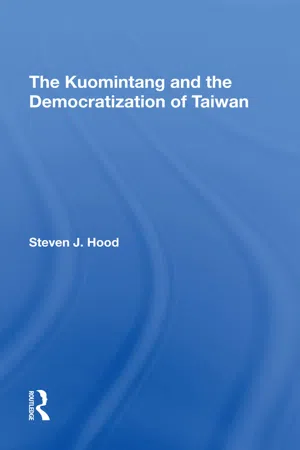
The Kuomintang And The Democratization Of Taiwan
About this book
Is the Kuomintang - the nationalist party of China - the villain it is sometimes portrayed to be? Or is it the embodiment of the political and moral good that partisans have claimed it to be? The party has managed a feat of economic modernization in Taiwan and has become a proponent of democracy, yet its reputation has been marred by brutal acts of repression and ineptitude. Focusing on the role of Kuomintang party elites in the democratization process in Taiwan, this book considers the Kuomintang's evolution from a Leninist state party to a fractious one in a competitive political system.
Information
1
Theoretical Considerations
A Party Shrouded In Controversy
In October 1986, President Chiang Ching-kuo announced that political parties would be allowed to organize and challenge the ruling Kuomintang (Nationalist Party or KMT) in national elections on Taiwan.1 Unprecedented political openness in the months prior to October buoyed up the opposition’s hope that the KMT would be relinquishing its monopoly of official power within the government. Chiang’s announcement, therefore, seemed a logical step in Taiwan’s painful journey towards democratic rule.2 Since the 1986 declaration of party pluralism, factional gaps have widened within the KMT and party leaders have openly criticized one another. Old-guard party members born on China’s mainland have fought against the rapid pace of liberalization within the party and have lamented losing their exclusive hold on political power. Younger mainlander party members have formed a new political party to challenge the Kuomintang, now dominated by Taiwan-born members. President Lee Teng-hui has publicly called for greater democracy for Taiwan’s citizens though he has resisted calls to democratize the party. These disagreements have weakened the effectiveness of the KMT vis-a-vis newly established political parties. The conflict caused some within the party to wonder whether the Kuomintang would stay intact long enough to celebrate its one-hundredth birthday in 1995.3 Yet for all its problems, the party has managed to maintain a high level of public support. Many observers believe, and recent elections attest, that the KMT can survive its current struggles and emerge as a democratic party stripped of its authoritarian past.4 More importantly, there is every indication that democracy is taking hold in Taiwan. Representative institutions have survived the transformation process and continue to gain strength. An open presidential election has been held. The people are free to express their opinions on policies, politicians, and the Taiwan’s future. Political debates have been moderated by mostly centrist positions taken by government leaders, opposition leaders, the media, and members of the business community. Thus Taiwan has so far been spared the dangerous influences of extremism that has plagued so many democratizing countries.
The clash of authoritarian and democratic tenets within Taiwan’s political system and the Kuomintang, and the party elite’s handling of this contradiction is the focus of this book. The Kuomintang’s role in the democratization process on Taiwan has been largely overlooked, though there are a number of good studies that have appeared in recent years that consider the emergence of democracy in Taiwan. Cheng and Haggard’s Political Change in Taiwan and Tien’s The Great Transition: Political and Social Change in the Republic of China are two excellent volumes that consider many important aspects of democratization, including economic and social development, the rise of opposition parties, Taiwan’s relations with mainland China, and electoral politics.5 The latter is also a focus of Tien’s recent book Taiwan’s Electoral Politics and Democratic Transition and Yun-han Chu’s Crafting Democracy in Taiwan.6 Alan Wachman has considered the important role of subethnic differences in Taiwan and how the national identity question has influenced the democracy movement, and Murray Rubenstein has written a fine study of politics and society in Taiwan generally.7 But all of these books fail to focus exclusively on the role of the Kuomintang in the democratization process.
Peter R. Moody’s Political Change in Taiwan: A Study of Ruling Party Adaptability, does focus on the role of the KMT.8 Like Moody, I will analyze the Kuomintang both as an independent actor and as an institution that was acted upon by a variety of economic, social, and political agents. Moody downplays the role of Leninism, however, and he does not document political change in Taiwan or within the KMT chronologically. I suggest these are important elements that have been overlooked by Moody and others in the recent studies that consider Taiwan’s democratization. They are the real keys to understanding Taiwan’s evolution from an authoritarian regime to a democratic one.
There has always been widely divergent views of the KMT. Praised by some, despised by others, the KMT has always been a focus of controversy. During the Nationalist era in China (1927–37), the KMT was opposed by industrialists who colluded with foreigners the KMT deemed imperialists. Warlords took advantage of KMT appeasement while offering little in return. Japan’s invasion of China in 1937 dealt yet another blow to the Kuomintang barely twenty years after individual Japanese had assisted in Sun Yat-sen’s early efforts to build the KMT into an effective revolutionary party. The communists weakened the Kuomintang by offering attractive alternatives to the often contradictory and ineffective policies of Chiang Kai-shek. After fleeing to Taiwan in 1949, the KMT government initially won only mixed support. A successful land reform program and rapid economic modernization stood in stark contrast to political repression characterized by fraudulent elections and organized brutality.
But by the late 1980’s, Taiwan was in the midst of a political transformation that mirrored the island’s much heralded economic achievements. Though the transformation seemed to have sparked suddenly, it had in reality been a gradual and complicated process spanning over four decades. That process is continuing and democracy is taking hold on Taiwan. A consideration of the forces of liberalization that has fueled democratic expectations on Taiwan gives rise to several important questions. How did the process of political liberalization begin? Did the KMT leadership employ a plan to create a “democratic miracle” to coincide with the “economic miracle?” What role has the party rank-and-file played in this process? What non-KMT forces played an important part in planting the seeds of democracy in Taiwan? Are there lessons in the Taiwan case for other authoritarian states facing liberalizing pressures? More particularly, since the regime in Taiwan was a Leninist party-state, does it provide a blueprint for other Leninist states to follow? Lastly, what is the quality of Taiwan’s political system now and what can we expect in the future?
This book seeks to answer these questions. In order to do so, a focused study of the Kuomintang on Taiwan is essential because the Kuomintang regime has been both an opponent and proponent of democratic change on Taiwan. We consider the contradictory mission of the KMT on Taiwan as a party organized along Leninist lines that promised democracy to its people. For decades that promise seemed empty-mere words spoken to buy time for a paranoid and repressive regime obsessed with a dream to reunite all of China under Nationalist rule. Under pressure of a patient but persistent opposition that was driven by subethnic rivalry and the hope of democracy, the Kuomintang gradually came to accept the legitimacy of democratic rule. This transformation warrants close examination.
This chapter begins with a consideration of what is meant by the terms liberalization and democracy. We then turn to a discussion of Sun Yat-sen’s notion of KMT democratic tutelage and how the KMT came to adopt a Leninist organization. Next we review what contemporary scholars have learned about the democratization process and how this relates to the KMT’s claims of having democratized Taiwan. Then we introduce the framework that will be used to analyze the party and the emergence of the democratic movement on Taiwan. This will be followed by some general conclusions of this study.
Liberalization and Democracy
Some argue there exists a distinct style of democracy in East Asian states.9 While particular arguments relating to the cultural aspects of democracy in Taiwan will be discussed later in this book, this study rejects the democratic uniqueness argument and accepts a more traditional concept of democracy as forwarded by Joseph Schumpeter, Philippe Schmitter, and Terry Lynn Karl. Democracy is “…a system of governance in which rulers are held accountable for their actions in the public realm by citizens, acting indirectly through the competition and cooperation of their elected representatives.”10 The expectation in this definition is that citizenship matters in a democracy. Citizens are able to vote in competitive, fair elections, run for public office, demand accountability from elected officials, have political rights and values respected in the political system, and be ensured of majority rule. While the above definition speaks in a general sense of what democracy entails it is by no means exhaustive. This study also seeks to analyze the staying power and quality of democratic principles in Taiwan. This necessitates considering some aspects of democratization in the consolidation phase of democracy.11 Democratic consolidation occurs when the democratic regime is reasonably secure from reverting back to authoritarian or pre-democratic rule. Rules are established, democratic procedures are made secure by the cooperation of competing political parties, groups, and the masses. Democratic uncertainty is replaced by a general sense of fair play, trust, tolerance, and moderation.12
Many regimes caught up in the most recent wave of democratization are not yet democratic, though they are in the process of liberalizing.13 Liberalization is done by degrees: loosening press restrictions, legalizing political parties, freeing political prisoners, tolerating free speech, etc.14 It is the process of opening up the political system, but ruling elites may not necessarily have in mind democratization when liberalizing a system. A regime that liberalizes may be trying to begin a process of democratization, or it may be trying to gain legitimacy to maintain its exclusive control of the system. It is argued in this study that until late 1986, KMT leaders found it necessary to liberalize the political system in degrees without having immediate intentions of moving towards democracy. In 1986, they found it was no longer possible to liberalize without beginning a democratic transition because further resistance would risk political chaos.
While the political system in Taiwan has gone through considerable liberalization, it is only now becoming fully democratic. The power of the executive remains great even though the legislature has been popularly elected and has become a powerful body in recent years. The office of president was contested in direct elections for the first time in 1996, and incumbent Lee Teng-hui won by a large margin. But uncertainty will continue to exist over the role of the president in regards to both law making and the extraordinary privileges the KMT executive has enjoyed in controlling the government bureaucracy.
The Kuomintang and Political Tutelage
The Kuomintang contends democracy is emerging in Taiwan because of its political tutelage plan. This plan was created by Sun Yat-sen on mainland China between 1910 and his death in 1925. Under Chiang Kai-shek’s rule the Kuomintang paid scant attention to Sun’s plan. Disastrous social, economic, and political policies, coupled with war and foreign encroachment shattered the KMT’s hopes of ruling mainland China. Chiang Kai-shek planned to use Taiwan as a temporary capital and base to launch a subsequent invasion of the mainland. But after retreating to Taiwan, Chiang realized he needed a tighter political organization to not only gain the strength needed to confront the communists, but to save his unpopular regime on Taiwan as well. A reorganization committee of the Kuomintang used parts of the plan authored by Sun Yat-sen in its blueprint for reorganizing the Kuomintang party-state. A brief description of Sun’s ideas are essential for understanding the Kuomintang’s claims that it introduced democracy to Taiwan.
By 1912, Sun’s ideas of political development were taking shape in a theory he referred to as the San Min Chu I (Three Principles of the People).15 The three principles Sun espoused were nationalism, democracy, and livelihood-the latter being a type of socialism. He believed nationalism had to be developed first to restore a great Chinese state. The development of nationalism would help the Chinese defeat its Manchu rulers as well as foreign powers who had encroached on China. Once China’s sovereignty had been established, the livelihood principle could be introduced which would develop the country economically and pave the way for the realization of democracy. But Sun Yat-sen’s idea of democracy was based more on organizing an efficient state apparatus and less on democratic principles. In addition, the socialism of Sun Yat-sen was a plan to have the state take control of the major sectors of a modern economy-transportation, industry, construction, utilities, and finance. Because the San Min Chu I encouraged a strong role for a central authority in implementing its goals, the idea of a broad-based democratic system characterized by party competition did not always interest Sun. He did maintain, however, that he eventually wanted the Kuomintang to compete as a democratic party in a parliamentary system but felt it would be best for the KMT to be an authoritarian party until the country was prepared for democracy. Sun attempted to control the party by himself, but he believed further steps were needed to strengthen his role. A Leninist organization seemed to fit that need.
Although he originally stayed clear of Russian help, by 1924 Sun had come to see advantages of allowing Comintern agents to help reorganize the party. With a Leninist organization, the Kuomintang would enjoy exclusive political power in implementing the tenets of the San Min Chu L Sun’s position as party...
Table of contents
- Cover
- Half Title
- Title
- Copyright
- Dedication
- Contents
- List of Tables and Figures
- Preface
- Acknowledgments
- 1 Theoretical Considerations
- 2 Rebuilding the Party on Taiwan
- 3 Political Calm and Slow Change
- 4 Chiang Ching-kuo’s Break from the Past
- 5 Liberalizing the Political System
- 6 Inner-Party Conflict and the Emergence of Democracy
- 7 Testing Democratic Reforms in Taiwan
- 8 Concluding Analysis: The Kuomintang and Political Development on Taiwan
- Acronyms
- Bibliography
- Index
- About the Book and Author
Trusted by 375,005 students
Access to over 1.5 million titles for a fair monthly price.
Study more efficiently using our study tools.
Frequently asked questions
Yes, you can cancel anytime from the Subscription tab in your account settings on the Perlego website. Your subscription will stay active until the end of your current billing period. Learn how to cancel your subscription
No, books cannot be downloaded as external files, such as PDFs, for use outside of Perlego. However, you can download books within the Perlego app for offline reading on mobile or tablet. Learn how to download books offline
Perlego offers two plans: Essential and Complete
- Essential is ideal for learners and professionals who enjoy exploring a wide range of subjects. Access the Essential Library with 800,000+ trusted titles and best-sellers across business, personal growth, and the humanities. Includes unlimited reading time and Standard Read Aloud voice.
- Complete: Perfect for advanced learners and researchers needing full, unrestricted access. Unlock 1.5M+ books across hundreds of subjects, including academic and specialized titles. The Complete Plan also includes advanced features like Premium Read Aloud and Research Assistant.
We are an online textbook subscription service, where you can get access to an entire online library for less than the price of a single book per month. With over 1.5 million books across 990+ topics, we’ve got you covered! Learn about our mission
Look out for the read-aloud symbol on your next book to see if you can listen to it. The read-aloud tool reads text aloud for you, highlighting the text as it is being read. You can pause it, speed it up and slow it down. Learn more about Read Aloud
Yes! You can use the Perlego app on both iOS and Android devices to read anytime, anywhere — even offline. Perfect for commutes or when you’re on the go.
Please note we cannot support devices running on iOS 13 and Android 7 or earlier. Learn more about using the app
Please note we cannot support devices running on iOS 13 and Android 7 or earlier. Learn more about using the app
Yes, you can access The Kuomintang And The Democratization Of Taiwan by Steven J Hood in PDF and/or ePUB format, as well as other popular books in Politics & International Relations & Asian Politics. We have over 1.5 million books available in our catalogue for you to explore.